Health, Strength And Conditioning, Technology
The Personal Health Data Revolution: How to Turn Information Into Performance
Transform Your Health Without Becoming a Scientist
Right now, you have access to a level of physiological insight that, until recently, was reserved for elite athletes and clinical environments. Your watch tracks your heart, sleep, movement, and recovery. Your phone aggregates it all. Yet for most people, this information remains unused, sitting passively like an unread report.
The issue is not access. It is an application.
Health tracking only becomes valuable when it drives decisions. Data without interpretation creates noise. Data with intent becomes one of the most powerful performance tools available.
This is the shift that defines the personal health data revolution. It is not about collecting more metrics. It is about understanding the few that matter and using them consistently to improve your body's performance, recovery, and adaptation over time.

The Illusion of Complexity and the Reality of Simplicity
There is a persistent belief that optimizing health requires advanced knowledge, expensive diagnostics, or highly technical protocols. In reality, most meaningful improvements come from mastering a small number of variables and executing them consistently.
Modern wearable technology has removed almost all barriers to entry. Whether through a smartwatch, a ring, or a simple smartphone application, the ability to monitor your physiology is now widely accessible. The differentiator is no longer technology. It is discipline and interpretation.
Most people track everything but understand very little. They accumulate metrics without context and then abandon the process because it feels overwhelming. High performers do the opposite. They simplify, focus, and apply.
Understanding your health is not about complexity. It is about clarity.
Understanding Your Baseline: The Starting Point of All Progress
Before any meaningful improvement can occur, you must establish a baseline. Without it, you are operating without a reference point, making it impossible to determine whether you are improving or regressing.
Resting heart rate is one of the most reliable indicators of cardiovascular efficiency. When it decreases over time, it reflects improved conditioning and a more efficient circulatory system. When it increases unexpectedly, it often signals accumulated fatigue, elevated stress, or insufficient recovery. It is highly sensitive to lifestyle factors, including sleep quality, hydration, and training load.
Sleep, however, operates at a deeper level. It is not simply a recovery tool. It is the foundation upon which all physiological processes depend. During sleep, the body repairs tissues, regulates hormones such as cortisol and growth hormone, consolidates memory, and recalibrates the nervous system. Many individuals assume they sleep well because they fall asleep quickly, yet their data often reveal fragmented sleep, insufficient duration, or reduced time in deep and REM phases. Once this gap between perception and reality is exposed, the opportunity for improvement becomes clear.
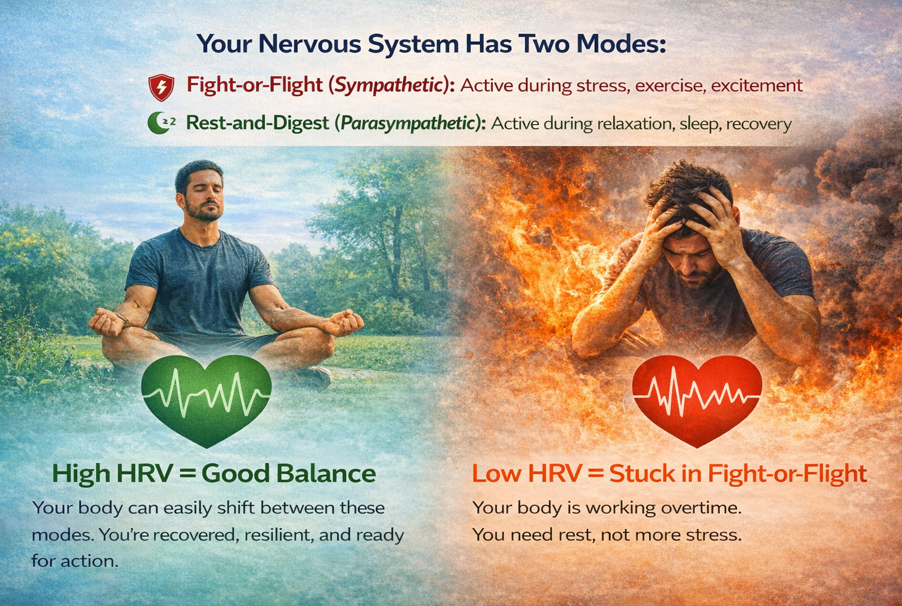
Heart rate variability adds another layer of insight by reflecting the adaptability of your nervous system. Unlike heart rate, which measures effort, HRV measures readiness. It captures how effectively your body transitions between stress and recovery states. A high HRV reflects a resilient system capable of adapting to physical and mental demands. A low HRV suggests a system under strain, often driven by accumulated stress, poor sleep, or excessive training load.
Over time, your baseline across these metrics becomes your personal reference system. It defines what is normal for you, not for someone else.
From Data to Decisions: Where Most People Fail
The majority of individuals stop at observation. They check their sleep score, glance at their steps, and review their workouts, but they fail to translate this information into action.
This is where progress is lost.
If your data shows consistent sleep deprivation, the solution is not to increase training intensity. It is to improve sleep duration and quality. If HRV trends downward for several days, it is not a signal to push harder. It is a signal to reduce load and prioritize recovery. If resting heart rate is elevated, it reflects a system under stress that requires adjustment.
Consider a simple scenario. You wake up after a poor night of sleep, with your HRV significantly below baseline and your resting heart rate elevated. The data is clear. Your system is under strain. Yet many individuals will still proceed with a high-intensity workout because it was scheduled. This is the disconnect between information and behavior.
High-level performance is built on alignment between what your body is telling you and how you respond to it.

Training With Precision Instead of Guesswork
One of the most common inefficiencies in training is the absence of structure in intensity. Many individuals operate in what can be described as the “moderate trap,” training at an intensity that is too hard to recover from consistently but not hard enough to drive meaningful adaptation.
Heart rate data provides a clear framework to avoid this.
Lower intensity training builds the aerobic base, improves metabolic efficiency, and enhances recovery capacity. It often feels too easy, which is precisely why it is neglected. Higher intensity training, when used strategically, improves speed, power, and cardiovascular capacity. The key is not choosing one over the other, but understanding how they complement each other.
The most effective training models rely on a distribution where the majority of work is performed at lower intensities, with a smaller portion allocated to high-intensity efforts. This allows for consistent progression without accumulating excessive fatigue.
VO2 max reinforces this concept at a macro level. It reflects your body’s ability to utilize oxygen during exercise and is strongly correlated with long-term health, endurance, and performance capacity. While consumer devices provide estimates rather than precise laboratory measurements, the trends are highly valuable. An improving VO2 max indicates that your system is becoming more efficient, more resilient, and more capable.
Training without data is guesswork. Training with data is a strategy.
Recovery: The Lever Most People Ignore
There is a natural bias toward action. More training, more sessions, more effort. Yet adaptation does not occur during effort. It occurs during recovery.
Modern devices have made recovery visible in ways that were previously inaccessible. Metrics such as HRV, resting heart rate, sleep quality, and readiness scores provide a composite view of your body's preparedness to perform.
Ignoring these signals leads to predictable outcomes. Performance plateaus. Fatigue accumulates. Injury risk increases.
Consider a common pattern. An individual increases training volume and intensity over several weeks. Initially, performance improves. Then HRV begins to decline gradually, resting heart rate trends upward, and sleep quality deteriorates. Despite these signals, training continues at the same intensity. Eventually, performance stagnates or declines.
This is not a lack of effort. It is a lack of recovery.
Understanding recovery requires a fundamental shift in perspective. Rest is not passive. It is a critical component of performance. When recovery is optimized, the body becomes more responsive to training stimuli. When it is neglected, even the most well-designed training program will fail to produce results.
Sleep as a Performance Multiplier
If there is one variable that consistently amplifies all others, it is sleep.
Sleep directly influences hormonal regulation, including testosterone, cortisol, and growth hormone. It impacts glucose metabolism, cognitive performance, emotional regulation, and immune function. It determines how effectively you recover, how well you perform, and how resilient you are to stress.
Chronic sleep restriction creates a cascade of negative effects. Reaction time slows, decision-making deteriorates, and physical performance declines. Appetite regulation is disrupted, often leading to increased caloric intake and poor food choices. Recovery is compromised, increasing the risk of injury.
Data removes the illusion of adequacy. It shows not only how long you sleep, but how well you sleep. Many individuals discover that they are operating with insufficient deep sleep or fragmented REM cycles, even when total sleep time appears adequate.
Improving sleep does not require complexity. Consistency in sleep and wake times stabilizes circadian rhythms. Reducing screen exposure before bed improves sleep onset. Managing caffeine intake and meal timing supports deeper sleep cycles. These adjustments produce measurable improvements within days.
Sleep is not just recovery. It is a performance multiplier.
Avoiding the Trap of Over-Tracking
While data is powerful, it can become counterproductive if misused.
There is a point at which tracking shifts from informative to intrusive. Constantly checking metrics, reacting emotionally to single data points, and over-analyzing small fluctuations can create unnecessary stress. This defeats the purpose of tracking, which is to simplify decision-making.
Effective use of data requires perspective. Individual data points are less important than trends. A single poor night of sleep is not a problem. A consistent pattern of poor sleep is. A temporary drop in HRV is not meaningful. A sustained decline is.
The goal is not perfection. It is awareness and adjustment.
Data should guide behavior, not control it.

The Power of Small, Controlled Experiments
The most effective way to use health data is through controlled experimentation.
Your body is unique. What works for one person may not work for another. Data allows you to test variables and observe their impact in a structured way.
When one variable is adjusted at a time, its effect becomes clear. For example, changing the timing of caffeine intake can have a measurable impact on sleep quality. Adjusting workout timing can influence recovery and performance. Reducing alcohol intake often leads to immediate improvements in sleep and HRV.
Over time, these small experiments create a personalized system. Decisions are no longer based on general advice but on direct evidence from your own physiology.
This is where health tracking transitions from information to intelligence.
Sustainability: The True Differentiator
Short-term improvements are common. Long-term consistency is rare.
The difference lies in habit formation. Data provides immediate feedback, which reinforces behavior. When progress is visible, adherence improves. When consistency produces results, motivation becomes intrinsic.
The objective is not to optimize for a week or a month. It is to build a system that supports performance and health over the years.
In the early phase, the focus is on awareness and consistency. Over time, it evolves into refinement and optimization. Eventually, it becomes intuitive. You begin to understand your body’s signals without needing constant validation.
This is the endpoint of effective tracking. Not dependence on data, but alignment with it.

The Future of Health Is Already Here
The personal health data revolution is not something that is coming. It is already here.
The tools are accessible. The insights are available. The barrier is no longer technology. It is execution.
Those who learn to interpret and apply their data gain a significant advantage, not only in performance but in long-term health, resilience, and quality of life. Those who ignore it continue to operate without feedback, relying on perception rather than evidence.
The difference between the two is not knowledge. It is action.
Your data is not there to impress you. It is there to guide you.
And the question remains simple.
Will you use it?