Most athletes train hard but fail to improve because their training does not reflect the real demands of their sport. This guide breaks down the science of sports-specific training and how to apply it for measurable performance gains.
Sports-specific training is the process of designing workouts that match the exact physiological, biomechanical, and energy demands of a sport to improve real performance.

Sports-Specific Training Explained: Why Most Athletes Get It Wrong
Let me be direct with you: most athletes are working hard in the wrong direction. They train consistently, they sweat, they push through soreness, and then they wonder why their on-field performance has not moved in six months. The problem is not effort. The problem is specificity.
Over more than two decades working across professional sports franchises, physical therapy clinics, university programs, and high-performance health systems, I have watched talented athletes plateau not because they lacked dedication but because their training failed to respect the fundamental science of how the body actually adapts. This guide is my attempt to close that gap, bluntly, practically, and backed by the research that should be driving every program design decision you make.
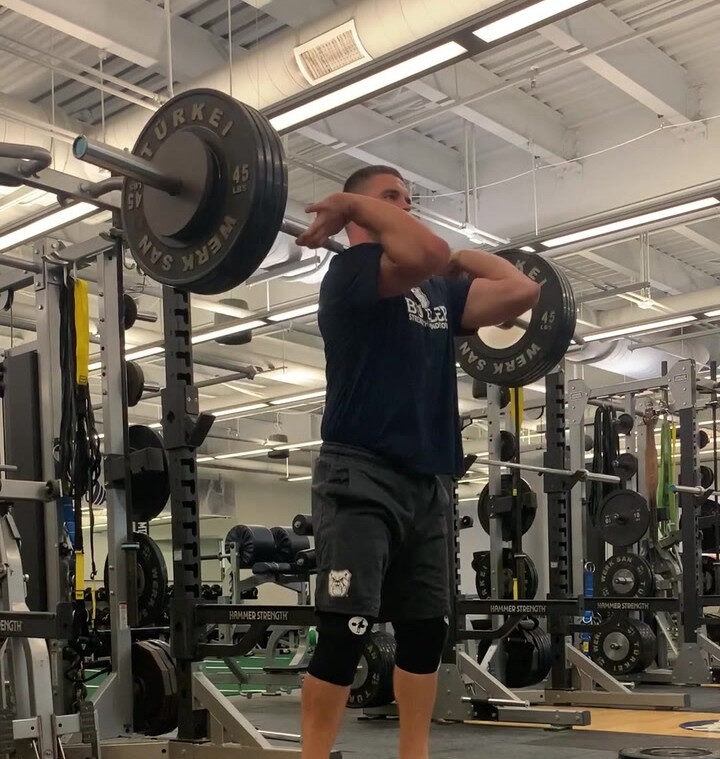
Sports-specific training is one of the most misunderstood concepts in performance coaching. Walk into almost any weight room, and you will see athletes doing exercises that share the name of their sport’s movements but nothing else about them. A basketball player is doing a slow, bilateral leg press because it “trains the legs.” A soccer midfielder grinding through isolated machine exercises because the gym program said so. A tennis player is doing generic cardio intervals with no relationship to the actual work-to-rest ratios of match play.
This is not training for sport. This is general fitness, wearing a sports jersey.
True specificity is not about mimicking sport movements in the weight room. It is about understanding what your sport actually demands metabolically, mechanically, and neurologically, and designing every training variable around that demand.
The foundational literature in periodization and strength training, built by researchers such as Tudor Bompa and Gregory Haff, is clear. Adaptation is specific to the stimulus. The neuromuscular system does not broadly improve. It improves precisely along the lines of what it is repeatedly asked to do. That is the biological contract of training.

Energy Systems in Sport: How to Train for Real Game Demands
Before any coach designs a single exercise, they need to answer one question: what energy system is driving performance in this sport, and in what proportions? The answer changes everything from exercise selection to rest intervals to weekly volume.
The three primary metabolic pathways, the phosphocreatine system for explosive, short-duration efforts, glycolysis for high-intensity work lasting up to two minutes, and aerobic oxidative metabolism for longer-duration activities, are not independent switches. They operate on a continuum and overlap during virtually every athletic performance. Research by Hargreaves and Spriet confirms that skeletal muscle energy metabolism during exercise is a dynamic, integrated process that shifts in response to intensity, duration, and training status.
A basketball guard, a rugby prop, and a marathon runner are not just doing different sports. They are living in different metabolic universes. Map your athlete’s actual game demands, average sprint length, work-to-rest ratios, total distance covered, and peak intensity windows before writing a single training block.
What this means, in practical terms, is that your conditioning work needs a work-to-rest ratio that matches real-game demands. The athlete who is aerobically undertrained will hit a performance ceiling no matter how strong they get. And the strength athlete who ignores metabolic conditioning entirely is leaving injury resilience on the table.

Unilateral vs Bilateral Training: The Hidden Performance Gap
Here is a finding that should be posted in every weight room: the bilateral deficit in force production is well-documented. When athletes perform bilateral movements such as squats and leg press with both feet on the ground, they consistently produce less total force per limb than when training unilaterally.
Research by Buckthorpe and colleagues demonstrated that this is not simply a neural inhibition issue but a real, functional gap in explosive force capacity that bilateral training alone cannot close.
Consider that fact in light of how most programs are designed. The back squat is the king. Bilateral loaded patterns dominate. And then coaches wonder why their athletes still exhibit asymmetries in sprint mechanics, deceleration, and change-of-direction speed.
The systematic review from Liao and colleagues examined the comparative effects of unilateral versus bilateral training across strength, jump, and change-of-direction speed outcomes. The finding was unambiguous. Unilateral training produced meaningful, sport-transferable improvements that bilateral training alone did not replicate.
This does not mean abandoning the bilateral squat. It means building a program architecture that respects the mechanical reality of sport, which happens almost entirely on one leg at a time.

Movement-Based Training: Why Sport Is Not Built on Machines
Saeterbakken and Fimland’s work on core muscle activity across bilateral, unilateral, seated, and standing exercise conditions is data every performance coach should internalize. Standing unilateral resistance exercises produce substantially greater core activation than seated, machine-based alternatives that dominate many commercial gym programs.
That is not an argument against machines. It is an argument for understanding what you are actually training when you choose each tool.
The biomechanical demand of most field and court sports is fundamentally asymmetrical, rotationally loaded, and performed in single-leg stances at speed. If your training environment never replicates those conditions, your athletes will not adapt to them. The nervous system is not a generalist. It is a specialist by nature.
The question is never whether an exercise is hard. The right question is whether this exercise solves a specific problem that your sport creates.

Power vs Strength in Sport: Why Explosive Ability Is the Real Differentiator
Two performance qualities that are almost always undertrained relative to their importance in sport are rate of force development and deceleration capacity.
Newton and Kraemer’s foundational work on developing explosive muscular power made a critical distinction that is still often overlooked. Maximum strength and the ability to express that strength rapidly are not the same quality. An athlete can have significant absolute strength and still be relatively slow because their neuromuscular system has not been trained to reach peak force in the time window that sport actually allows, which is often under 200 milliseconds.
That is the training gap that plyometrics, loaded ballistic training, and carefully designed stretch-shortening cycle work exist to close.
The stretch-shortening cycle, the elastic energy storage and release mechanism that underlies virtually every jump, sprint, and change-of-direction movement, is a trainable quality. But only if you train it specifically. Slow, controlled lifting develops strength, which is a prerequisite but not a substitute.

Deceleration Training in Sport: The Missing Link in Performance and Injury Prevention
Deceleration deserves its own training category. The braking performance framework developed by Harper and colleagues provides the most complete practical roadmap currently available for developing horizontal deceleration ability in multi-directional sports.
The point is sobering. Most soft tissue injuries in team sports occur during deceleration, not acceleration. Yet most programs spend far more time developing speed than developing the capacity to control it safely. That imbalance is both a performance limitation and an injury risk.

Athlete Monitoring and Performance Data: How to Know If Training Is Working
Program design is only half the equation. The other half is knowing whether your training is actually working and being willing to adjust when it is not.
This requires measurement frameworks aligned with your training goals, not just whatever metrics are easy to collect.
James and colleagues published a framework for selecting test measures in athlete physical preparation that every coach working with performance athletes should understand. The central argument is that the tests you choose need to have a demonstrable relationship to the performance qualities that matter in your specific sport.
The monitoring framework described by Rebelo and colleagues adds another dimension. Tracking training effects requires a multidimensional lens. Load, recovery, neuromuscular readiness, and subjective wellness all provide different signals, and no single metric tells the complete story.
Environmental Factors in Training: Heat, Surface, and Performance Adaptation
One area that coaches systematically undervalue is the training environment itself. Heat, altitude, surface type, and equipment resistance profiles all modify the adaptation stimulus, and ignoring them is a programming error.
The consensus recommendations on training and competing in the heat published in the British Journal of Sports Medicine are the standard reference for any coach whose athletes will compete or train in elevated temperatures. Heat acclimation is a trainable quality with meaningful implications for performance and safety.
The cardiovascular and thermoregulatory adaptations that develop with systematic heat exposure are not incidental side effects. They are competitive advantages that can be deliberately developed.

Applying Sports-Specific Training: How to Build a Program That Works
Here is the practical takeaway from everything above.
Map your sport’s actual energy system demands before designing conditioning. Audit your program’s bilateral-to-unilateral training ratio and close the gap. Add dedicated deceleration and stretch-shortening cycle training to every block, not as an afterthought but as a programming priority. Choose measurement tools that reflect what your sport actually demands. Build recovery into your program the same way you build training into it, with intent, structure, and accountability.
Sports-specific training is not a philosophy. It is a set of decisions grounded in physiology, biomechanics, and honest assessment of what your sport actually requires.

Final Note: Training Must Reflect What Sport Actually Demands
The research is clear. The gap between knowing it and applying it is where most athletes and coaches lose ground they should be gaining.
Every athlete deserves a program designed around what their sport actually demands, not around what the equipment available happens to allow.
You have the science. Now build the program to match it.
Academic References
FOUNDATIONAL PRINCIPLES AND TRAINING THEORY
Aslam, S., Habyarimana, J. D. D., & Bin, S. Y. (2025). Neuromuscular adaptations to resistance training in elite versus recreational athletes. Frontiers in Physiology, 16, 1598149.
Bompa, T., & Buzzichelli, C. (2015). Periodization training for sports (3rd ed.). Human Kinetics.
Haff, G. G., & Triplett, N. T. (Eds.). (2015). Essentials of strength training and conditioning (4th ed.). Human Kinetics.
James, L. P., Haycraft, J. A. Z., Carey, D. L., & Robertson, S. J. (2024). A framework for test measurement selection in athlete physical preparation. Frontiers in Sports and Active Living, 6, 1406997.
Rebelo, A., Bishop, C., Thorpe, R. T., Turner, A. N., & Gabbett, T. J. (2026). Monitoring training effects in athletes: A multidimensional framework for decision-making. Sports Medicine.
BIOENERGETICS AND METABOLIC EFFICIENCY
Baker, J. S., McCormick, M. C., & Robergs, R. A. (2010). Interaction among skeletal muscle metabolic energy systems during intense exercise. Journal of Nutrition and Metabolism, 2010, 905612.
Hargreaves, M., & Spriet, L. L. (2020). Skeletal muscle energy metabolism during exercise. Nature Metabolism, 2(9), 817–828.
Neufer, P. D. (2018). The bioenergetics of exercise. Cold Spring Harbor Perspectives in Medicine, 8(5), a029678.
Patel, P. N., Horenstein, M. S., & Zwibel, H. (2024). Exercise physiology. StatPearls Publishing.
UNILATERAL TRAINING AND BIOMECHANICS
Buckthorpe, M. W., Pain, M. T. G., & Folland, J. P. (2013). Bilateral deficit in explosive force production is not caused by changes in agonist neural drive. PLoS ONE, 8(3), e57549.
Eliassen, W., Saeterbakken, A. H., & van den Tillaar, R. (2018). Comparison of bilateral and unilateral squat exercises on barbell kinematics and muscle activation. International Journal of Sports Physical Therapy, 13(5), 871–881.
Knudson, D. (2007). Fundamentals of Biomechanics (2nd ed.). Springer Science+Business Media.
Liao, K. F., Nassis, G. P., Bishop, C., Yang, W., Bian, C., & Li, Y. M. (2021). Effects of unilateral vs. bilateral resistance training on strength, jump, linear and change of direction speed: A systematic review and meta-analysis. Biology of Sport, 39(3), 485–497.
Saeterbakken, A. H., & Fimland, M. S. (2012). Muscle activity of the core during bilateral, unilateral, seated and standing resistance exercise. European Journal of Applied Physiology, 112(5), 1671–168.
POWER, DECELERATION, AND SPECIALIZED ADAPTATIONS
Harper, D. J., Cervantes, C., Van Dyke, M., et al. (2024). The braking performance framework: Practical recommendations and guidelines to enhance horizontal deceleration ability in multi-directional sports. International Journal of Strength and Conditioning.
Newton, R. U., & Kraemer, W. J. (1994). Developing explosive muscular power: Implications for a mixed methods training strategy. Strength and Conditioning, 16(5), 20–31.
Pilotto, A. M., Turner, D. C., Mazzolari, R., et al. (2025). Human skeletal muscle possesses an epigenetic memory of high-intensity interval training. American Journal of Physiology–Cell Physiology, 328, C258–C272.
Saville, W. (2025). Stretch-shortening cycle (SSC). Science for Sport.
ATHLETE HEALTH AND ENVIRONMENT
Dalleck, L. C. (n.d.). The science of post-exercise recovery. American Council on Exercise.
Khosravi, M. R. (2025). Sports injuries: Biomechanical data analysis and prevention. Advanced Journal of Management, Humanity and Social Science, 1(9), 559–578.
Racinais, S., Alonso, J. M., Girard, O., et al. (2015). Consensus recommendations on training and competing in the heat. British Journal of Sports Medicine, 49(18), 1164–1173.