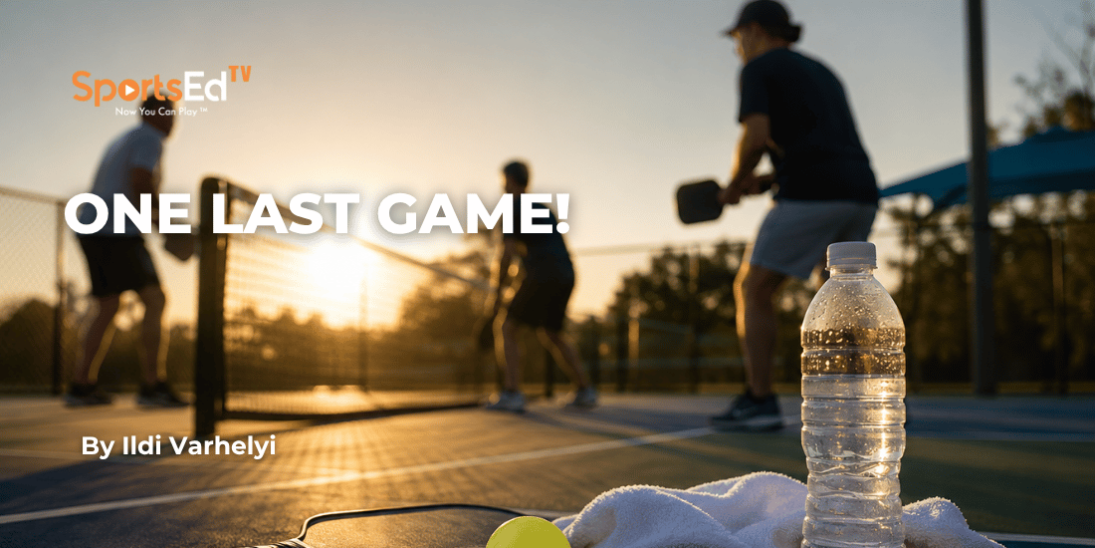
“Okay, this is definitely my last game.”
As a coach, I hear that sentence almost every day on the pickleball court. And every single time, I silently laugh… because I already know there’s about a 90% chance that same player will still be out there 45 minutes later, chasing a wide dink with tired legs and negotiating with gravity like it’s a hostage situation.
Honestly, I get it. I’ve done it too. Despite teaching recovery, conditioning, injury prevention, vision training, and movement quality, it still happens to me. I’ve looked at my watch, felt my body getting tired, and still said:
“Eh… one more.”

Why Do We Keep Saying “One More Game”?
Why do we do this? Why do intelligent, responsible adults - people who spend half the day talking about hydration, inflammation, stretching, mobility, magnesium supplements, and recovery tools - suddenly transform into highly competitive teenagers the second someone yells:
“We need one more player!”
Because “just one more game” is not really about the game. It’s about the brain!
And the fascinating part is that the exact neurological systems that make pickleball so energizing, social, mentally stimulating, and emotionally rewarding are also the same systems that can quietly begin working against us once fatigue enters the picture.
Humans Are Neurologically Wired for Play
As a brain-based movement and sports vision coach, this is the part of performance I wish more players understood. Humans are wired for play. Not just emotionally - neurologically.
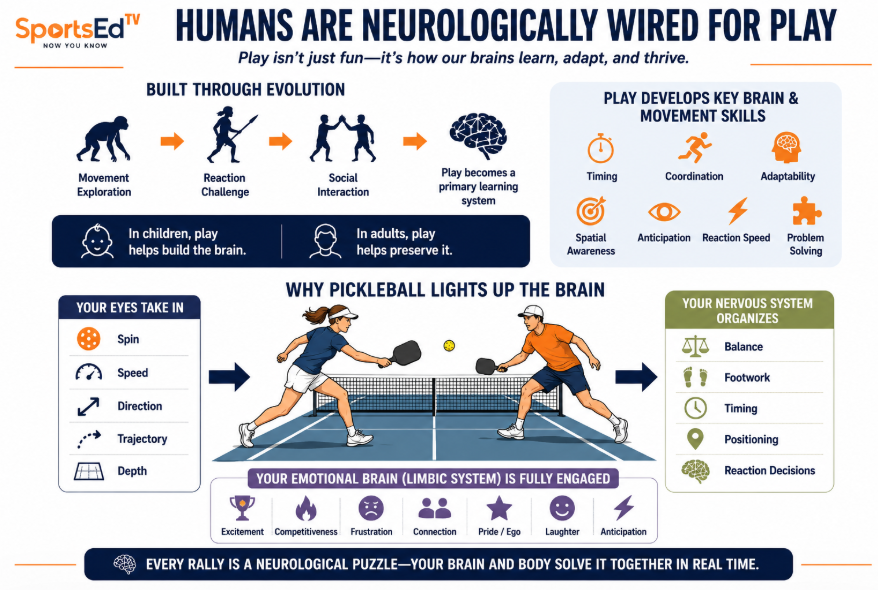
Long before organized sports existed, the human brain evolved through movement, exploration, reaction, challenge, and social interaction. Play is one of the nervous system’s primary learning systems. It develops coordination, timing, adaptability, spatial awareness, anticipation, reaction speed, and problem-solving. In children, play helps build the brain. In adults, it helps preserve it.
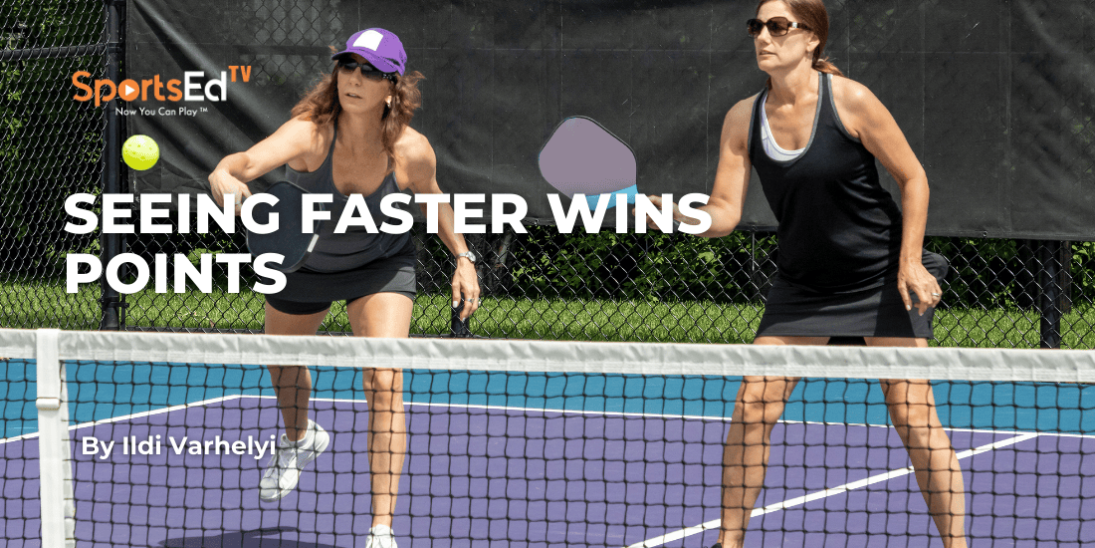
That’s one reason pickleball has exploded the way it has. The game doesn’t feel like traditional exercise. It feels engaging, fast, social, and unpredictable. Every rally creates a tiny neurological puzzle your brain and body have to solve together in real time. Your eyes track spin, speed, direction, trajectory, and depth while your nervous system organizes balance, footwork, timing, positioning, and reaction decisions in fractions of a second. At the exact same time, your emotional brain - the limbic system - is fully involved.
Excitement. Competitiveness. Frustration. Connection. Pride. Ego. Laughter. Anticipation. All firing together during a single game.
Dopamine, Competition, and the Pickleball Brain
The brain absolutely loves this combination. Every rally also contains uncertainty, and uncertainty activates the brain’s reward system. Dopamine, one of our most powerful neurotransmitters, starts driving motivation and pursuit. Most people think dopamine is simply the “feel-good” chemical, but that’s not entirely accurate. Dopamine is more about anticipation and wanting. It pushes us toward repeating behaviors that feel rewarding or meaningful.
That’s why losing a close game often makes players want another game even more than winning easily. Your brain interprets a tight 11–9 loss as: “You’re close. Run it back.”
Then adrenaline and norepinephrine enter the picture, sharpening focus, increasing alertness, and preparing the body to react quickly. Exercise also stimulates endorphins, which help reduce stress and improve mood. Physical activity also increases the production and release of serotonin, which contributes to emotional well-being and satisfaction.
Suddenly, pickleball becomes much more than movement. It becomes a source of stress relief, mental stimulation, social connection, competition, community, and play.
And honestly, adults need to play far more than most people realize.
Why Pickleball Feels Different Than Traditional Exercise
Somewhere between careers, schedules, responsibilities, injuries, stress, and endless screen time, many adults stop doing things that challenge the brain in joyful ways. Pickleball gives that back. It reconnects people to spontaneity, movement, laughter, challenge, and shared experiences. That’s one reason players become emotionally attached to the game so quickly. The court becomes one of the few places where the brain is fully present. Bills disappear. Stress fades. The nervous system organizes around one simple mission: watch the ball, move your feet, survive the kitchen battle.
As a coach, I actually love this part. That level of engagement is incredibly healthy for the brain. Fast-paced racket sports challenge reaction timing, coordination, cognitive flexibility, visual processing, and balance all at once. The nervous system thrives on meaningful challenge.
Neuroplasticity and Athletic Performance
But here’s where the science behind “just one more game” becomes both fascinating and brutally honest.
The brain learns through repetition. This process is called neuroplasticity - the brain’s ability to adapt and strengthen neural pathways based on repeated experiences. Every successful movement pattern, every improved reaction, and every cleaner footwork sequence strengthens communication between the brain and body. That’s how athletes improve. The nervous system becomes more efficient at whatever it practices consistently. And because pickleball combines movement, emotional engagement, and play, learning sticks exceptionally well. The brain learns faster when emotions are involved, and the nervous system pays attention because the experience feels meaningful.
The Dark Side of Neuroplasticity
But neuroplasticity has another side that most recreational athletes never think about.
The dark side of neuroplasticity is that the brain not only learns efficient movement, but also learns repeated movement. Even when those repetitions are compromised. That becomes incredibly important once fatigue sets in.
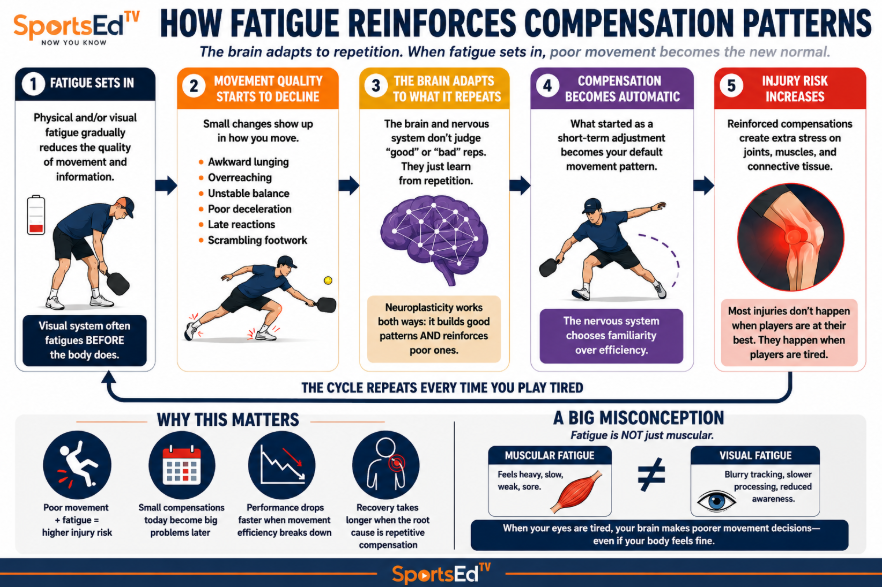
At first, fatigue is subtle. Your split-step gets a little slower. Your footwork becomes heavier. You stop moving your feet efficiently and begin reaching instead. Balance becomes less stable. Timing delays appear in tiny fractions of a second. And then suddenly, the smooth, controlled player from an hour ago is lunging across the kitchen line like a shopping cart with one broken wheel.
I see this all the time as a coach. Players think they are “just tired,” but what they are really experiencing is neurological fatigue affecting movement quality.
And here’s the important part: the brain and nervous system are still learning from every repetition. That means the exact same neuroplasticity that helps improve performance can also reinforce compensation patterns when athletes repeatedly play while fatigued.

How Fatigue Reinforces Compensation Patterns
If fatigue consistently causes awkward lunging, overreaching, unstable balance, poor deceleration, late reactions, or scrambling footwork, those patterns slowly become more familiar to the nervous system. And guess what eventually becomes more automatic? Compensational movement. Not because the athlete lacks discipline or effort, but because the brain adapts to repetition.
This matters because most injuries occur when players are not moving at their best. They happen when players are tired. And one of the biggest misconceptions I see in pickleball is that fatigue is only muscular. In many cases, the visual system fatigues before the body does.
Why Visual Fatigue Changes Everything
That’s a huge deal because vision drives movement. Your eyes are not passive cameras. Vision is an active brain process. Every second on the court, the visual system is processing ball speed, spin, trajectory, depth perception, peripheral awareness, opponent positioning, and timing. That is an enormous neurological workload. As the visual system becomes fatigued, tracking accuracy declines. Depth perception becomes less precise. Peripheral awareness narrows. Reaction timing slows. The brain begins receiving less reliable sensory information.
And this is where the real problem begins. The brain can only organize movement based on the information it receives. So when visual input becomes less accurate, the brain tries to produce fast, coordinated movement from flawed sensory data.
The Connection Between Vision, Reaction Time, and Injury Risk
Think about what that looks like during a fast rally. You’re late getting to a dink. You mistime a volley. You overrun a ball. You lunge awkwardly for a speed-up. You react late to a body shot. You accelerate quickly but cannot decelerate under control; you lose balance and fall. Most players blame their legs, their paddles, or sometimes even their partners. But often the issue started much earlier in the chain - with visual fatigue and slowed sensory processing.
The body is only as efficient as the information feeding the system. And that realization changes the entire conversation around “just one more game.”
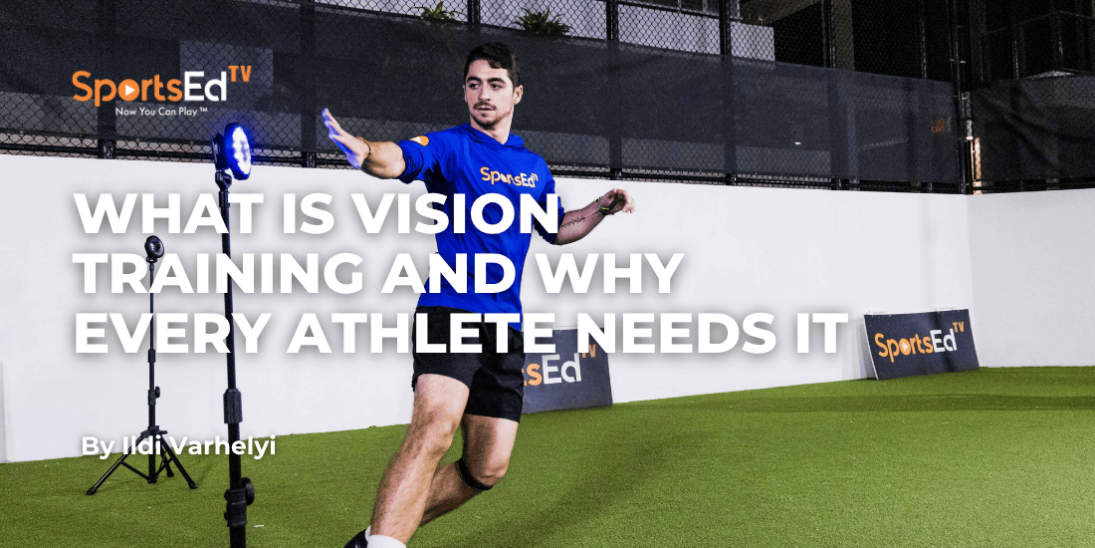
Read here why everyone needs vision training

The Real Question Players Should Ask
Because sometimes one more game is exactly what the brain needs. Play is healthy. Challenge is healthy. Competition, movement, laughter, social interaction, and learning are incredibly beneficial for long-term brain health. But there’s also a point where efficient movement quietly turns into compensation. Where reactions become survival instead of skill. Where the nervous system is no longer performing cleanly but simply trying to keep up. Where competitiveness overrides awareness. And the tricky part is this: Most players don’t recognize that moment while it’s happening. The emotional brain still wants redemption. The dopamine system still wants another chance. The ego still wants one more clean winner down the line. Meanwhile, the visual system is slowing, movement quality is dropping, and the body is quietly negotiating with gravity.
Final Thoughts on Longevity in Pickleball
That’s the paradox of “Just One More Game”. The game is helping the brain learn, adapt, connect, and stay engaged through play - while fatigue can slowly begin undoing the very movement quality the brain worked so hard to build.
So instead of asking:
“Do you want one more game?” - Of course, we do.
The better question is:
Can our eyes, brain, reactions, balance, and movement quality still support the demands of another fast-paced game safely and efficiently?
Because longevity in pickleball is not built by winning one more tired game today.
It’s built by recognizing when your nervous system has already given you its answer - even if your ego hasn’t caught up yet.
Choose wisely.
Frequently Asked Questions About Pickleball Fatigue and Brain Performance
Why do pickleball players always want to play one more game?
Pickleball activates the brain’s reward system through competition, movement, unpredictability, social interaction, and dopamine-driven anticipation. That combination makes players naturally want to continue playing even when physically tired.
Can pickleball become addictive?
While pickleball is not considered a clinical addiction, the sport strongly stimulates dopamine, emotional engagement, and competitive reward pathways, which can create highly repetitive play behavior and emotional attachment to the game.
What is neurological fatigue in pickleball?
Neurological fatigue occurs when the brain and nervous system become less efficient at processing movement, reactions, balance, coordination, and sensory information during extended play.
Why do most pickleball injuries happen late in games?
As fatigue increases, movement quality declines. Players begin to compensate with poor footwork, unstable balance, slower reactions, and inefficient movement patterns, significantly increasing the risk of injury.
Is visual fatigue real in pickleball?
Yes. In many cases, the visual system fatigues before the muscles do. Reduced tracking accuracy, slower visual processing, and decreased depth perception can negatively affect reaction time and movement decisions.
How does neuroplasticity affect pickleball performance?
Neuroplasticity allows the brain to strengthen movement patterns through repetition. However, repeatedly playing while fatigued can also reinforce poor compensation patterns and inefficient movement habits.
Why does pickleball feel different than traditional exercise?
Pickleball combines movement, reaction, social interaction, competition, and cognitive challenge in real time. The brain experiences it more as play and problem-solving than conventional exercise.
Can pickleball help long-term brain health?
Research suggests that fast-paced racket sports may support cognitive function by simultaneously challenging coordination, reaction timing, visual processing, decision-making, and adaptability.
What are the signs that fatigue is affecting movement quality?
Common signs include slower footwork, awkward lunging, poor balance, delayed reactions, reaching instead of moving efficiently, and difficulty decelerating under control.
How can players reduce injury risk during long pickleball sessions?
Proper recovery, hydration, conditioning, visual training, rest periods, and early recognition of neurological fatigue can help maintain movement quality and reduce injury risk.
About the Author
Ildi (Ildiko) Varhelyi is a Brain-Based Movement Coach & Sports Vision Specialist, USOP NPC with over 20 years of experience helping people move, feel, and perform at their best.