In Part 1 of this series, we explored three critical strategies that tennis clubs must adopt to survive and grow: embracing high-tech management systems, pivoting to multi-sport models that include pickleball and padel, and building experience-driven membership communities.
Now we turn to what may be the most urgent threat of all, one that no amount of operational excellence can outrun on its own.
Let’s face it: the biggest threat to your favorite racquet club is not a lack of backhands. It is real estate.
You could have a thriving club, a waitlist out the door, and members practically begging to hand you their money. But if a real estate developer looks at your land and sees a goldmine, you are officially in the danger zone.
Across the United States and many major cities worldwide, tennis and racquet clubs increasingly sit on some of the most valuable land in their markets. As housing demand and urban density continue to rise, developers and municipalities are aggressively seeking opportunities to maximize land use.
When the value of the dirt under the courts completely outpaces the value of the sports business itself, even a packed house may not save you.
In Part 1 of this series, we explored three critical strategies that tennis clubs must adopt to survive and grow: embracing high-tech management systems, pivoting to multi-sport models that include pickleball and padel, and building experience-driven membership communities.
Now we turn to what may be the most urgent threat of all, one that no amount of operational excellence can outrun on its own.
Let’s face it: the biggest threat to your favorite racquet club is not a lack of backhands. It is real estate.
You could have a thriving club, a waitlist out the door, and members practically begging to hand you their money. But if a real estate developer looks at your land and sees a goldmine, you are officially in the danger zone.
Across the United States and many major cities worldwide, tennis and racquet clubs increasingly sit on some of the most valuable land in their markets. As housing demand and urban density continue to rise, developers and municipalities are aggressively seeking opportunities to maximize land use.
When the value of the dirt under the courts completely outpaces the value of the sports business itself, even a packed house may not save you.

Why High Membership Numbers Won’t Stop a Bulldozer
1. The “Highest and Best Use” Reality Check
In the real estate world, land is judged by its “highest and best use” (HBU).
Your club might be making a nice profit, but a multi-story condo building, mixed-use development, or trendy shopping hub on that same exact dirt will often generate significantly more money.
As nearby land values rise, cities frequently reassess properties and increase taxes to reflect what the land could potentially generate rather than what it currently generates.
Suddenly, keeping the lights on becomes a lot harder, no matter how full your clinics are.
This is one of the major reasons traditional tennis clubs are disappearing.
2. The Temptation of the Big Payday
For many long-term club owners, the land itself becomes the retirement fund.
Sure, a successful club can provide a steady monthly income. But when a developer shows up offering five or ten times annual revenue, it becomes difficult to ignore.
Choosing between continuing to manage a demanding sports facility or accepting a life-changing financial offer is not an easy decision.
Many clubs eventually choose the latter.
3. Cities Are Prioritizing Density
We are living through a major housing shortage, and local governments are increasingly rezoning land to increase density and tax revenue.
Cities are actively encouraging developers to build:
- apartments
- mixed-use projects
- retail centers
- high-density housing
To many city planners, a sprawling racquet facility with multiple outdoor courts can appear financially underutilized compared to residential development.
They may not see community first.
They see land that could generate substantially more tax revenue.
The Ultimate Counter-Move: Become the Anchor
So how do clubs fight back?
Simple: if you cannot beat developers, make them build around you.
Instead of allowing developers to bulldoze the club entirely, smart owners are transforming their facilities into the centerpiece of new developments, becoming what many now call the “lifestyle anchor.”
Rather than disappearing, the racquet club becomes one of the main reasons people want to live there in the first place.
By building apartments or condos above or around the courts, clubs can capture the massive real estate upside while preserving and even expanding the sports community.
Vertical racquet clubs are no longer a futuristic concept. They are becoming a reality.
Three Real Estate Models That Are Reshaping Racquet Clubs
1. The “Anchor” Model
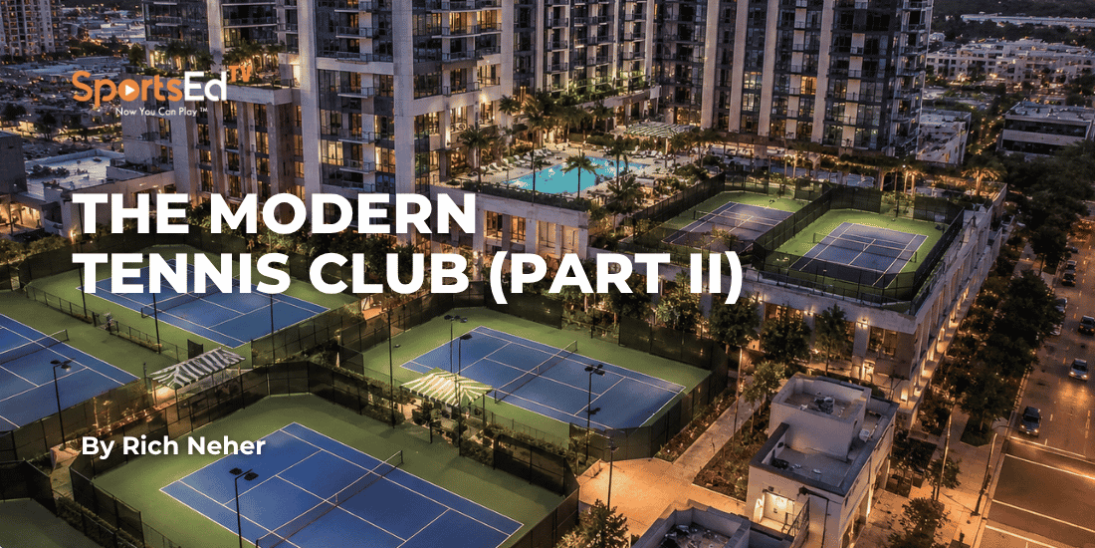
One of the clearest examples is the redevelopment approach at Bath & Racquet Residences in Sarasota, Florida.

Instead of selling out and disappearing, the facility reinvented itself as the centerpiece of a luxury residential development.
Condo units now wrap around the sports facilities, giving residents direct access to tennis and pickleball courts just steps from their homes.
The club is no longer an afterthought.
It is one of the primary selling points of the project itself.
2. The “Podium” Model
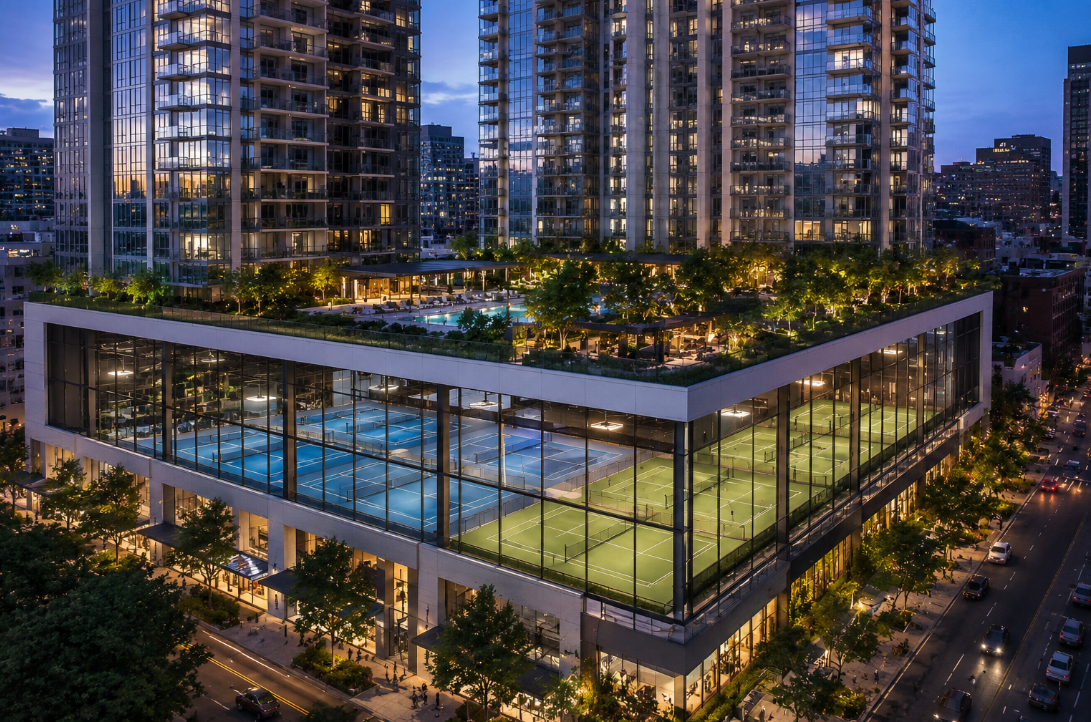
In high-density cities such as Boston, Melbourne, Singapore, and Miami, developers increasingly use podium construction.
Think of it like a giant concrete platform:
- Lower levels contain indoor courts and athletic facilities
- Towers rise above the sports complex
- Both businesses share the same footprint
This approach allows clubs to survive in markets where traditional horizontal expansion no longer makes economic sense.
Indoor tennis and pickleball facilities become integrated into modern urban architecture.
3. The “Rooftop” Model
Sometimes the courts move upward entirely.
As ground-floor real estate becomes increasingly valuable, developers are moving recreational amenities to rooftops.
Specialized sports construction companies are now designing rooftop tennis and pickleball courts that can meet the structural demands of modern facilities.
The result:
- panoramic city views
- premium member experiences
- efficient use of unused rooftop space
- increased real estate appeal
What once sounded unrealistic is quickly becoming part of the future of modern racquet club design.
Why This Could Actually Be a Massive Opportunity
Land scarcity does not necessarily have to destroy tennis clubs.
In many cases, it can actually finance their reinvention.
By partnering with developers and leveraging mixed-use structures or air rights, clubs may be able to:
- Eliminate debt
- Build state-of-the-art facilities
- Modernize aging infrastructure
- Create premium wellness environments
- Secure long-term financial stability
- Gain hundreds of nearby potential members
This is not just survival.
For some clubs, it could become the biggest upgrade in their history.
The Five Survival Models for Modern Tennis Clubs
The clubs most likely to survive over the next decade are adapting far beyond the traditional membership model.
1. Multi-Sport Integration
Adding pickleball, padel, fitness, wellness, and recovery services.
2. Technology-Driven Operations
Using AI scheduling, analytics, and modern club management systems.
3. Experience-Based Communities
Creating social ecosystems and lifestyle destinations rather than simply renting court time.
4. Real Estate Partnerships
Working with developers rather than fighting against redevelopment pressure.
5. Vertical Facility Design
Building upward instead of outward.
Together, these models represent the future of racquet club economics.

The Bottom Line
Traditional tennis clubs are not failing because people have stopped loving the game.
In fact, participation in tennis, pickleball, and padel continues to grow globally.
The problem is economic.
Many clubs are still occupying prime real estate as if it were still 1985.
To survive the next generation, clubs will likely need to become:
- Denser
- Smarter
- More diversified
- More technologically integrated
- More community-driven
The clubs that survive the land crisis will probably not be the ones that fought developers.
They may be the ones developers chose to build around.
Read Part 1
The Modern Tennis Club: An Endangered Species? Part 1