Weightlifting
How to Implement the K-Value in Weightlifting Programming

It has been a while since I touched on the K-value, but it is often helpful to revisit a topic — especially when it has real value in weightlifting programming.

The Origins of the K-Value in American Weightlifting
The concept of the K-value was introduced to American weightlifting through an article written by the ever-inquisitive coach Carl Miller in 1974. Upon returning from a study tour of European weightlifting, Carl wrote an article in IOL magazine in which he touched briefly on the topic of the K-value. He explained that it was used as a programming index by Eastern Bloc coaches to help maintain a balance between the speed and strength aspects of training.
What Is the K-Value?
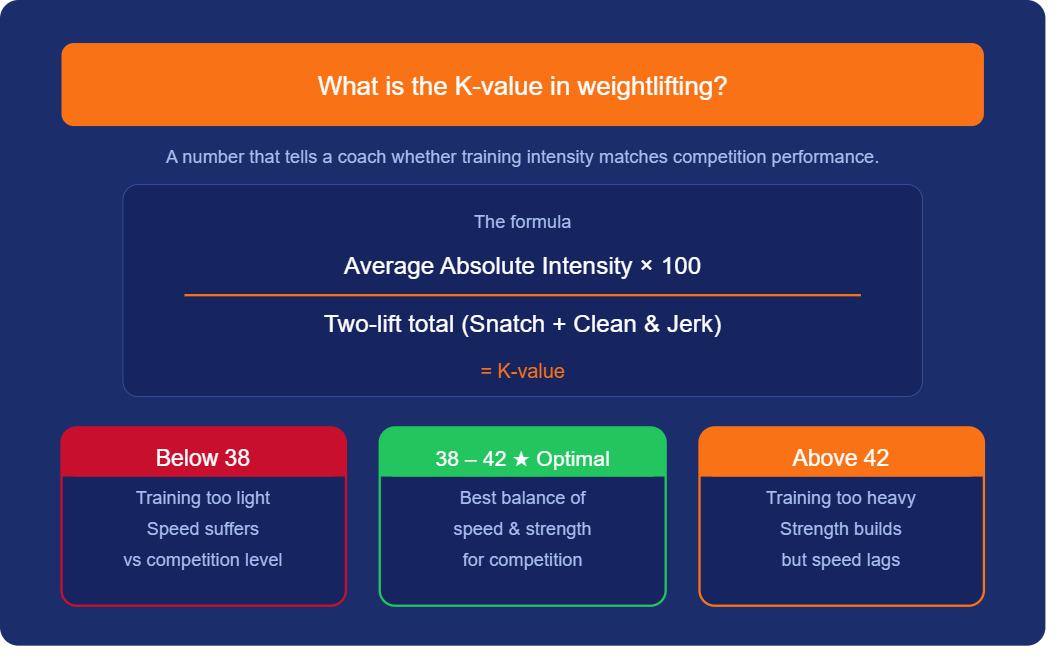
The K-value is a single number that indicates whether an athlete's training intensity is well matched to their competition performance.
It is calculated by taking the average weight lifted across all training sets in a macrocycle (the Average Absolute Intensity), multiplying it by 100, and dividing it by the athlete's two-lift total, the combined snatch and clean & jerk result from the competition at the end of that cycle.
In plain terms: if an athlete trains at an average of 74kg per lift and totals 190kg in competition, the K-value is (74 × 100) ÷ 190 = 38.9, right in the sweet spot.
Research and experience have shown that a K-value between 38 and 42 produces the best balance of speed and strength development. Too far below 38 and the training is too light relative to the athlete's competitive level. Too far above 42 and the training is too heavy, which tends to build strength at the expense of the speed and technique needed in competition.
How to Calculate the Average Absolute Intensity
To arrive at the K-value, you must first calculate the Average Absolute Intensity (AAI) for the macrocycle. This is done using all repetitions performed at 60% and above.
For example, to calculate the AAI for a sequence such as 60kg/3, 70kg/3, (80kg/3)×3:
- Load: (60×3=180) + (70×3=210) + (80×9=720) = 1,110
- Volume: 3 + 3 + 9 = 15
- Average Absolute Intensity: 1,110 ÷ 15 = 74
This calculation must be carried out for all repetitions performed at 60% and above across the entire macrocycle.
Determining Your Athlete's Ideal K-Value
The best results will most likely be achieved by calculating K-values across three or more macrocycles. The coach must then determine which macrocycle produced the best result.
What Counts as a "Best Performance"?
Ideally, the best performance would be a 6-for-6 result with personal records (PRs) in both the snatch and the clean & jerk. However, it could also be a performance in which the athlete displays exceptional or improved speed and power while recording slight misses with PR weights. This determination is left to the coach's discretion.
Once the best performance is identified, the K-value for that macrocycle becomes the ideal index for that athlete.

Programming Macrocycles Around the K-Value
From this point forward, all macrocycles should be programmed so that the ideal K-value is consistently achieved.
For example, a lifter might be programmed for three macrocycles with K-values of 40, 38, and 41. If the best result was achieved using the first macrocycle — with a K-value of 40 — then all future macrocycle programming should be designed to target a K-value of 40.
It is worth noting that Eastern Bloc coaches once performed all of these arithmetic calculations entirely by hand, without the benefit of computers or spreadsheet software. Every figure was worked out manually — a remarkable feat of dedication to athlete development.
How to Calculate the K-Value Using a Spreadsheet
Today, Excel makes this process far more manageable. A well-structured spreadsheet can keep a running total of load and volume — and therefore the K-value — as programming is entered.
Below is an example of how a single training session might be laid out, with columns for each percentage zone and corresponding repetitions:
| Exercise | 60% | R | 65% | R | 70% | R | 75% | R | 80% | R | 85% | R |
|---|---|---|---|---|---|---|---|---|---|---|---|---|
| Back Squat | 150 | 4 | 163 | — | 175 | 4 | 188 | 12 | 200 | — | 213 | — |
| Snatch | 78 | 3 | 85 | — | 91 | 3 | 98 | 9 | 104 | — | 111 | — |
| Clean | 96 | 3 | 104 | — | 112 | 3 | 120 | 9 | 128 | — | 136 | — |
| Jerk | 96 | 1 | 104 | — | 112 | 1 | 120 | 3 | 128 | — | 136 | — |
| Snatch Deadlift | 78 | — | 85 | — | 91 | — | 98 | — | 104 | — | 111 | 16 |
| Press | 54 | — | 59 | — | 63 | — | 68 | 20 | 72 | — | 77 | — |
The numbers in each percentage column represent kilograms, calculated by multiplying the 100% value by the relevant decimal and rounding to the nearest integer. The volume figure for each exercise is the sum of all repetition (R) columns. Daily, weekly, and monthly volume and load totals are tracked in additional columns.
Once the first row of formulas is programmed, it can be dragged down throughout the file. The final volume and load totals at the bottom of the spreadsheet are then used to calculate the K-value.

Why K-Value Programming Matters for Athlete Development
This is a significant amount of calculation — but it is worthwhile if the goal is to develop a talented athlete to the limits of their potential. Great talent will go quite far even with suboptimal programming, but for an athlete's true potential to be fully realized, the careful planning of these details could well be the deciding factor.
Related articles:
- The Meaning of the K-Value in Weightlifting
- Calculating and Interpreting the K-Value in Weightlifting