Physical Education, Volleyball
How Technology Is Transforming Physical Education Through SportsEdTV and Dartfish
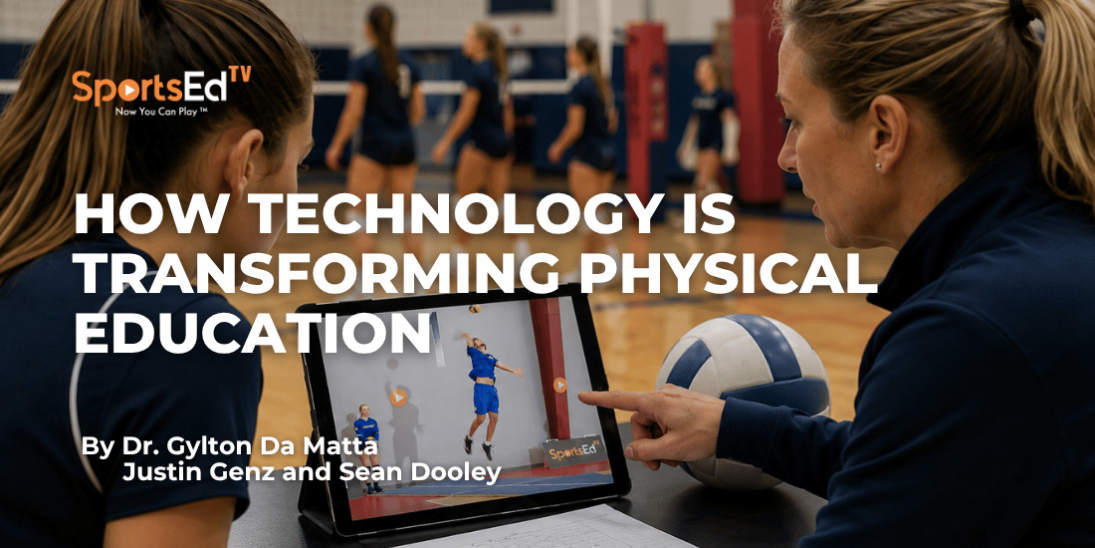
Technology is rapidly reshaping physical education, coaching, and athletic development. What once relied almost entirely on live demonstrations and verbal instruction now benefits from video analysis, digital learning platforms, augmented feedback, and on-demand access to world-class coaching.
Two platforms helping drive this transformation are SportsEdTV and Dartfish. While both serve different purposes, together they demonstrate how modern technology can improve skill acquisition, athlete engagement, coaching effectiveness, and long-term learning in sports and physical education.
As schools, coaches, and athletes continue embracing digital tools, platforms like these are becoming increasingly important in shaping the future of sports instruction.

The Evolution of Physical Education
For decades, physical education was centered around traditional instruction methods such as demonstrations, repetitive drills, verbal corrections, and observation. While these methods still play a critical role, technology has dramatically expanded what is possible in modern sports education.
Today’s students learn differently from previous generations. They consume information visually, expect immediate feedback, and respond well to interactive learning environments. This has pushed physical education toward a more dynamic and individualized approach.
Modern sports technology allows athletes and students not only to practice skills but also to analyze, review, and better understand movement itself. That shift is significant because physical education is no longer viewed simply as a recreational activity. It is increasingly recognized as an essential component of health, cognitive development, confidence, teamwork, and lifelong physical literacy.
SportsEdTV and the Democratization of Elite Coaching
One of the biggest strengths of SportsEdTV is accessibility. The platform provides athletes, coaches, parents, and teachers access to high-level instruction across multiple sports, regardless of location or experience level.
Unlike random online sports videos that often focus on entertainment or isolated tricks, SportsEdTV organizes content intentionally around learning and progression. The platform breaks down skills by sport, technique, and instructional focus, creating a more structured educational experience.
This distinction matters because proper skill development requires more than imitation. Effective sports instruction helps learners understand not only how to execute a movement but also why it works and when to use it.
That educational structure aligns closely with inquiry-based learning models commonly discussed in modern pedagogy. Instead of blindly copying movement patterns, learners are encouraged to think critically about mechanics, tactics, and performance outcomes.
Volleyball Instruction Beyond Mechanics
One instructional example analyzed in the assignment was a volleyball jump topspin serve lesson presented by Dr. Gylton Da Matta. The video demonstrated how effective coaching goes far beyond simply teaching mechanics.
The lesson covered the entire serving sequence, including the toss, jump timing, arm swing, contact point, and follow-through. However, what made the instruction particularly effective was its integration of mindset and tactical intent.
The serve was framed not merely as a technical movement but as an aggressive offensive weapon designed to pressure opponents and create scoring opportunities. This connects the mechanics directly to strategy and competition.
The video also included structured practice recommendations involving repeated serves and spikes throughout the week. This elevated the lesson from pure technical instruction into a broader discussion of training design and deliberate practice.
This type of integrated instruction reflects one of the most important principles in modern coaching: great teaching combines technique, strategy, psychology, and repetition within a clear learning structure.
Why Simplicity Matters in Basketball Instruction
Another instructional video analyzed focused on basketball shooting fundamentals, specifically the role of the guide hand during the shooting motion.
What made this lesson effective was its simplicity and precision. Rather than overwhelming learners with multiple corrections at once, the video isolated one critical technical variable and focused entirely on mastering it.
The instruction repeatedly reinforced proper hand positioning, elbow alignment, release mechanics, and follow-through. The guide hand was clearly explained as a stabilizing mechanism rather than a source of power during the shot.
This teaching approach aligns closely with motor learning research, which shows that athletes often improve faster when coaches emphasize a limited set of high-priority cues rather than an excessive amount of technical information.
In many ways, simplicity is one of the most underrated components of elite coaching.

The Importance of Check for Understanding
One concept highlighted throughout the analysis was “check for understanding.”
In education, this refers to moments where instructors verify that learners truly understand the material before progressing further. In sports instruction, this can involve observing movement quality, pausing for corrections, or asking athletes to self-assess their execution.
The basketball lesson demonstrated this effectively through continuous feedback during practice repetitions. Simple verbal confirmations, such as “perfect,” and instructions, like “hold at the top,” served as real-time learning checkpoints.
These moments may seem small, but they are extremely important for skill acquisition because they help athletes actively process feedback rather than simply imitate movements.
Learning becomes far more effective when athletes engage cognitively with the skill instead of operating on autopilot.
Dartfish and the Power of Video Analysis
While SportsEdTV focuses primarily on instruction and learning progression, Dartfish approaches sports development from a performance analysis perspective.
Dartfish became widely recognized for its advanced video analysis capabilities, which are used by Olympic teams, professional organizations, universities, and elite coaches around the world.
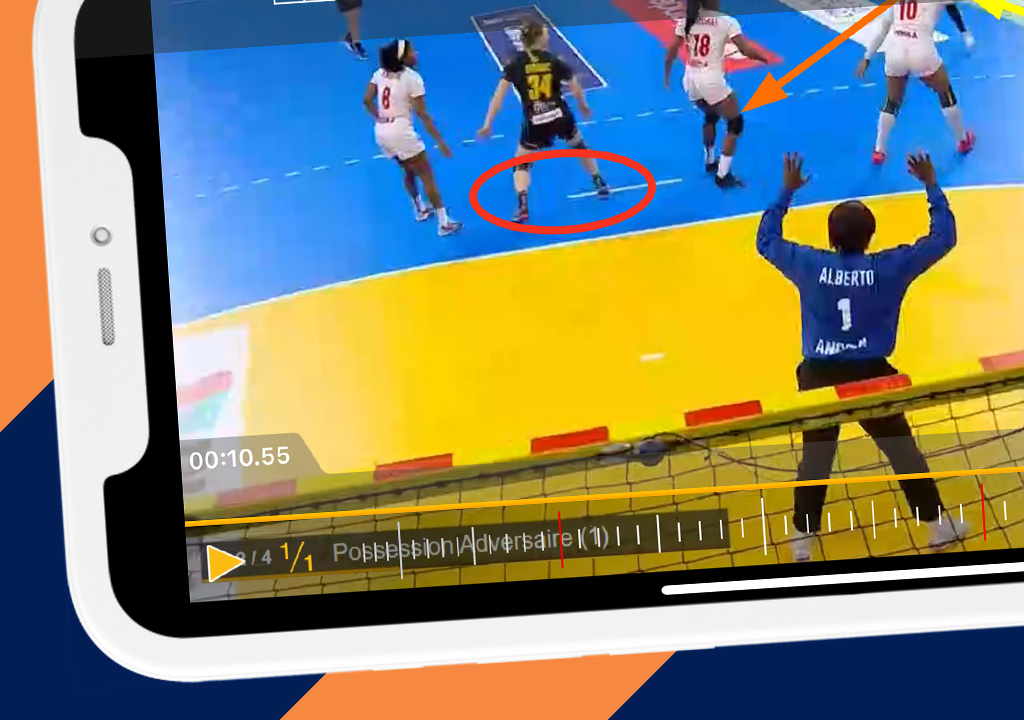
The platform allows users to slow down movement, compare performances side by side, annotate techniques, and isolate key moments frame by frame. This transforms video from passive observation into an active learning system.
One of the most powerful aspects of video analysis is that athletes can finally see what they are actually doing rather than relying solely on what they think they are doing.
That distinction is enormous in sports performance.
Many athletes struggle to translate verbal coaching cues into movement corrections because movement awareness is often limited during execution. Video creates a bridge between perception and reality.
When athletes observe themselves visually, self-awareness improves dramatically. They begin recognizing technical errors, movement inefficiencies, posture issues, timing mistakes, and tactical habits more clearly.
This often accelerates learning far more effectively than verbal instruction alone.
Why Augmented Feedback Accelerates Learning
The assignment also highlighted the importance of augmented feedback in sports instruction.
Augmented feedback refers to external information provided to learners that they cannot fully perceive through their own senses. Video replay, slow motion, coaching corrections, and biomechanical analysis all fall into this category.
Research consistently shows that augmented feedback improves motor learning by helping athletes connect feeling with execution.
In the volleyball lesson, feedback focused on concepts such as the aggressive snap at contact and generating topspin. In the basketball lesson, it centered around hand positioning, elbow placement, and release timing.
These external cues help athletes perceive subtle details that are often difficult to detect internally while moving.
The addition of video technology makes this process even more effective because learners can immediately visualize what coaches are describing.
SportsEdTV and Dartfish as Complementary Tools
Perhaps the most interesting takeaway from the analysis is that SportsEdTV and Dartfish are not competing technologies. Instead, they complement one another extremely well.
SportsEdTV functions primarily as a teaching and instructional platform. Dartfish functions more as a performance analysis and feedback system.
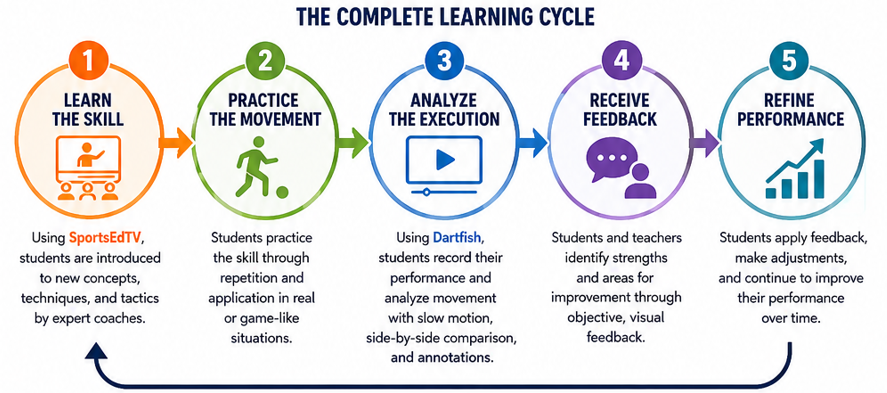
Together, they create a complete learning cycle:
learn the skill, practice the movement, analyze the execution, receive feedback, and refine performance.
In a physical education setting, a teacher could use SportsEdTV to introduce a new concept or skill, then use Dartfish to help students evaluate their own movement and identify areas for improvement.
This combination supports both initial learning and long-term reflection, which are essential components of effective instructional design.
The Future of Physical Education
The future of physical education will likely involve even greater integration between technology, instruction, and performance analytics.
Artificial intelligence, wearable technology, video feedback systems, and interactive coaching platforms are already reshaping how athletes train and learn. However, technology itself is not the goal.
The real value lies in how these tools improve communication, understanding, engagement, and long-term development.
Great coaches and teachers will always remain essential. Technology simply enhances their ability to personalize learning, provide clearer feedback, and accelerate improvement.
Platforms like SportsEdTV and Dartfish demonstrate how sports education is evolving into a more intelligent, reflective, and accessible experience for learners of all ages and skill levels.

Final Thoughts
Both SportsEdTV and Dartfish highlight how technology is fundamentally changing physical education and athletic development.
SportsEdTV excels at delivering structured, high-quality instruction in an accessible format. Dartfish excels at helping athletes and students better understand their own performance through visual analysis and feedback.
Together, they represent a broader evolution occurring across sports education. Physical education is no longer simply about participation. Increasingly, it is about understanding movement, developing self-awareness, improving decision-making, and creating lifelong learners through sport.
As technology continues advancing, the integration between coaching, education, and performance analysis will likely become one of the defining features of the future of physical education.
References
Da Matta, G.B. (2026). Video technology as instructional strategy towards motor skills acquisition. International Olympic Academy.
Da Matta, G.B. (2026). Sports pedagogy: A compendium of good ideas for teaching and learning effectively. Western Illinois University, Department of Physical Education.
Metzler, M.W. (2011). Instructional models for physical education (3rd ed.). Holcomb Hathaway Publishers.
Romack, J.L., & Valantine, A.D. (2005). Teaching proper lift techniques: The benefits of supplementing verbal feedback with video playback. Strength and Conditioning Journal, 27(3), 60-63.