Many lifters may experience difficulty dealing with the internal changes that can take place during the final week before a meaningful competition. A meaningful competition is one that has been preceded by a well-planned macrocycle training program designed to lead to peak performance.
This training program may include one or more preparation mesocycles that often conclude with a general feeling of malaise. At the end of the preparation mesocycle, the individual will likely be in a state of fatigue and insomnia. The athlete should be experiencing physiological distress as well as psychological fatigue. The weights lifted during the preparation mesocycle will rarely be considered maximal intensity, but the accumulated load serves as the primary stressor.

Why Lifters Often Feel Worse Before They Feel Better
One of the most misunderstood aspects of high-level weightlifting preparation is that performance often declines temporarily before improving. During demanding preparation phases, athletes frequently experience sluggishness, irritability, sleep disturbances, reduced explosiveness, and mental fatigue.
For inexperienced lifters, this can create panic. Many begin to question the effectiveness of the program just as the physiological adaptations are beginning to occur. Experienced coaches, however, recognize that these symptoms are often signs that the body is under the type of stress necessary to produce long-term adaptation.
The purpose of the preparation mesocycle is not to make the athlete feel fresh. Its purpose is to create the training stimulus required to eventually produce peak performance during competition.
The Science of Supercompensation and Volume Accumulation
The pre-competition mesocycle allows the body not only to recover but to supercompensate in terms of endocrine secretion and overall readiness. General energy levels increase. The malaise begins to disappear. Aggressiveness rises, along with the desire to lift heavy weights.
What many younger lifters fail to understand is that this heightened state does not appear magically. It is the direct result of accumulated training stress created during the preparation phases of the macrocycle. In many successful weightlifting programs, volume, not maximum intensity, becomes the primary driver of adaptation. Large amounts of submaximal work gradually create fatigue, hormonal stress, and neurological strain that temporarily suppress performance before the body eventually rebounds at a higher level once the load is reduced.
This is one reason experienced coaches often remain calm when athletes feel terrible during heavy preparation phases. Fatigue, irritability, poor sleep, lack of explosiveness, and even reduced motivation can all be expected signs that the training stimulus is working as intended. When the taper is properly designed, the body responds by restoring energy reserves, increasing readiness, and improving force production capacity during the final week.
For a deeper understanding of how training volume drives adaptation and why fatigue accumulation is essential to successful peaking, read Weightlifting Periodization Explained: How Volume Drives Results
For some athletes, however, this altered state can create feelings of dread if they are inexperienced or if proper guidance has been lacking.

Why Experienced Coaching Matters
The most effective way of dealing with the heightened internal environment is to surround oneself with experienced competitors and to work under the guidance of a knowledgeable coach who understands how to elicit quality performances.
When programmed properly, the final week can become an incredibly stimulating experience. The lifter cannot wait to get his or her hands on a barbell. The reduced training load also creates more free time, which can become challenging because the athlete is operating in a heightened state of energy, strength, aggression, and competitiveness.
Experienced coaches also understand that the final week is psychological as much as physiological. The athlete’s confidence can fluctuate dramatically during this period. Small technical mistakes suddenly appear catastrophic. Light warm-up weights may feel strangely heavy one day and unusually explosive the next.
A seasoned coach helps stabilize the athlete emotionally while maintaining confidence in the process. In many ways, the coach becomes a regulator of the athlete’s emotional state during the final days leading into competition.
Emotional vs. Focused Competitors
Athletes who competed in other sports before entering competitive weightlifting often adapt more effectively, provided their previous sports were not heavily dependent on emotional expression. Some athletes naturally attempt to solve competitive problems emotionally. While this can work in certain sports, weightlifting requires a more controlled and focused approach.
Success in weightlifting competition depends on harnessing the elevated energy state that develops during the final week of the pre-competition mesocycle.
Weightlifting rewards precision under pressure. Emotional overreaction often leads to technical breakdowns, rushed timing, excessive aggression on the pull, or loss of positional discipline. The most successful lifters learn how to remain emotionally controlled while simultaneously maintaining a high level of aggression and intent.
This balance is difficult to master and usually only develops after repeated exposure to competition environments.
The Solitary Nature of Weightlifting
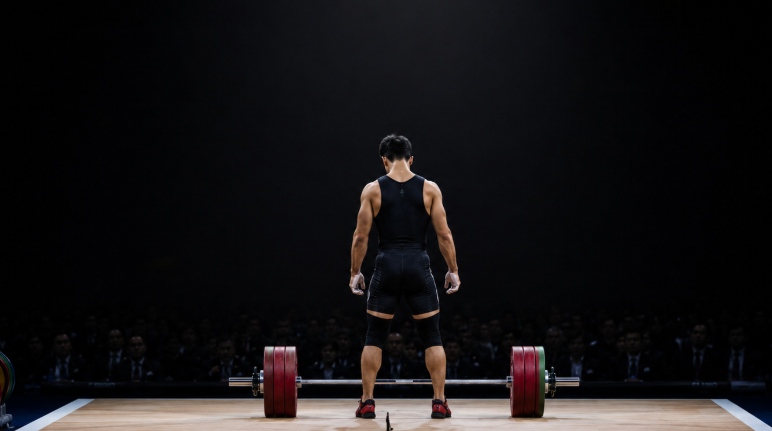
Part of the anxiety that arises during the final week comes from the realization that weightlifting is an intensely solitary competitive activity. During competition, there is no teammate or opponent to divert the audience’s attention.
Track and field events may involve multiple athletes on the field simultaneously, and wrestling requires direct opposition. Weightlifting, however, places the athlete entirely alone on the platform. For individuals uncomfortable with being the sole focus of attention, this can become a significant source of anxiety.
The elevated energy state of the final week can therefore intensify competition jitters in anxious athletes. Conversely, weightlifting can be an ideal sport for highly self-driven and attention-oriented personalities.
There are a few sports where silence can feel so loud. The athlete walks onto the platform alone. The outcome is immediate and public. There are no substitutions, no tactical delays, and no opportunity to hide within a team dynamic. This unique psychological environment is part of what makes weightlifting both intimidating and deeply rewarding.
Learning to Embrace the Final Week
Some individuals never fully learn how to use the remarkable altered state that develops during the final week before competition. The only true solution is repeated exposure to competition and the deliberate observation of seasoned competitors.
Imprinting on the behaviors and routines of exceptional athletes can be tremendously effective. This process works best when the anxious lifter regularly trains alongside experienced competitors and learns to recognize how the training environment differs from the competitive environment.
Experienced competitors often appear calmer, not because they feel less nervous, but because they have learned how to interpret the sensations correctly. Elevated heart rate, restlessness, increased aggression, and nervous anticipation are no longer viewed as threats. They are recognized as part of the preparation process.
Over time, the athlete begins to understand that the heightened physiological state of the final week is not something to fear. It is often the body’s final preparation for peak performance.

Final Thoughts
The final week before a major weightlifting competition is unlike any other phase of training. It is a period where fatigue transforms into readiness, where aggression rises alongside confidence, and where the body prepares itself for maximal performance.
For experienced athletes, this phase becomes exhilarating. For inexperienced athletes, it can feel overwhelming. The difference often lies in preparation, environment, coaching, and experience.
Understanding the wonder of the last week is not simply about physiology. It is about learning how to channel heightened energy, control emotional responses, and embrace the unique psychological demands of stepping alone onto the platform.