Strength And Conditioning, Weightlifting
The Use of Mobile Applications to Measure Barbell Velocity in Velocity-Based Training (VBT)
Introduction to Velocity-Based Training and Barbell Velocity Measurement
This article examines the use of mobile applications to assess movement velocity during resistance training. Measuring movement velocity in strength training is commonly referred to as velocity-based training (VBT), a concept originating in Soviet sports science research in the 1950s (11). In this context, VBT refers to training approaches in which movement velocity is incorporated as a key variable for prescribing, monitoring, and evaluating resistance training programs (18, 20). Before reviewing the mobile applications used to measure training velocity, it is necessary to briefly outline the principles of VBT to understand the potential value of these tools better.

What Is Velocity-Based Training (VBT)?
Origins of Velocity-Based Training in Sports Science
Velocity-based training emerged from early research conducted in the former Soviet Union, where researchers sought objective methods to quantify training intensity and neuromuscular output (11). These early investigations established the foundational understanding of the relationship between load, velocity, and force production that underpins modern resistance training science.
Defining VBT: Velocity as a Programming, Monitoring, and Evaluation Variable
Velocity-based training refers to a broad training framework in which movement velocity is used as a primary variable to guide resistance training decisions. Rather than relying exclusively on percentages of one-repetition maximum (1RM), VBT incorporates velocity data to prescribe training intensity, monitor fatigue, and evaluate performance adaptations (18, 20).
Velocity-Based Training as an Emerging Resistance Training Method
From Soviet Research to Modern Strength and Conditioning Practice
Velocity-based training has progressed from early Soviet research into a practical and increasingly affordable training method for athletes at all performance levels (11, 18, 20). Contributions from researchers and practitioners such as Dr. Bryan Mann (USA) and Dr. Dan Baker (Australia) have played a critical role in translating VBT from elite laboratory settings into applied strength and conditioning environments.
A significant factor driving this growth is the availability of technologies capable of measuring movement velocity, including linear position transducers (LPTs), inertial measurement units, and smartphone-based applications.
VBT as a Programming and Testing Framework
Although VBT is not a new concept, it is still frequently described as an emerging training methodology (11). It is commonly used as both a programming and testing tool within strength and conditioning programs (1, 18, 21). Recent peer-reviewed research has examined a wide range of VBT applications, including load–velocity profiling, velocity-loss thresholds, load adjustment strategies, and the reliability of velocity-measurement technologies (7, 13, 18).
Thompson et al. (18) describe VBT as a contemporary resistance-training approach that enables the objective and precise prescription of training intensity and volume. Similarly, Guppy et al. (11) characterize VBT as an increasingly popular strategy for developing an athlete’s capacity to express force rapidly.
Load–Velocity Profiling and Autoregulation in Resistance Training
Velocity-based training is frequently discussed as a broad framework rather than a single isolated method (10, 18, 20). It can be implemented along a continuum, from simple velocity feedback to advanced autoregulatory programming (21). At a basic level, velocity measurement can supplement traditional percentage-based training by providing real-time performance feedback, which may enhance motivation and training outcomes (16, 21).
At more advanced levels, VBT influences load selection, repetition targets, set termination criteria, and overall programming strategy (18). As such, VBT can be broadly defined as a training approach that uses velocity data to improve decision-making in resistance training. In addition to performance settings, VBT has also been applied in rehabilitation contexts, including post–anterior cruciate ligament reconstruction (9, 18, 20).
Why Measure Barbell Velocity in Strength Training?
The Load–Velocity Relationship and Training Intensity
As external load increases, lifting velocity progressively decreases until a maximal load (1RM) is reached (5, 12, 13). Research consistently demonstrates a near-linear relationship between movement velocity and relative intensity across a wide range of exercises and submaximal loads.
Fatigue, Velocity Loss, and Performance Monitoring
Fatigue temporarily reduces muscle shortening velocity and force production, leading to measurable decreases in movement velocity. By monitoring velocity outputs, practitioners can more accurately prescribe training loads and volumes on a session-by-session basis, while also managing acute and accumulated fatigue (13, 18, 20).
Mean Velocity vs. Peak Velocity: Key VBT Metrics
The primary variables used in velocity-based training are mean velocity and peak velocity. Mean velocity represents the average concentric velocity throughout the movement, while peak velocity reflects the highest instantaneous velocity achieved during the concentric phase (13, 18). Both metrics provide valuable information depending on the training objective.
Limitations of Traditional Barbell Velocity Measurement Technologies
Linear Position Transducers and Inertial Measurement Units
Both accelerometer-based devices and linear position transducers demonstrate high validity and reliability for measuring barbell velocity (6, 12, 14). However, these systems are often costly and require additional hardware, which limits widespread adoption in many training environments.
Cost, Accessibility, and Practical Constraints
While laboratory-grade systems provide high levels of accuracy, their financial and logistical demands restrict accessibility for many coaches and practitioners. These limitations have accelerated interest in more affordable alternatives.
Mobile Applications for Measuring Barbell Velocity
Why Smartphone-Based VBT Tools Are Gaining Popularity
Mobile applications offer a lower-cost and more accessible option for measuring barbell velocity. These tools enable practitioners to monitor mean and peak velocity using commonly available devices, making VBT more practical for a broader range of users (6, 7, 15).
Advantages and Limitations of Mobile Velocity Tracking Apps
While mobile applications increase accessibility, their effective use requires an understanding of both their capabilities and limitations. Factors such as camera positioning, movement plane, and environmental conditions can influence measurement accuracy (6, 15).

The Importance of Real-Time Velocity Feedback in VBT
Effects of Immediate Feedback on Motivation and Performance
Immediate feedback has been shown to enhance motivation and performance outcomes (15, 18, 20). Athletes who receive velocity feedback demonstrate greater improvements in jumping and sprinting performance compared with those who do not receive feedback (14). In some cases, velocity and power outputs have been shown to increase by up to 10% when feedback is provided (15).
Exercises Best Suited for Velocity Feedback
Velocity feedback is most appropriate for exercises aimed at developing force and power, such as Olympic lifts, squats, jumps, and the bench press. It is generally less applicable for stability or mobility-focused exercises, where movement velocity is not a primary performance determinant (18).
Practical Implementation of Velocity-Based Training
Autoregulating Load and Volume Using Velocity Data
Effective resistance training seeks to improve force, velocity, and power characteristics. Training within prescribed velocity ranges allows practitioners to adjust loads dynamically within a set or session (5, 18, 20). Improvements in velocity associated with specific percentages of 1RM typically occur after four to six weeks of training, indicating that load–velocity profiles should be reassessed at similar intervals (7, 18).
Managing Fatigue with Velocity-Loss Thresholds
Autoregulating training loads using velocity data can assist in managing acute and accumulated fatigue. Velocity-loss thresholds help prevent unintended training to failure and should be used alongside traditional prescriptions for volume and intensity (7, 18, 20).
Integrating VBT Within Annual and Seasonal Training Plans
Velocity-based training should be integrated within the broader annual training plan. Off-season phases typically emphasize volume and work capacity, while pre-season and in-season phases prioritize performance and fatigue management (18, 20).
Accuracy and Validity of Mobile Applications for Velocity-Based Training
Validity and Reliability Compared with Laboratory-Grade Systems
For VBT to be effective, coaches must have confidence in the accuracy of the technology being used (7, 15, 18). Several mobile applications have demonstrated high levels of validity and reliability when compared with laboratory-grade systems such as three-dimensional motion capture and linear position transducers (6, 15).
Factors Affecting Measurement Accuracy in Smartphone Apps
Factors that may influence measurement accuracy include barbell tilt, camera lens distortion, and movement outside the sagittal plane (6, 15). Recent research has shown that smartphone applications using artificial intelligence can accurately measure maximal eccentric and concentric barbell velocity in real time without the need for expensive equipment (6).
Practical Setup Guidelines for Measuring Barbell Velocity with Mobile Apps
Camera Positioning and Filming Considerations
Sufficient space is required to ensure that the entire movement of the loaded plates is captured during filming. The camera should be positioned directly lateral to the barbell or loaded weights to optimize measurement accuracy.
Barbell Tracking, Plate Diameter, and Device Stability
Many applications rely on the known diameter of the weight plates to calculate velocity. The smartphone should be mounted on a tripod to minimize device movement, as any camera instability can negatively affect measurement accuracy.

Review of Validated Mobile Applications for Measuring Barbell Velocity
MyJump Lab, MyLift, and PowerLift
The MyJump Lab application, including its MyLift and PowerLift versions, demonstrates near-perfect agreement with linear position transducers for measuring mean concentric velocity (4). The application accurately assesses barbell velocity during the bench press at 50% and 75% of 1RM and requires minimal calibration procedures.
Key characteristics include extensive validation in the literature, high correlation with LPTs for mean and peak velocity, potential systematic bias at higher loads, and availability on both iOS and Android platforms.

Qwik VBT
Qwik VBT has demonstrated high measurement accuracy comparable to linear position transducers for both powerlifting and Olympic weightlifting movements (6, 17). The application provides metrics including mean and peak velocity, range of motion, pause duration, and bar path analysis.
Validation studies report results closely aligned with LPT measurements, strong concurrent validity, and availability on both iOS and Android platforms.
Metric VBT
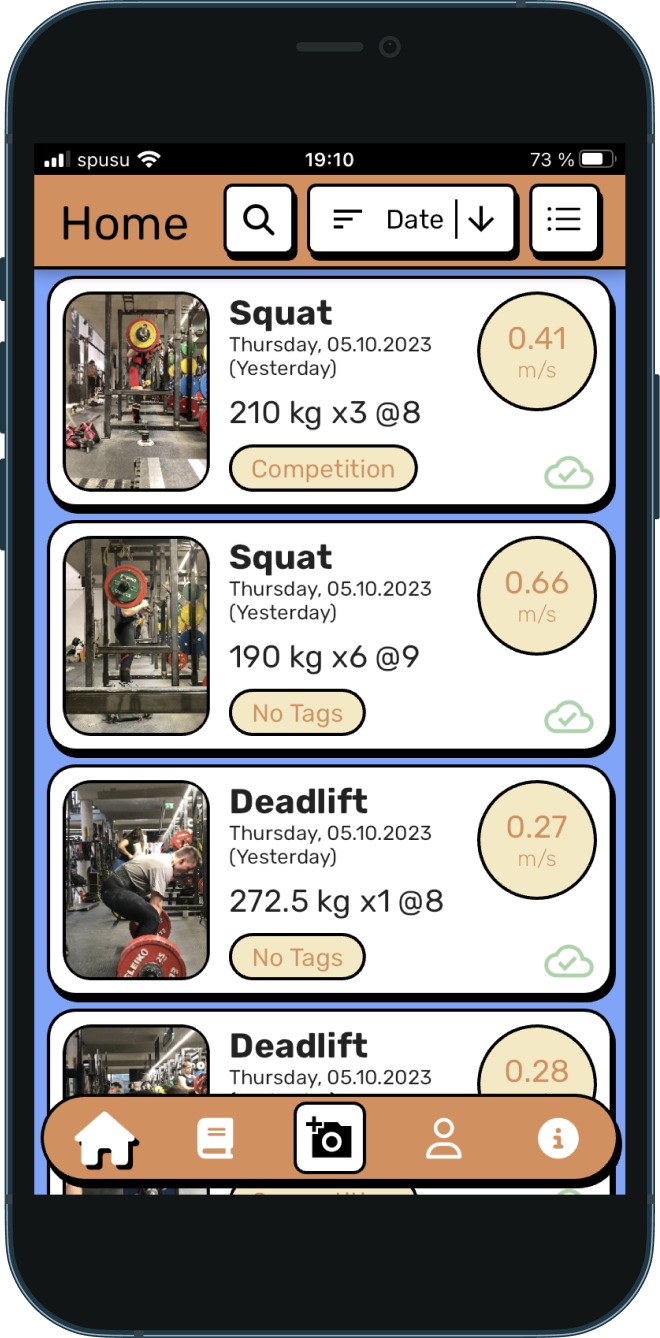
Metric VBT uses automated computer vision technology to track barbell and trap bar exercises from various smartphone positions (18). The application measures velocity, range of motion, tempo, power output, and bar path while providing real-time feedback.
Validation studies confirm its reliability compared with both three-dimensional motion capture systems and linear position transducers. Occasional missed repetitions have been reported, and the application is available on iOS with limited Android support.

Conclusion: The Role of Mobile Applications in Modern Velocity-Based Training
Velocity-based training is a practical, increasingly accessible approach for enhancing strength and power performance. At the same time, traditional velocity-measurement systems offer high levels of accuracy, but their cost limits widespread adoption. Smartphone-based applications provide an affordable alternative, delivering valid and reliable measurements of mean and peak velocity when used correctly.
These applications support real-time feedback, load autoregulation, and increased athlete motivation, making them valuable tools for strength and conditioning professionals. Careful selection of validated applications and an understanding of their limitations are essential to ensure accurate measurement and effective integration into training programs (1, 6, 10, 15, 18, 20).
References
1. A complete guide to VBT training devices and barbell velocity tracker apps [2025 update]. Retrieved September 2025 from https://www.vbtcoach.com/blog/velocity-based-training-devices-buyers-guide.
2. Apps to measure bar velocity. Retrieved September 2025 from: https://www.bing.com/search?q=phone+apps+to+measure+bar+velocity&pc=GD03&form=GDAVG1&ptag=7511.
3. Balsalobre-Fernández, C., Marchante, D., Baz-Valle, E., Alonso-Molero, I., Jiménez, S.L., and Muñóz-López, M. Analysis of wearable and smartphone-based technologies for the measurement of barbell velocity in different resistance training exercises. Frontiers in Physiology 8, 2017.
4. Balsalobre-Fernández, C., Marchante, D., Muñoz-López, M., and Jiménez, S.I. Validity and reliability of a novel iPhone app for the measurement of barbell velocity and 1RM on the bench-press exercise. Journal of Sports Science 36(1):64-70, 2018.
5.Balsalobre-Fernández, C., Torres-Ronda, L. The implementation of velocity-based training paradigm for team sports: framework, technologies, practical recommendations and challenges. Sports; Basel 9(4), 2021.
6. Balsalobre-Fernández, C., Xu, J., Jarvis, P., Thompson, S., Tannion, K., and Bishop, C. Validity of a Smartphone App Using Artificial Intelligence for the Real-Time Measurement of Barbell Velocity in the Bench Press Exercise. Journal of Strength and Conditioning Research 37(12):640-645, 2023.
7. Banyard, H., Nosaka, K., and Haff, G. Reliability and validity of the load–velocity relationship to predict the 1RM back squat. Journal of Strength and Conditioning Research 31(7):1897-1904, 2017.
8. Barbell Velocity Tracker for Strength Training. Retrieved September 2025 from https://vitruve.fit/blog/barbell-velocity-tracker/.
9. Forelli F., Marine, P, Moiroux-Sahraoui A., Mazeas, J., Thoelen, M., Swinnen, B., Bizzini, M., Van Melick, N., and Rambaud, A. Velocity-based training in mid- and late-stage rehabilitation after anterior cruciate ligament reconstruction: a narrative review and practical guidelines. BMJ Open Sport Exerc Med. Retrieved September 2025 from https://pubmed.ncbi.nlm.nih.gov/40297302/.
10. Glaeser, C. Buyer’s guide to velocity-based training and weight room monitoring systems. Retrieved September 2025 from https://simplifaster.com/articles/buyers-guide-velocity-based-training-systems/.
11. Guppy, S., Kendall, K., Haff, G. Velocity-based training—a critical review. Strength and Conditioning Journal 46(3):295-307, 2024.
12. Mann, J. Ivey, Patrick A., Sayers, Stephen P. Velocity-based training in football. Strength and Conditioning Journal 37(6):52-57, 2015.
13. Martínez-Cava, A., Hernández-Belmonte, A., Courel-Ibáñez, J., Morán-Navarro, J., José González-Badillo, J., Pallarés, J.G. Reliability of technologies to measure the barbell velocity: implications for monitoring resistance training. Plos One, 2020.
14. Pareja-Blanco, F., Walker, S., and Häkkinen, K. Validity of using velocity to estimate intensity in resistance exercises in men and women. International Journal of Sports Medicine 41(14):1-9, 2020.
15. Perez-Castilla, A., Piepoli, A., Delgado, G., Garrido-Blanca, G., Garcia-Ramos, A. Reliability and concurrent validity of seven commercially available devices for the assessment of movement velocity at different intensities during the bench press. Journal of Strength and Conditioning Research 33(5): 1258-1265, 2019.
16. Plaza, J.V. Barbell velocity tracker – what’s its purpose. Retrieved September 2025 from https://vitruve.fit/blog/barbell-velocity-tracker/.
17. Renner, A., Mitter, B., and Baca, A. Concurrent validity of novel smartphone-based apps monitoring barbell velocity in powerlifting exercises. Plos One. Retrieved September 2025 from https://journals.plos.org/plosone/article?id=10.1371/journal.pone.0313919.
18. Taber, C., Patterson, E., Shah, J., Francis, P., and Wager, J. Validity and Reliability of a Computer Vision System to Determine Bar Displacement and Velocity. International Journal of Strength and Conditioning 33(1), 2023.
19. Thompson, S.W. “Is it a slow day or a go day?” The perceptions and applications of velocity-based training within elite strength and conditioning.
20. Thompson, S., Fernandes, J, Dorrell, H., Greig, L., Bishop, C. A coach’s guide to velocity-based training: definitions and diagnostics. Strength and Conditioning Journal 47(2):230-244, 2025.
21. Velocity Based Training with Spleeft: The ultimate velocity tracker for coaches & athletes. Retrieved September 2025 from https://spleeft.app/velocity-based-training-with-spleeft-velocity-tracker/.
22. Weakley, J., Mann, B., Banyard, H., McLaren, S., Scott, T., Garcia-Ramos, A. Velocity-based training: from theory to application. Strength and Conditioning Journal 43(2):31-49, 2021.
23. Zhang, X., Feng, S., Peng, R., and Hansen, L. The role of velocity-based training (VBT) in enhancing athletic performance in trained individuals: a meta-analysis of controlled trials. International Journal of Environmental Research and Public Health 19(15):9252.