Basketball
The Underhand Free Throw: What the Science Actually Says, What It Does Not, and Why Basketball Still Resists It
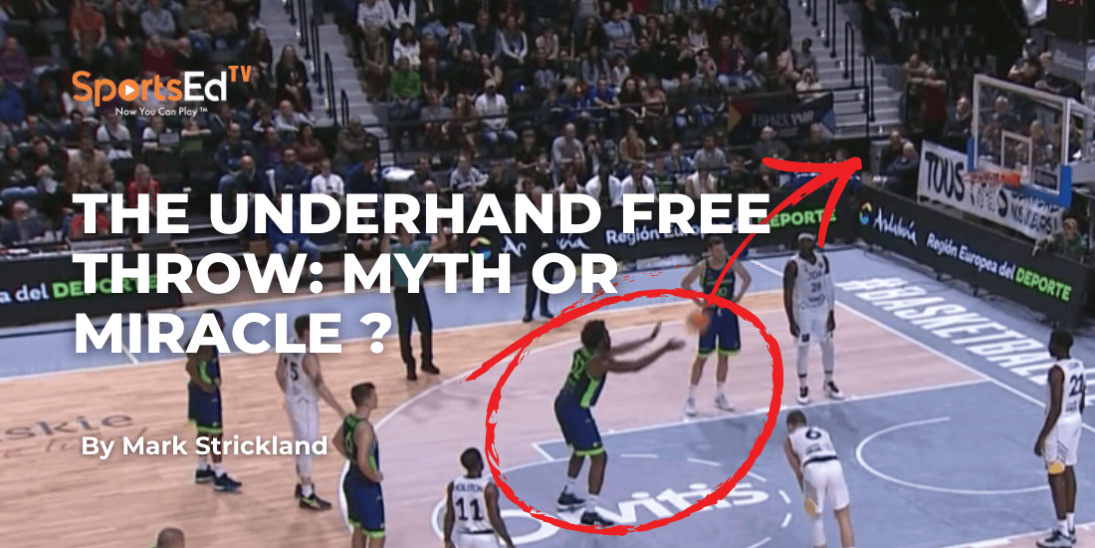
Few topics in basketball generate as much quiet curiosity and instinctive dismissal as the underhand free throw, often labeled the “granny shot.” From time to time, videos resurface claiming that data proves it is superior and that players avoid it purely out of embarrassment.
At SportsEdTV, the goal is not to chase viral claims. The goal is to help coaches, athletes, and parents understand what the science actually supports, what remains unresolved, and how to think critically about performance decisions.
This article examines the underhand free throw through the lenses of biomechanics, motor control, and basketball-specific research. Rather than arguing for or against a single technique, it clarifies why the idea remains scientifically plausible, why it has never been decisively proven at the elite level, and what lessons it offers about shooting mechanics, error tolerance, and performance under pressure.
What the Underhand Free Throw Actually Is and Is Not
An underhand free throw is a two-handed, pendulum-style motion in which the ball is released from below the waist and propelled upward with a smooth, symmetrical movement. Its defining characteristics typically include a relatively high arc, stable and consistent backspin, a lower peak release speed than many overhand free throws, and reduced left-to-right asymmetry at the point of release.
What it is not is a trick shot, a violation of the rules, automatically easier to learn, or a guaranteed accuracy upgrade.
The real discussion is not about style or aesthetics. It is about how different mechanics influence sensitivity to error.

The Core Scientific Question: Error Tolerance, Not Style
Every free throw is a constrained motor task. The distance is fixed. The hoop is fixed. The margin for error between the ball and the rim is small. Under those constraints, performance is governed less by strength or flair and more by how small execution errors propagate through the movement.
In motor control science, accuracy is not about eliminating variability. Human movement is inherently noisy. Accuracy is about shaping movement so that inevitable noise matters less. This concept is often described as error tolerance or error sensitivity.
Some release conditions amplify small errors and result in significant misses. Others absorb small errors and still result in made shots.
That distinction sits at the center of the underhand free-throw discussion.
What Physics and Biomechanics Strongly Support
Higher arcs can reduce sensitivity to angle error
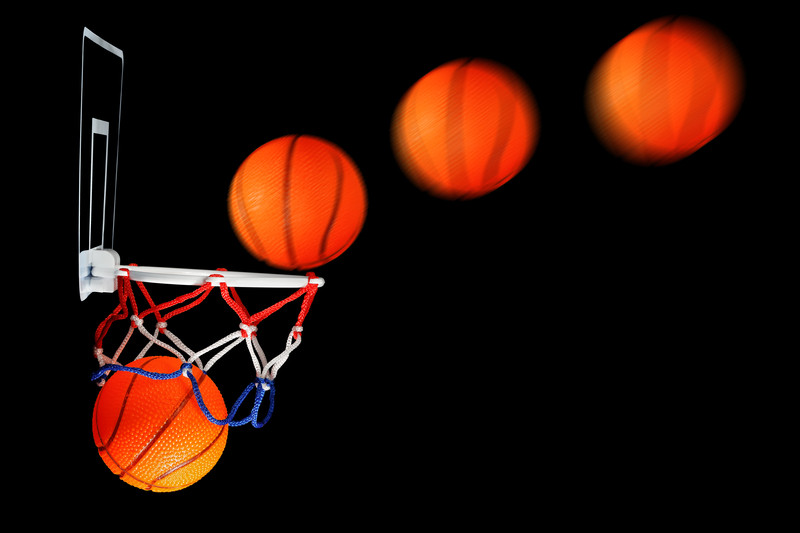
Projectile motion analysis shows that flatter trajectories are more sensitive to small angular deviations. A small change in release angle can produce a large change in where the ball intersects the plane of the rim. More arcing trajectories, within reasonable limits, reduce how punishing those angular errors become.
This does not mean that higher is always better. Extremely high arcs introduce their own problems, particularly increased sensitivity to release speed and timing. However, within realistic basketball ranges, moderate to high arcs tend to be more forgiving to angle error.
Underhand mechanics naturally bias shooters toward higher arcs.
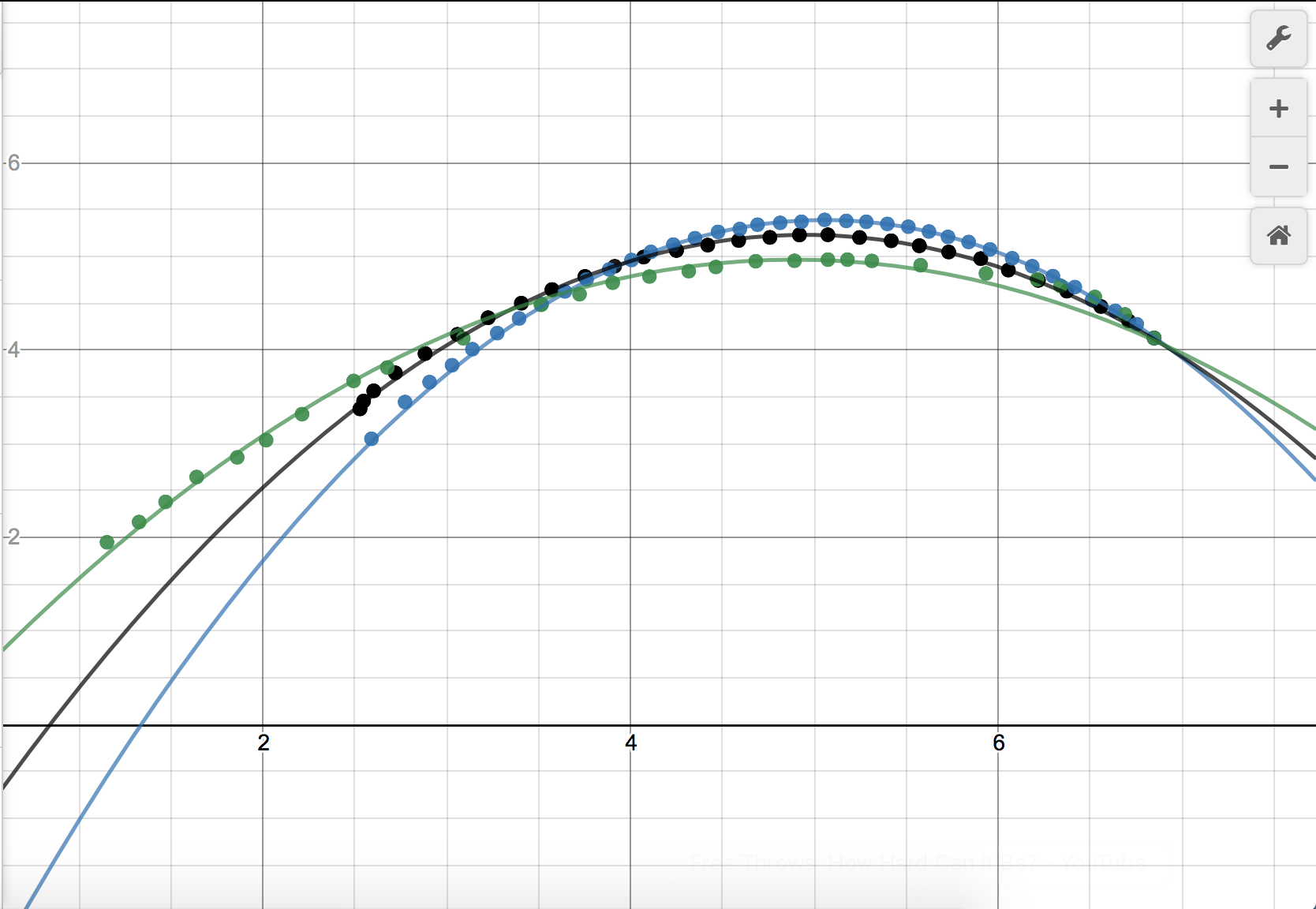
Picture/analysis by Meridian Academy
Lower release speeds can reduce variability for some athletes
Motor control research consistently shows that higher force production often comes with greater variability, especially in precision tasks. A free throw that relies on sharp wrist acceleration and precise distal timing may amplify execution noise in certain shooters.
Underhand shooting typically uses lower peak release speeds and distributes force production across larger muscle groups. For some athletes, especially those with inconsistent wrist mechanics under pressure, this can reduce shot-to-shot variability.
This is not a universal advantage. It is athlete-dependent.
Stable backspin improves rim interaction
Backspin softens rim contact and biases the ball downward rather than forward after contact. Basketball trajectory simulations consistently show that shots with appropriate backspin have a higher probability of dropping after rim contact.
Because the underhand motion is symmetrical and upward oriented, it often produces stable backspin more easily than some overhand motions. Again, this is common but not guaranteed.
What Basketball Specific Research Actually Demonstrates
Engineering and biomechanics researchers have modeled hundreds of thousands of free-throw trajectories to identify release conditions associated with higher make probability. These studies do not prescribe shooting styles. They identify ranges of release angle, release speed, backspin, and aim point that statistically increase tolerance to execution error.
Typical findings include release angles in the low to mid-50-degree range, controlled backspin, and aim points that bias toward the back of the rim rather than the center.
Crucially, these studies do not conclude that underhand shooting is superior. They conclude that some release profiles are more forgiving than others. The underhand argument enters here because, for certain shooters, underhand mechanics may make these forgiving profiles easier to reproduce consistently.
That is a plausible inference. It is not definitive proof.
What Controlled Experiments Do and Do Not Show
When researchers have directly compared underhand and overhand free throws in controlled experimental settings, usually using inexperienced shooters, the results are more nuanced than popular narratives suggest.
These studies generally show no automatic advantage for underhand shooting, strong learning effects for both techniques, and large individual differences between participants.
This matters. It means no evidence that simply switching styles guarantees improvement. Any advantage must be developed through practice, adaptation, and motor learning.
This is one of the main reasons experts correctly push back against claims that research proves the granny shot is better.
The Rick Barry Question: Evidence or Illustration
No discussion of underhand free throws can avoid Rick Barry. Barry shot underhand free throws throughout his professional career and finished with one of the highest free-throw percentages in basketball history.
What Barry demonstrates is feasibility. The technique can work at the highest level, under pressure, across an entire career.
What Barry does not demonstrate is causality. He was an exceptional shooter overall. His success does not prove that underhand shooting caused his accuracy, nor that it would generalize to most players.
Using Barry as proof is a logical error. Using him as a real-world example that the technique can succeed is reasonable.
Why Elite Basketball Has Never Truly Tested the Idea
Embarrassment is often cited as the primary reason players avoid underhand shooting. That explanation is incomplete.
Skill transfer matters
Players accumulate tens of thousands of repetitions building an overhand shooting motor pattern that applies to jump shots, floaters, and free throws. Free throws may be stationary, but they are neurologically linked to the rest of a player’s shooting identity.
Introducing a second, unrelated shooting system creates cognitive and motor overhead. Coaches are justified in considering this cost.
Short-term performance risk is real
Any technique change produces a temporary dip in performance. In elite environments, even a short visible dip can affect playing time, contracts, and confidence. This is not irrational behavior. It is a rational response to structural incentives.
Basketball culture penalizes deviation
Basketball strongly values aesthetic conformity. Unconventional mechanics draw attention and scrutiny. That pressure alone is often sufficient to suppress experimentation, even if the expected value might be positive.

Where the Underhand Argument Is Weakest
To be credible, it is essential to be explicit about the limitations.
There is no large sample professional dataset comparing underhand and overhand free throws. There is no randomized elite trial demonstrating superiority. There is no evidence that strong free-throw shooters would benefit from switching. There is no guarantee that underhand mechanics reduce degrees of freedom in a way that benefits all athletes.
Any claim that ignores these limitations is overstated.
A More Defensible Framing
The strongest defensible position is not that underhand shooting is better, but that for some poor or inconsistent free-throw shooters, underhand mechanics may offer a path to a more error-tolerant release profile, at the cost of social stigma and short-term adaptation.
That claim is consistent with physics, biomechanics, and the absence of decisive counter evidence.
Who Might Rationally Consider It
From a performance standpoint, the population is narrow.
- Chronically low percentage free-throw shooters
- Players whose misses cluster the front rim or the back rim, suggesting speed inconsistency
- Athletes with unstable wrist mechanics under pressure
- Late game liabilities where marginal gains matter
For elite shooters, there is no rational incentive to change.
Coaching Perspective: What This Really Teaches
For coaches, the underhand free throw should not be viewed as a gimmick. It should be viewed as a case study in error tolerance and repeatability.
The larger lesson is not about copying a specific technique. It is about identifying which mechanical variables dominate failure for a given athlete and selecting movements that reduce sensitivity to those variables.
For players, the lesson is that good mechanics are not defined by how they look, but by how well they hold up under pressure.
For parents and developing athletes, the takeaway is broader. Performance gains often come from mechanics that feel unfamiliar, not from those that feel traditional.

Final Verdict
The underhand free throw is neither a myth nor a miracle.
Science supports the idea that certain release conditions improve tolerance to error. It also supports the idea that underhand mechanics can help some athletes reach those conditions. What science does not support is a universal prescription.
If basketball ever reaches a point where marginal gains outweigh stigma, the question may finally be tested properly.
Until then, the underhand free throw remains a rational idea constrained by culture, identity, and incentive structures rather than by physics alone.