Tennis
Tennis Rating Systems Explained: NTRP, UTR, and ITF World Tennis Number (WTN)

Understanding tennis ratings is essential for players, coaches, clubs, and parents who want fair competition, meaningful development, and properly structured play. Yet tennis ratings remain one of the most misunderstood aspects of the sport, mainly because multiple systems coexist, each designed for a different purpose.
This article provides an explicit, authoritative reference to the three most crucial tennis rating systems in use today: NTRP, UTR, and the ITF World Tennis Number (WTN). It is written to serve as a long-term reference for SportsEdTV, grounded in official standards and real-world coaching applications.

Why tennis ratings are often misunderstood
Most confusion comes from treating all ratings as if they mean the same thing. In reality, tennis ratings fall into two distinct categories. Some are classification systems designed to organize league play. Others are match-result-based ratings designed to compare players across regions, ages, and competitive environments.
When classification systems are mistaken for performance metrics, or when global ratings are forced into league contexts they were not designed for, mismatches, frustration, and disputes follow.
Understanding intent is the first step to using ratings correctly.

What a tennis rating is actually supposed to measure
A tennis rating is not a judgment of technique, aesthetics, or potential. It is a practical tool meant to group players so that matches are competitive, safe, and developmentally appropriate.
A well-designed rating system should create competitive matches, reduce extreme mismatches, provide a clear development pathway, and remain stable enough to be trusted while still adjusting as players improve.
NTRP, UTR, and WTN all pursue this goal, but each uses a different methodology and serves a different competitive environment.
The USTA NTRP rating system explained
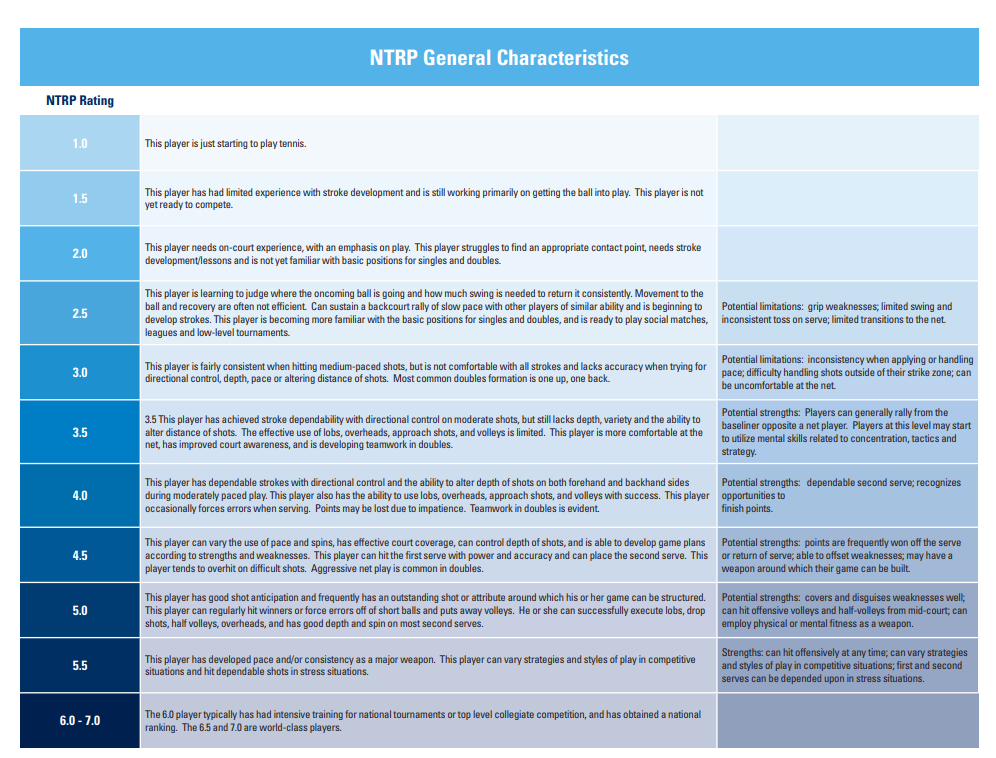
The National Tennis Rating Program (NTRP) is the skill classification framework developed and administered by the United States Tennis Association. It is the foundation of USTA league play in the United States and remains the most widely used descriptive skill system for adult recreational and competitive tennis.
NTRP ratings are expressed in half-point increments, most commonly from 2.0 through 5.5, with higher numbers reserved for elite and professional players.
What NTRP is designed to do
NTRP exists to group players of similar competitive ability within leagues. It is not designed to be a universal, global comparison tool. Its strength lies in internal consistency across USTA competition.
Ratings are established through a combination of self-assessment, match results in sanctioned play, and computer-generated dynamic ratings that adjust as competition data accumulates.
NTRP skill levels explained in detail
NTRP 1.0–1.5
Players at this level are developing basic tennis-specific coordination and learning how to make consistent contact with the ball. Rallying is minimal and usually only possible at very slow speeds or with cooperative feeding. Players are learning stroke fundamentals, grip basics, scoring, court positioning, and match flow. Movement patterns are inefficient, and most errors stem from timing and footwork rather than tactical decisions.
NTRP 2.0–2.5
Players can sustain short rallies at a slow to moderate pace and are beginning to establish directional control, though depth and consistency remain inconsistent. Serves are generally reliable enough to start points but lack placement or intent. Groundstrokes show improving shape, but errors increase under movement or pressure. Players understand basic singles and doubles positioning but recover late and leave open court frequently. Weaknesses are general rather than specific.
NTRP 3.0
Advanced beginners who can sustain rallies and begin to control direction and depth with greater intent. Serves are consistent and directional, but not yet weapons. Players start to recognize opportunities to approach the net but struggle with transition shots and first volleys. Strengths and weaknesses are identifiable, such as a dependable forehand or a vulnerable backhand. Unforced errors and declining consistency under pressure heavily influence match outcomes.
NTRP 3.5
Intermediate players who can control pace, sustain longer rallies, and direct the ball with moderate reliability. Serves show improved placement and occasional spin or power. Returns are more purposeful, and players can identify opponent weaknesses and attempt to exploit them. Net play is functional, though transition skills still limit effectiveness. Tactical understanding exists, but execution often breaks down in tight situations.

NTRP 4.0
Advanced intermediate players who can execute dependable strokes on both sides, handle increased pace, and build points using recognizable patterns. Serves and returns are reliable and intentional. Players transition effectively to the net and can finish points when given opportunities. Defensive skills allow players to stay in points under pressure. Errors are more often forced by opponents rather than self-inflicted.

NTRP 4.5
Advanced players with strong all-court games, improved net play, and the ability to execute under pressure. Players demonstrate tactical awareness, adjust strategies mid-match, and maintain discipline in shot selection. Weaknesses are relatively minor and situational. Matches are decided more by execution quality and decision-making than by obvious technical gaps.
NTRP 5.0–5.5
Expert-level players who possess defined weapons, high consistency, and advanced tactical sophistication. These players can dictate play with serve patterns, aggressive returns, and strong first-ball control. Defensive capabilities allow them to neutralize pressure and counterattack effectively. Errors are infrequent and usually the result of calculated risk rather than breakdowns.
NTRP 6.0–7.0
Elite national and world-class competitors, including touring professionals. Players exhibit exceptional athleticism, precision, tactical intelligence, and mental durability. These levels primarily exist for classification completeness and are typically not relevant to recreational or league-based play.
Universal Tennis Rating (UTR) explained
UTR, or Universal Tennis Rating, is a global rating system that places all players on a single numerical scale based on match results. Unlike NTRP, UTR does not rely on descriptive categories or self-assessment.
UTR uses match outcomes, opponent strength, and score margins to calculate ratings that generally range from approximately 1.00 for beginners to over 16.50 for top professionals.
UTR is widely used in junior development, college recruiting, and international competition because it enables meaningful comparison across age groups, regions, and competitive environments.
ITF World Tennis Number (WTN) explained
The World Tennis Number (WTN) is a global rating system developed by the International Tennis Federation. It uses a reverse scale from 40 for beginners to 1 for elite professionals and provides separate ratings for singles and doubles.
A defining feature of WTN is its confidence indicator, which reflects how much match data supports a player’s current number. Ratings with low confidence should be treated as provisional until sufficient data is accumulated.
Comparing NTRP, UTR, and WTN
NTRP is best suited for organizing USTA league play and maintaining parity within a domestic league structure. UTR excels at global performance comparison and competitive matchmaking across different ecosystems. WTN offers a federation-backed global standard with transparency around data confidence and discipline-specific ratings.
Each system is effective when used as intended. Problems arise only when they are misapplied.

What actually separates tennis levels in real match play
Across all rating systems, advancement is driven by the same underlying performance factors: serve and first-ball effectiveness, second-serve resilience, return quality and depth, consistency under pace, point construction using patterns, and error management under pressure.
Players do not move up levels by accumulating more strokes or hitting harder. They progress by reducing leaks in these core areas and executing them reliably in match conditions.
Final takeaway
Tennis ratings exist to serve the game, not the ego. NTRP provides a stable and practical framework for league play, while UTR and ITF World Tennis Number offer robust global performance metrics. When each system is used as designed, players experience fairer matches, clearer development pathways, and a healthier competitive environment.