Tennis
How Tennis Points Are Really Won at the Competitive Amateur Level

Many tennis players spend years working on technique. They refine their forehand, improve their serve, and groove their backhand until it feels reliable in practice. Yet when matches become tight, progress often stalls. Wins do not come as easily as expected, and players begin to wonder why improved strokes are not translating into better results.
The answer is rarely technical.
At the competitive amateur level, tennis is no longer decided by who can hit the cleanest shot. It is decided by who manages points more effectively. Strategy, positioning, shot selection, and emotional control become the true differentiators.
This article explains how tennis points are really won at the club and tournament level, and what players must understand to move beyond the plateau.

Why Better Technique Alone Stops Being Enough
At early stages of development, technique is the primary limiter. Improving consistency immediately improves outcomes. But as players reach the intermediate to advanced recreational level, most opponents can rally, defend, and attack with reasonable quality.
At this stage:
-
Errors are often forced by decisions, not mechanics
-
Points extend longer, increasing mental pressure
-
Players lose matches they feel they “should” win
This is where tennis becomes a thinking game.
Players who continue to focus only on stroke production often miss the bigger picture. Those who learn how to manage points, patterns, and pressure begin to separate themselves.
The Difference Between Hitting Shots and Building Points
One of the most essential distinctions in competitive tennis is the difference between executing a shot and constructing a point.
Less experienced players tend to focus on the shot they are hitting. More advanced players focus on what that shot sets up next.
Stronger players consistently consider:
-
Court position after contact
-
The opponent’s likely response
-
Risk versus reward in that moment
-
Whether the rally is being neutralized or pressured
When players feel rushed or out of control, it is usually because an earlier decision placed them in a compromised position.
Understanding the Phases of a Tennis Point
Most tennis points follow a predictable structure:
-
Serve or return initiation
-
Neutral rally phase
-
Advantage creation
-
Point resolution, often through an error
Problems arise when players try to skip steps.
Attempting to finish points too early, attacking from poor positions, or forcing winners from neutral balls leads to inconsistency. Stronger players accept that earning advantage is a process.

Court Position Is Strategy in Motion
Where you hit from matters as much as how you hit.
At the competitive amateur level:
-
Shots struck from inside the baseline carry more offensive value
-
Shots hit while retreating reduce margin
-
Balance and spacing dictate shot quality
Good strategy constantly works to:
-
Move the opponent laterally
-
Push them behind the baseline
-
Create short balls rather than forcing winners
Players who control the court position control the point.
Shot Selection Over Shot Speed
One of the most common misconceptions in tennis is that winning more points requires hitting harder.
In reality, effective shot selection wins far more matches than increased pace.
Key decision moments include:
-
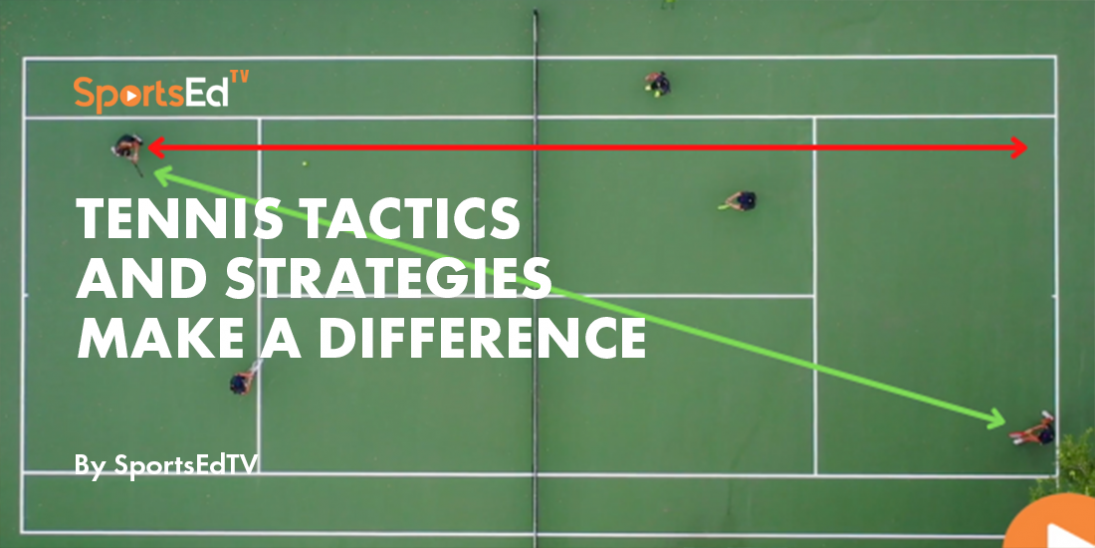
Choosing cross-court versus down the line
-
Knowing when to change direction
-
Recognizing when to stay patient
-
Understanding when not to attack
A helpful principle is simple:
If your opponent is comfortable, you did not gain advantage.
Shots that apply pressure without sacrificing margin consistently outperform low-percentage attacks.
Managing Neutral Balls and Avoiding Forced Errors
At the competitive level, many rallies are neutral for several shots. Neither player has a clear advantage.
This is where many matches are decided.
Less experienced players attempt to escape neutral situations by forcing offense. Stronger players use neutral balls to:
-
Improve positioning
-
Test opponent consistency
-
Create openings gradually
Errors often come not from lack of ability, but from impatience.
Winning players are willing to rally until the odds are in their favor.
The Role of Serve and Return in Point Control
Serve and return do not need to be overpowering to be effective.
At this level, their primary purpose is to:
-
Establish favorable patterns
-
Avoid immediate disadvantage
-
Set up the next ball
Effective servers focus on placement, variation, and patterns rather than speed alone. Effective returners prioritize depth, margin, and recovery position over aggression.
Points are often decided by what happens after the serve and return, not on them.
Understanding High-Percentage Attacking Opportunities
Not all attacking balls are equal.
Strong players learn to recognize:
-
Short balls with time and balance
-
Balls that sit up in the strike zone
-
Opponent positions that are clearly compromised
Attacking from these situations increases success rates and reduces errors.
Attacking from poor balance or defensive positions usually does the opposite.
Why Most Tennis Points Are Lost, Not Won
This is one of the hardest lessons for competitive players to accept.
At the amateur and club level:
-
The majority of points end on errors
-
Winners are often situational
-
Pressure magnifies decision mistakes
Common causes of lost points include:
-
Changing direction too early
-
Over-hitting from neutral positions
-
Playing emotionally when trailing
-
Abandoning patterns under pressure
Reducing unnecessary errors is often the fastest path to improvement.
Emotional Control as a Strategic Skill
Mental discipline is not separate from strategy. It is part of it.
Players who struggle emotionally tend to:
-
Rush points
-
Take unnecessary risks
-
Abandon patience when frustrated
Strong players maintain tactical discipline regardless of score. They understand that strategy works best when emotions are managed.
Staying calm allows decision-making to remain clear under pressure.
Practicing Tennis the Right Way for Match Improvement
Practice that focuses only on strokes does not fully prepare players for competition.
Effective training includes:
-
Pattern-based drills
-
Live ball scenarios
-
Situational games
-
Score-based pressure exercises
Players improve faster when practice reflects how points unfold in matches, not just how shots look in isolation.

The Strategic Shift That Unlocks Better Results
When players begin to think strategically, several changes occur:
-
They feel less rushed
-
They trust patience
-
They make fewer emotional decisions
-
Their consistency improves under pressure
Strategy creates clarity.
Clarity creates confidence.
Confidence allows execution to hold up when it matters most.
At SportsEdTV, our mission is to help athletes understand their sport deeply enough to guide themselves on the court. Tennis improvement is not about chasing perfect technique, but about learning how to manage points intelligently and consistently.
That is how tennis players stop plateauing and start winning more matches.