Health, Mental Health, Mental Toughness, Pickleball, Tennis
Closing the Practice–Game Day Performance Gap

We’ve all been there. Great week of practice, flowing, decisive, calm. Then the big match comes, and we’re a shadow of that practice self. We might eke out an ugly win, yes, but more often than not, it’s a loss and a head scratch for why. We were so good in practice, so what happened when the match started?

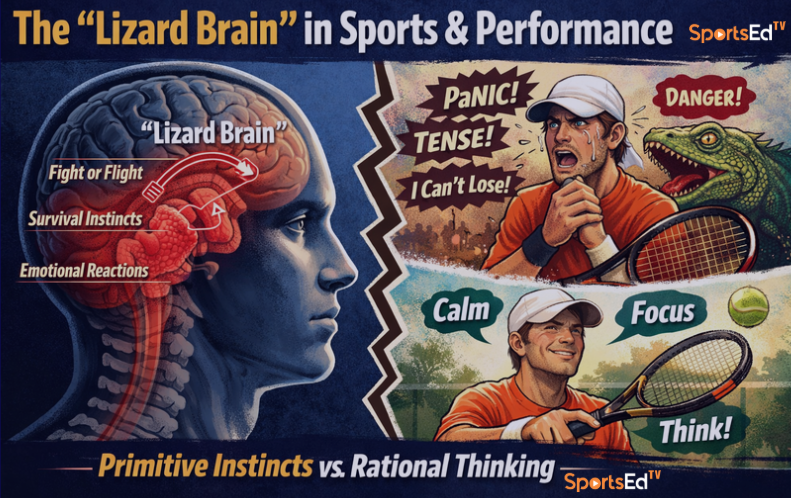
When the Lizard Brain Takes Over in Competition
Your lizard brain took over your tennis bus, which is what happened. The most primitive part of the brain, back where the skull and neck meet, has very little nuance; everything is either life or death. And that pure survival instinct makes it nearly impossible to find rational solutions to the problems of a match, the only solution the lizard brain knows is, get out of here, now!
Why does this instinct get activated so powerfully? All humans have 3 basic needs when it comes to motivation: The need to feel autonomy, some control in a situation; the need to feel like we belong, that we’re loved and respected; and the need to feel competent, that we’re good at things we and others value. Sports threaten all of those. Losing threatens all of those. So, in a flash, a missed ball becomes a deep proof of our worthlessness and incompetence.
These are not conscious processes; you cannot willfully keep these thoughts out of your mind, nor should you try to. But you can manage them. You are not trying to kick the lizard off your sports bus, just push them back into the passenger seat so you can drive!
Step One: Redefining Winning and Losing
The first step is to take a good, hard look at how you relate to winning and losing. How important is the outcome to you? Are you able to compete honorably and furiously, but accept the outcome one way or the other without falling apart? Or do you have to win to feel ok about yourself?
If winning is overly important, you have to convince yourself of one key fundamental truth that unlocks all the rest: You are not a better person if you win, and you are not a worse person if you lose. Winning and losing tell you absolutely nothing about who you are as a human being, about your generosity, loyalty, dedication to causes, character, sense of humor, contribution to your friends, family, and community, work ethic, etc. When you truly believe that winning and losing do not define you as a human being, you are free to play the best you can on any given day.
One way to reinforce this is to focus more on problem-solving or puzzle-solving. All a tennis match is, all any sports contest is, is a series of puzzles or problems to be solved. When you approach your competition this way, you can face it objectively, like a surgeon doing an operation. It’s not personal. It’s just a problem to solve, and you’re trying to solve it better or faster than your opponent. That’s all it is! So, focusing on your game plan, your overall strategy that draws on your strengths, your tactics to get that strategy to happen, all that is what needs to occupy your mind, not winning and losing.

Step Two: Creating a Between-Points Routine
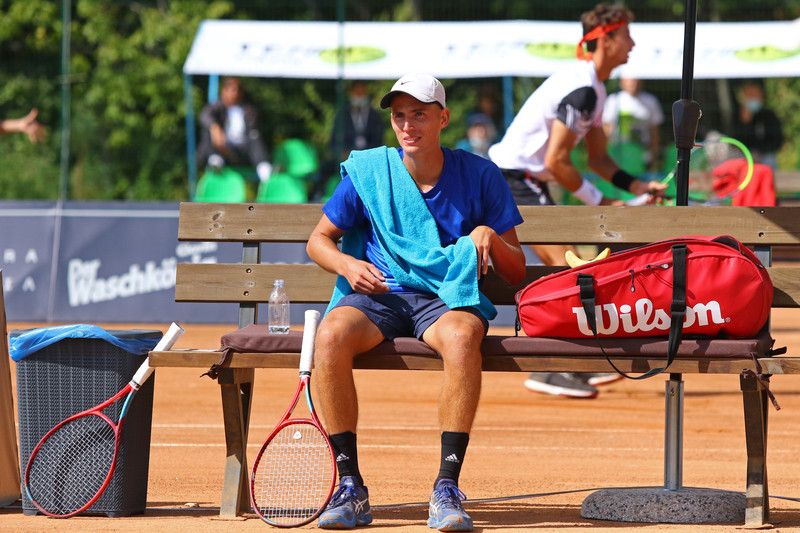
The 2nd step is having a plan, a routine you have practiced over and over again, for in-between points or plays. In most sports, more time is spent not playing than playing. In tennis, 75%-80% of the time is spent between points or on change-overs. Those moments when you're not playing are when the lizard brain loves to barge in and take over with thoughts like, "I stink today," "I’ll never beat this girl," "ugh, why did I ever start playing?" So you need a routine that helps you react positively — or at least neutrally — to the point just played, win or lose; a way to relax your mind and body; a way to refocus; and a way to get ready for the next point to start. These can be a quick word or phrase (I encourage my students to simply say “ok” at the end of each point), a body movement (deep belly breaths), humming a favorite song, whatever works for you.
Step Three: Using Visualization to Prepare for Match Day
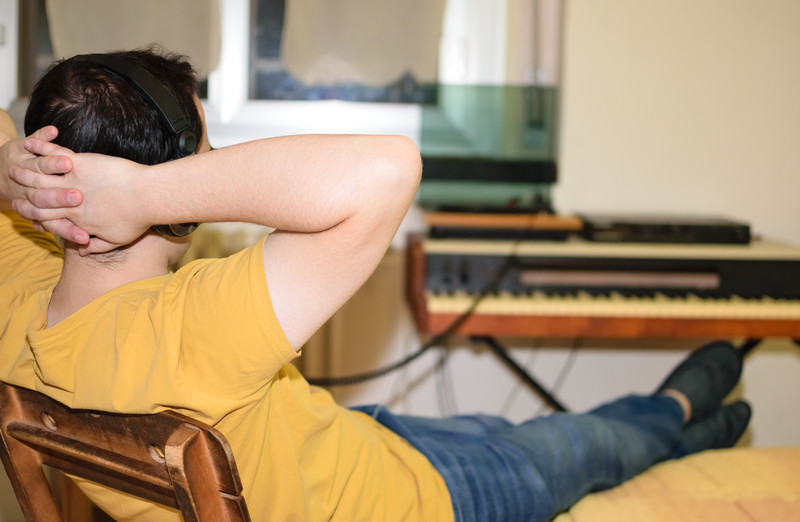
The 3rd step is visualization. Get into a comfortable chair or lie down, and close your eyes. Visualize going to the courts on game day. See yourself warming up, smiling, feeling loose. Imagine yourself serving and returning with clarity and decisiveness, executing your game plan. See yourself shaking hands with your opponent at the end, no matter the outcome. Visualize as much of the sights, sounds, smells, and touch (the racquet handle, the strings, the ball, the warm air if outdoors) of the match as you can. Take a good 5 minutes for this. Do this a few times before game day.
Step Four: Reconnecting With Why You Play
The last step is to write down all the reasons you love to play, then keep reading them or repeating them to yourself throughout the week and during your matches. You can record on your phone if that works better for you. In all the years I’ve had my tennis students do this, no one has ever said winning was why they played. They list the fun of running around, the excitement of competition, seeing yourself grow and learn, the social aspects of being with friends and making new ones, and being outdoors. Keep reminding yourself of why you love the game. You didn’t fall in love with the sport because of winning—you fell in love with it because you loved playing it.
Do these things, and instead of feeling you have everything to lose on game day, you will walk into your game day matches feeling like you have nothing to lose. You will feel better no matter what, and you will play better, which gives you more chances to win, without worrying about winning and losing!