Pickleball “levels” are supposed to make games fair, safe, and fun. But in real life, they often create arguments, mismatched open play, and confusion about what a rating actually represents.This guide is designed to be a durable reference you can use for years, because it is anchored to the most defensible, widely adopted standard in the U.S.: USA Pickleball’s published skill levels and skill matrix/assessments.It also clarifies the common mix-up between “levels” and algorithmic ratings like DUPR, which are related but not the same thing.
First, a critical clarification: “Skill level” is descriptive. “DUPR” is a dynamic rating.
If you take only one idea from this article, make it this:
- Descriptive skill levels (2.0, 2.5, 3.0, 3.5, 4.0, 4.5, 5.0, 5.5+) are checklists of what a player can do and how reliably they can do it. USA Pickleball publishes these and provides tools like a downloadable skill matrix and level-specific guidance.
- DUPR is an outcomes-based rating that updates as match results are entered, and it is used to group players based on measured results rather than purely descriptive labels.
In practice, a player might describe themselves as “about a 3.5” while also holding a DUPR rating number that moves as they play. Confusion starts when players treat one as a substitute for the other.
How to read a level the right way
A level is not your best rally or your best day. A level is closer to:
- your median execution under real points,
- your ability to select the correct option (soft vs hard, reset vs counter, dink vs speed-up),
- and your consistency when the rally speeds up.
This is why USA Pickleball’s guidance is structured around categories such as serve/return, dinking, third shot, volley skills, and strategy.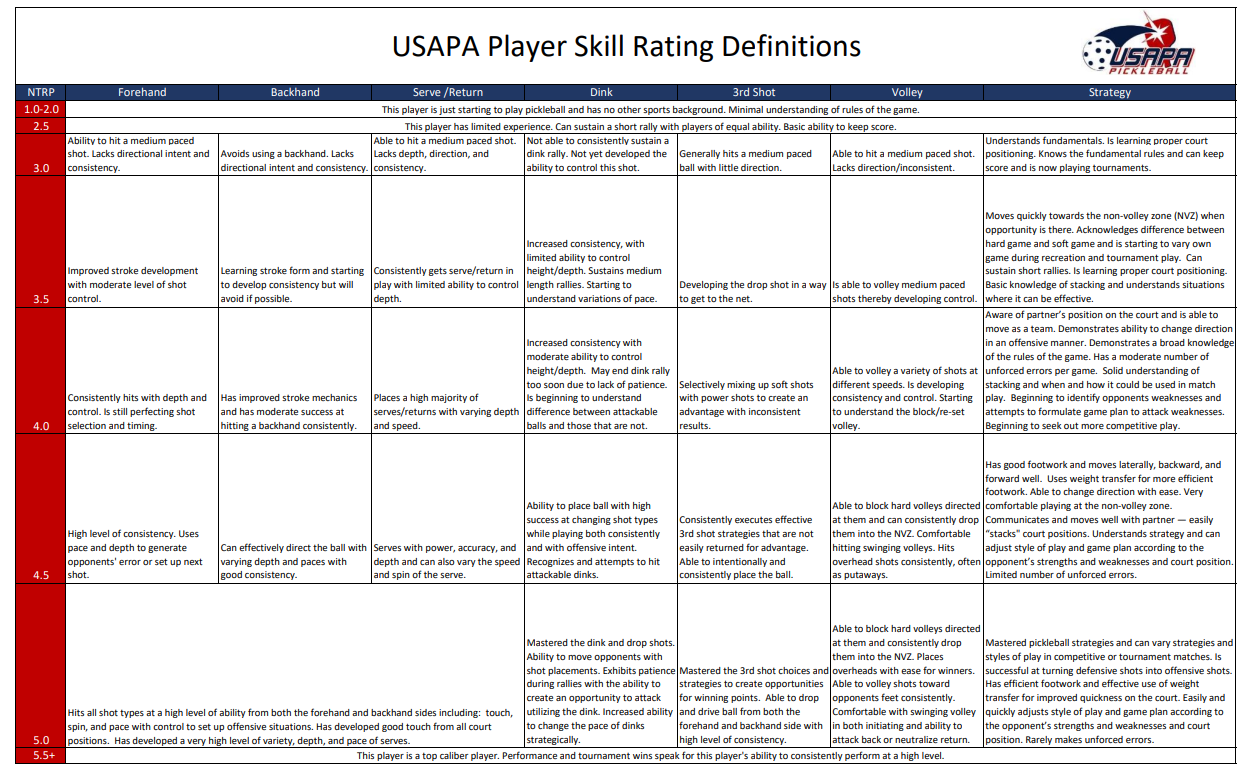
The levels at a glance (USA Pickleball framework)
USA Pickleball’s public framework commonly lists: 2.5 (Beginner), 3.0 (Advanced Beginner), 3.5 (Intermediate), 4.0 (Advanced Intermediate), 4.5 (Advanced), 5.0 (Expert), 5.5+ (Expert Pro), and also publishes a page for Level 2.0 guidance. Below, I’ll break down every level from 2.0 through 5.5+, plus how “6.0+” is often used informally.
2.0: True beginner (learning contact, rules, and positioning)
At 2.0, you are still building a reliable contact. You may have athletic potential, but the ball does not consistently go where you intend, and basic patterns (serve, return, move) are not yet automatic. USA Pickleball’s Level 2.0 guidance emphasizes developing strokes that are still inconsistent and early-stage reliability on serve/return/dink.What you can usually do at 2.0
Pickleball “levels” are supposed to make games fair, safe, and fun. But in real life, they often create arguments, mismatched open play, and confusion about what a rating actually represents.This guide is designed to be a durable reference you can use for years, because it is anchored to the most defensible, widely adopted standard in the U.S.: USA Pickleball’s published skill levels and skill matrix/assessments.It also clarifies the common mix-up between “levels” and algorithmic ratings like DUPR, which are related but not the same thing.
First, a critical clarification: “Skill level” is descriptive. “DUPR” is a dynamic rating.
If you take only one idea from this article, make it this:
- Descriptive skill levels (2.0, 2.5, 3.0, 3.5, 4.0, 4.5, 5.0, 5.5+) are checklists of what a player can do and how reliably they can do it. USA Pickleball publishes these and provides tools like a downloadable skill matrix and level-specific guidance.
- DUPR is an outcomes-based rating that updates as match results are entered, and it is used to group players based on measured results rather than purely descriptive labels.
In practice, a player might describe themselves as “about a 3.5” while also holding a DUPR rating number that moves as they play. Confusion starts when players treat one as a substitute for the other.
How to read a level the right way
A level is not your best rally or your best day. A level is closer to:
- your median execution under real points,
- your ability to select the correct option (soft vs hard, reset vs counter, dink vs speed-up),
- and your consistency when the rally speeds up.
This is why USA Pickleball’s guidance is structured around categories such as serve/return, dinking, third shot, volley skills, and strategy.
The levels at a glance (USA Pickleball framework)
USA Pickleball’s public framework commonly lists: 2.5 (Beginner), 3.0 (Advanced Beginner), 3.5 (Intermediate), 4.0 (Advanced Intermediate), 4.5 (Advanced), 5.0 (Expert), 5.5+ (Expert Pro), and also publishes a page for Level 2.0 guidance. Below, I’ll break down every level from 2.0 through 5.5+, plus how “6.0+” is often used informally.
2.0: True beginner (learning contact, rules, and positioning)
At 2.0, you are still building a reliable contact. You may have athletic potential, but the ball does not consistently go where you intend, and basic patterns (serve, return, move) are not yet automatic. USA Pickleball’s Level 2.0 guidance emphasizes developing strokes that are still inconsistent and early-stage reliability on serve/return/dink.What you can usually do at 2.0
- Start points sometimes (serve/return may miss under mild pressure)
- Rally briefly with other true beginners
- Understand basic scoring and rules inconsistently, improving quickly
What separates 2.0 from 2.5
- Fewer complete mishits
- More balls back in play
- Beginning awareness that doubles spacing and the NVZ matter

2.5: Beginner (you can sustain short rallies, and the game “works”)
USA Pickleball’s skill level page describes 2.5 as limited experience, but able to sustain a short rally with players of equal ability and keep score.What you can usually do at 2.5
- Serve in reliably enough to play full games
- Return the serve with a basic, safe swing
- Volley easy balls when you have time
- Move toward the NVZ sometimes, even if late
Common 2.5 leaks (very normal)
- Pop-ups on dinks and blocks
- Standing in “no man’s land” too long
- Overhitting because you don’t yet trust soft control
3.0: Advanced beginner (you have shots, but consistency and intent lag)
At 3.0, the game starts to look like pickleball, not just “paddle-ball.” You can rally, you can hit a variety of strokes, and you’re beginning to understand why the NVZ is the most valuable real estate on the court.Many widely used USAPA/USA Pickleball-style definition matrices describe 3.0 players as able to hit a medium-paced shot but lacking consistent directional control and depth, with developing dinks and third-shot intentions. What you can usually do at 3.0
- Keep the ball in play longer and reduce unforced errors on routine balls
- Understand the idea of a third-shot drop (even if it fails often)
- Compete comfortably in recreational games without constant stoppages
What separates 3.0 from 3.5
- You stop playing every ball the same way
- You begin to choose: drop vs drive, dink vs speed-up, reset vs counter

3.5: Intermediate (the soft game becomes a requirement, not a bonus)
3.5 is the largest “serious recreational” bracket in many markets. It is also where mismatches become obvious, because players who cannot dink/reset get exposed quickly.USA Pickleball defines 3.5 as “Intermediate,” and the USAPA-style matrices describe improved consistency and control, developing drop shots, more purposeful movement to the NVZ, and better shot selection than 3.0. What you can usually do at 3.5
- Dink with moderate consistency (but pop-ups still appear)
- Attempt third-shot drops (or drives) with a plan to get to the kitchen
- Volley with more stability, not just reactive punching
- Understand basic stacking concepts (even if not executing perfectly)
The classic 3.5 plateau
- Speeding up balls that are not attackable
- Winning some games by athleticism, then losing to patient, disciplined teams
- Getting to the NVZ, but not staying stable and controlled once there
Read the blog about the pickleball strategy guide for 3.0 to 3.5 players
4.0: Advanced intermediate (you run patterns, you don’t just hit shots)
At 4.0, pickleball becomes a strategy sport. You can create advantages with depth, shape, and patience. You also start to neutralize pressure (blocks and resets), not just absorb it.USA Pickleball labels 4.0 as “Advanced Intermediate,” and the common skill definition matrices emphasize improved directional control, depth, and decision-making under pressure.What you can usually do at 4.0
- Return deeper and more intentionally, reducing the opponent’s third-shot options
- Execute third-shot drops and transition with higher success
- Reset from the transition zone often enough to avoid gifting points
- Identify attackable balls more accurately (and leave non-attackable balls alone)
What separates 4.0 from 4.5
- Your composure improves
- Your soft game holds up against speed
- Your counters and resets are purposeful, not lucky
4.5: Advanced (pace management, precision, and tactical adaptation)
USA Pickleball lists 4.5 as “Advanced.”
This is the level where players can win in multiple styles: slower, faster, more aggressive, or more patient. The skill is not just execution; it is selection and adaptation.What you can usually do at 4.5
- Absorb pace with blocks and resets that land low
- Initiate speed-ups at the right time and to the correct targets (hip, shoulder, dominant-side patterns)
- Maintain disciplined dinks that do not drift into the opponent’s strike zone
- Punish floating balls consistently without overhitting
The separator to 5.0
- How few free points you give away
- How well you handle “chaos rallies” without losing structure
5.0: Expert (complete game, low leakage, and professional shot selection)
USA Pickleball lists 5.0 as “Expert.”
At 5.0, the game is clean. Points end because someone forced an advantage, not because someone donated errors.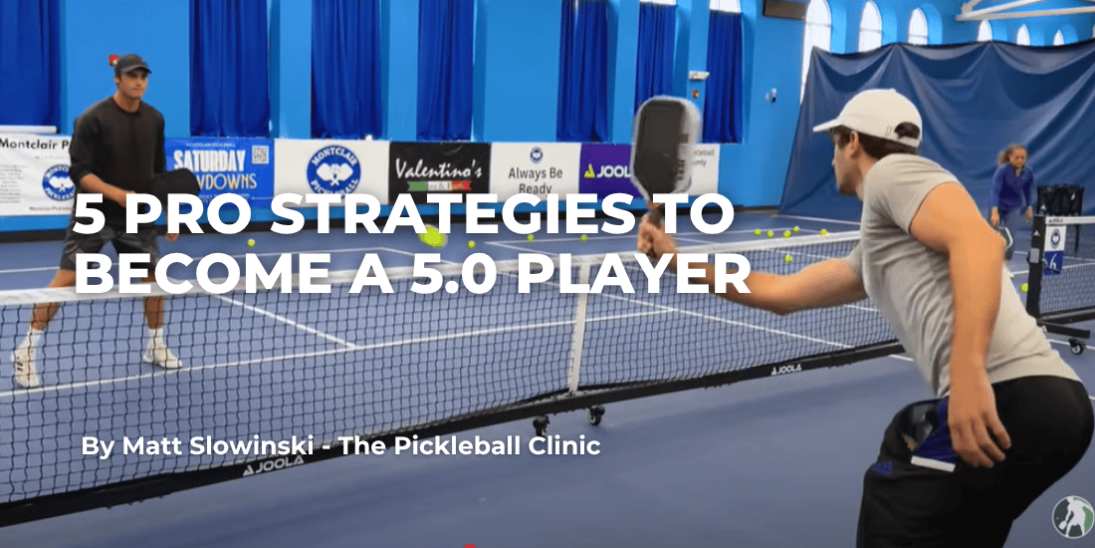 What you can usually do at 5.0
- Third-shot drop, third-shot drive, and hybrid options are all available, and you select correctly
- You can reset even when under stress, not only when fed
- Your dink patterns set up offense rather than just “keeping the ball in.”
- Your speed-ups are precise and repeatable, not random
5.5+: Expert Pro (results-based tier)
USA Pickleball lists 5.5+ as “Expert Pro.”
At this stage, descriptive checklists begin to overlap heavily with competitive outcomes. Players at 5.5+ typically demonstrate dominance against 5.0 fields and show high-level consistency in tournament environments.What “6.0+” usually means in real life
You will hear “6.0” in some clubs and regions, but many standardized public matrices effectively top out at 5.5+. When people say 6.0+, they typically mean “pro-caliber” or “elite open” performance. Treat it as an informal label unless your organization has an explicit internal definition.
Skill level quiz (SportsEdTV version): 12 questions that place you accurately
Score each question 0–2:
- 0 = rarely
- 1 = sometimes
- 2 = most of the time under real points
- I can serve in with a reliable, repeatable motion (not necessarily hard).
- My return is deep enough to reduce the opponent’s third-shot advantage.
- I can dink crosscourt without popping up frequently.
- I can dink straight ahead with control (not drifting high).
- I can execute a third-shot drop well enough to move forward behind it.
- If my third-shot drop fails, I can reset the next ball and keep the point alive.
- When opponents speed up at my body, I can block with control (not just react).
- I speed up only attackable balls (below net height or clearly in my strike zone).
- I can win points by moving opponents with placement, not only by pace.
- I can hold the NVZ line with my partner (spacing and discipline) for extended rallies.
- I can adjust tactics mid-game (target selection, tempo, formation, patterns).
- In close games, my unforced errors stay low.
Interpreting your total (24 max)
- 0–6: 2.0–2.5 range (new/early beginner; focus on contact + rules)
- 7–12: 3.0 range (advanced beginner; focus on depth + NVZ movement + basic dink control)
- 13–16: 3.5 range (intermediate; focus on drops, resets, disciplined speed-ups)
- 17–20: 4.0–4.5 range (advanced; focus on transition mastery, pace absorption, adaptation)
- 21–24: 5.0–5.5+ range (expert; focus on precision, selection, and competitive execution)
If you want a formal cross-check, USA Pickleball also offers a self-assessment questionnaire that generates a skill level score.
How to use this guide at your club (and prevent the usual chaos)
For open play that runs smoothly:
- Use bands: 2.5–3.0, 3.0–3.5, 3.5–4.0, 4.0–4.5, 4.5+.
- Define the band by two divider skills:
- Can you hold the NVZ without gifting pop-ups?
- Can you get to the NVZ with a functional third-shot plan?
Those two items reduce mismatches faster than any argument about labels.
For players who want a number that updates with results:
- Use DUPR (or your preferred match-based system), log matches consistently, and treat the output as a dynamic rating rather than a static identity.

Pickleball skill levels are not identities or opinions; they are descriptive benchmarks designed to organize play, guide development, and reduce mismatches. When used correctly, USA Pickleball’s skill levels provide a common language grounded in repeatable on-court behaviors—serve-and-return reliability, control of the non-volley zone, third-shot effectiveness, transition skills, and decision-making under pressure. Players progress not by chasing labels, but by mastering the specific “divider skills” that separate one level from the next. Treat the level as a tool, not a judgment, and the pathway forward becomes clear.