Introduction: The Master of Sport Weightlifter
The Master of Sport (MS) athlete is a weightlifter who is the equivalent of a full-time professional. Master of Sport is considered the lowest stage of the High Mastery category. Because of the number of times training per day, the time devoted to pre-workout and post-workout restoration, as well as the numerous feedings that are an absolute necessity, a Master of Sport weightlifter will not have enough time, nor energy, to work for a living.
In many countries, this support is provided by the government through the national Olympic Committee. In some cases, a wealthy benefactor can provide support for a promising, talented lifter. Still, in many sports and many countries, financial support comes from parents and family.
For an athlete to reach this level, he or she should regularly be placing in the top three in the weight class at national and/or continental championships. It is not uncommon for national junior and youth records to have been set by Master of Sport athletes. Master lifters may also frequently be named to junior and youth world championship teams. They are essentially waiting to move forward and take their places as national senior champions and members of senior world national teams and Olympic teams. It should not need to be said, but athletes who reach this point have considerable talent in the sport.

Introduction: The Master of Sport Weightlifter
The Master of Sport (MS) athlete is a weightlifter who is the equivalent of a full-time professional. Master of Sport is considered the lowest stage of the High Mastery category. Because of the number of times training per day, the time devoted to pre-workout and post-workout restoration, as well as the numerous feedings that are an absolute necessity, a Master of Sport weightlifter will not have enough time, nor energy, to work for a living.
In many countries, this support is provided by the government through the national Olympic Committee. In some cases, a wealthy benefactor can provide support for a promising, talented lifter. Still, in many sports and many countries, financial support comes from parents and family.
For an athlete to reach this level, he or she should regularly be placing in the top three in the weight class at national and/or continental championships. It is not uncommon for national junior and youth records to have been set by Master of Sport athletes. Master lifters may also frequently be named to junior and youth world championship teams. They are essentially waiting to move forward and take their places as national senior champions and members of senior world national teams and Olympic teams. It should not need to be said, but athletes who reach this point have considerable talent in the sport.
Master of Sport Qualification Totals for Men
Male weightlifters who have achieved the following totals are considered Masters of Sport:
| Weight Class (kg) |
60 |
65 |
71 |
79 |
88 |
94 |
110 |
+110 |
| Total (kg) |
210 |
225 |
255 |
285 |
307 |
314 |
325 |
330 |
Table 1. Master of Sport qualification totals for men
Master of Sport Qualification Totals for Women
Female weightlifters who have achieved the following totals are considered Masters of Sport:
| Weight Class (kg) |
48 |
53 |
58 |
63 |
69 |
77 |
86 |
+86 |
| Total (kg) |
130 |
140 |
150 |
160 |
170 |
180 |
190 |
200 |
Table 2. Master of Sport qualification totals for women

Technical and Physical Characteristics of a Master of Sport
Athletes in this class should have excellent technique and speed characteristics. They should have the genetics to proceed further without significant injuries or nagging injuries that will interfere with or inhibit training. It is during this stage of development that these factors will begin to influence the progression of the athletic career.
Exercise Selection for the Master of Sport Class
The exercises to be employed are the same as those used for the Candidate for Master of Sport class. They are more geared toward developing strength in an individual who has been trained to be balanced for the execution of the snatch and clean & jerk.
There will be fewer pulling movements performed from the various hang heights and from blocks. There will be very few partial movements unless the athlete is recovering from an injury. The proportion of classical lifts and their derivatives to strength-building exercises will vary considerably between the preparation mesocycles and the pre-competition mesocycles.
The loading will be the primary variant rather than the exercise choices. Some of these exercises will be employed only in the event of a need for remediation and then will be discontinued once the weakness is brought into balance. Again, the variety of exercises will diminish as the competition draws near.
On blocks means the lifter is standing on a block that places the instep very nearly touching the bar at the starting position. Off blocks means that the bar is resting on blocks that elevate it off the floor prior to the start of each repetition.
- Snatch (from the hang, on blocks, off blocks)
- Clean & Jerk
- Cleans (from the hang, on blocks, off blocks)
- Jerk off Rack
- Power Snatch (from the hang, on blocks, off blocks)
- Power Clean (from the hang, on blocks, off blocks)
- Power Jerk
- Snatch Pull (or Extension, on blocks, off blocks)
- Clean Pull (or Extension, on blocks, off blocks)
- Snatch Deadlift (Halting, Slow and Eccentric, on blocks)
- Clean Deadlift (Halting, Slow and Eccentric, on blocks)
- Romanian Deadlift (may be on blocks)
- Back Squat (Halting, Slow, and Eccentric)
- Front Squat (Halting, Slow, and Eccentric)
- Push Press
- Press (Standing, Seated, or Supine)
- Good Mornings
- Overhead Squat

Yearly Loading Parameters for a Master of Sport Weightlifter
At this point, it is important for the coach to recognize that weightlifters who have achieved Master of Sport status are talented individuals who have demonstrated a drive and intensity that have placed them at this point in their careers. They are susceptible to certain training trends reflected in the figures in this section, yet they are individuals with different combinations of abilities and aptitudes that must be considered in planning training.
A common error among newer coaches is trying to adhere too closely to the prescribed numbers. One must keep in mind that the numbers presented are empirically derived from the training of experienced, talented weightlifters. They do not, however, cover all individuals a coach might encounter, especially in a professional situation. This is why it is important for younger coaches to consult regularly with veteran coaches.
The annual volume for a Master of Sport weightlifter can range from 16,000 to as high as 21,000 repetitions. The number of repetitions in the 90–100% zone for snatch and clean & jerk exercises can range from 300 to 600 repetitions. In this calculation, the cleans and jerks are counted separately.
When determining the actual volume, the athlete's restoration capacity must be taken into consideration. The lighter and younger the athlete, the greater the volume that can be accommodated. For talented, light, and young athletes, the volume can range in the higher numbers, while for older, heavier athletes, the volume will be considerably lower.
The relative intensity in the Snatch and Clean & Jerk exercises should be in the 73% to 77% range. These exercises include snatches, power snatches, cleans, jerks, power cleans, and power jerks. The majority of power snatch, power clean, and power jerk exercises will fall within the 60% to 80% zones and thus will lower the average intensity.
Stage 1 and Stage 2 Masters of Sport
Master of Sport can be further divided into two stages. There is a minimum level of attainment, followed by a second stage for those who have placed from 3rd to 10th in the Republic Championships. Since placings are relative designations, the coach may simply divide the range between Master of Sport and International Master of Sport in half to determine the cutoff between Stage 1 and Stage 2.
The average volume for a four-week preparation mesocycle for Stage 1 Masters should average 1,900 repetitions, while the four-week pre-competition mesocycle should average 1,330 repetitions. Stage 2 Masters should average 2,280 repetitions for a four-week preparation mesocycle and 1,410 repetitions for a four-week pre-competition mesocycle.
The maximum number of hours per week spent in training should be in the 30 to 32-hour range.
Distribution of Yearly Volume by Intensity Zone
The percentages below represent the annual volume for the designated exercise group. These are guideline numbers proven to be effective and may be modified by a skillful coach depending on the individual athlete’s situation.
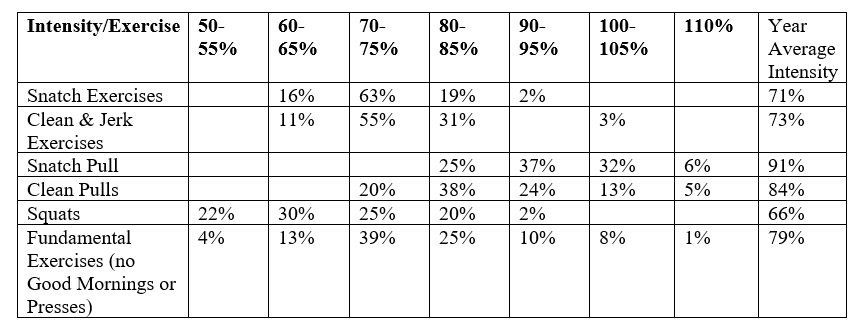
Table 3. Distribution of annual volume by intensity zones
Exercise Group Definitions
The Snatch exercises include all snatches and power snatches.
Clean & Jerk exercises include all cleans, power cleans, jerks, and power jerks.
The Fundamental Exercises include all exercises in Groups 1–10 as listed in Chapter 8.
Calculations and Peaking Structure for Master Athletes
For Master Athletes, it is advisable to schedule the major peak after three four-week preparation mesocycles followed by a four-week pre-competition mesocycle. This means that the weekly volumes must be varied during the preparation phase so they do not fall into a regular pattern and can build to a high-volume point that sufficiently taxes the endocrine system.
The percentage of the 1,900 repetitions of the preparation mesocycle and the 1,330 repetitions of the pre-competition mesocycle given over to the four weeks are 30%, 27%, 23%, and 20% in any order.
Weekly Volumes by Mesocycle
Preparation Month 1
| |
Week 1 |
Week 2 |
Week 3 |
Week 4 |
| Volume |
570 |
380 |
513 |
437 |
Preparation Month 2
| |
Week 5 |
Week 6 |
Week 7 |
Week 8 |
| Volume |
570 |
513 |
380 |
437 |
Preparation Month 3
| |
Week 9 |
Week 10 |
Week 11 |
Week 12 |
| Volume |
570 |
437 |
513 |
380 |
Pre-Competition Month
| |
Week 13 |
Week 14 |
Week 15 |
Week 16 |
| Volume |
399 |
359 |
305 |
266 |
Table 4. Weekly volume distribution for the 16-week structure
Tapering Week
A 17th tapering week should precede the competition. The volume should be approximately 150 repetitions. This creates a 17-week macrocycle.
The data from Table 4 is represented in Chart 1.
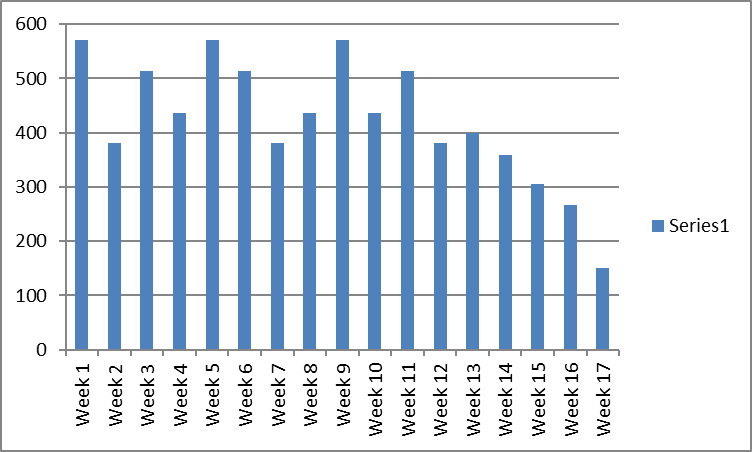
Chart 1. Master of Sport Weekly Volumes
| Week |
1 |
2 |
3 |
4 |
5 |
6 |
7 |
8 |
9 |
10 |
11 |
12 |
13 |
14 |
15 |
16 |
17 |
| No. of Training Days |
6 |
4 |
6 |
5 |
6 |
6 |
4 |
5 |
6 |
5 |
6 |
4 |
5 |
4 |
4 |
4 |
3 |
Table 5. Number of training days per week across the 17-week macrocycle
Daily Volume for a 17-Week Macrocycle for a Master of Sport Weightlifter
| Week |
Day |
Week Volume |
Daily % |
Daily Volume |
| Week 1 |
Day 1 |
570 |
26% |
148 |
| |
Day 2 |
|
11% |
63 |
| |
Day 3 |
|
19% |
108 |
| |
Day 4 |
|
11% |
63 |
| |
Day 5 |
|
22% |
125 |
| |
Day 6 |
|
11% |
63 |
| |
Day 7 |
|
0% |
0 |
| Week 2 |
Day 8 |
380 |
35% |
133 |
| |
Day 9 |
|
15% |
57 |
| |
Day 10 |
|
0% |
0 |
| |
Day 11 |
|
28% |
106 |
| |
Day 12 |
|
0% |
0 |
| |
Day 13 |
|
22% |
84 |
| |
Day 14 |
|
0% |
0 |
| Week 3 |
Day 15 |
513 |
26% |
133 |
| |
Day 16 |
|
11% |
56 |
| |
Day 17 |
|
19% |
97 |
| |
Day 18 |
|
11% |
56 |
| |
Day 19 |
|
22% |
113 |
| |
Day 20 |
|
11% |
56 |
| |
Day 21 |
|
0% |
0 |
| Week 4 |
Day 22 |
437 |
30% |
131 |
| |
Day 23 |
|
13% |
57 |
| |
Day 24 |
|
0% |
0 |
| |
Day 25 |
|
15% |
66 |
| |
Day 26 |
|
27% |
118 |
| |
Day 27 |
|
15% |
66 |
| |
Day 28 |
|
0% |
0 |
| Week 5 |
Day 29 |
570 |
26% |
148 |
| |
Day 30 |
|
11% |
63 |
| |
Day 31 |
|
19% |
108 |
| |
Day 32 |
|
11% |
63 |
| |
Day 33 |
|
22% |
125 |
| |
Day 34 |
|
11% |
63 |
| |
Day 35 |
|
0% |
0 |
| Week 6 |
Day 36 |
513 |
26% |
133 |
| |
Day 37 |
|
11% |
56 |
| |
Day 38 |
|
22% |
113 |
| |
Day 39 |
|
11% |
56 |
| |
Day 40 |
|
19% |
97 |
| |
Day 41 |
|
11% |
56 |
| |
Day 42 |
|
0% |
0 |
| Week 7 |
Day 43 |
380 |
35% |
133 |
| |
Day 44 |
|
15% |
57 |
| |
Day 45 |
|
0% |
0 |
| |
Day 46 |
|
28% |
106 |
| |
Day 47 |
|
0% |
0 |
| |
Day 48 |
|
22% |
84 |
| |
Day 49 |
|
0% |
0 |
| Week 8 |
Day 50 |
437 |
30% |
131 |
| |
Day 51 |
|
15% |
66 |
| |
Day 52 |
|
0% |
0 |
| |
Day 53 |
|
27% |
118 |
| |
Day 54 |
|
15% |
66 |
| |
Day 55 |
|
15% |
66 |
| |
Day 56 |
|
0% |
0 |
| Week 9 |
Day 57 |
570 |
26% |
148 |
| |
Day 58 |
|
11% |
63 |
| |
Day 59 |
|
22% |
125 |
| |
Day 60 |
|
11% |
63 |
| |
Day 61 |
|
19% |
108 |
| |
Day 62 |
|
11% |
63 |
| |
Day 63 |
|
0% |
0 |
| Week 10 |
Day 64 |
437 |
30% |
131 |
| |
Day 65 |
|
13% |
57 |
| |
Day 66 |
|
0% |
0 |
| |
Day 67 |
|
27% |
118 |
| |
Day 68 |
|
15% |
66 |
| |
Day 69 |
|
15% |
66 |
| |
Day 70 |
|
0% |
0 |
| Week 11 |
Day 71 |
513 |
26% |
133 |
| |
Day 72 |
|
11% |
56 |
| |
Day 73 |
|
19% |
97 |
| |
Day 74 |
|
11% |
56 |
| |
Day 75 |
|
22% |
113 |
| |
Day 76 |
|
11% |
56 |
| |
Day 77 |
|
0% |
0 |
| Week 12 |
Day 78 |
380 |
35% |
133 |
| |
Day 79 |
|
15% |
57 |
| |
Day 80 |
|
0% |
0 |
| |
Day 81 |
|
28% |
106 |
| |
Day 82 |
|
0% |
0 |
| |
Day 83 |
|
22% |
84 |
| |
Day 84 |
|
0% |
0 |
| Week 13 |
Day 85 |
399 |
30% |
120 |
| |
Day 86 |
|
13% |
52 |
| |
Day 87 |
|
0% |
0 |
| |
Day 88 |
|
27% |
108 |
| |
Day 89 |
|
15% |
60 |
| |
Day 90 |
|
15% |
60 |
| |
Day 91 |
|
0% |
0 |
| Week 14 |
Day 92 |
359 |
35% |
126 |
| |
Day 93 |
|
15% |
54 |
| |
Day 94 |
|
0% |
0 |
| |
Day 95 |
|
28% |
101 |
| |
Day 96 |
|
0% |
0 |
| |
Day 97 |
|
22% |
79 |
| |
Day 98 |
|
0% |
0 |
| Week 15 |
Day 99 |
305 |
35% |
107 |
| |
Day 100 |
|
15% |
46 |
| |
Day 101 |
|
0% |
0 |
| |
Day 102 |
|
28% |
85 |
| |
Day 103 |
|
0% |
0 |
| |
Day 104 |
|
22% |
67 |
| |
Day 105 |
|
0% |
0 |
| Week 16 |
Day 106 |
266 |
35% |
93 |
| |
Day 107 |
|
15% |
40 |
| |
Day 108 |
|
0% |
0 |
| |
Day 109 |
|
28% |
74 |
| |
Day 110 |
|
0% |
0 |
| |
Day 111 |
|
22% |
59 |
| |
Day 112 |
|
0% |
0 |
| Week 17 |
Day 113 |
150 |
42% |
63 |
| |
Day 114 |
|
26% |
39 |
| |
Day 115 |
|
0% |
0 |
| |
Day 116 |
|
32% |
48 |
| |
Day 117 |
|
0% |
0 |
| |
Day 118 |
|
0% |
0 |
| |
Day 119 |
|
0% |
0 |
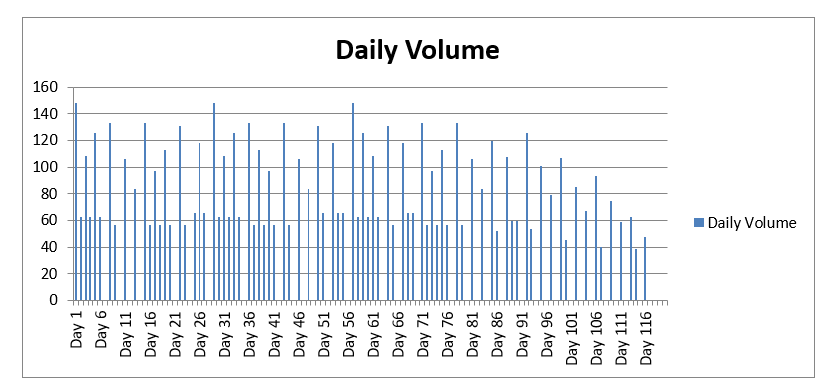
Chart 2 shows the daily volume for a Master of Sport.
Sample Training Program: Master of Sport 17-Week Macrocycle
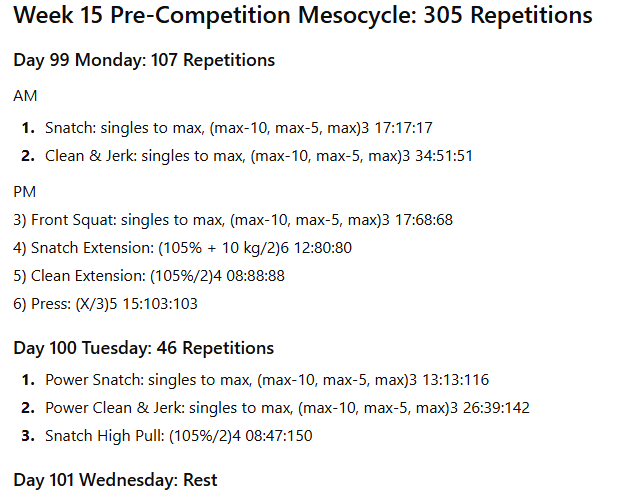
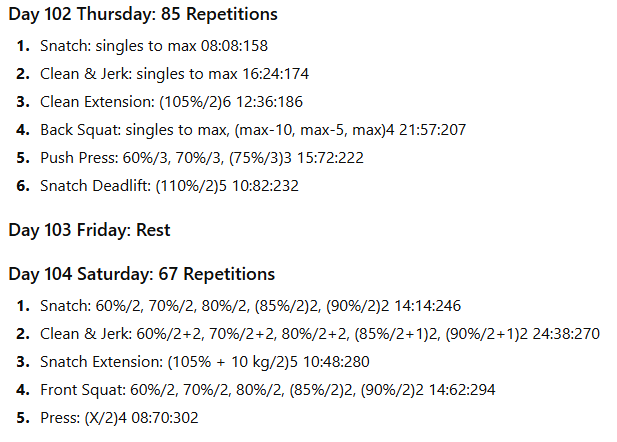
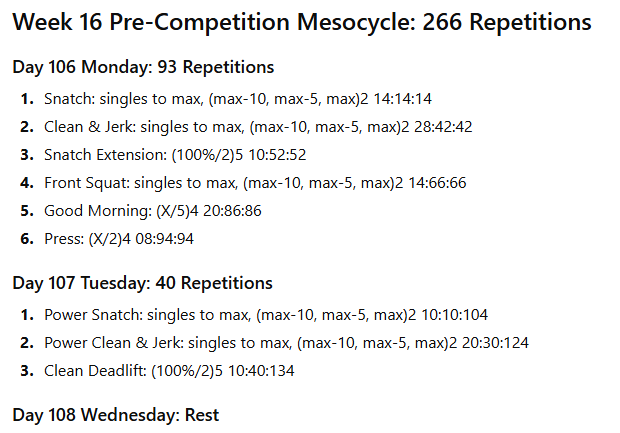
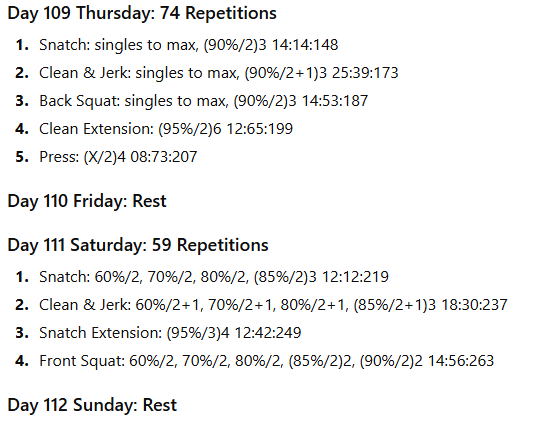
How to Read This Program
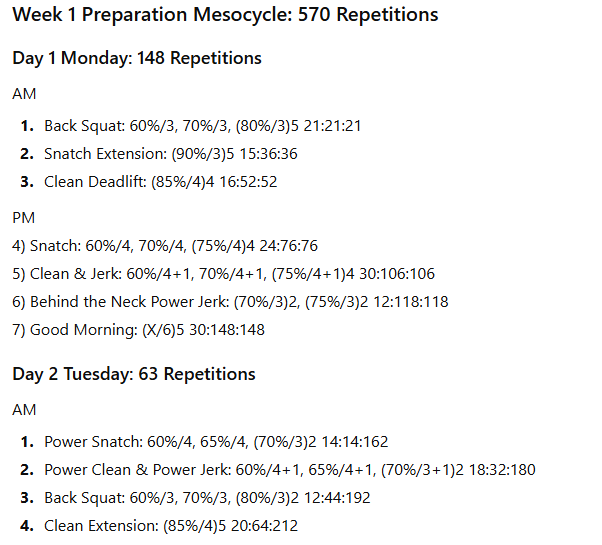
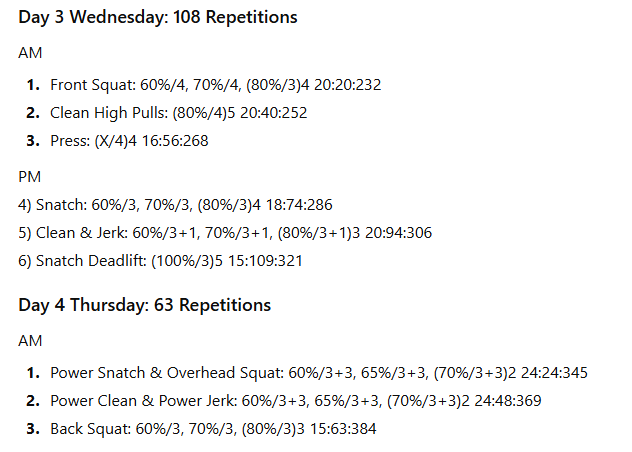
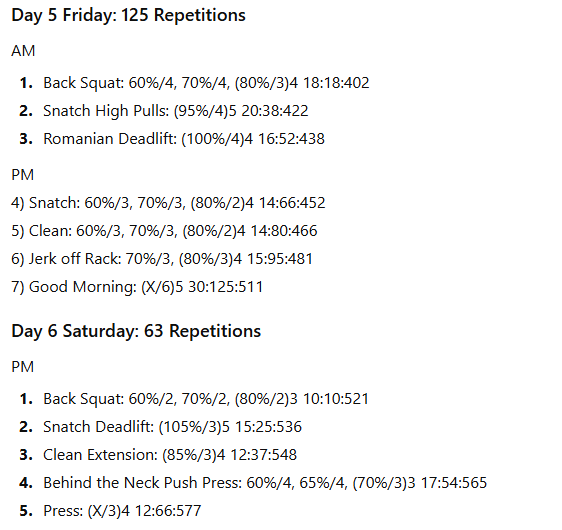
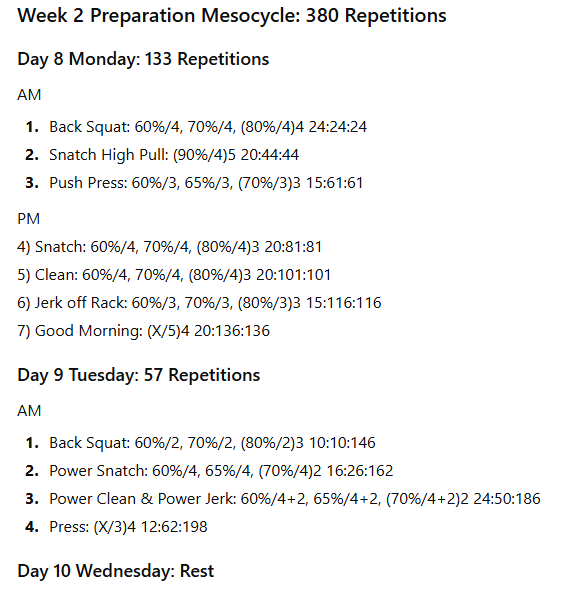
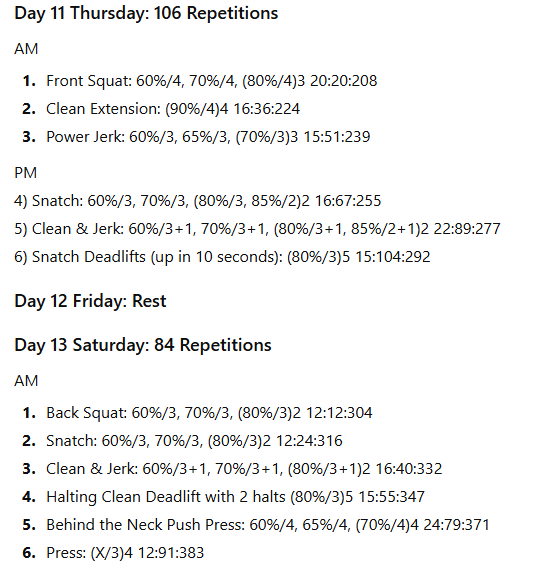
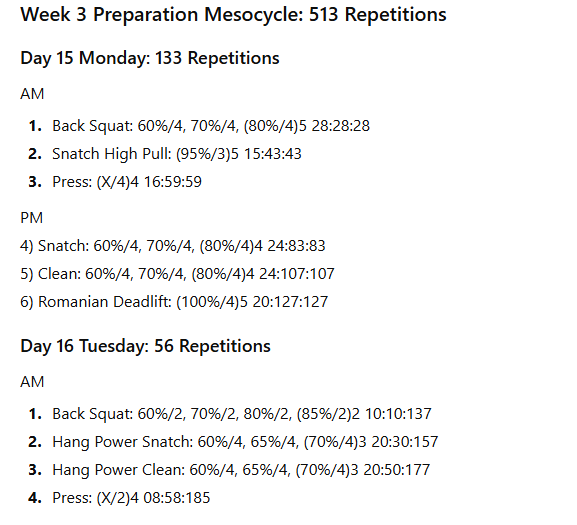
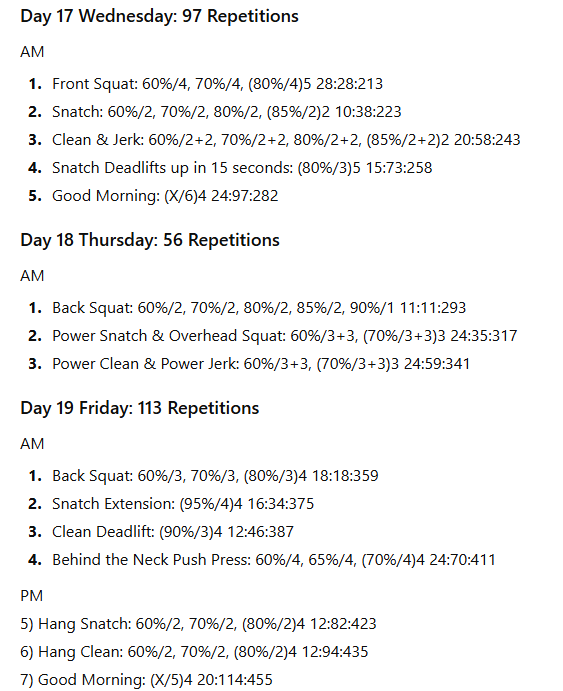
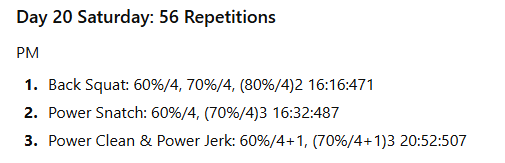
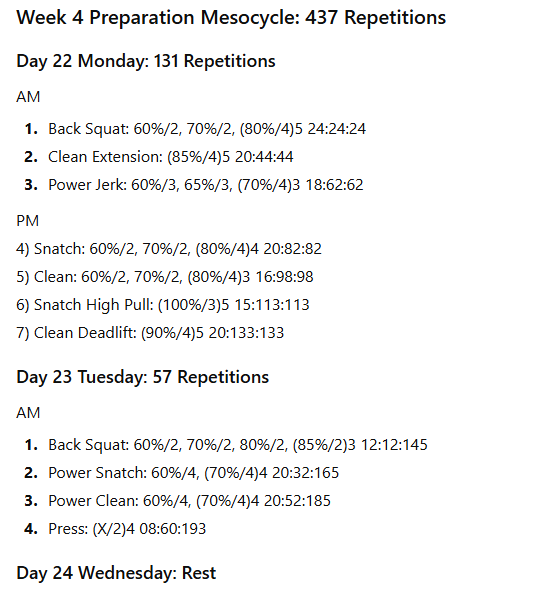
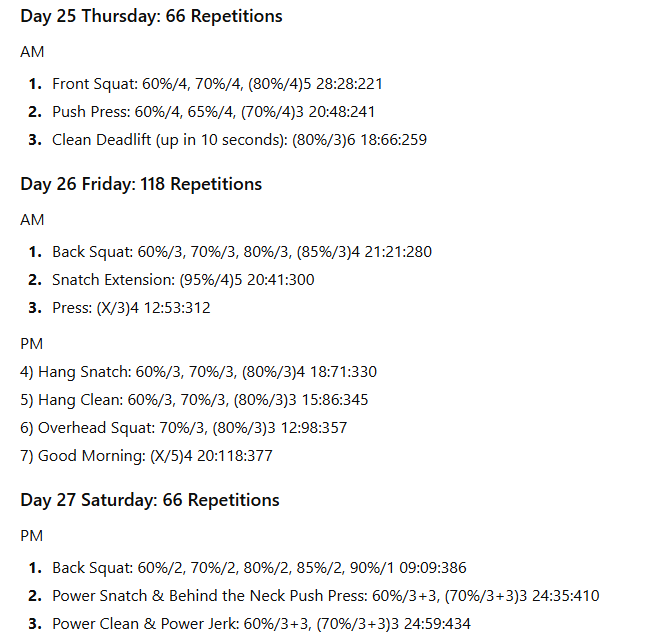
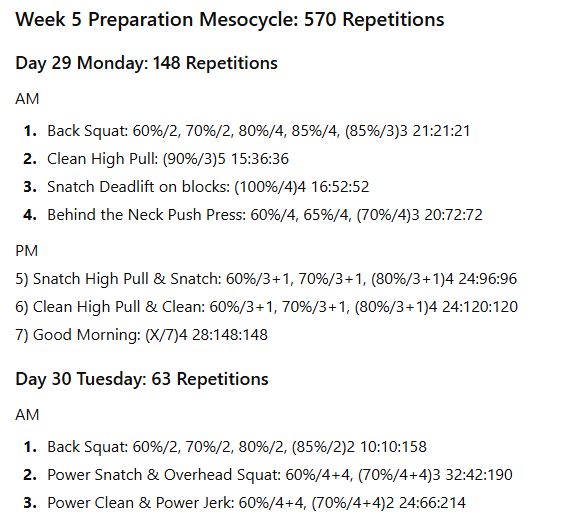
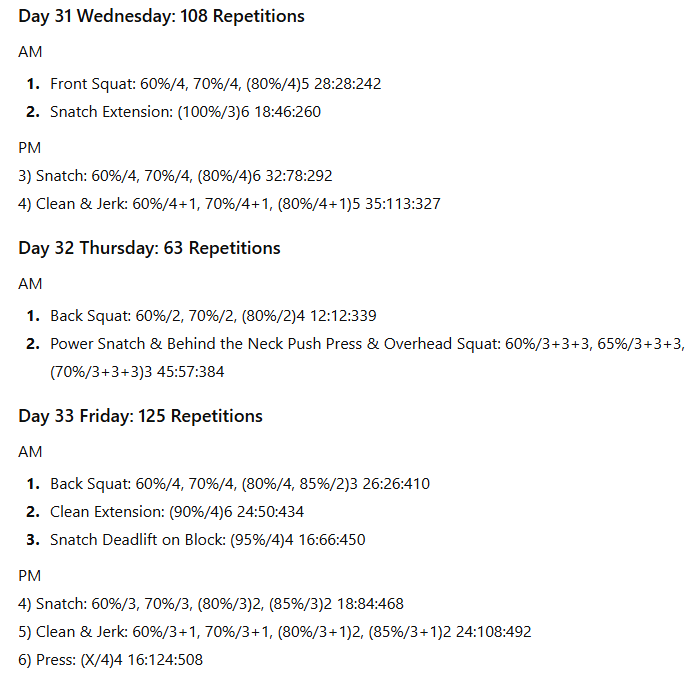
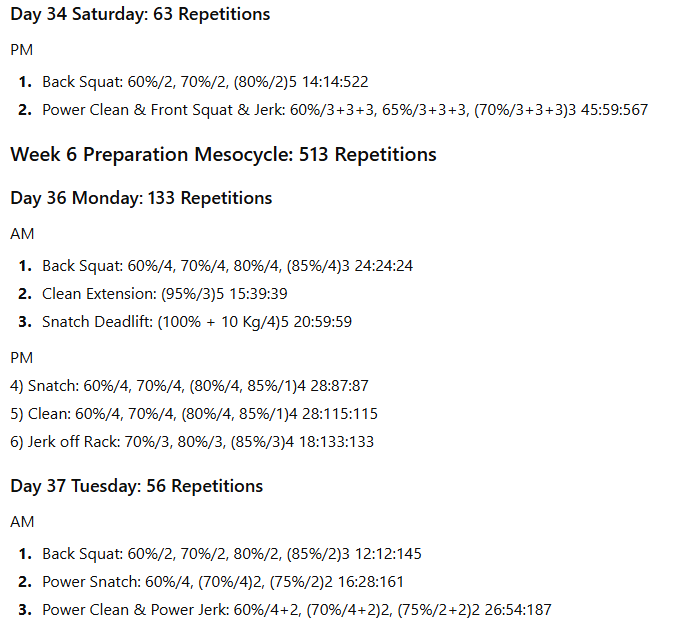
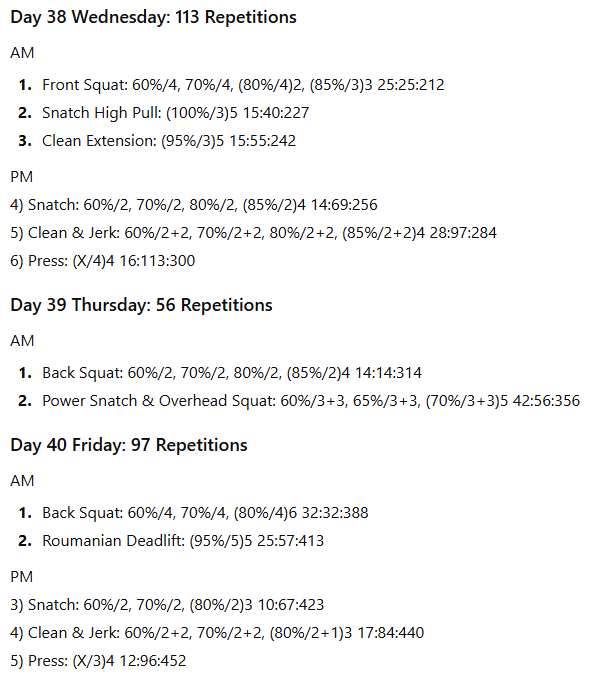
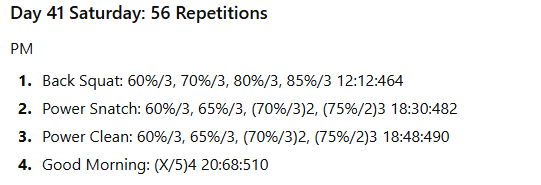
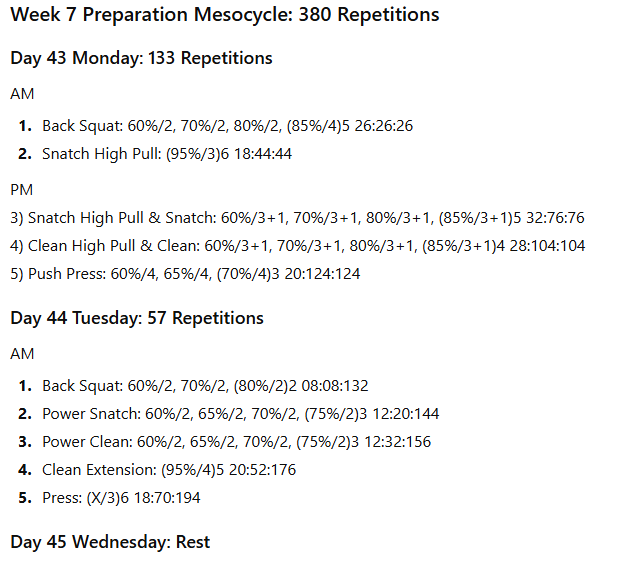
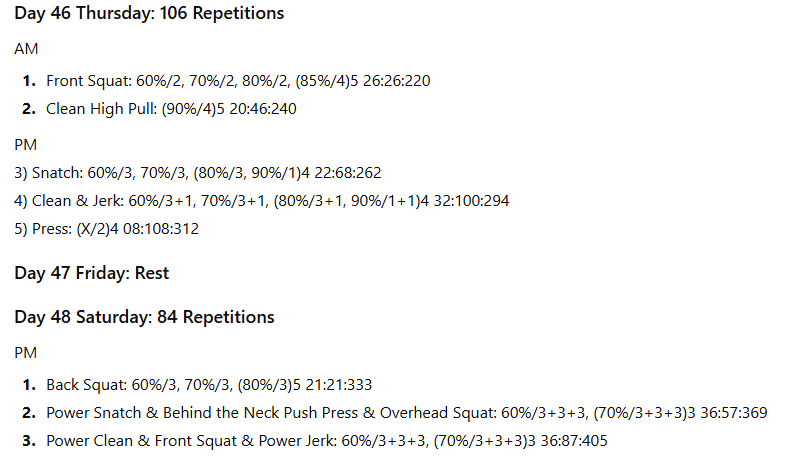
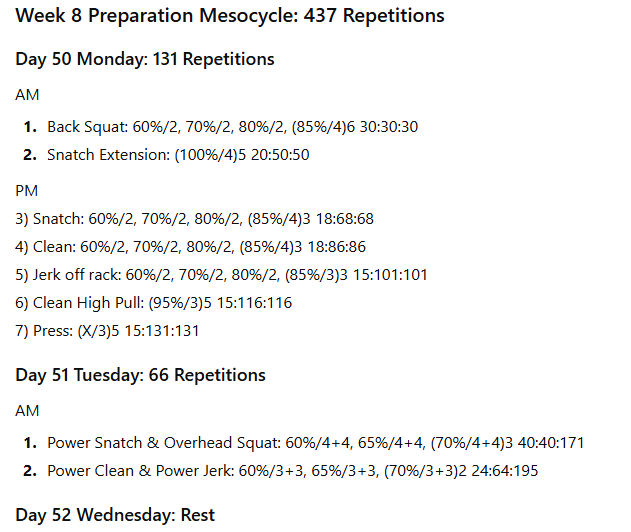
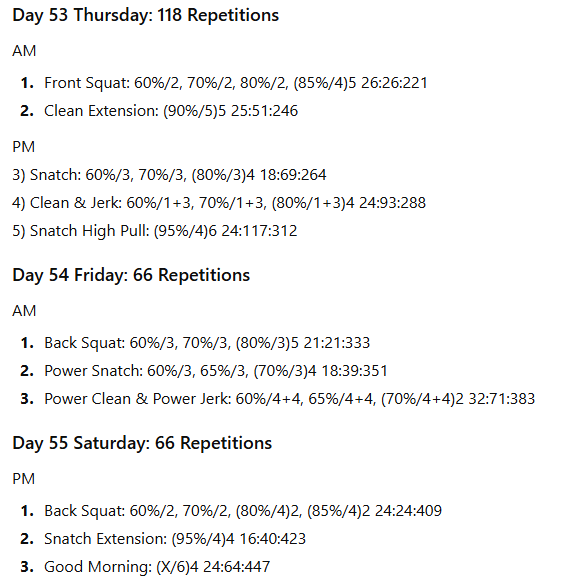
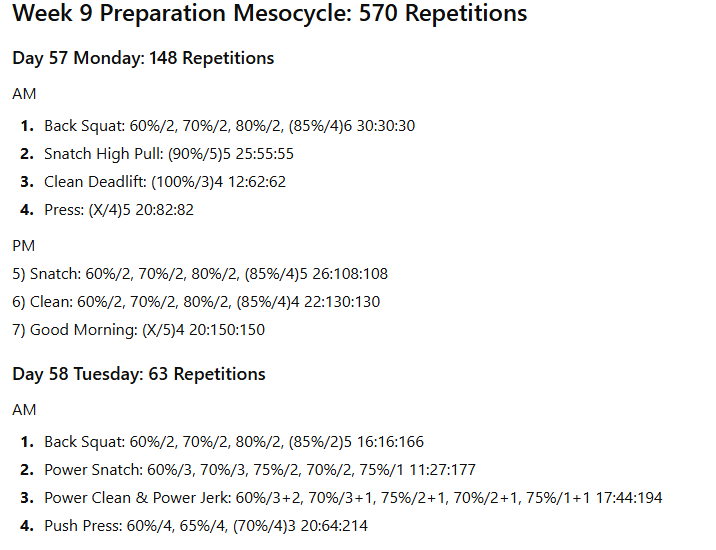
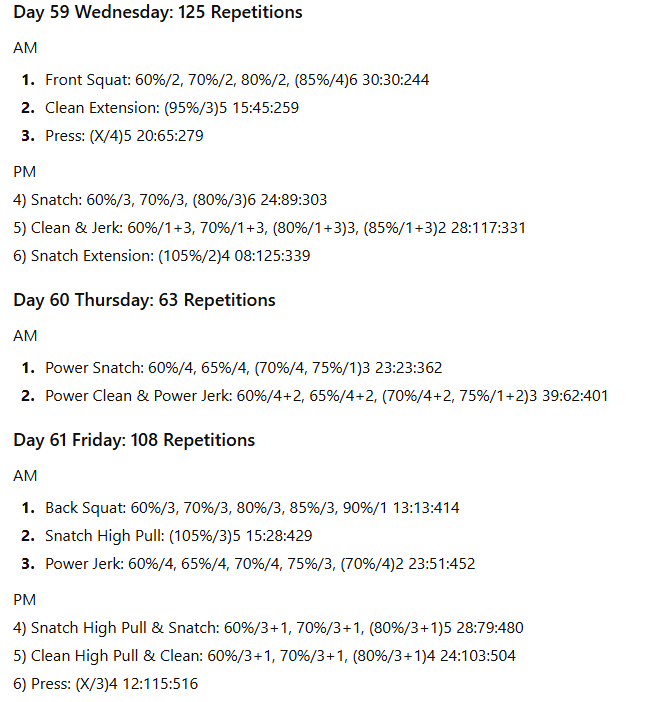
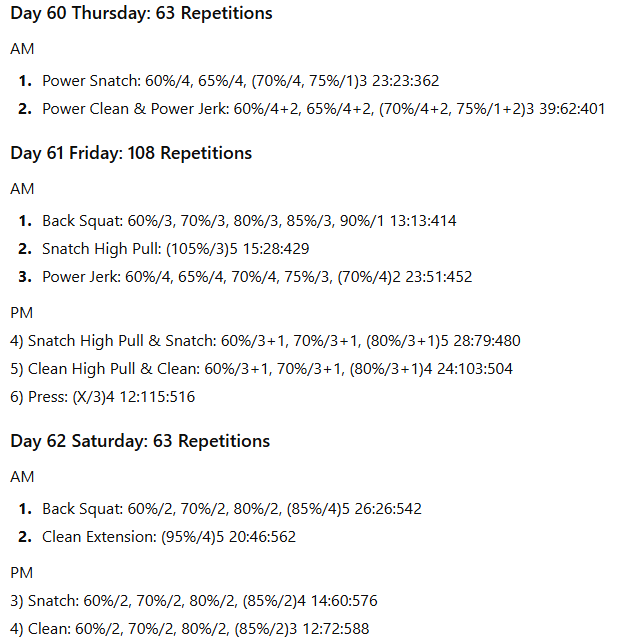
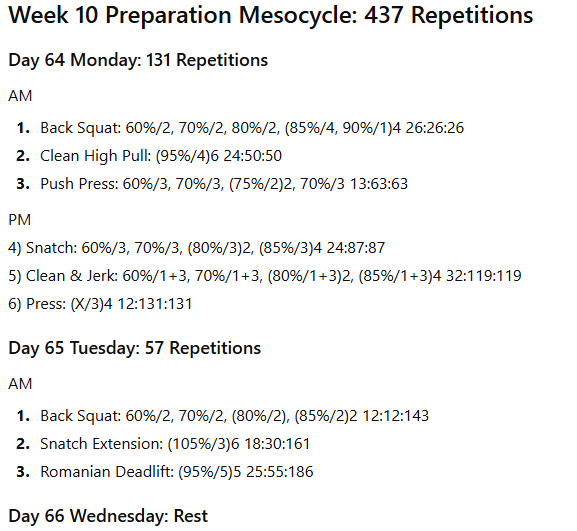
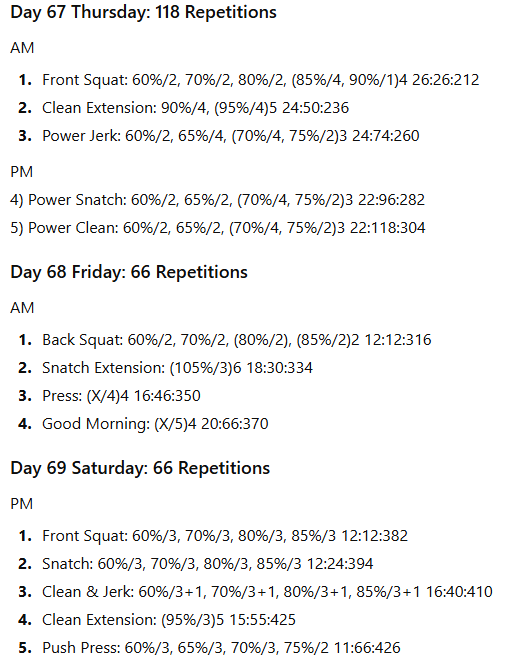
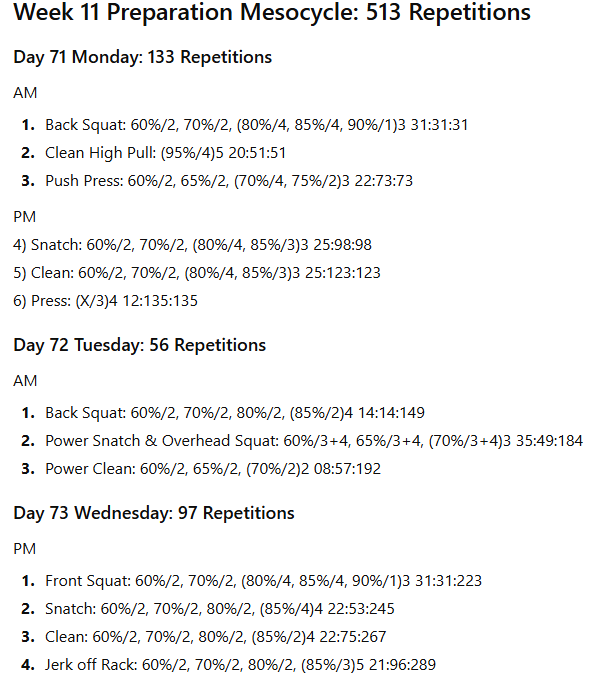
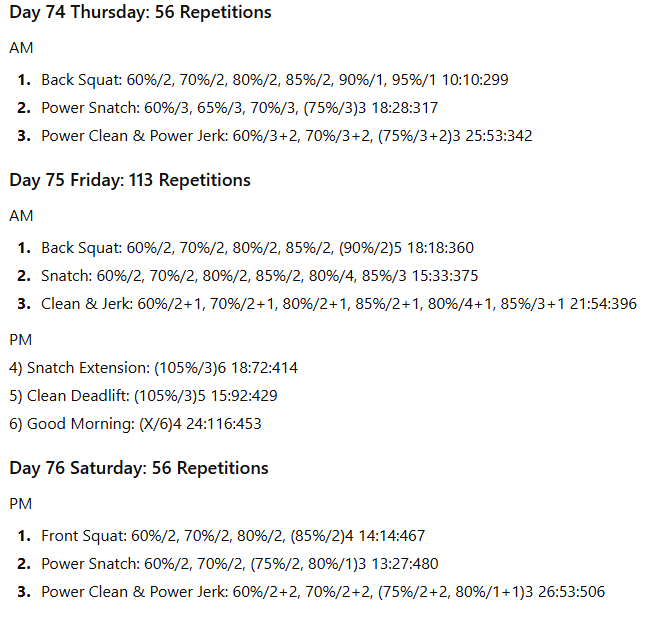
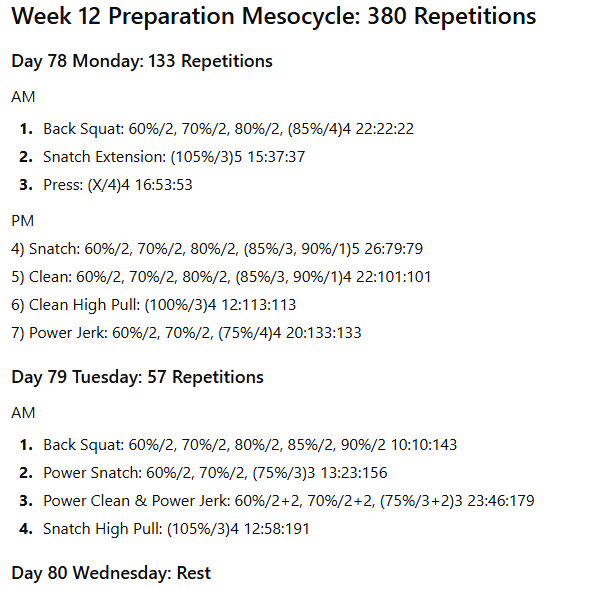
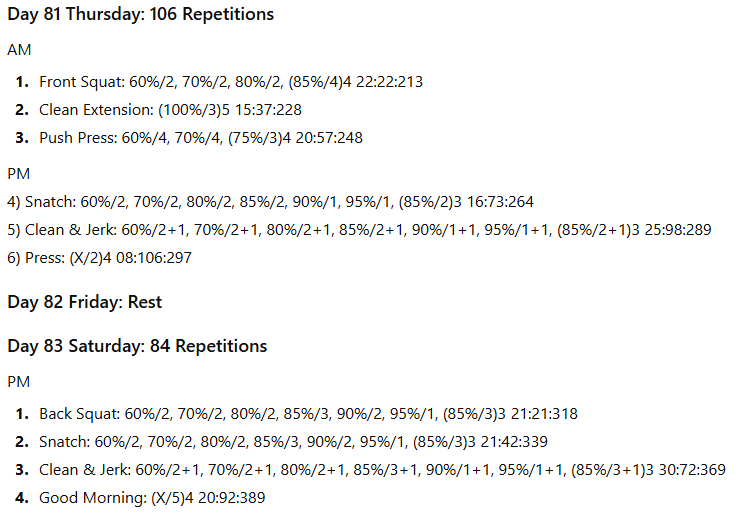
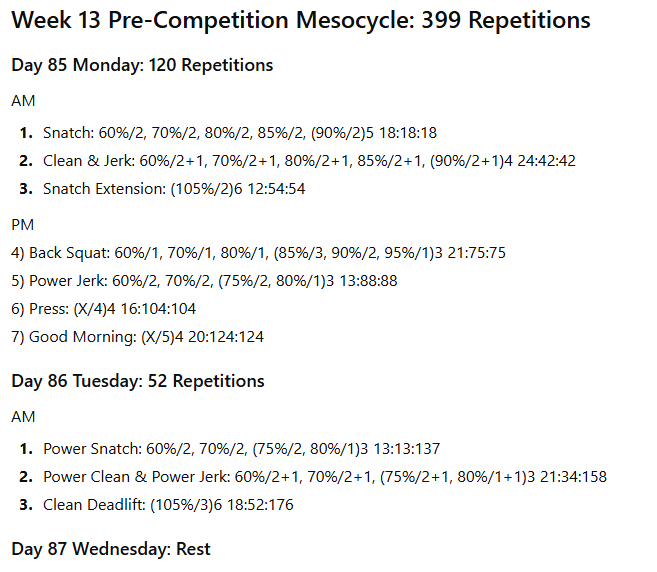
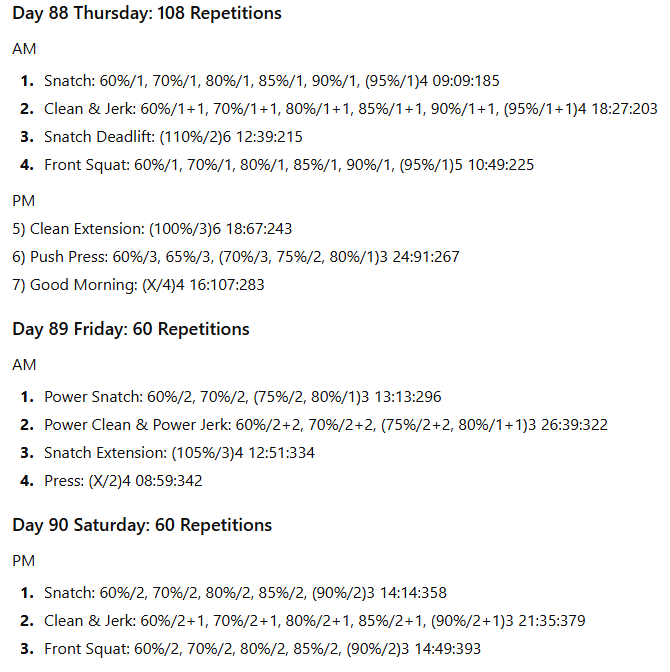
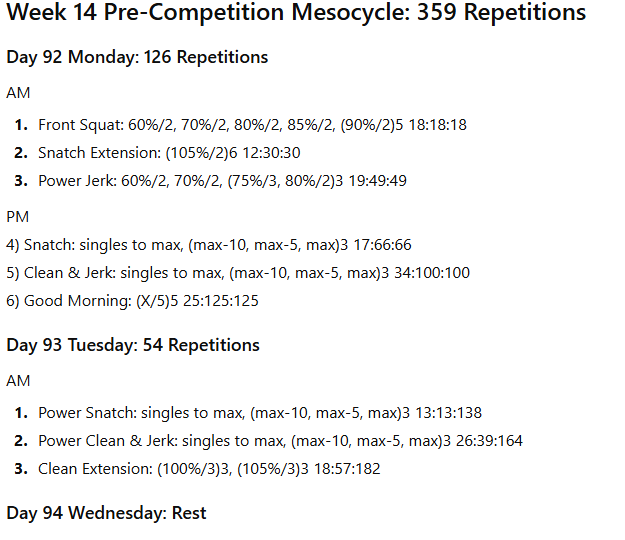
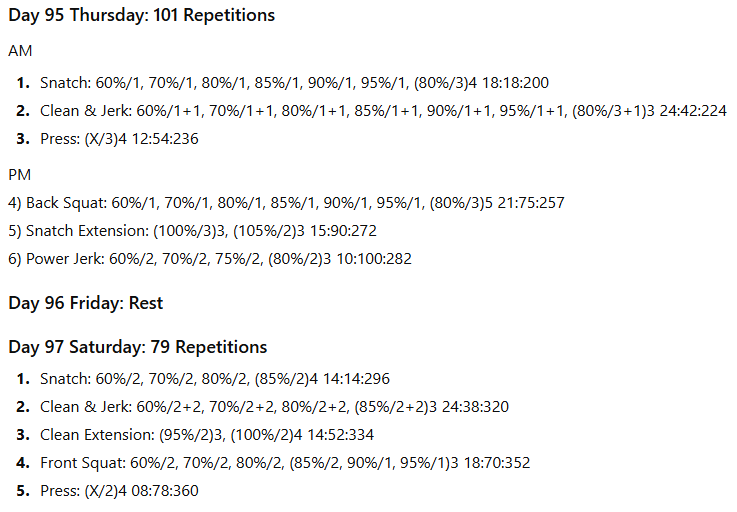
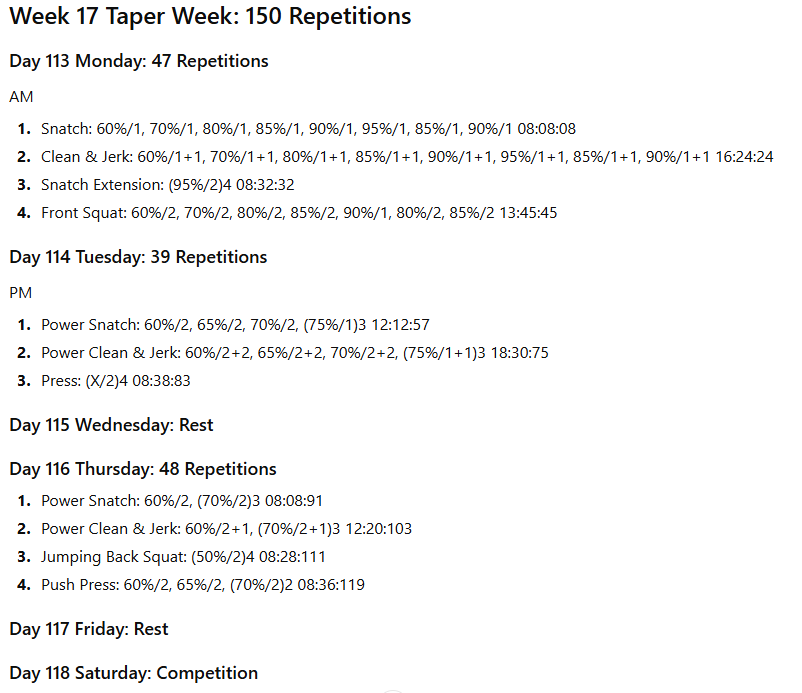
The numbers to the right represent the exercise volume, the daily volume, and the running weekly volume, respectively. On days when the daily volume exceeds 100 repetitions, the training has been divided into two sessions to allow better performance of the lifts in the second session.
The first session should take place in the morning after the athlete has eaten breakfast. The second session should take place in the afternoon after lunch, and possibly after a brief nap. The late afternoon is probably the best time for this training.