What does “Candidate for Master of Sport” means
A Candidate for Master of Sport (CMS) athlete is moving toward either being a lifestyler or a paraprofessional. The training demands, restoration requirements, and feeding needs often make full-time employment either impossible or overly demanding.
A CMS lifter is typically qualified for national-level competition, performs well on the platform, and may already have qualified for minor international competition (especially juniors). They are usually sophisticated in logistics and travel skills for national competitions. CMS is considered the last classification before entering the high mastery stage.
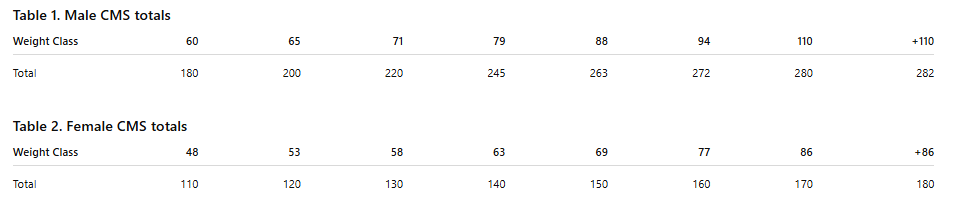
CMS qualifying totals
Performance expectations at CMS level
CMS weightlifters should:
What does “Candidate for Master of Sport” means
A Candidate for Master of Sport (CMS) athlete is moving toward either being a lifestyler or a paraprofessional. The training demands, restoration requirements, and feeding needs often make full-time employment either impossible or overly demanding.
A CMS lifter is typically qualified for national-level competition, performs well on the platform, and may already have qualified for minor international competition (especially juniors). They are usually sophisticated in logistics and travel skills for national competitions. CMS is considered the last classification before entering the high mastery stage.
CMS qualifying totals
Performance expectations at CMS level
CMS weightlifters should:
Talent is often reflected in speed retention during preparation cycles. Lesser athletes show a significant drop in speed qualities during this phase, while talented athletes show a much smaller decline.

Exercise selection
Exercise variety becomes slightly smaller than Class 1, but only to a limited degree. The focus shifts toward strength development in an athlete who is already balanced for executing the snatch and clean & jerk.
Key programming changes vs earlier classes:
-
Fewer pulling movements from varying hang heights and blocks
-
No partial movements
-
The main variant becomes loading, not exercise choice
-
Some remediation exercises may be used temporarily, then removed once balance is restored
CMS Exercise Menu
-
Snatch
-
Clean & Jerk
-
Cleans
-
Jerk off Rack
-
Power Snatch
-
Power Clean
-
Power Jerk
-
Snatch Pull (or Extension)
-
Clean Pull (or Extension)
-
Snatch Deadlift (Halting, Slow and Eccentric)
-
Clean Deadlift (Halting, Slow and Eccentric)
-
Romanian Deadlift (May be on blocks)
-
Back Squat (Halting, Slow and Eccentric)
-
Front Squat (Halting, Slow and Eccentric)
-
Push Press
-
Press
-
Good Mornings
-
Overhead Squat

Yearly loading parameters
These figures represent trends and approaches and may be adjusted for individual circumstances. Ranges are used to allow specific coaching adjustments.
-
Annual volume: 13,000 to 17,000 reps
-
90% to 100% zone (snatch and clean & jerk exercises): 300 to 500 reps
How power variations affect intensity interpretation
The 90% to 100% range for snatch and clean & jerk exercises must be considered in light of the lower potential for power snatches, power cleans, and power jerks.
A working interpretation:
-
If 100% power snatch ≈ 80% classic snatch, then most power snatch reps fall around 65% to 70% of classic snatch
-
A 90% power snatch then approximates 72% of the classic snatch
Including power snatches, power cleans, and power jerks inside the snatch / clean & jerk exercise categories affects:
Annual intensity and lift distribution targets
-
Relative intensity in snatch and clean & jerk exercises: 73% to 75%
-
Snatch lift repetitions: ~21%
-
Clean & jerk lift repetitions: ~17%
-
This is the first class where snatch lifts exceed clean & jerk lifts
-
“Snatch lifts” and “Clean & Jerk lifts” include complete lifts: classic lifts, power snatches, power cleans, and power jerks
Mesocycle volume norms
-
Average four-week preparation mesocycle volume: 1,680
-
Average four-week pre-competition mesocycle volume: 1,072
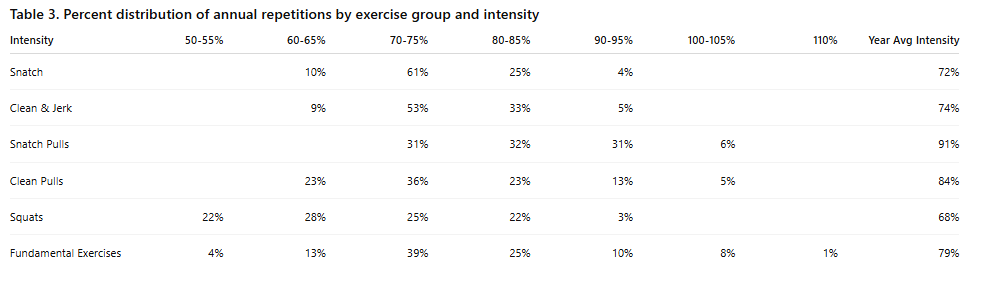
Loading zones: distribution of yearly volume
Notes
-
The snatch category includes power snatches
-
The clean & jerk category includes power cleans and power jerks
-
Squats include front and back squats
-
Fundamental exercises include all movements from groups 1–10 in Chapter 8, excluding presses and good mornings (excluded due to variability vs classic lifts/squats)

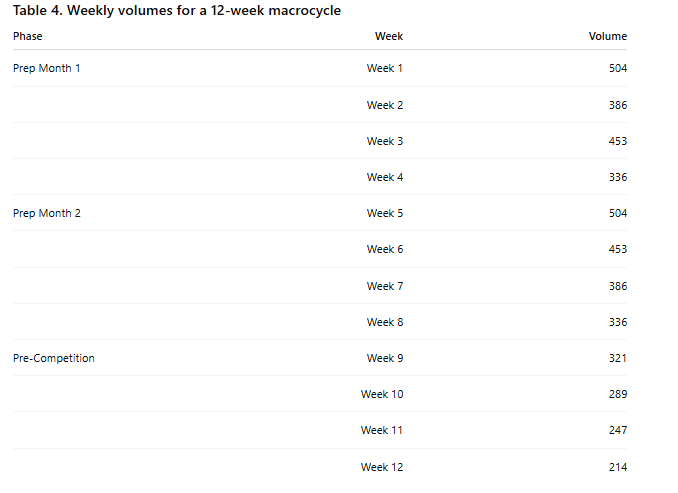
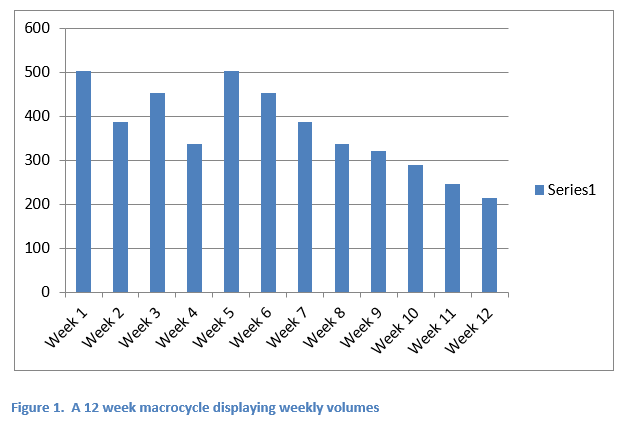
Macrocycle calculations and structure
A workable approach:
-
2 four-week preparation mesocycles
-
Followed by 1 four-week pre-competition mesocycle
-
A transitional week may follow each of the two most important competitions of the year
Mesocycle weekly distribution:
-
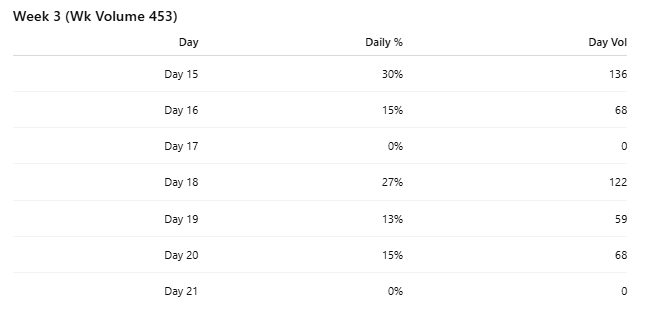
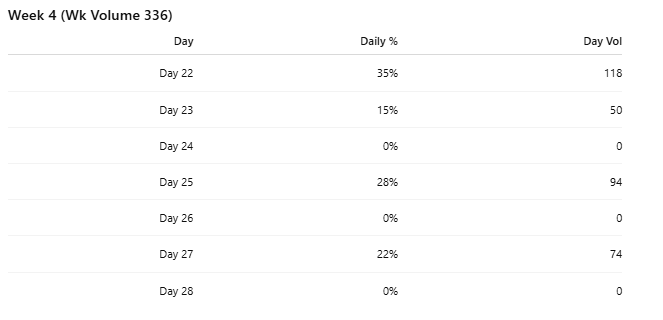
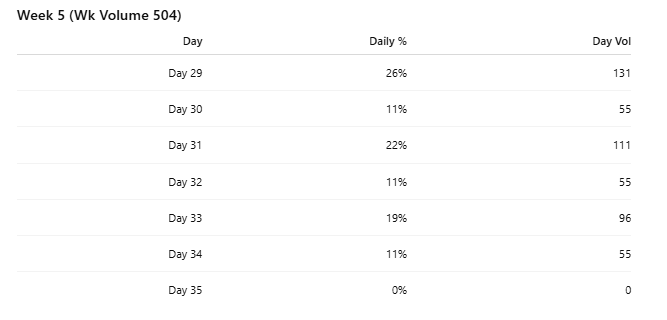
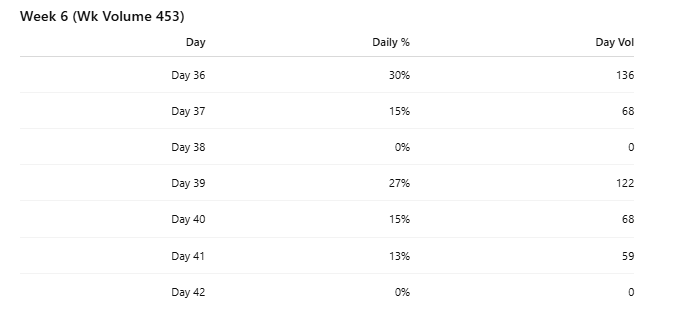
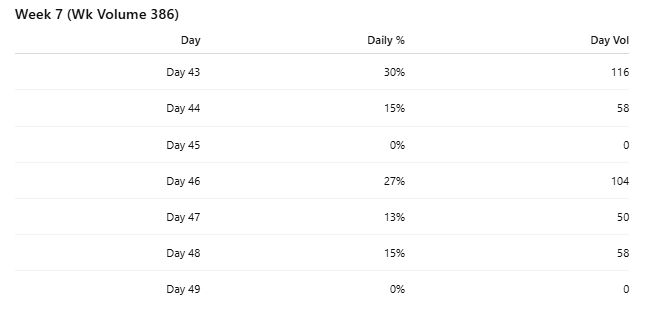
30%, 27%, 23%, 20% across the four weeks (not necessarily in that order)
-
A variance of 2% to 3% is acceptable
Daily volume calculations (by week)
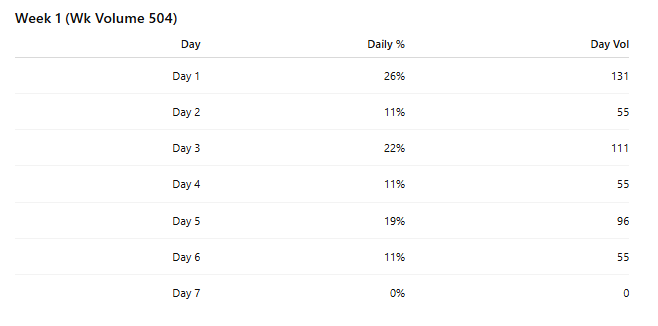
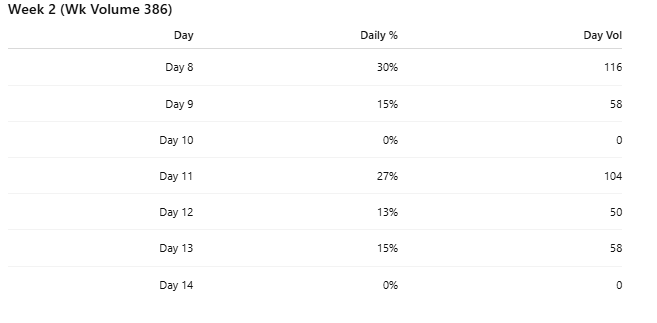
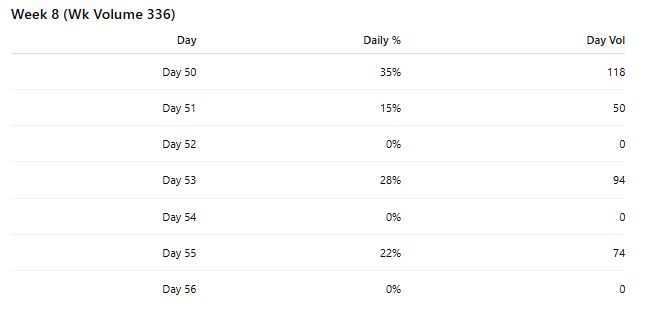
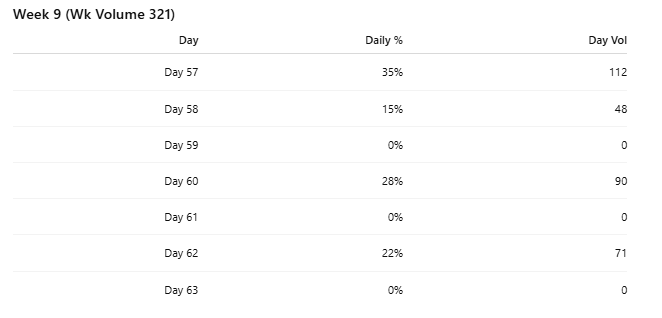
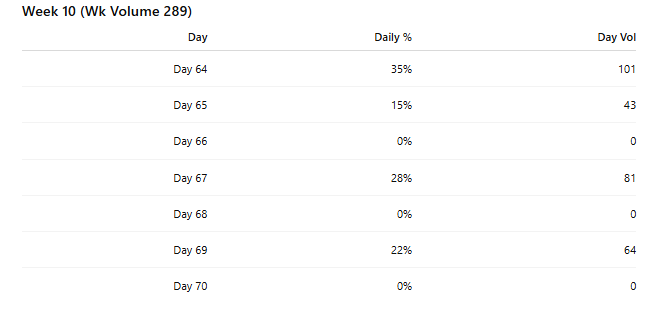
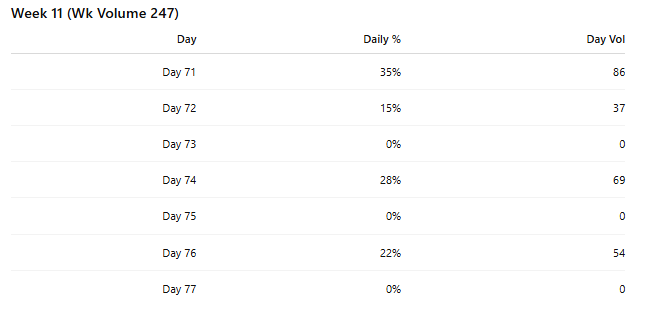
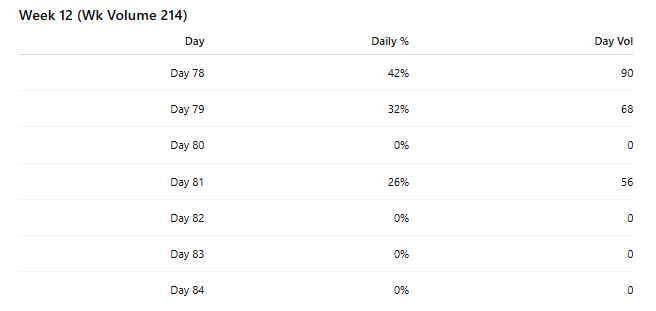
Daily volumes are derived from weekly volume and daily percentage distribution.
Sample training program
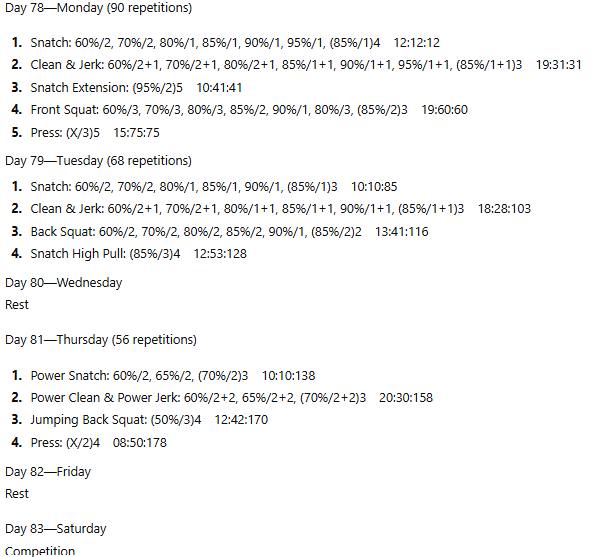
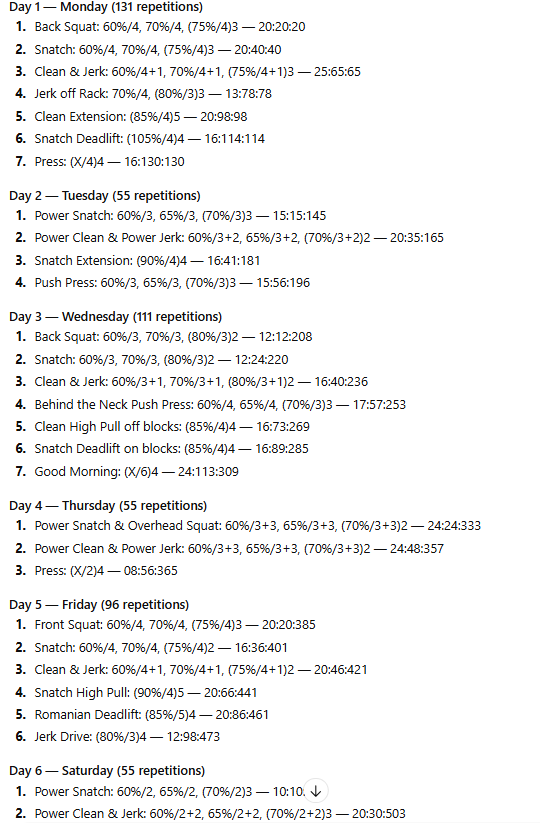
WEEK 1 (Preparation Mesocycle) 504 repetitions
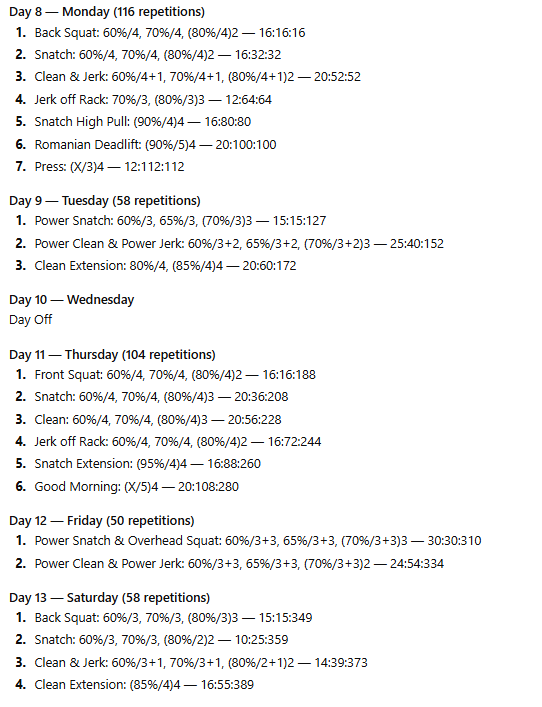
Note: The numbers to the right represent:
-
repetitions in the exercise, 2) repetitions in the workout, 3) running cumulative repetitions for the week.
WEEK 2 (Preparation Mesocycle) 386 repetitions
WEEK 3 (Preparation Mesocycle) 453 repetitions
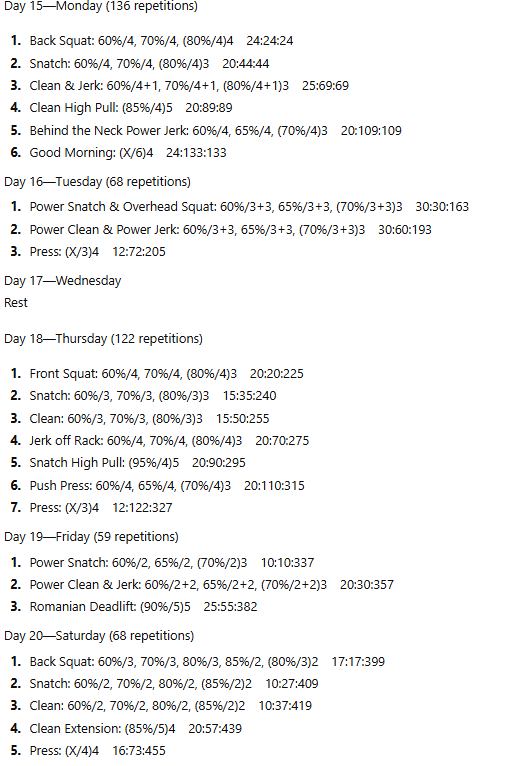
WEEK 4 (Preparation Mesocycle) 336 repetitions
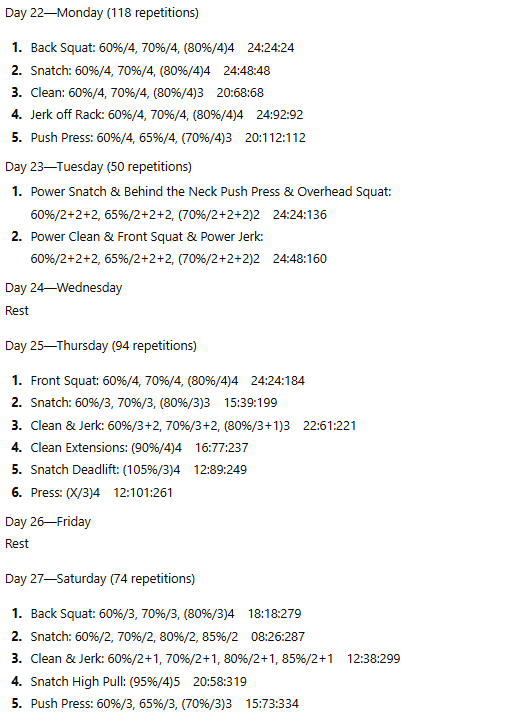
WEEK 5 (Preparation Mesocycle) 504 repetitions
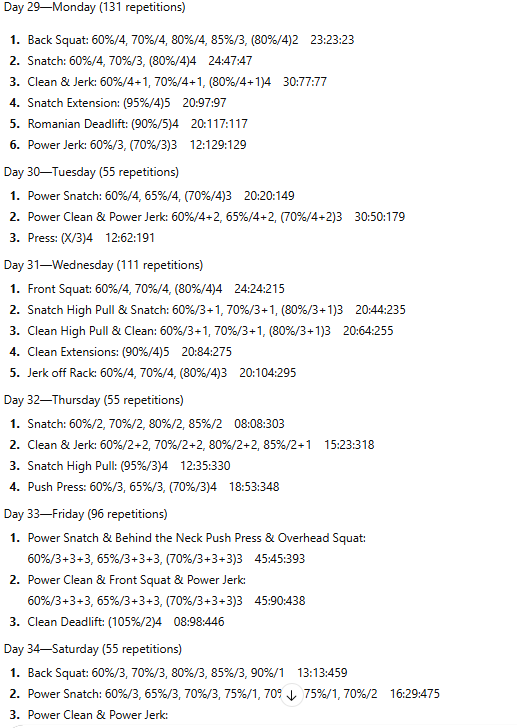
WEEK 6 (Preparation Mesocycle) 453 repetition
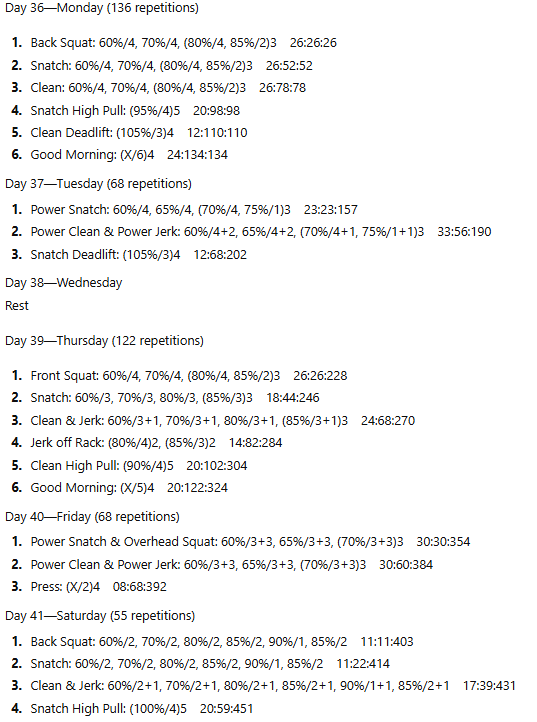
WEEK 7 (Preparation Mesocycle) 390 repetitions
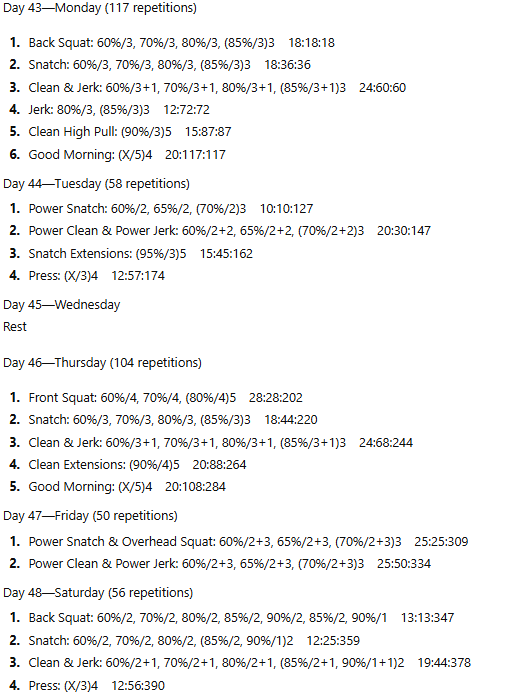
WEEK 8 (Preparation Mesocycle) 336 repetitions
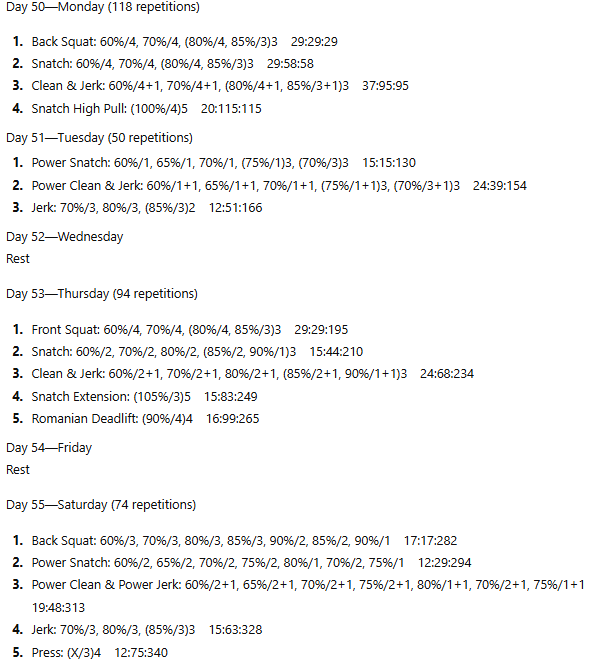
WEEK 9 (Pre-Competition Macrocycle) 321 repetitions
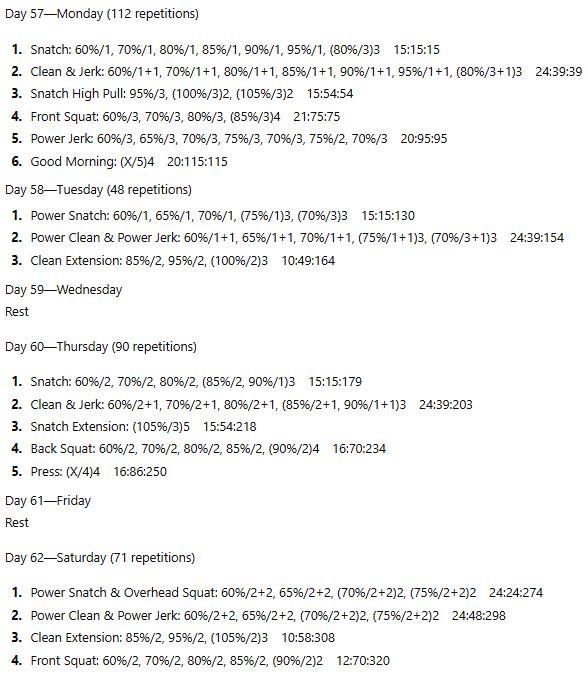
WEEK 10 (Pre-Competition Mesocycle) 289 repetitions
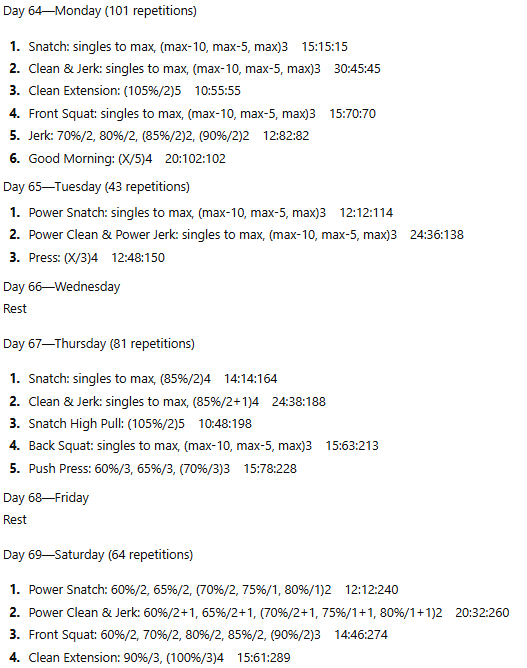
WEEK 11 (Pre-Competition Mesocycle) 247 repetitions
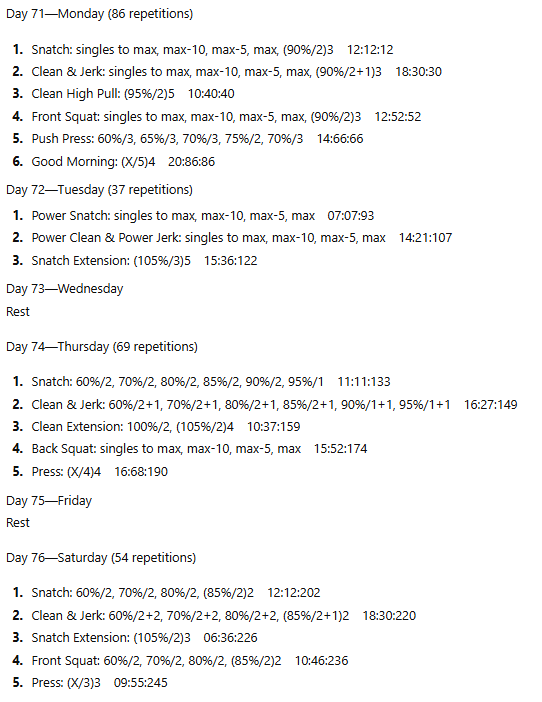
WEEK 12 (Pre-Competition Mesocycle) 214 repetitions