Soccer
Can the United States Win the FIFA World Cup? A Complete Analysis
Quick Answer
Yes — the United States has the resources, population, and infrastructure to win the FIFA World Cup, but not yet. The current men's national team is the most talented in US history, with players developed through European and MLS academies rather than the traditional college route. The core barriers are structural: a pay-to-play youth system that filters out lower-income talent, coaching education that is not yet aligned with UEFA and CONMEBOL standards, and a soccer identity that has shifted with every new head coach. Solving those three problems — not simply producing more players — is what stands between the US and a World Cup title.

Introduction: Why This Question Matters Now
The United States is co-hosting the 2026 FIFA World Cup alongside Canada and Mexico. For the first time in decades, there is genuine optimism around the US Men's National Team — a roster built on players who bypassed the old American development model and entered professional environments in Europe and MLS at a young age.
Christian Pulisic, Weston McKennie, Tyler Adams, Gio Reyna, Yunus Musah — these names are not household words yet in the United States, but they are recognizable across the European soccer landscape. They represent a break from the past. The question is whether that break is sustainable and whether it points toward a system capable of producing a World Cup-winning team.
This article draws on 30 years of experience working in youth, college, and professional soccer on both sides of the Atlantic to examine where US Soccer stands, what is holding it back, and what a realistic path to a World Cup title actually looks like.
How Has US Soccer Developed Since 1994?
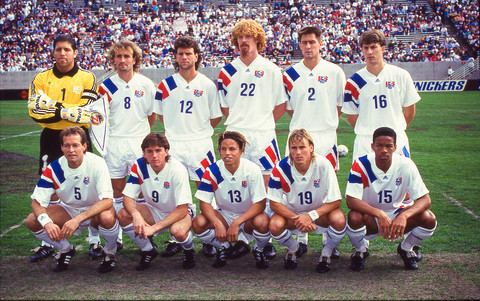
The 1994 World Cup, hosted in the United States, was a turning point. The crowds were enormous. The infrastructure was world-class. The US national team, coached by a foreign-born manager, advanced out of the group stage before losing to eventual champions Brazil. Most spectators in the stadiums were expatriates and overseas visitors — American sports fans were largely indifferent.
That tournament left two direct legacies. First, Major League Soccer launched in 1996, replacing the fragmented semi-professional leagues that had existed before. Second, youth soccer participation exploded across the country. State associations formed or expanded. Clubs appeared in every state. Parents who had watched the World Cup enrolled their children.
In those early years, handing out rulebooks to parents on the sideline was a normal part of game day. The sport was new to most American families. Broadcasting companies and sports executives remained skeptical about soccer's commercial potential. The sport was growing in participation but not yet in cultural legitimacy.
Thirty years later, soccer is the third most popular sport in the United States by participation, behind only American football and basketball. MLS has expanded to 30 clubs, draws legitimate international stars in their prime rather than their twilight years, and operates in stadiums funded by NFL ownership groups who recognized soccer as the natural complement to their football business.
The growth is real. The gap between growth and elite performance is also real, and it requires explanation.
What Is the Biggest Problem Holding US Soccer Back?
The United States does not have a talent problem. It has a conversion problem.
A country of more than 340 million people, with every climate, world-class facilities, and enormous financial resources, should produce far more elite players than it does. Croatia has a population of under four million and consistently fields Champions League-caliber players. Belgium, Portugal, and the Netherlands — each a fraction of the US population — do the same. The problem is not the raw material. It is the system that is supposed to identify and develop it.
The Pay-to-Play Model
Competitive youth soccer in the United States is expensive. Club fees routinely exceed $5,000 per year per child, and that figure does not include travel, tournaments, or equipment. Clubs have established scholarship funds for lower-income players, but travel costs are typically excluded — meaning families still bear significant financial burdens even when fees are waived.
The result is that competitive soccer has become an upper-middle-class to wealthy person's sport. Talent that exists in lower-income communities — communities that in every other major soccer nation supply a disproportionate share of elite players — is filtered out before it is ever identified.
Club directors, who in the early days of American youth soccer earned $75,000–$100,000 per year, now command salaries that frequently exceed $250,000 — and sometimes considerably more. Clubs operate on million-dollar budgets. The incentive structure rewards enrollment numbers and winning records, not player development. Coaches are paid to produce championship-winning teams, not to develop players who will reach the next level.
The College Pathway Distortion
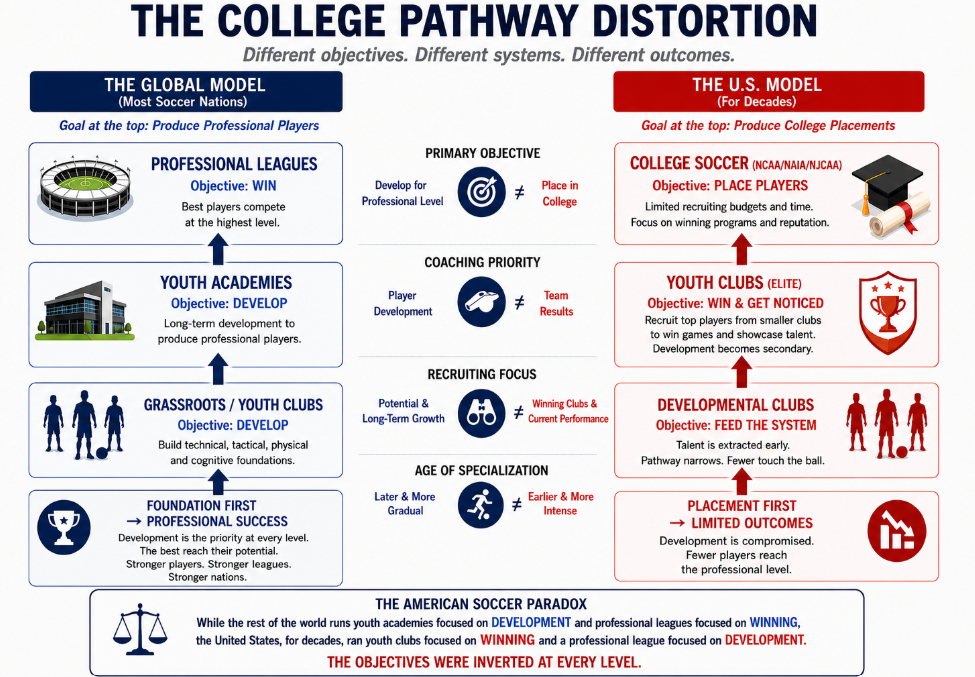
In most soccer nations, the goal of a youth academy is to produce professional players. In the United States, for decades, the goal of a youth club was to produce college placements. That difference in objective shaped everything — training methods, coaching priorities, recruiting practices, and the age at which players were pushed to specialize.
College coaches have limited recruiting budgets and limited time. They concentrate on clubs with winning records and league prestige. Clubs responded by recruiting the best players from smaller developmental clubs — not to develop them further, but to field winning teams that would attract college attention. Development became secondary to results. Results became secondary to placement statistics.
This created what can be called the American Soccer Paradox: while the rest of the world ran youth academies focused on development and professional leagues focused on winning, the United States, for decades, ran youth clubs focused on winning and a professional league focused on development. The objectives were inverted at every level.
Is the Current US Men's National Team Evidence That Things Are Changing?
Yes — and it is the most compelling evidence available. The core of the current USMNT did not follow the traditional American pathway. They entered professional environments as teenagers, either in Europe or through MLS academies, and their development accelerated as a result.
Key examples:
- Christian Pulisic — developed through PA Classics, then Borussia Dortmund's academy in Germany from age 16.
- Weston McKennie — FC Dallas Academy to Schalke 04 in Germany.
- Tyler Adams — New York Red Bulls Academy to RB Leipzig.
- Gio Reyna — New York City FC academy to Borussia Dortmund.
- Chris Richards — FC Dallas to Bayern Munich.
- Tim Weah — New York Red Bulls to Paris Saint-Germain.
- Yunus Musah — developed at Arsenal in England.
- Antonee Robinson — came through Everton's academy system.
None of these players went through four years of NCAA soccer. That is not a coincidence. It is a proof of concept: American players can compete at the highest levels of world soccer when they enter professional environments early enough. The challenge now is scaling that pathway so it is accessible to talented players across the entire country, regardless of geography or family income.
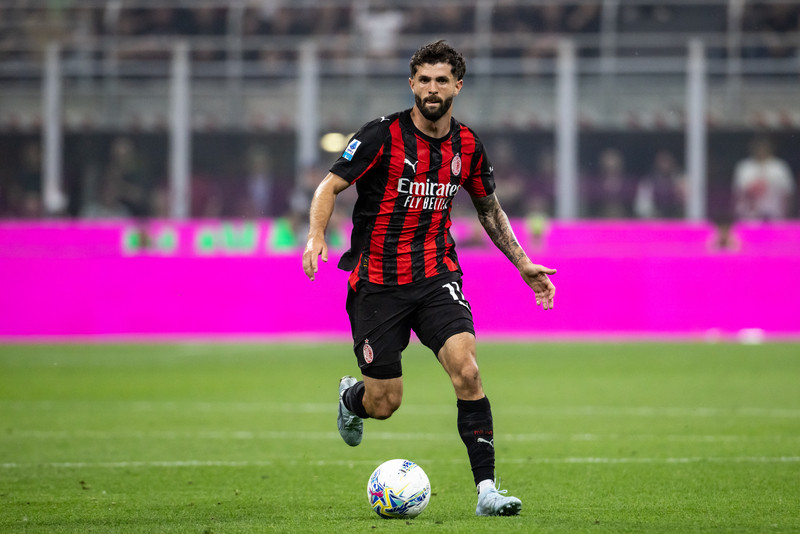
Christian Pulisic with AC Milan
How Does US Soccer Compare to Top Soccer Nations?
European and South American football federations had a 60–70-year head start on the United States. They built their development models, coaching education systems, and professional leagues across decades of institutional learning. The United States has been trying to compress that timeline.
One specific gap is coaching education. US Soccer's coaching licenses are not currently aligned with UEFA (Europe) or CONMEBOL (South America) certifications — the two most prestigious and internationally recognized systems. Top European and South American leagues require coaches to hold specific credentials issued by those governing bodies. An American coach with a US Soccer license cannot easily move into those environments, which limits the flow of knowledge and methodology between the US and the world's elite soccer cultures.
US Soccer has committed to aligning its top coaching licenses with UEFA and CONMEBOL standards. That alignment would allow American coaches to work abroad, gain exposure to elite methodologies, and eventually bring those insights back into the American system. It is a meaningful structural step.
MLS has also matured significantly. The early league strategy — signing aging international stars like David Beckham, Thierry Henry, Zlatan Ibrahimovic, and Kaká to fill seats — has been replaced by a model that prioritizes younger players in their prime and invests in academy development. NFL ownership groups brought American sports marketing expertise into MLS, which helped the league grow commercially and, in turn, invest more heavily in player development infrastructure.
What Structural Changes Does US Soccer Need to Win the World Cup?
Three structural changes are essential. They are listed here in order of difficulty, not importance.
1. Align Coaching Licenses with International Standards
US Soccer must obtain recognition from UEFA and CONMEBOL for its top coaching credentials. This is already in progress. When completed, it will allow American coaches to work in elite European and South American environments and return with the knowledge those systems have built over decades.
2. Build a Partnership Between US Soccer, MLS, and the NCAA
The college system is not going away, and it should not be treated as the enemy. Colleges provide pathways for millions of players and are deeply embedded in American sports culture. The transition is already underway — the NCAA is moving toward a five-year eligibility model, is open to limiting foreign player rosters, and is exploring year-round play. US Soccer, MLS academies, and NCAA institutions need a formal framework that coordinates rather than competes.
3. Dismantle the Pay-to-Play Model State by State
This is the hardest change. State associations have accumulated significant financial reserves over decades and hold seats on the US Soccer board — giving them the institutional power to delay or block reform. Clubs have captured the competitive marketplace in many states and operate largely outside US Soccer's direct authority.
The most promising lever is MLS. Academy programs operated by MLS clubs have already eliminated pay-to-play for their own players. Those academies are funded by billionaire-owned ownership groups that have a direct financial incentive to identify talent on the broadest possible scale. Expanding the geographic reach and identification networks of MLS academies — and finding insurance and federal government partnerships that create access points outside the club system — is the most realistic path to systemic change.
Does the United States Have a National Soccer Identity?
Not yet — and this is one of the most underappreciated obstacles.
Every enduring soccer power has a recognizable style of play that persists across generations and coaching changes. Germany's physicality and organization. Brazil's technical flair. Spain's possession and pressing. The Netherlands' positional fluidity. These identities were not accidents — they were deliberate choices, embedded into coaching education, reinforced through youth academies, and protected even when they produced short-term losses.
The United States has changed its style of play with nearly every head coach. There is no through-line from the youth academies to the senior national team that defines how American players are expected to play. Until that identity is established and protected — through coaching education, youth curriculum, and deliberate long-term planning — the national team will continue to reflect its coach's preferences rather than a national philosophy.
This requires what can only be described as decisive, even uncomfortable, leadership within US Soccer — the willingness to make a choice, commit to it, and protect it from the political pressure at every level of American soccer governance. Too many stakeholders currently benefit from the fragmented system. Change will require people willing to lose short-term political capital for long-term development gains.

Frequently Asked Questions
Has the United States ever won the FIFA World Cup?
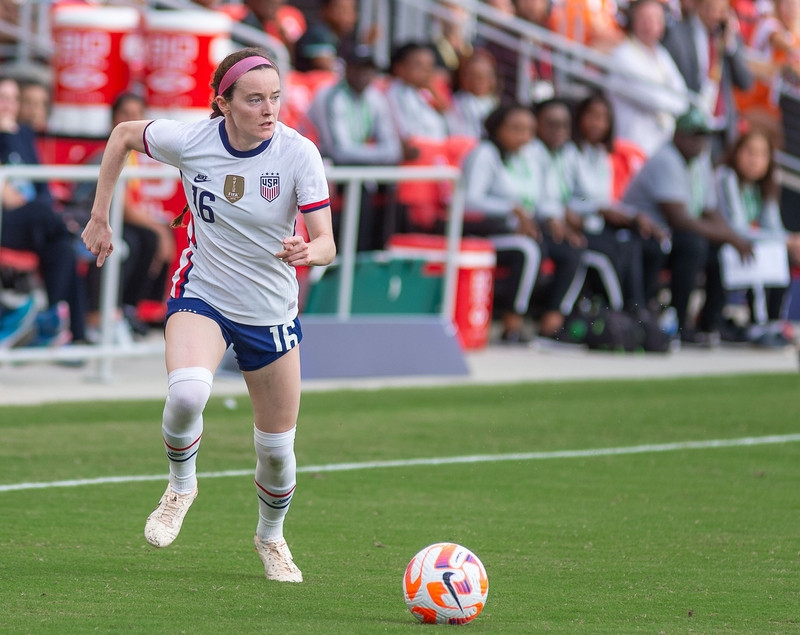
No. The US Men's National Team has never won the FIFA World Cup. Their best finish was third place in the inaugural 1930 tournament in Uruguay. In the modern era, the USMNT reached the quarterfinals in 2002 — their best result in the modern era — under head coach Bruce Arena, widely regarded as the greatest coach in US Soccer history. That squad featured players who had sought professional experience abroad at an early age: Landon Donovan had gone to Germany with Bayer Leverkusen as a teenager, Clint Dempsey and DaMarcus Beasley were developing outside the traditional college pathway, and the team's collective hunger and organization reflected Arena's ability to build a competitive culture. The 2002 quarterfinal run remains a benchmark — and a reminder that strong coaching and players who seek elite environments early can punch well above a nation's expected level. The US Women's National Team has won the World Cup four times (1991, 1999, 2015, 2019), making them the most successful women's team in the history of the tournament.
Why is the US Women's team so much more successful than the men's team?
The US women's program benefited from Title IX legislation, which mandated equal athletic funding at universities, giving women's soccer a strong college infrastructure decades before other nations had equivalent development systems. The US had a structural head start on the rest of the world in women's soccer — the same college model that constrains men's development was actually an advantage when the rest of the world was still building women's programs from scratch. That head start is narrowing as other nations have invested heavily in women's football.
Is MLS a good enough league to develop World Cup-level players?
MLS has improved substantially and now serves as a legitimate development platform for young American players. However, the players currently driving the USMNT — Pulisic, McKennie, Adams, Musah — are playing in top European leagues, not MLS. The league's role in the development pipeline is primarily at the academy level, identifying and preparing players for professional environments in Europe. MLS, as a senior league, still lags behind the top five European divisions in terms of overall quality and competitive intensity.
What is pay-to-play soccer, and why does it matter for the World Cup?
Pay-to-play refers to the model in which youth soccer players must pay significant fees — often $5,000 or more per year — to participate in competitive club soccer. This model effectively excludes players from lower-income families, limiting the talent pool from which the national team is drawn. Every major World Cup-winning nation draws heavily from working-class communities. Until the United States builds free or low-cost competitive development pathways at scale, it will continue to develop a fraction of its actual talent base.
When could the United States realistically win the World Cup?
A realistic timeline depends on how quickly structural reforms are implemented. If coaching education alignment, MLS academy expansion, and pay-to-play reduction advance at pace, the US could be a genuine World Cup contender within two to three tournament cycles — potentially by 2030 or 2034. The talent pipeline is improving. The institutional reforms are the variable. A home tournament in 2026 creates both a unique opportunity and a useful pressure test for where the program actually stands.

Conclusion: The Potential Is Real. The Work Is Structural.
The United States has never been better positioned to compete at the top of world soccer. The current national team is proof that the American player — when developed in the right environment — can perform at the highest level. Pulisic at AC Milan. McKennie at Juventus. Dest at PSV. Tillman at Bayer Leverkusen. These are not flukes. They are the first results of a development shift that is still in its early stages.
What stands between the United States and a World Cup title is not talent. It is structural. The pay-to-play model narrows the talent pool. The absence of a national soccer identity means the program reinvents itself with every coaching cycle. The misalignment between coaching education and international standards slows the transfer of knowledge from the world's elite soccer cultures into the American system.
None of those problems is unsolvable. All of them are in motion. The question is whether US Soccer can build the institutional will to see the changes through, past the political resistance, past the financial interests, and past the short-term thinking that has slowed progress before.
The ingredients are there. The recipe just needs to be followed.
About the Author
Alex Pama is an internationally respected soccer development expert, head coach at Life University, and a former Dutch professional club executive who has spent more than 30 years developing elite players and coaches and building winning programs.