Every greatest-of-all-time list ever published has the same two problems: nobody agrees with it, and nobody can check it. The first problem is unsolvable — you will not agree with this list either. The second one we decided to fix.
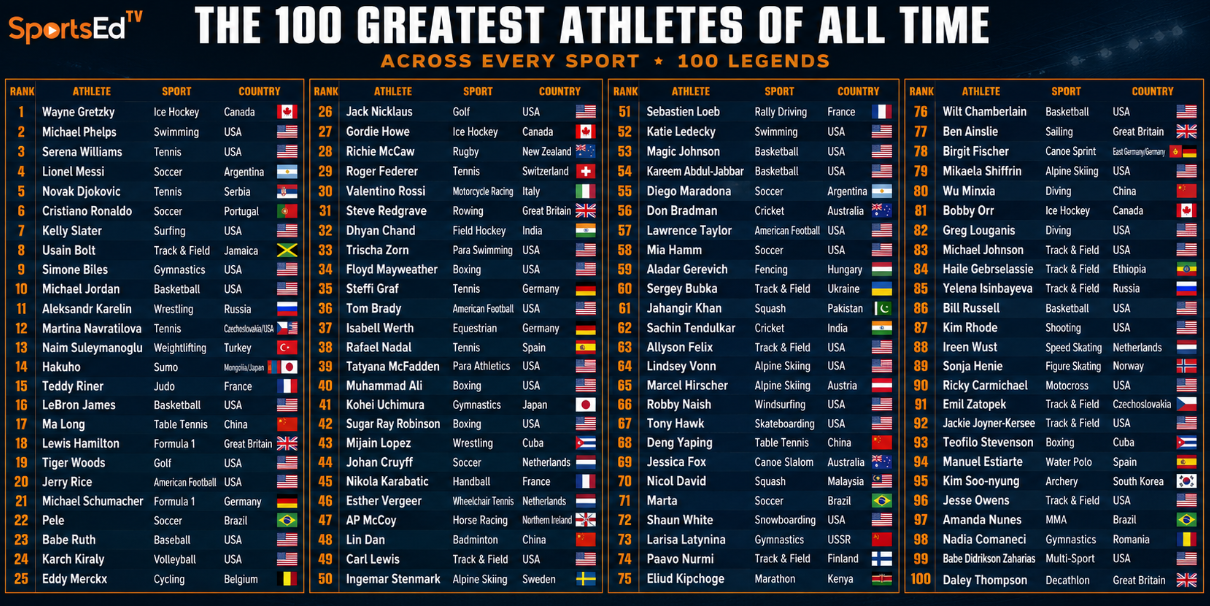
This is our ranking of the 100 greatest athletes in history, across every sport, every era, and both sexes. It was built from a published formula: five criteria, fixed weights, every athlete scored the same way. The order below was produced by the math, not by our affections — which is why our own list ranks a sumo wrestler above Muhammad Ali and left Kobe Bryant off entirely, two outcomes nobody designs on purpose.
One thing before the arguments start: this is our list, built on our criteria. Greatness has no official definition, so we wrote one down and applied it consistently. If you would define it differently — more weight on peak, on titles, on cultural meaning — you are not wrong; you are running a different model. We publish our weights precisely so you can build your own and show us the result. That is the whole idea.

How the Model Works
Every athlete is scored 1–10 on five criteria. Each score is multiplied by the criterion's weight and summed to a final score out of 10. That number alone produces the ranking — no manual adjustments, no vetoes, no rescues.
1. Peak Dominance & Records — 32.5%. How far did the athlete separate from the elite field of their own era? Standing records, statistical outliers, and paradigm shifts live here. This is the heaviest weight, and it is why streak-builders and scale-breakers rank above accumulators throughout the list.
2. Career Longevity — 22.5%. Elite performance sustained across years and championship cycles. A transcendent five years scores below a dominant fifteen — a choice with real consequences we discuss openly below.
3. Depth of Competition — 17.5%. The size and global competitiveness of the field the athlete actually faced, in their own era — not what their sport later became. This is the criterion that holds Don Bradman below his raw numbers and lifts Messi above his trophy count.
4. Titles, Opportunity-Adjusted — 17.5%. Championships won, corrected by a disclosed multiplier: single-title team sports ×1.10 (one shot every cycle), multi-medal individual sports ×0.90 (many podiums per meet), all else ×1.00. A swimmer can win eight golds in a week; a footballer gets one World Cup final every four years. The adjustment stops the medal table from deciding the argument by itself.
5. Cultural Impact — 10%. What the athlete meant beyond the results. This is deliberately the smallest weight and openly the most subjective column. We included it because greatness without meaning is a spreadsheet; we capped it because meaning partly measures which sports television chose.
The rules around the model. Sports requiring sustained physical exertion only — which excludes darts, snooker, and chess, and costs the list two all-time greats (Phil Taylor and Ronnie O'Sullivan would both score top-20 if admitted; the line is definitional, not a verdict on their mastery). Completed or near-completed careers only — no Ohtani, no Usyk, no Jon Jones, no Adam Ondra; check back in 2030. Men's MMA is absent because no GOAT consensus survives its asterisks. And no quotas of any kind: no cap per sport, per country, or per sex. Representation follows scores, wherever they land.
What this model is not. It is not a measurement. No common statistical unit exists across sports — anyone claiming to compute cross-sport z-scores is disguising judgment as arithmetic. Every score here is an analyst judgment grounded in sourced records: the judgments are debatable, the criteria are consistent, and the whole sheet is visible. That is as honest as this genre can be.

The List
Access the model here
The Most Contested Placements — Argued Before You Ask
Wayne Gretzky at #1. The objection: hockey is a regional sport. The answer: the depth criterion already prices that — Gretzky's depth score sits well below Messi's. What no athlete in any sport matches is his dominance column: 61 NHL records at retirement, more career assists than anyone else has career points, four 200-point seasons in a league where no one else has one. The model asks how far you separated from the best field available to you. Nobody separated further. Weight depth above dominance, and Messi is your #1 — that is a legitimate model, and it is not ours.
Muhammad Ali at #40. The single hardest placement in the model. If greatness means what an athlete meant to the world, Ali is #1, and it is not close — and he scores the maximum on our cultural criterion. But that criterion is 10% of the model. The other 90% is the measured career, and the ledger is complicated: three and a half prime years lost to his ban, five defeats, a résumé magnificent but not the statistical outlier of a Karelin (887–2) or a prime Sugar Ray Robinson. We published where the criteria put him rather than quietly moving him to where sentiment wants him — because the moment one legend is hand-adjusted, every other number on the list stops meaning anything. Raise cultural impact to 30%, and Ali climbs toward the top five. For many people, that is the right model. It is a different one than ours, and both can exist honestly.
Don Bradman at #56. The most extreme dominance number in measured sport belongs to Bradman: a 99.94 Test average, roughly 4.4 standard deviations above his elite peers. Nobody on this list — not Gretzky, not Phelps — separates from their field by that margin, and if the ranking were peak dominance alone, Bradman is #1, and we have said so publicly. What the model weighs against it: 52 Tests against essentially five competitive nations, a career interrupted by war, and a global talent pool in the 1930s that was a fraction of modern cricket's. The depth criterion prices the field an athlete actually faced, not what his sport became. His placement will anger cricket forever, and the argument against our depth weighting is genuinely strong. It is also visible, which is the point.
Serena Williams at #3, Novak Djokovic at #5. Separated by decimals, and honest people can flip them. Djokovic leads the records: 24 majors, most weeks at No. 1, winning records against both his great rivals, forged against a field containing Federer and Nadal. Serena's edge is dominance margin — her separation from her era's field at peak was wider than his over his — and a longevity column spanning Slams across four different decades. His competition was harder; her gap was bigger. The model scores both, and the order could reverse on a single point change. We are comfortable saying so.
Tiger Woods at #19, Jack Nicklaus at #26. Jack has 18 majors to Tiger's 15 and always will. Our heaviest criterion is peak separation from the field, and Tiger's peak has no parallel in golf: 15 shots at the 2000 US Open, four majors held simultaneously, courses redesigned to contain one man. Weight titles above peak and Jack is golf's GOAT — plenty of golf people legitimately do.
Floyd Mayweather at #34, above Ali. The placement nobody designs on purpose. Floyd's ledger has no holes: 50–0 across 21 years and five divisions, world titles from his teens to his 40s. Ali's ledger has entries on both sides. Mayweather's cultural score is a fraction of Ali's — but cultural impact is 10% of the model, and the other 90% favors the unbeaten record. This is not a claim that Floyd was the greater fighter. It is what happens when a measurable career is weighted 90% and meaning 10% — and the dials are published so you can set them differently.

What the Model Cannot Measure
A criteria model has blind spots. Naming them is more honest than pretending they do not exist.
Careers cut short. Bo Jackson was an All-Star in the NFL and MLB simultaneously — no one else has ever done it — and his football career lasted four seasons before a hip injury ended everything at 28. Jim Brown retired at 29 at his absolute peak. Cathy Freeman's greatness lives concentrated in one lap of Sydney in 2000, carrying a nation's weight over 400 meters. Shane Gould held five individual world records simultaneously at 15 and left the sport at 16. The model weights longevity at 22.5%, and it prices what happened — not what was prevented, and not what walked away. Two half-careers, however dazzling, score below one complete one. That is a choice, and these athletes are its cost.
Versatility. Jim Thorpe won Olympic decathlon gold and played professional football and baseball. Babe Didrikson Zaharias made the list; Thorpe fell just short of it — because versatility spreads greatness across columns while specialists stack one, and the criteria reward stacking. Thorpe may be the greatest pure athlete who ever lived. He is also the best argument against our own spreadsheet, and we would rather say so than hide him.
Influence beyond playing. Johan Cruyff's playing career made the list on its own merits. His larger legacy — Total Football, the Barcelona philosophy, half of the modern game's thinking — lives partly in his coaching years, which a ranking of playing careers cannot count. The most influential football mind ever is slightly shortchanged by the rules, and we note it.
What was stolen. Jackie Robinson is not on this list, and he is the hardest omission on it. By cultural and historical weight, he belongs beside Ali and Owens: what he carried in 1947, alone, changed a country. But segregation kept him out of MLB until he was 28, leaving a ten-season career, and 90% of this model prices what happened on the field. It has no column for what was stolen before he got there. Some greatness does not fit in a spreadsheet. The honest thing is to say so rather than pretend the spreadsheet settles it.
The Near Misses
Every cut has a reason. These are the athletes who came closest, with the criterion that held the door.
Kobe Bryant — the closest basketball miss. Five rings and two decades, but his individual dominance numbers sit just below a queue of six (Jordan, LeBron, Kareem, Magic, Wilt, Russell) already on the list. No cap on basketball exists; the decimals decided. Yevgenia Kanaeva (rhythmic gymnastics) — scored 6.89 against a 7.02 cutline; the honest miss that proves the cutline is real. Jim Thorpe and Jim Brown — see above. Mark Spitz — seven golds in Munich, but Phelps occupies swimming's ceiling so completely that Spitz's résumé reads as its preview. Annika Sörenstam, Hicham El Guerrouj, Marit Bjørgen, Eric Heiden, Fanny Blankers-Koen, Ole Einar Bjørndalen — all held top-100 places in earlier versions and were displaced by later, stronger cases; all remain within decimals of the line. Andrew Johns (rugby league) — the eighth Immortal, held by a three-nation elite pool. Shane Warne — 708 wickets and the ball of the century, but cricket's third slot is a knife-fight he narrowly loses to the two on the list. Michael Dunlop (road racing) — 33 Isle of Man TT wins, the most ever, in the most dangerous sporting event on Earth; held by the field's size, not his courage. Franz Klammer, Paul Elvstrøm, Ed Moses (122 consecutive wins across nine years — the streak the boycott kept from being even more), Irene van Dyk (netball), Leigh Matthews (AFL), Daniela Ryf (triathlon), Gary Gait (lacrosse), Dan Gable and Cael Sanderson (wrestling's queue behind Karelin and López), Sugar Ray Leonard (boxing's fifth), Willie Mays and Hank Aaron (baseball's second and third — and the case that baseball deserves two is the best argument against its one). Kílian Jornet and Adam Ondra — careers still open; the active-career rule, not the résumé. Same for Shohei Ohtani, Oleksandr Usyk, and every current great: this list ranks finished bodies of work, and theirs are gloriously unfinished.
Disciplines swept without producing a top-100 case: powerlifting and strongman (no unified championship record to price), freediving, race walking, artistic swimming, speedway, softball, trampoline, korfball, bandy, floorball, and others. Checked is not the same as represented, and both are documented.
The Changelog — What the Comments Changed
This list was published in stages, and the audience improved it. The original build omitted Formula 1 entirely (both Hamilton and Schumacher now rank top 25), horse racing (AP McCoy, 4,358 winners, 20 consecutive championships), rally (Loeb's nine straight world titles), windsurfing (Naish, world champion at 13), water polo (Estiarte, top scorer at four straight Olympics), motocross (Carmichael's two perfect seasons — flagged by a commenter with the words "you've gotta be kidding," scored, and confirmed in), and Paralympic athletics (McFadden, 22 medals across seven Games). Every one of those corrections came from a reader or a systematic audit the readers forced. A list that shows its math can be argued into getting better. That is the model working, and the credit is yours.
FAQ
Is there a limit per sport or country?
No. There are no quotas anywhere in the model. Basketball places six athletes because six cleared the cutline; sumo places one because one did. If eight tennis players had qualified, eight would have been included.
Isn't this list biased toward Americans?
The list's #1 athlete is Canadian. The top ten includes an Argentine, a Serbian, a Portuguese, and a Jamaican, while a Turkish weightlifter, a Mongolian sumo legend, and a Cuban wrestler all rank above LeBron James. Americans are well represented because the United States has more than 330 million people and the world's largest sports infrastructure. The model scores careers, not passports.
Isn't it biased toward men?
The criteria are sex-blind: the same five categories, the same weights, and dominance measured within each athlete's own sport. The list is roughly 30% women, including three of the top ten. Bias genuinely enters through history, not the formula. Women were excluded from much of organized sport for much of the period this list covers, so fewer complete careers exist to evaluate. The model reflects the history of sport, even when it applies today's criteria consistently.
Why isn't sport popularity a bigger factor?
It is a factor. Depth of competition accounts for 17.5% of the score, which helps explain why Lionel Messi ranks in the top five while Don Bradman finishes lower. However, making popularity a larger multiplier would turn a ranking of athletes into a ranking of sports. Aleksandr Karelin's 887–2 record should not be discounted simply because football attracts larger audiences. The model adjusts for weaker competitive fields but does not allow sport size alone to outweigh extraordinary dominance.
How is a sumo wrestler ahead of Muhammad Ali?
Hakuho's 45 top-division championships represent the most decorated career in centuries of professional sumo history, while Muhammad Ali's record includes a 3.5-year ban from competition and five professional losses. Ali overwhelmingly surpasses Hakuho in cultural impact, but that category represents 10% of the model. Increase the weight assigned to cultural impact, and their positions reverse. That tradeoff is exactly what the scoring system is designed to make transparent.
Why are darts, snooker, and chess excluded?
The list includes sports in which sustained physical performance is central to the competition. That definition excludes exceptional competitors in darts, snooker, and chess. Any boundary inevitably leaves out deserving individuals, but a consistent definition is necessary for meaningful comparison.
Why are there no active athletes?
Only completed careers are ranked. Athletes such as Shohei Ohtani, Oleksandr Usyk, Kylian Mbappé, Adam Ondra, and Kilian Jornet are still building their legacies. They will be eligible for future editions once their careers are complete.
Can I change the weights?
Yes—and that is part of the purpose of publishing the methodology. The complete scoring sheet accompanies this article. Increase cultural impact to 30%, and Muhammad Ali and Michael Jordan climb. Increase depth of competition to 30%, and Lionel Messi becomes the likely #1. Remove longevity entirely, and peak-performance athletes such as Bo Jackson rise dramatically. Your weighting reflects your definition of greatness. Ours produced this ranking, and we welcome others to build their own.
Is this list definitive?
No. No ranking of the greatest athletes of all time can ever be definitive. What makes this list different is that every score and weighting is open for inspection and debate. Readers are encouraged to challenge the numbers, propose alternatives, and refine the methodology—the discussion itself is part of the project.