Soccer
Everything You Need to Know About Soccer Positions
Whether you want to improve as a player, a coach, or simply better enjoy watching soccer matches (and impress your friends with your soccer knowledge), understanding the positions behind the beautiful game is essential. On a basic level, soccer positions can be broken down into four categories:
- Goalkeepers
- Defenders
- Midfielders
- Forwards
This article will first cover the basics of how these positions are structured in a team (called a ‘formation’), then the specifics of each position.

Soccer Position Numbers Explained
In soccer, positions are often identified by both numbers and names. While modern formations and tactics have evolved, these traditional numbers remain widely used by coaches, players, commentators, and fans around the world. Understanding soccer position numbers can help players better understand their role on the field and how different positions work together within a team.
| Number | Position | Primary Role |
|---|---|---|
| 1 | Goalkeeper | Protects the goal and organizes the defense |
| 2 | Right Back | Defends wide areas and supports attacks down the flank |
| 3 | Left Back | Defends and provides width on the left side |
| 4 | Center Back or Defensive Midfielder | Defensive leader and ball winner |
| 5 | Center Back | Marks attackers and dominates aerial duels |
| 6 | Defensive Midfielder | Shields the defense and controls the tempo |
| 7 | Winger | Creates chances through speed and dribbling |
| 8 | Box-to-Box Midfielder | Contributes to both attack and defense |
| 9 | Striker | Primary goal scorer |
| 10 | Attacking Midfielder | Creative playmaker and chance creator |
| 11 | Left Winger | Attacks from the left side and creates scoring opportunities |
While these numbers originated from traditional formations, they are still commonly used to describe playing styles today. For example, a coach may refer to a "Number 6" when discussing a defensive midfielder or a "Number 10" when describing a creative playmaker. Likewise, a "Number 9" is typically the team's central striker and primary goal scorer.
Some of the most famous soccer players in history have become synonymous with these roles. The Number 10 is often associated with creative legends such as Lionel Messi and Diego Maradona, while modern Number 9s such as Erling Haaland are known for their goal-scoring ability. Understanding these numbers provides valuable insight into how players contribute to a team's success and how coaches build tactical systems around different strengths.
This section would likely become one of the most visited parts of the article because searches for Number 6, Number 8, Number 9, and Number 10 are extremely common.
What Is A Soccer Formation?
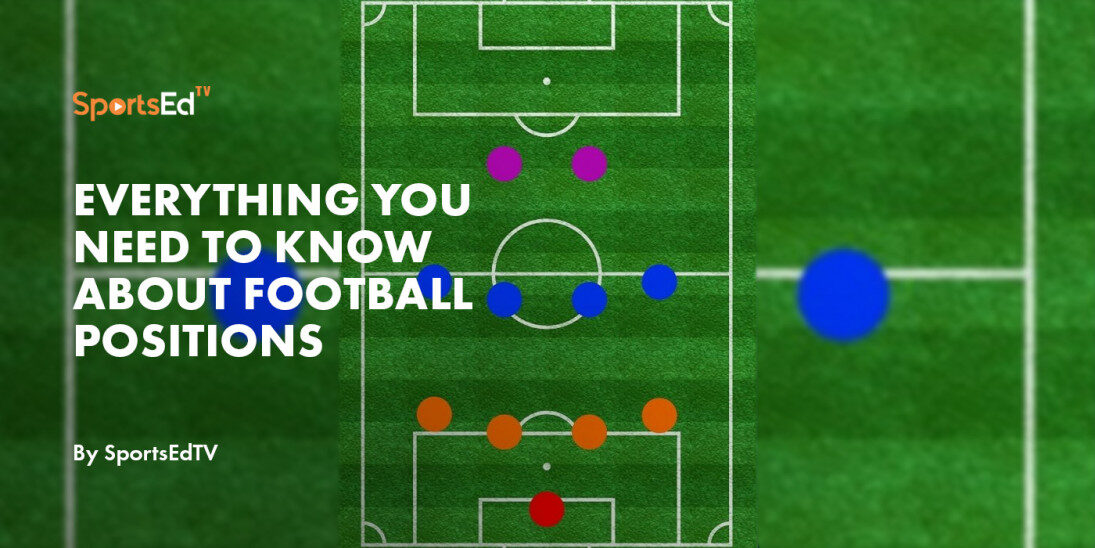
Soccer teams always have 11 players on the field: 1 goalkeeper + 10 field players. A soccer formation refers to how a team’s 10 field players are structured for a match (and it can change at any point during the match). The formation is described as a few consecutive numbers (often 3) which generally refer to the number of defenders, midfielders, and forwards a team has on the field. These 3 numbers always add to 10 as they do not count the goalkeeper. One of the more common and straightforward formations is called a ‘4-4-2’. This means 4 defenders, 4 midfielders, and 2 forwards. The first number refers to defenders, the second to midfielders, and the third to forwards. Here is what a 4-4-2 looks like for a team:
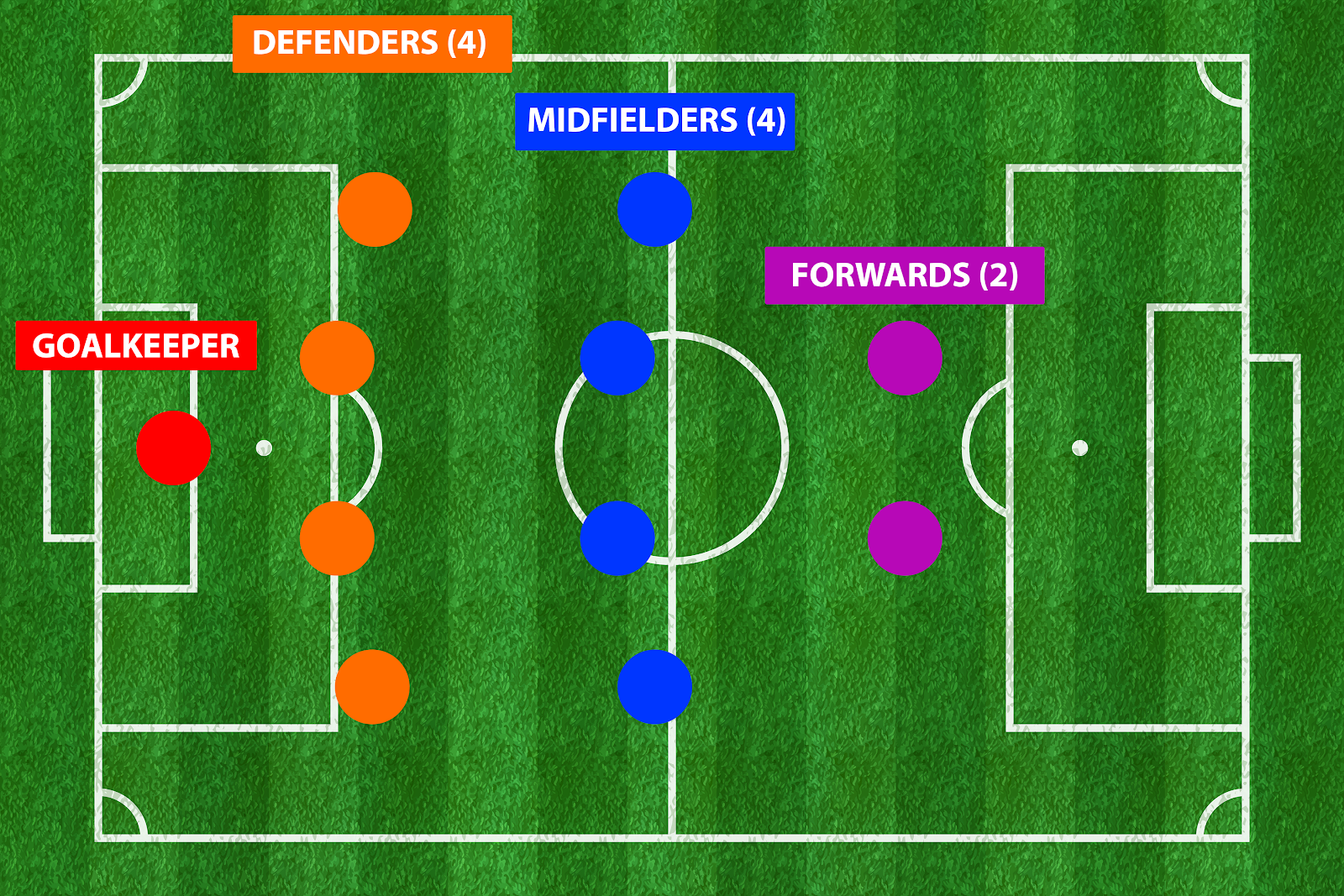
The formation a team will play is always announced before the match begins, however, it will change throughout the game. Now that you’ve seen what a 4-4-2 looks like, let’s examine each of the positions that create this formation.
Goalkeepers
The goalkeeper is in some ways the most straightforward position, as it is always 1 player who generally remains around the team’s goal for the whole match. They can use their hands within the 18-yard box, which is shown here in highlighted in red:
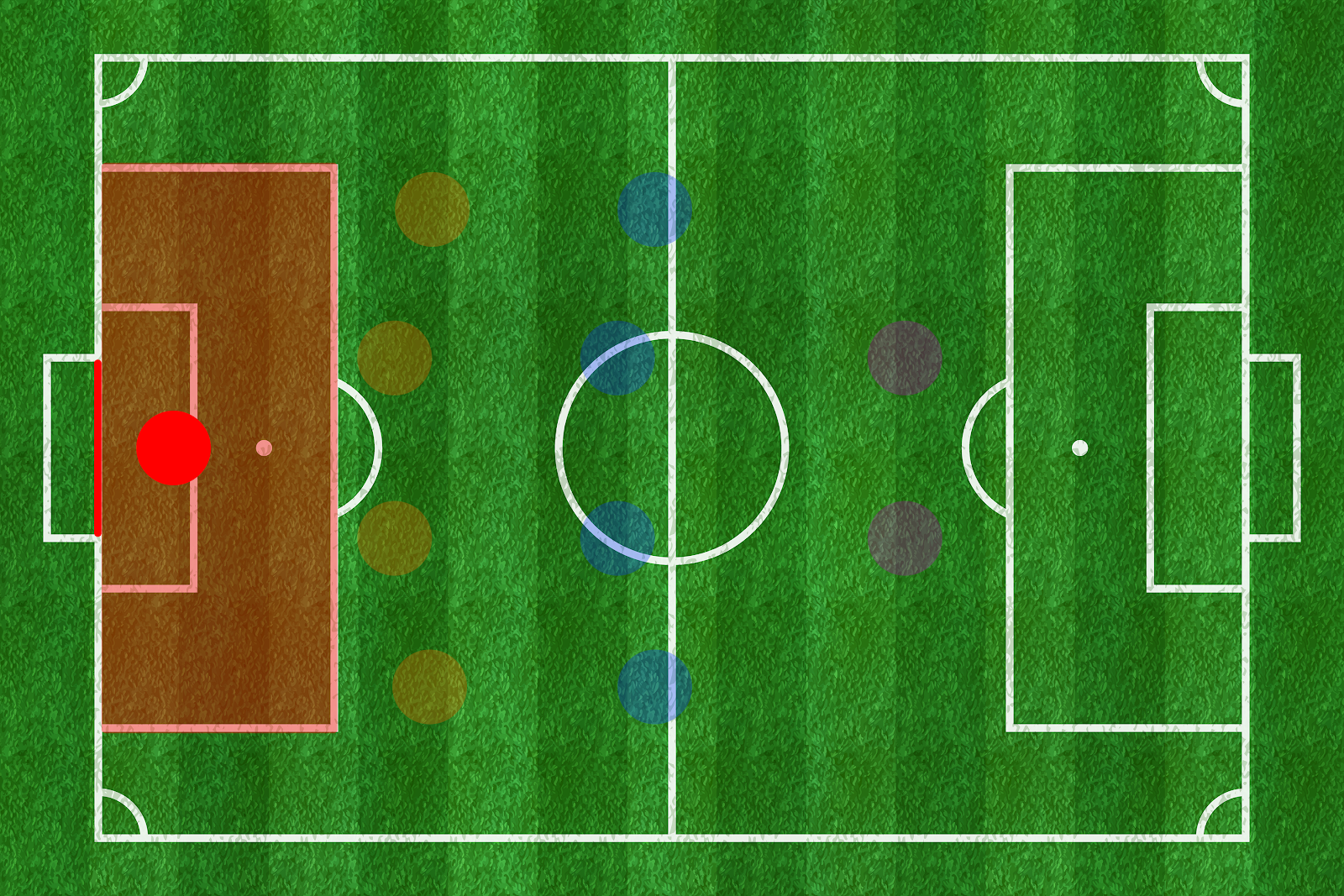
The goalie can use any part of their body within this 18-yard box and is allowed to hold the ball in their hands for up to 6 seconds within this area. Outside of that box, they cannot use their hands and are held to the same rules as the field players. Furthermore, if a teammate passes them the ball, they cannot receive it with their hands even if they are inside the 18-yard box. They will primarily use their hands to stop shots, intercept passes by the opponents, and collect loose balls. The goalkeeper’s objective is to stop the ball from entering the goal behind them. A goal is counted when the whole ball crosses the line between the posts. This line, called the goal line, is shown in the picture above as a bright red line behind the goalkeeper.
When the goalie’s team has the ball far on the other side of the field, you might see the goalie standing outside the 18-yard box by a considerable distance. This is common because it gives them a passing option for teammates if they need to pass back, and it allows the goalkeeper to intercept any long passes the opposing team might play.

Soccer Defenders
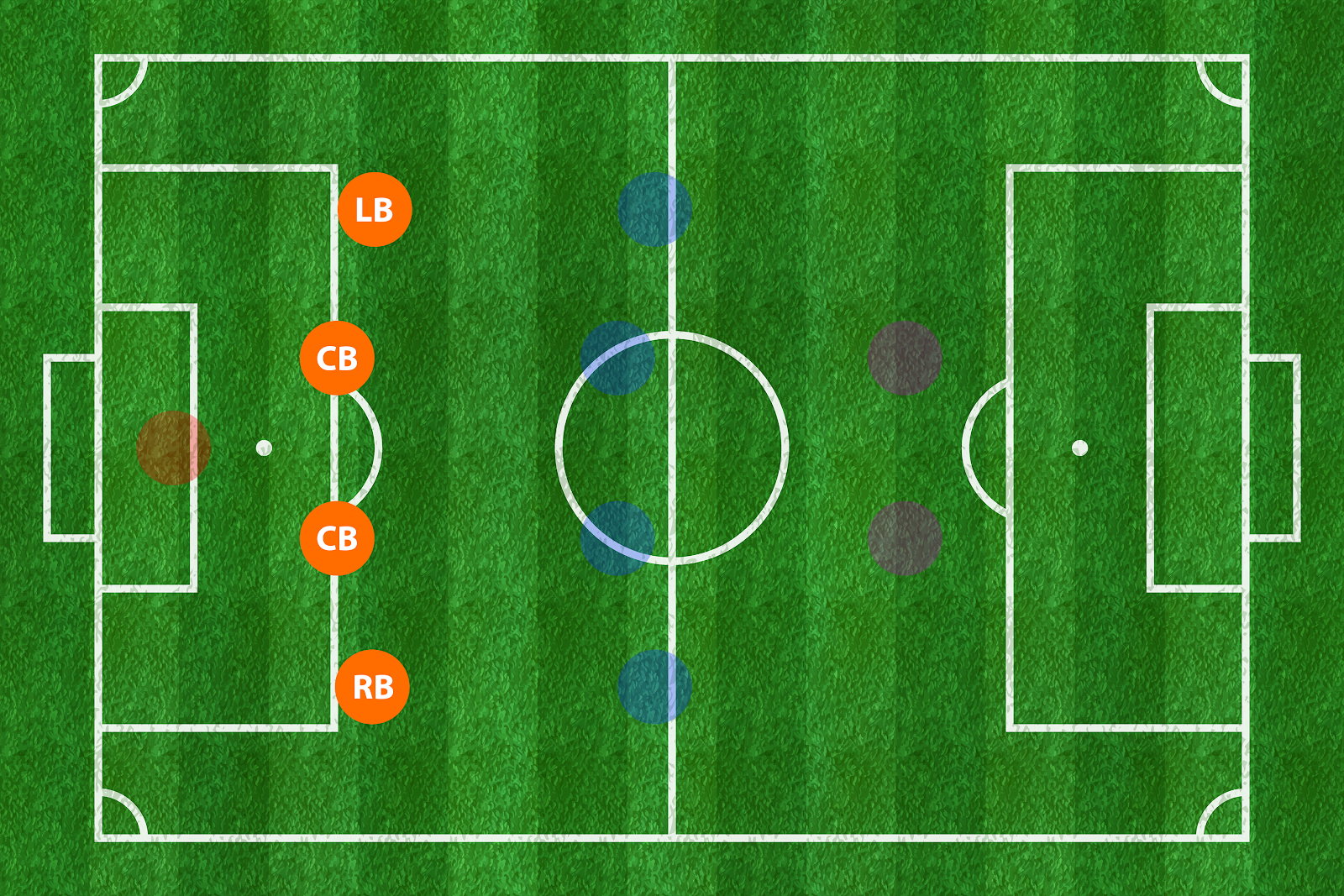
The defenders, also called the back line, will usually be 4 players. Sometimes it will be 3, and sometimes 5, but we’ll focus on the most common scenario of 4 for this explanation. There are different types of defenders, but here we’ll examine the two most general: Center-Backs and Fullbacks. From left to right, they are referred to as the left back (LB), center back (CB), center back (CB), and right back (RB). The left and right backs are known as the fullbacks. Here is what the defending soccer positions look like in the 4-4-2 formation:
Soccer Center-Backs
The two center-backs are in the middle of the defense and are generally tall and strong (though not always). Often, the captain of the team is one of the center-backs. They are one of the positions most involved in organizing the rest of the team; being central and behind, they have a view of the full team at almost all times. They constantly deal with the opposing forwards and must ensure these opponents are always under pressure and never have enough space to receive the ball and play a dangerous pass or shoot. Below is a picture showing some of a centerback’s duties in defending the opposing forwards (shown as black circles), not letting them receive the ball close to the goal, and not letting them find space for a shot.
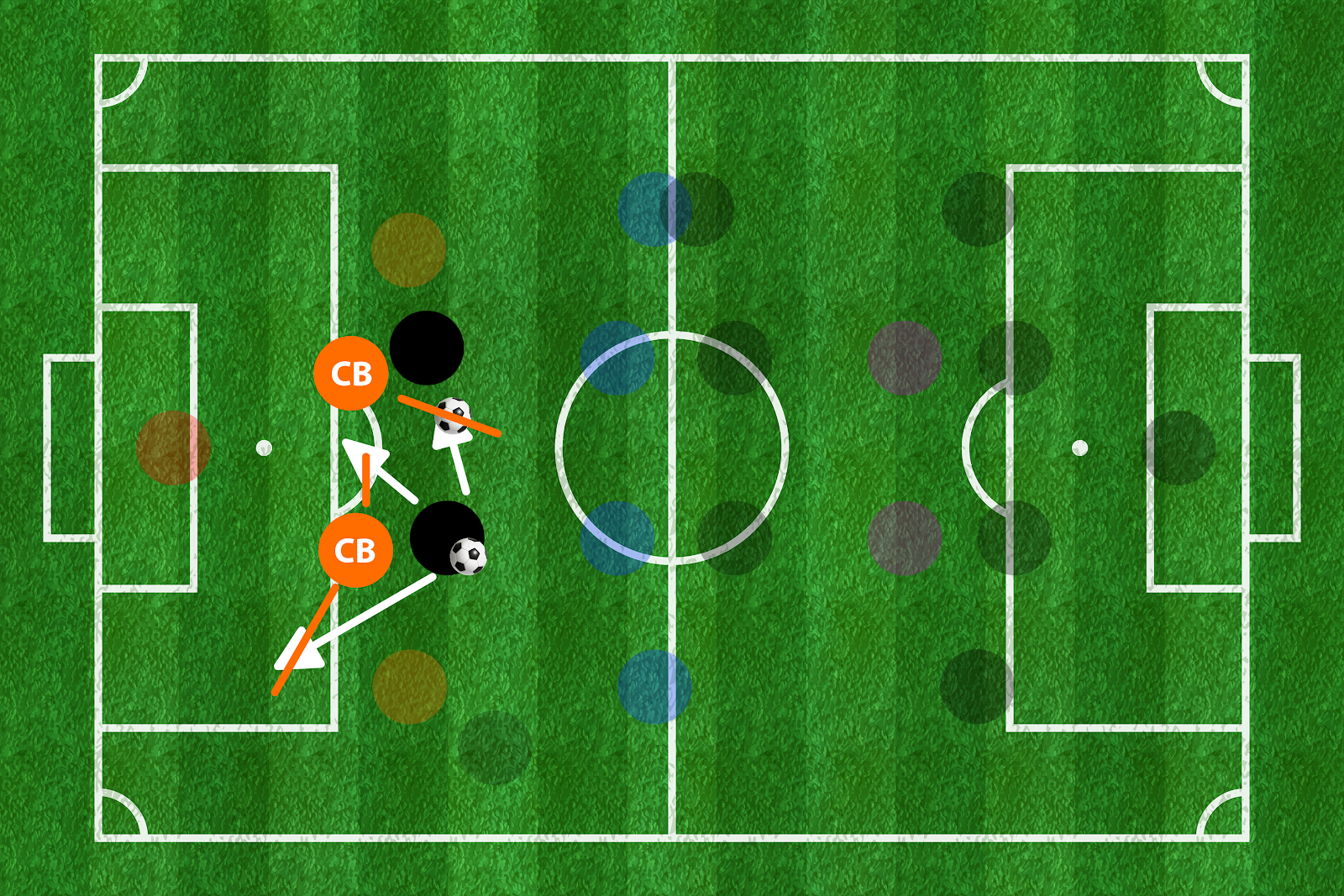
The white arrows show possible dribbling and passing paths for the forwards, and the orange lines show the responsibilities of the centerbacks to cut off the possible paths.
Depending on the team’s strategy, the center-backs might also be commonly involved in a practice called ‘playing out of the back’. When a team has the ball with their goalkeeper or defense, which happens frequently, they have two very general options:
- A long, usually in the air, pass up the field to a forward
- Play out of the back
Playing out of the back refers to a focus on playing on-the-ground passes with the aim of moving the ball from defense to midfield to forwards and into the opposing goal. This strategy generally results in a team having a larger percentage of ball possession (time spent with the ball), however, it can be risky as defenders might lose the ball trying to play out of the back if a pass is intercepted by an opposing forward, who will then have won the ball very close to the goal.
Soccer Fullbacks
The fullbacks, or right and left backs, are the outside defenders. Not always, but often they are not quite as large as the center-backs and are faster with impressive stamina. They are also more involved in the attacking play than centerbacks, usually joining when their team is attacking on their side of the field (meaning a right-back is likely to join an attack down the right side of the field). On defense, fullbacks are dealing with the opposing team’s wide midfielders or wingers (which we’ll explain soon), and are often in a 1v1 scenario where the opposing player has the ball and will try to dribble by them. This opposing player has 2 very general choices in this scenario: dribble outside and ‘down the line’ (meaning down the outside of the field), and cross the ball in, or dribble inside and look to create a scoring opportunity. The fullback must be ready to stop both of these, making speed and quality 1v1 defending essential. Here is the situation the fullback often faces when defending, the black circles representing the other team:
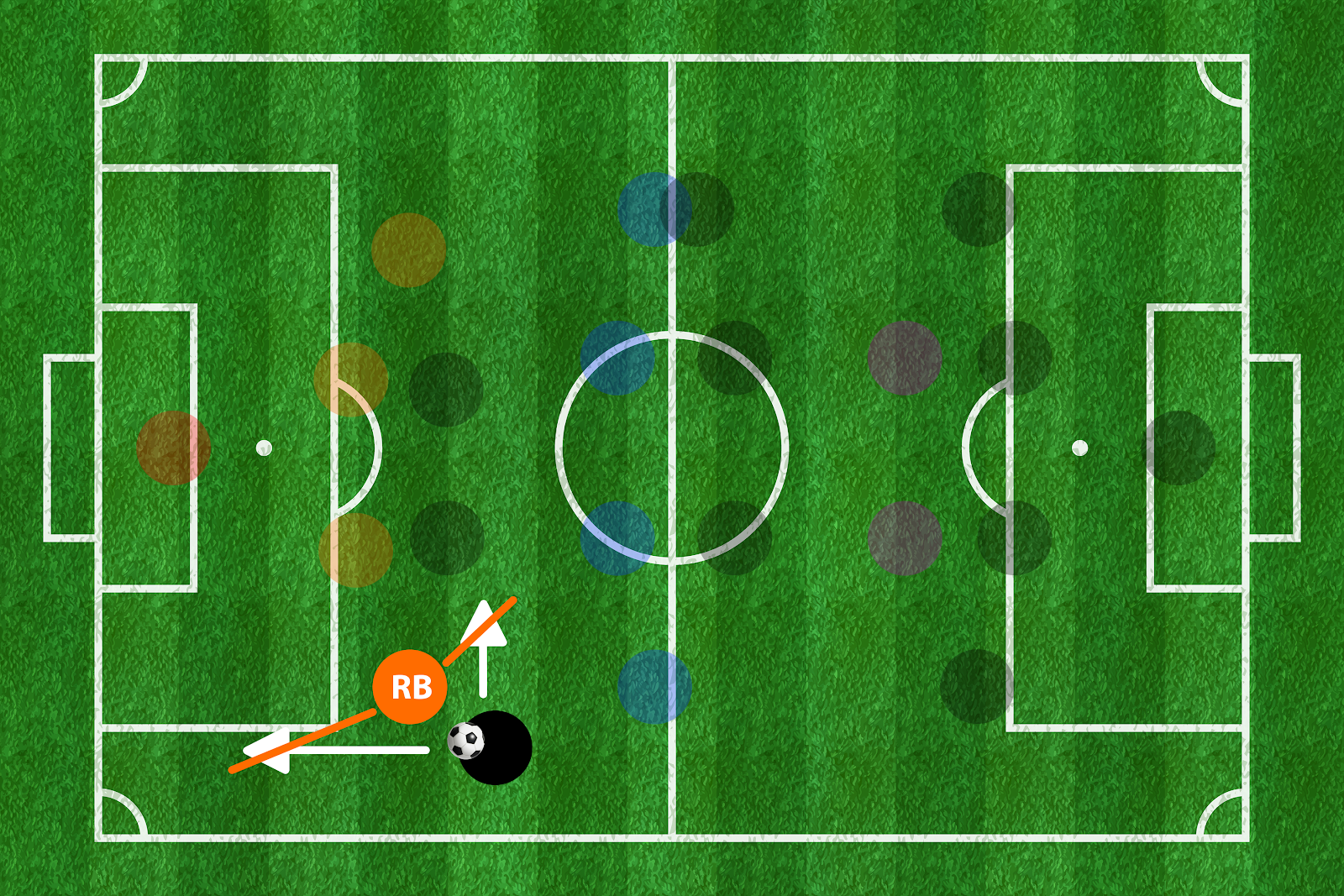
As seen, the right back needs to be ready to defend this opponent whether they dribble the ball inside the field or ‘down the line’.

Soccer Midfielders
Like defenders, midfielders can be broken into two general categories: wide and center. Midfield formation varies, but in the 4-4-2, there are 2 central and 2 wide, just like the defenders. Here are the midfield soccer positions in a 4-4-2:
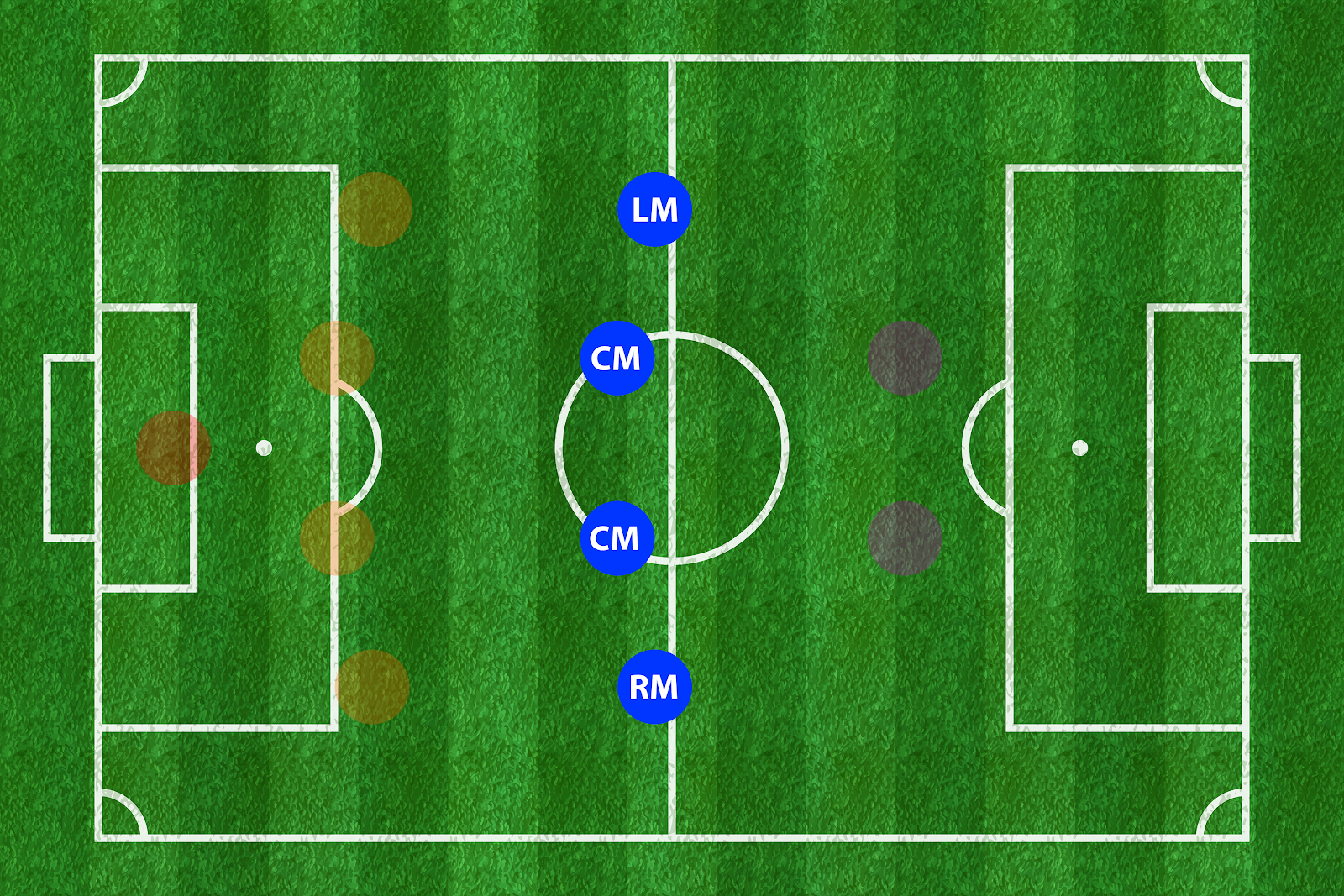
Soccer Central Midfielders
The role of central midfielders is to help defend and win the ball back, maintain possession through passing, move the ball from defense to attack, and ultimately create scoring opportunities. They are involved in both defense and offense. Central midfielders are smart and technical players, able to read the game and predict the movements of both teammates and opponents, and play accurate and quick passes. They must know what is happening around them at all times. Here are three options for a center midfielder with the ball (marked CM), from top to bottom in the picture below:
- The other central midfielder drops back and is open to pass to
- The central midfielder with the ball dribbles around the opposing midfielder and plays a pass that puts their forward in on goal
- The central midfielder finds an open pass to the right midfielder.
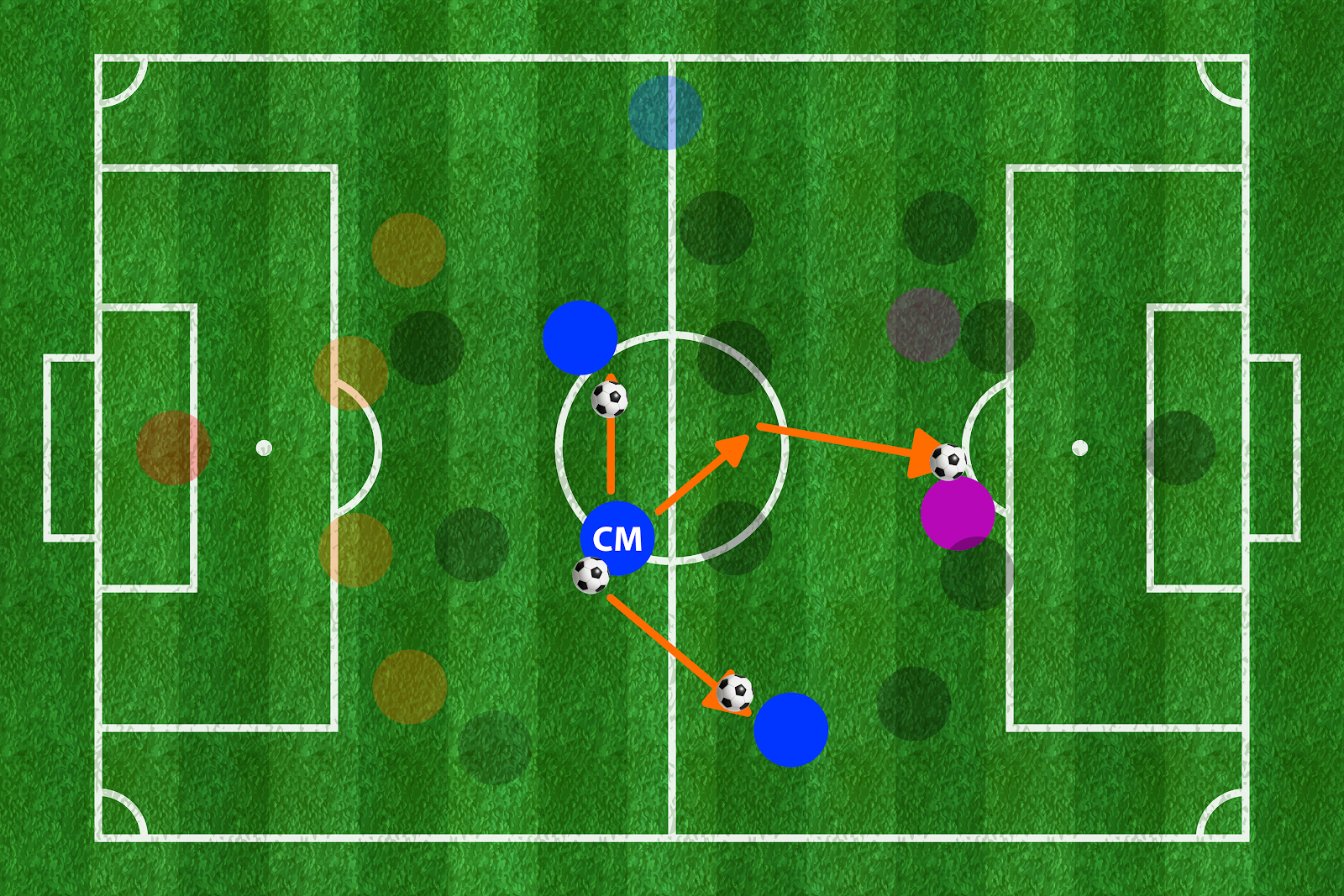
This shows three possibilities of what the center midfielder with the ball (marked CM) might do, depending on the positions of teammates and opposing players. Effective decision-making is critical for central midfielders, as they have many different possibilities to quickly determine which is the right pass to play.
Soccer Wide Midfielders
Teams generally play with either wide midfielders or wingers (we’ll cover wingers in the next section). Wide midfielders play along the left or right side of the field and provide a passing outlet for their defenders and central midfielders. They will often try to either find a pass into the forwards or take the ball down the line and cross it in, both shown here:
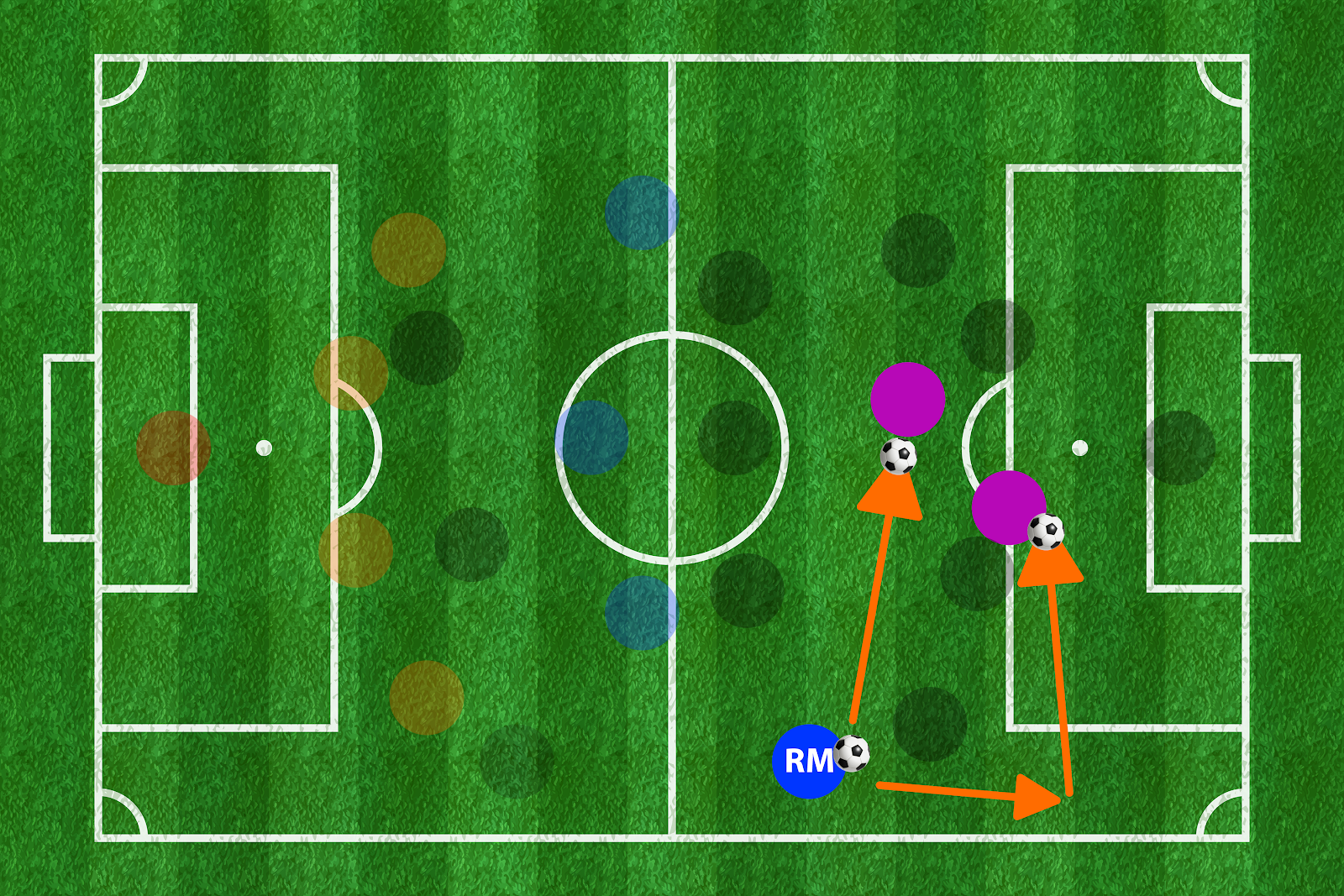
The right midfielder in this picture has two options, to pass to their center forward, or to dribble outside and cross the ball in for the center forwards to score off of.
However, wide midfielders still have defensive duties, often needing to drop back and help defend against opposing fullbacks (the right and left defenders) who have come forward. The wide midfielder will also sometimes drop back to defense if one of their own team’s fullbacks has gotten far up and joined the attacking play.
Soccer Forwards
In a 4-4-2, there are 2 center forwards (also called strikers). Often. 1 of them will play a little bit behind the other, but they might be in the same line as well or change back and forth throughout the game. Here is what they look like in the same line in a 4-4-2:
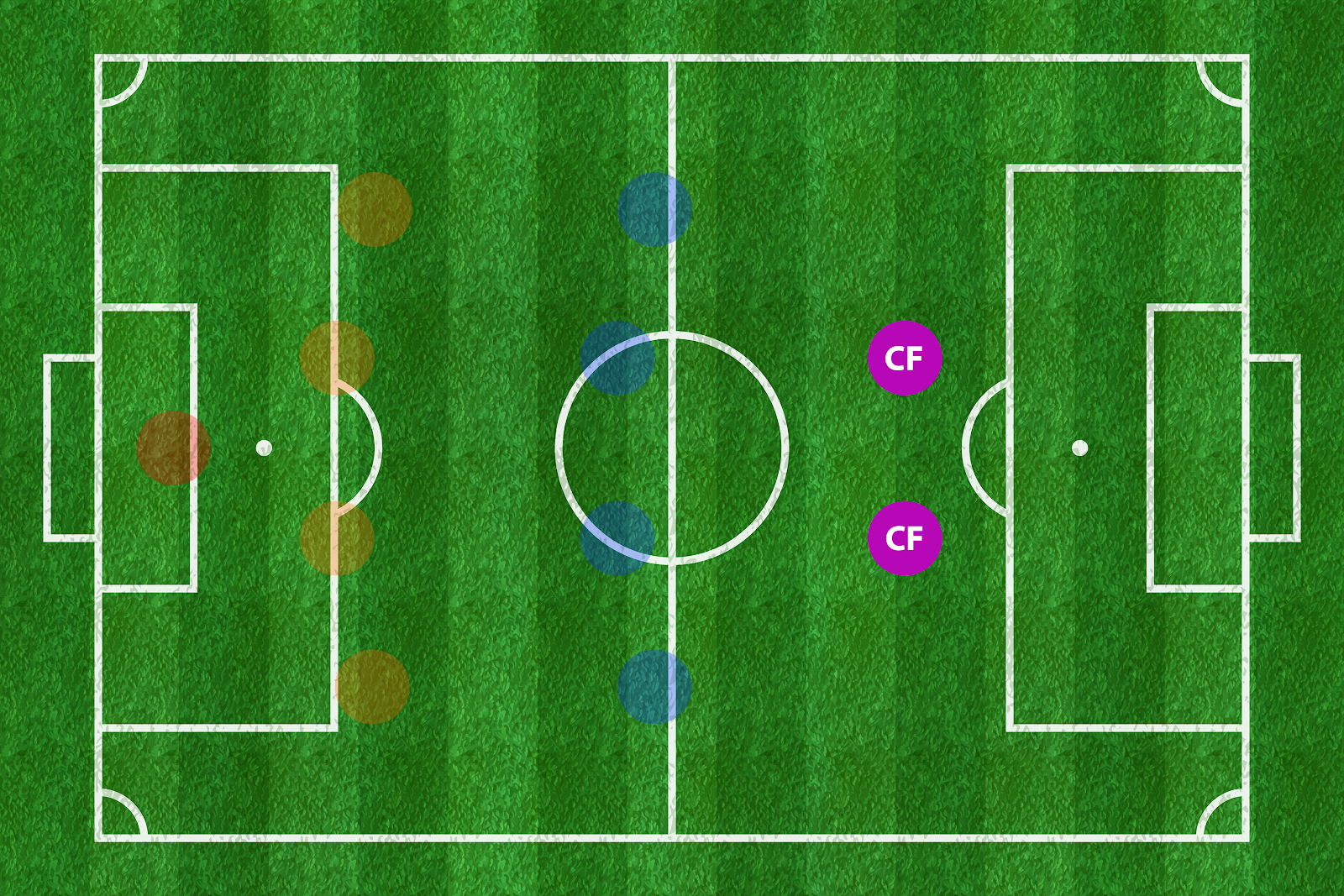
Soccer Center Forwards
The main job of center forwards in soccer is to score. They are always looking to get behind the opposing team’s center backs and in a 1v1 situation with the goalie. They will also occasionally drop back a little to help their team with passing when needed (though usually, only one at a time will do this). Center forwards vary in playstyle and physical attributes, but they are always very effective finishers (heading, scoring off a cross, etc.). Here is a typical center-forward run and finish that often results in a goal. The arrow behind the center forward shows their run to escape the opposing center-backs and meet the cross from their wide midfielder.
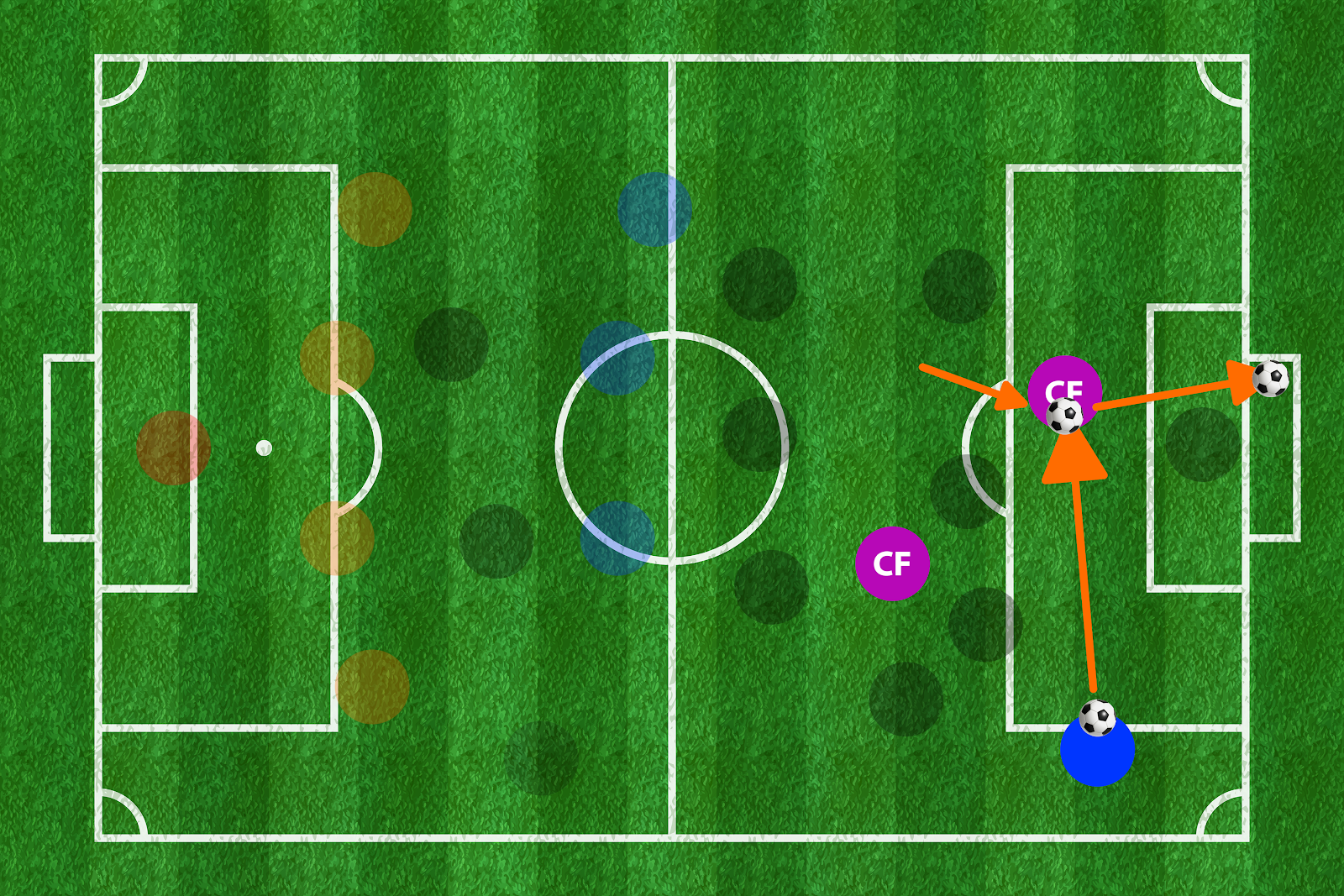
In this scenario, the wide midfielder crossed the ball to meet the center forward’s run, who scored with one touch. Scoring with one touch means that as the ball approached the forward, they immediately shot it towards the goal with their first touch, rather than taking a touch to control the ball first. Usually, a forward in this situation won’t have time to take two touches (one to control, one to shoot), so it’s important they are effective at shooting with their first touch (which can be difficult depending on how fast the incoming pass is and how fast they are running).

Wingers and a 4-3-3
We have now covered all the soccer positions in a 4-4-2; however, another type of forward commonly used doesn’t appear in a 4-4-2. This type of forward is a winger, which you can think of as a wide midfielder who plays further up the field, or a forward who plays far to the left or right side. The most common soccer formation involving wingers is a 4-3-3. Here is what that looks like, with the wingers labeled (LW for left-wing, RW for right-wing).
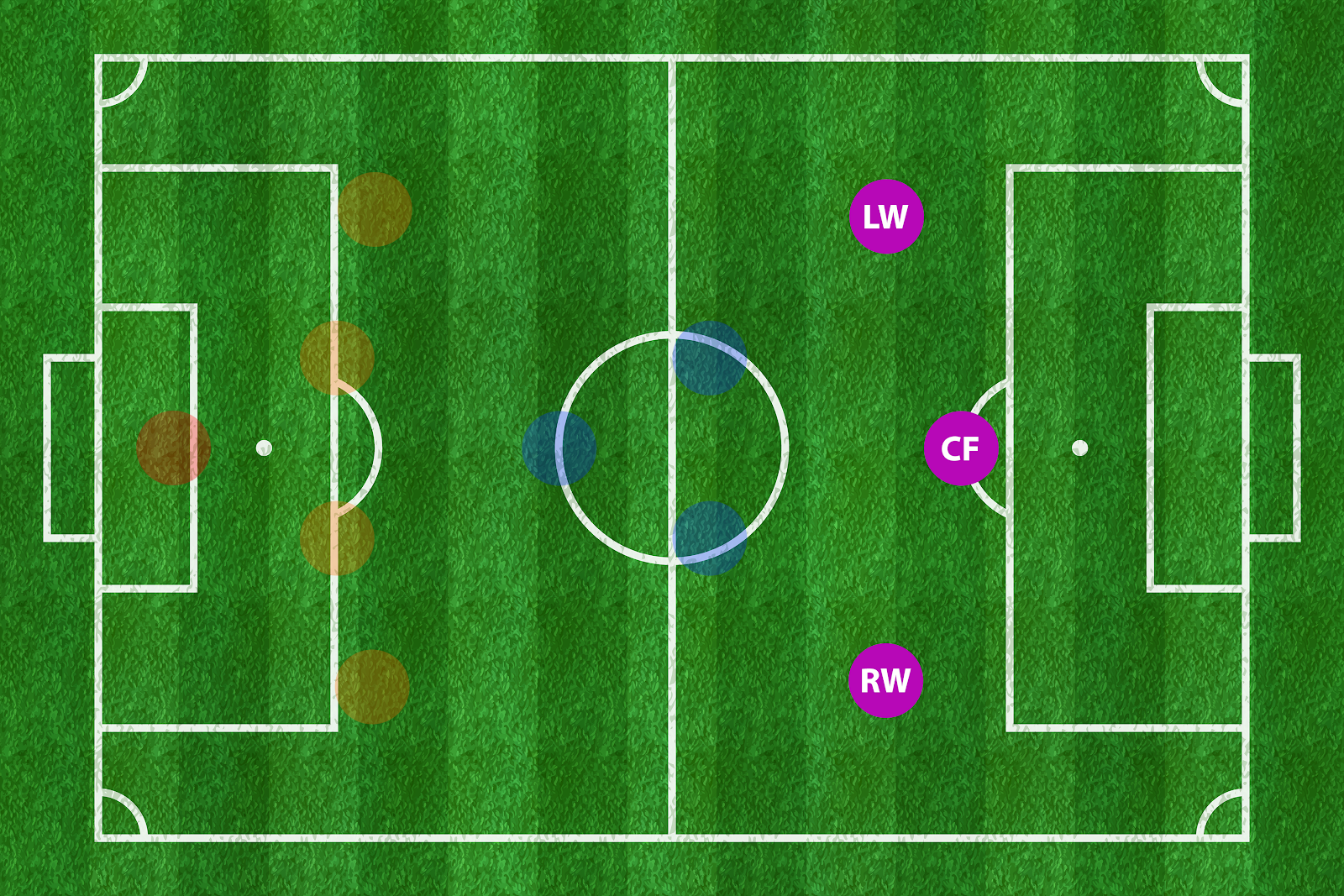
As you can see, in a 4-3-3 there are 3 central midfielders, 2 wingers, and 1 center forward. The midfielders are now structured differently, with 1 being more defensive and 2 being more attacking, and wingers are used instead of wide midfielders. Wingers are effectively a more attacking version of the wide midfielders. Wingers are often fast players and generally very skilled at dribbling in 1v1 scenarios (often against the opposing fullback, as we covered before in the fullback section). They will constantly look to either dribble down the line and cross the ball into their forwards, or cut inside and find a shot on goal, both shown here:
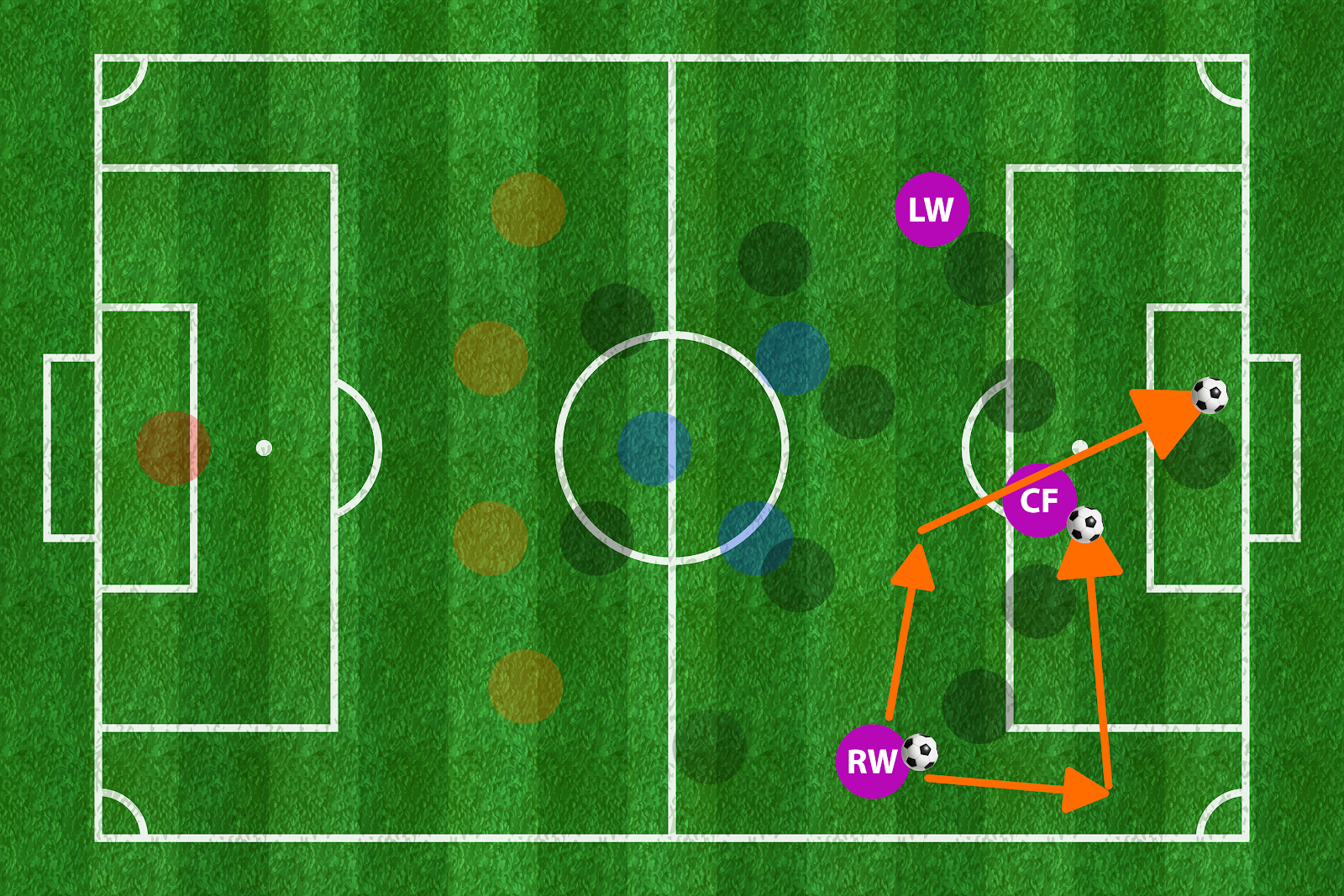
The first option shows the winger dribbling the ball inside and finding an opening for a shot. The second shows the winger taking the ball ‘down the line’ (meaning outside the field, as the player stays close to the line) and crossing the ball in. You might notice that this crossing into the center forward is the same play that we highlighted when describing the center forward. This cross-and-finish is a very common way to score goals.
Modern Soccer Roles Explained
While traditional soccer positions such as goalkeeper, defender, midfielder, and forward remain the foundation of the game, modern soccer has become increasingly specialized. Coaches now assign players specific tactical roles that may differ significantly from their listed position. Understanding these modern roles can help players, parents, and fans better appreciate how the game is played today.
The Sweeper Keeper
A sweeper keeper is a goalkeeper who actively participates in play outside the penalty area. In addition to making saves, they help their team maintain possession by acting as an extra defender and initiating attacks from the back.
Responsibilities include:
- Playing accurate passes under pressure
- Clearing through balls behind the defense
- Supporting possession-based systems
- Organizing the defensive line
The Ball-Playing Center Back
Modern center-backs are expected to do much more than defend. A ball-playing center back helps start attacks by carrying the ball forward and making precise passes into midfield or attack.
Key qualities include:
- Strong passing ability
- Tactical awareness
- Composure under pressure
- Vision and decision-making
The Wing-Back
A wing-back combines the responsibilities of a fullback and a winger. They defend their side of the field while also providing width and attacking support.
Wing-backs are commonly used in formations such as 3-5-2 and 3-4-3.
Key responsibilities:
- Defending wide areas
- Delivering crosses into the box
- Supporting counterattacks
- Covering a significant distance during matches
The Holding Midfielder (The Number 6)
Often called the "anchor" of the team, the holding midfielder sits in front of the defense and helps maintain balance between attacking and defending.
Responsibilities include:
- Winning possession
- Breaking up opposing attacks
- Protecting the center backs
- Controlling the tempo of the game
The Box-to-Box Midfielder (The Number 8)
The box-to-box midfielder contributes across the entire field, supporting both defensive and attacking phases of play.
These players are often among the fittest athletes on the team because they are constantly involved in the action.
Key responsibilities:
- Supporting attacks
- Recovering defensively
- Linking defense and offense
- Creating scoring opportunities
The Playmaker (The Number 10)
The playmaker is the team's primary creator. Operating between midfield and attack, they look for opportunities to unlock defenses through vision, passing, and creativity.
Responsibilities include:
- Creating goal-scoring chances
- Delivering key passes
- Controlling attacking rhythm
- Finding space between defensive lines
The Inverted Winger
Unlike a traditional winger who stays wide and crosses the ball, an inverted winger plays on the opposite side of their dominant foot and frequently cuts inside toward goal.
For example:
- A left-footed player on the right wing
- A right-footed player on the left wing
This role often creates additional shooting opportunities.
The False 9
A false 9 is a striker who regularly drops into midfield rather than staying high near the opposing goal.
This movement can:
- Confuse defenders
- Create space for teammates
- Increase possession in attacking areas
- Improve build-up play
The Target Striker
A target striker serves as a focal point for the attack. These players typically use strength, size, and aerial ability to hold up the ball and bring teammates into play.
Responsibilities include:
- Winning aerial duels
- Holding possession under pressure
- Creating opportunities for runners
- Finishing crosses and set pieces
Why Modern Roles Matter
As soccer continues to evolve, players are increasingly valued for their ability to perform specialized tactical roles rather than simply occupy a position on the field. A midfielder may function as a deep-lying playmaker, a defender may become an attacking playmaker from the back, and a goalkeeper may help build attacks like an extra outfield player. Understanding these roles provides a deeper appreciation of modern soccer and helps players identify the skills they need to succeed in today's game.
What Is the Best Soccer Position for Me?
One of the most common questions among new players is, "What position should I play?" While every player is unique, certain physical attributes, skills, and personality traits often align naturally with specific positions on the field.
It's important to remember that many players experiment with several positions before finding the role that best suits their strengths. Young athletes, in particular, benefit from experiencing different positions to develop a complete understanding of the game.
If You Are Fast and Enjoy Running
Players with speed and stamina often excel in wide positions where they can use their pace to attack and defend.
Consider:
- Winger
- Fullback
- Wing-back
These positions require players to cover large areas of the field, create attacking opportunities, and track back defensively.
If You Are Strong and Physical
Players who enjoy challenges, aerial battles, and one-on-one defending often thrive in central defensive roles.
Consider:
- Center Back
- Defensive Midfielder
These positions require strength, positioning, and the ability to win possession under pressure.
If You Love Passing and Creating Opportunities
Players with strong vision and decision-making skills often become the team's creative engine.
Consider:
- Central Midfielder
- Attacking Midfielder
- Playmaker
These positions allow players to control possession, connect teammates, and create scoring chances.
If You Like Scoring Goals
Players who enjoy finishing attacks and being near the goal may be best suited for attacking positions.
Consider:
- Striker
- Center Forward
- False 9
Successful attackers combine movement, anticipation, confidence, and finishing ability.
If You Enjoy Defending and Reading the Game
Some players naturally enjoy stopping attacks and protecting their teammates.
Consider:
- Center Back
- Fullback
- Defensive Midfielder
These positions reward tactical awareness, discipline, and strong decision-making.
If You Have Quick Reflexes and Fearlessness
Goalkeepers are often fearless competitors who enjoy taking responsibility and making crucial saves.
Consider:
- Goalkeeper
Strong communication skills, concentration, and courage are essential traits for success in goal.
Soccer Positions by Player Traits
| Your Strength | Potential Positions |
|---|---|
| Speed | Winger, Fullback, Wing-back |
| Strength | Center Back, Defensive Midfielder |
| Creativity | Attacking Midfielder, Playmaker |
| Endurance | Box-to-Box Midfielder, Wing-back |
| Finishing Ability | Striker, Center Forward |
| Tactical Awareness | Center Back, Defensive Midfielder |
| Quick Reflexes | Goalkeeper |
Can You Change Positions?
Absolutely. Many successful players have changed positions throughout their careers as they developed new skills, gained experience, or adapted to their team's needs. Young players should focus on building a complete skill set rather than specializing too early.
The best soccer position is ultimately the one that allows a player to contribute to the team while enjoying the game and continuing to develop their strengths.
Soccer Positions in Different Game Formats
Not all soccer matches are played with 11 players per team. Youth soccer often uses smaller-sided formats to help players develop technical skills, decision-making, and game awareness. As players progress through the age groups, the number of players on the field typically increases.
Understanding how positions work in different game formats can help players adapt as they move through their soccer journey.
Soccer Positions in 7v7 Soccer
Many younger players begin playing in a 7v7 format, which provides more touches on the ball and greater involvement in the game.
A common 7v7 formation is:
- Goalkeeper (1)
- 2 Defenders
- 3 Midfielders
- 1 Forward
In 7v7 soccer, players often take on multiple responsibilities. Defenders may join the attack, while forwards may be expected to help defend.
Key skills developed in 7v7:
- Ball control
- Passing and receiving
- Dribbling
- Decision-making
- Spatial awareness
Because there are fewer players on the field, every player is involved in both attacking and defending phases of play.
Soccer Positions in 9v9 Soccer
As players develop, many leagues transition to a 9v9 format. This serves as a bridge between small-sided soccer and the full 11v11 game.
A common 9v9 formation is:
- Goalkeeper (1)
- 3 Defenders
- 3 Midfielders
- 2 Forwards
At this stage, players begin learning more specialized positional responsibilities while still maintaining versatility.
Important concepts introduced in 9v9 include:
- Team shape
- Defensive organization
- Width and depth
- Positional discipline
- Combination play
Many coaches use 9v9 soccer to help players understand the tactical principles that will later be required in the full game.
Soccer Positions in 11v11 Soccer
The traditional version of soccer is played with 11 players on each team.
The positions typically include:
- Goalkeeper
- Fullbacks
- Center Backs
- Midfielders
- Wingers
- Forwards
Common formations include:
- 4-4-2
- 4-3-3
- 4-2-3-1
- 3-5-2
In 11v11 soccer, players generally have more specialized responsibilities and must understand how their role fits within the team's overall tactical system.
Key skills emphasized include:
- Tactical awareness
- Positioning
- Communication
- Team coordination
- Transition play
Why Small-Sided Soccer Matters
Many of today's top professional players developed their skills in small-sided games before progressing to full-sided soccer. Smaller formats provide more touches, more decision-making opportunities, and more involvement for every player.
Whether playing 7v7, 9v9, or 11v11, the fundamental objective remains the same: work together as a team to create scoring opportunities while preventing the opposition from doing the same.
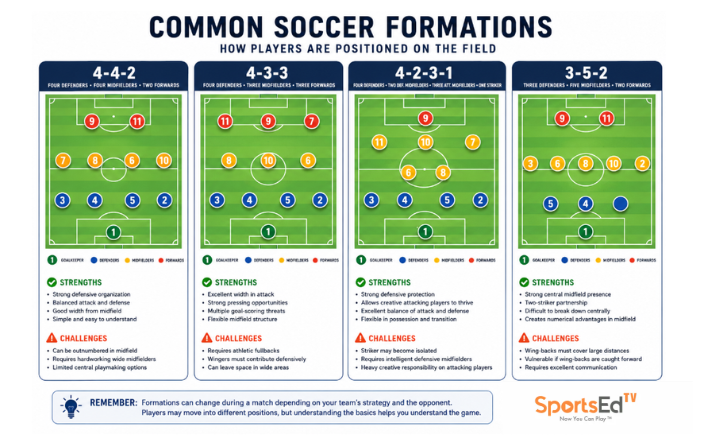
Common Soccer Formations and How Positions Work Together
While positions describe where individual players typically operate on the field, formations describe how an entire team is organized. A formation determines the balance between defense, midfield, and attack, helping coaches create a style of play that matches their team's strengths.
Modern teams may adjust their shape throughout a match, but understanding the most common formations helps players better understand their role within the team structure.
The 4-4-2 Formation
The 4-4-2 is one of the most recognizable formations in soccer.
Typical Setup:
- Goalkeeper
- 4 Defenders
- 4 Midfielders
- 2 Forwards
Strengths
- Strong defensive organization
- Easy for players to understand
- Balanced attack and defense
- Good width from midfield
Challenges
- Can be outnumbered in midfield
- Requires hardworking wide midfielders
- Limited central playmaking options
The 4-4-2 remains popular because of its simplicity and balance, making it a common formation at youth, amateur, and professional levels.
The 4-3-3 Formation
The 4-3-3 emphasizes attacking play, width, and ball possession.
Typical Setup:
- Goalkeeper
- 4 Defenders
- 3 Midfielders
- 3 Forwards
Strengths
- Excellent width in attack
- Strong pressing opportunities
- Multiple goal-scoring threats
- Flexible midfield structure
Challenges
- Requires athletic fullbacks
- Wingers must contribute defensively
- Can leave space in wide defensive areas
Many elite clubs and national teams use variations of the 4-3-3 because it provides a strong balance between possession and attacking creativity.
The 4-2-3-1 Formation
One of the most widely used formations in modern soccer, the 4-2-3-1 provides defensive stability and attacking flexibility.
Typical Setup:
- Goalkeeper
- 4 Defenders
- 2 Defensive Midfielders
- 3 Attacking Midfielders
- 1 Striker
Strengths
- Strong defensive protection
- Allows creative attacking midfielders to flourish
- Excellent balance between attack and defense
- Flexible in possession and transition
Challenges
- Striker may become isolated
- Requires intelligent defensive midfielders
- Heavy creative responsibility on attacking players
This formation is particularly effective for teams with a talented Number 10 and disciplined defensive midfielders.
The 3-5-2 Formation
The 3-5-2 relies heavily on wing-backs to provide width while maintaining strength through the center of the field.
Typical Setup:
- Goalkeeper
- 3 Center Backs
- 5 Midfielders
- 2 Forwards
Strengths
- Strong central midfield presence
- Two-striker partnership
- Difficult to break down centrally
- Creates numerical advantages in midfield
Challenges
- Wing-backs must cover large distances
- Vulnerable if wing-backs are caught forward
- Requires excellent communication among defenders
Teams using the 3-5-2 often rely on energetic wing-backs who contribute significantly in both attack and defense.
Which Formation Is Best?
There is no single "best" formation in soccer. The ideal formation depends on:
- Player strengths
- Team philosophy
- Opponent tactics
- Match situation
- Available personnel
The most successful coaches build systems around their players rather than forcing players into a system that doesn't fit their abilities.
Position vs. Formation: What's the Difference?
A position describes an individual player's role, such as goalkeeper, center back, midfielder, or striker.
A formation describes how all eleven players are arranged on the field.
For example, a striker remains a striker whether the team plays a 4-4-2, 4-3-3, or 4-2-3-1. However, their responsibilities may change depending on the formation and tactical approach.
Understanding both positions and formations gives players a more complete understanding of how soccer is played and why teams use different tactical systems to achieve success.
Conclusion
That covers the basics of formations, goalkeepers, central defenders, fullbacks, central midfielders, wide midfielders, center forwards, and wingers. Watching professional games is a great way to further understand the various soccer positions and how they move and relate to each other. The games get more entertaining to watch the more you understand about the soccer positions, as there are so many intricate relationships and patterns that play out every match between these different positions. There’s a reason it’s called the beautiful game!
Follow SportsEdTV Soccer on Facebook and Instagram to stay up-to-date with the latest free pro-level soccer education