Altitude and climate significantly impact soccer performance more than most players realize. Playing in a cold environment is different from playing in hot weather, and playing at sea level is not the same as competing at a high altitude, where oxygen levels are lower. All of these environmental factors directly influence a player’s physical and mental performance, stamina, and even technical execution.
Understanding how altitude and climate impact the body allows players and coaches to adapt their training, tactics, and recovery strategies for better results. Every game is different, with unique environmental factors that challenge a player’s ability to maintain focus, endurance, and consistency throughout the match.
With the FIFA World Cup coming to North America in 2026, where professional soccer players will compete across diverse environmental conditions—from extreme heat and humidity to high-altitude locations—understanding how these external factors affect match performance has become increasingly crucial for team-sport athletes.

How do Altitude and Climate Affect Football Performance?
As a soccer player looking to achieve optimal performance, it is essential to focus on the things you can control, which include things like your work ethic, mindset, training routines, network, sleep, nutrition, hydration, EMF exposure, and overall recovery habits, since these directly influence how well your body adapts to different environmental conditions. Since you cannot control the weather, you need to learn to adapt to it through thoughtful preparation, the right soccer training gear for that scenario, and proper recovery strategies.
Below are 5 of the most significant ways environmental conditions can influence your game.
Altitude and climate significantly impact soccer performance more than most players realize. Playing in a cold environment is different from playing in hot weather, and playing at sea level is not the same as competing at a high altitude, where oxygen levels are lower. All of these environmental factors directly influence a player’s physical and mental performance, stamina, and even technical execution.
Understanding how altitude and climate impact the body allows players and coaches to adapt their training, tactics, and recovery strategies for better results. Every game is different, with unique environmental factors that challenge a player’s ability to maintain focus, endurance, and consistency throughout the match.
With the FIFA World Cup coming to North America in 2026, where professional soccer players will compete across diverse environmental conditions—from extreme heat and humidity to high-altitude locations—understanding how these external factors affect match performance has become increasingly crucial for team-sport athletes.
How do Altitude and Climate Affect Football Performance?
As a soccer player looking to achieve optimal performance, it is essential to focus on the things you can control, which include things like your work ethic, mindset, training routines, network, sleep, nutrition, hydration, EMF exposure, and overall recovery habits, since these directly influence how well your body adapts to different environmental conditions. Since you cannot control the weather, you need to learn to adapt to it through thoughtful preparation, the right soccer training gear for that scenario, and proper recovery strategies.
Below are 5 of the most significant ways environmental conditions can influence your game.
High Altitude vs Sea Level Conditions
Playing soccer at high altitude versus sea level is very different because of changes in air pressure, reduced oxygen availability, and how the body produces energy and recovers during high-intensity exercise. At moderate to high altitudes, oxygen availability decreases, making it harder for players to breathe and potentially affecting performance if they are not conditioned adequately through altitude training before the competition.
At lower altitudes, or near sea level, the oxygen availability is higher, allowing players to sustain higher sprint performance and recover faster between sprints. This means that if players who are used to training at a lower altitude, such as sea-level natives, have to travel to a game at a higher altitude, they may experience faster fatigue, heavier breathing, and reduced running performance, giving high-altitude natives a competitive edge.
Hot Conditions and Heat Stress
When playing soccer in hot conditions, players can experience an increase in core temperature, faster dehydration, and overall higher physiological demands on the body, depending on how hot it is. If your body is not used to or capable of absorbing the sun's intense heat, or if it is actually extremely hot, it can lead to overheating, early fatigue, and decreased physical performance during matches.
In these situations, heat stress doesn't just affect stamina, but it can also affect a player’s decision-making and technical execution, making it harder to stay composed and energetic throughout the full 90 minutes. The best ways to deal with the heat include staying properly hydrated, allowing enough recovery time between sessions, and gradually exposing your body to hot environmental conditions through heat acclimatization.

Cold Weather and Energy Demands
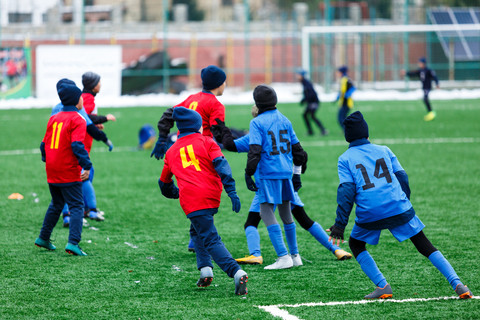
On the other hand, playing in cold weather challenges the body in completely different ways. Low ambient temperatures can reduce muscle flexibility, slow reaction time, and increase the body’s energy demands as it works harder to provide warmth.
Without proper warm-ups, layers, and preparation, players may experience stiffness, a higher risk of injury, and a decrease in technical skills and match performance. The best ways to deal with the cold include doing a longer and more dynamic warm-up, wearing thermal or moisture-wicking layers, and staying active during breaks to maintain blood flow.
Humidity and Hydration Demands
Humidity is another environmental factor that can impact soccer performance because it prevents sweat from evaporating properly, which makes it harder for the body to regulate core body temperature during high-intensity exercise. This environmental stress leads to increased physiological responses, faster dehydration, and greater physical demands, which can decrease match performance even in conditions that aren't extremely hot.
The best ways to deal with high humidity include increasing your hydration intake before, during, and after soccer matches, wearing lightweight, breathable gear, and gradually increasing your exposure to that type of environment.

The Wind and Ball Control
Finally, the wind is another external factor that creates unique challenges for soccer performance whenever it is present. Strong winds can directly influence ball trajectory, passing accuracy, and shooting precision, forcing players to adjust their technique and decision-making.
It can also affect running performance by increasing physical effort when moving against the wind, though not by a significant amount, and by altering the pace of the game. Learning to read wind direction and adapt your technical skills accordingly — such as keeping passes lower to the ground, adjusting shot power, and being patient with your timing — can help minimize the impact of wind on your match performance.