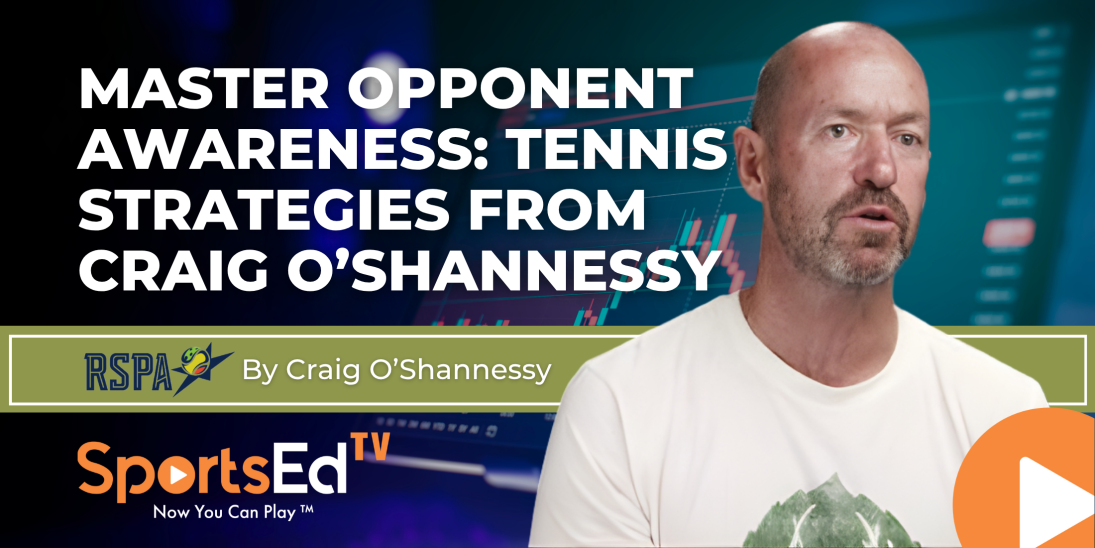
When most players step on court, they’re focused on themselves — their forehand technique, footwork patterns, or mental focus. But according to strategy expert Craig O’Shannessy, that’s not how great match play works.
In his Opponent Awareness webinar, O’Shannessy — the world’s leading tennis strategy analyst — reveals a mindset shift that separates winners from the rest:
“You are the second most important person on the court.”
This concept, simple yet powerful, forms the foundation of smarter tennis. It’s not just about what you do with the ball — it’s about how you make your opponent react.
What Is Opponent Awareness in Tennis?
Opponent awareness is the ability to read and understand the player across the net — their tendencies, emotional patterns, and weaknesses — and then build your game plan around that information.
It’s one of the least trained yet most valuable skills in tennis strategy.
When most players step on court, they’re focused on themselves — their forehand technique, footwork patterns, or mental focus. But according to strategy expert Craig O’Shannessy, that’s not how great match play works.
In his Opponent Awareness webinar, O’Shannessy — the world’s leading tennis strategy analyst — reveals a mindset shift that separates winners from the rest:
“You are the second most important person on the court.”
This concept, simple yet powerful, forms the foundation of smarter tennis. It’s not just about what you do with the ball — it’s about how you make your opponent react.
What Is Opponent Awareness in Tennis?
Opponent awareness is the ability to read and understand the player across the net — their tendencies, emotional patterns, and weaknesses — and then build your game plan around that information.
It’s one of the least trained yet most valuable skills in tennis strategy.
“Opponent awareness was my secret weapon growing up,” Craig shares. “I wasn’t the best player technically, but I learned how to outthink my rivals and make them beat themselves.”
That mindset helped him win matches against players who were, on paper, better — higher-ranked, more powerful, and more experienced.
The Missing Element in Modern Tennis Training
In today’s tennis world, junior and adult players often spend endless hours on the practice court — hitting with ball machines, perfecting repetition drills, or training in academies.
But O’Shannessy believes that’s only half of player development.
“You can hit 300 backhands and feel like you’ve improved,” he says, “but until you face an opponent trying to beat you, you’re not learning how to compete.”
The key? Play more sets.
When Craig was growing up in Australia, he played as many as 30 sets a week. There were no structured academies, few coaches, and no video analysis.
Every match sharpened his tactical sense — his ability to see patterns, spot emotional cracks, and adjust strategy in real time.
That’s what opponent awareness builds: tennis intelligence.
Opponent Awareness and the Mental Game
Tennis is as much a mental game as a physical one.
Understanding your opponent’s psychology can often swing a close match in your favor.
O’Shannessy teaches players to look for specific signs:
-
How an opponent reacts after missing a key point
-
Which serve they rely on under pressure
-
Whether they avoid certain patterns late in sets
-
How quickly they recover after mistakes
These are not random details — they’re clues to your opponent’s mental state. When you can read those cues, you can control the flow of the match.
“In many matches, your opponent is looking for an excuse to beat themselves. Your job is to help them find it.”
How to Develop Opponent Awareness
You don’t need advanced analytics to start using this skill. Every player — from juniors to adults — can improve their opponent awareness by following these steps:
-
Play real sets regularly – Drills don’t teach pressure; matches do.
-
Watch closely – Use warm-ups and early games to study tendencies.
-
Test your opponent – Change tempo, direction, or serve patterns and observe reactions.
-
Take mental notes – After each match, write down what worked and what didn’t.
Over time, this builds your match IQ — your ability to make smart decisions when it matters most.

Why Opponent Awareness Is the Future of Tennis Strategy
At the pro level, tennis has already evolved. Data-driven match play shows that winning the shorter rallies (0–4 shots) is far more important than long baseline exchanges.
Yet even more critical is understanding why those rallies unfold the way they do — and that starts with reading your opponent.
Developing opponent awareness helps players:
It’s the foundation of tactical tennis and a core focus of Craig’s teaching across all levels of the game.
Watch the Full Webinar: Learn from Craig O’Shannessy
This blog introduces the core message of Craig’s Opponent Awareness Webinar — one of his most insightful and personal sessions yet.
In the full 90-minute program, Craig breaks down:
-
How to analyze opponents effectively
-
Real examples from ATP and WTA matches
-
Psychological tools to stay one step ahead
-
Data-driven strategies that apply to every level of play
Watch the full webinar now at Brain Game Tennis and take your match play strategy to the next level.
Final Takeaway
You can’t win tennis matches by hitting balls alone.
To compete at any level, you must understand who you’re playing — not just how you’re playing.
Opponent awareness turns tennis into a thinking player’s game — where strategy, observation, and mental sharpness matter as much as power and precision.