Tennis
Why Money Can’t Buy Tennis Champions: The Grand Slam Nations’ Dilemma
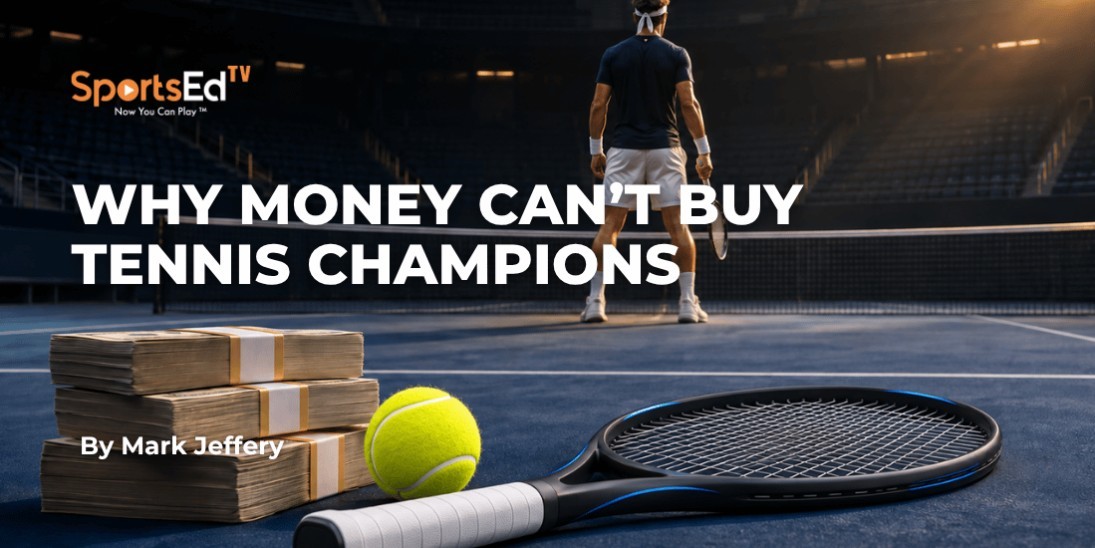
Great Britain, the USA, Australia and France stage the Grand Slams and run the richest federations in tennis. So why do so few of their players reach the year-end finals? Money can buy almost everything in tennis. It can't buy the last 4%.
Count the flags
This week, the tennis season ends twice. The WTA Finals crown their champions at Indian Wells, and on the same day the Nitto ATP Finals begin in Turin.
Eight singles players and eight doubles teams at each. Forty-eight places in all, for the best of the best of the best.
Now count the flags.
Four countries stage the Grand Slams: Great Britain, the United States, Australia and France. Those four tournaments generate most of the money in tennis, and much of it flows straight back to their national federations.
So you'd expect those four countries to fill the finals.
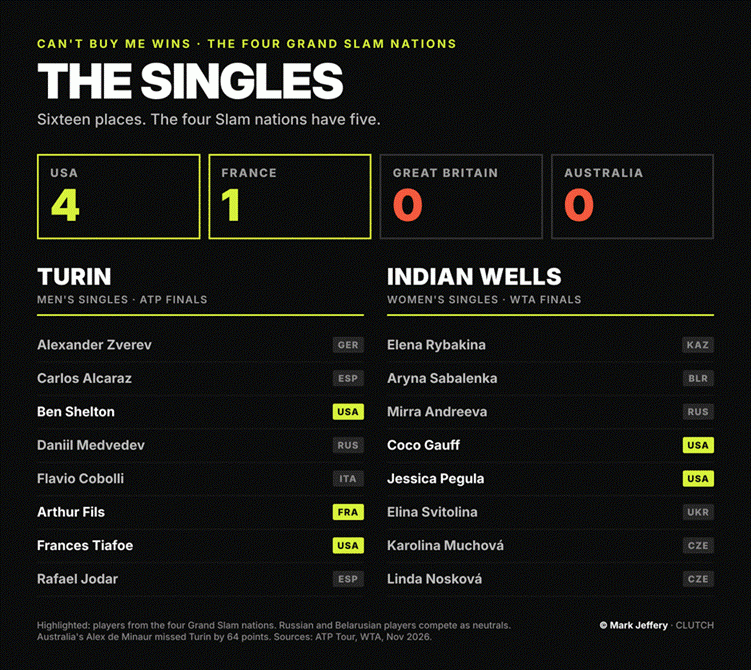
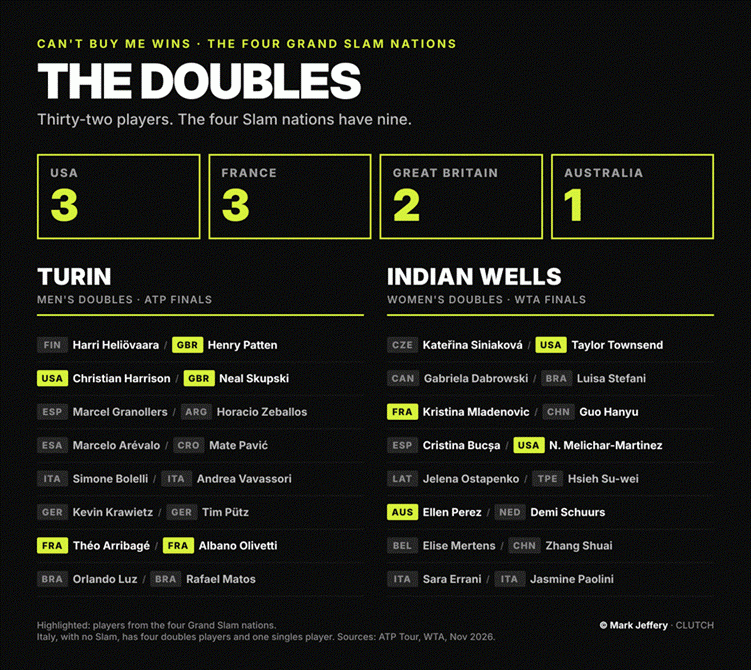
They don't. Of the 48 places, 14 belong to the Slam nations, and half of those are American.
In singles, the picture is starker. The United States has four of the 16 singles players: Ben Shelton and Frances Tiafoe in Turin, Coco Gauff and Jessica Pegula at Indian Wells. France has one, Arthur Fils. Great Britain and Australia have none. Australia's best hope, Alex de Minaur, missed Turin by 64 points after eleven months of tennis.

Doubles is kinder. Great Britain has Henry Patten and Neal Skupski. France has three players, Australia has Ellen Perez, and the USA has three more.
Meanwhile, Italy, which has no Slam at all, has five places on its own. The Czech Republic, a country of about eleven million people, has two women in the singles. Great Britain, with Wimbledon, has none.
Follow the money
This isn't a money shortage.
Wimbledon passes 90% of its surplus to the LTA, under a contract that runs until 2053. That's roughly £40–50 million every year. The US Open earns more than half a billion dollars, almost 90% of the USTA's income. Tennis Australia's revenue is approaching A$700 million a year.
Courts. Coaches. Academies. Sports science. Wildcards. Everything money can buy, these four countries can buy.
Britain even built a £40 million National Tennis Center at Roehampton. Within two years it was being criticized for waste, and for not producing world-class players.
The excuses don't survive
We're not a tennis nation. It's in the genes. Football takes all the athletes.
Italy demolishes all three. Fifteen years ago, Italy wasn't a tennis nation either. Football took its athletes too. And genes don't change in fifteen years.
What changed was the system. The Italian federation moved its funding away from a single national center and into local clubs and private coaches, so young players could stay at home with the coach who knew them best. It staged more professional tournaments at home. And it changed what was coached: tactics before technique, the serve and the return before endless forehands and backhands.
That isn't a change of budget. It's a change of homework.
What money can buy, and what it can't
The Beatles sang that money can't buy you love. Tennis is learning that it can't buy you wins either.
Money can buy talent identification. It can buy beautiful ball striking. It can buy fitness, footwork, physios, analysts, and the best racket on the market. It can take a player all the way to world-class.
But at the top, everybody has all of that. Every player in Turin and Indian Wells has the coach, the physio, and the data. When everybody has everything, money stops being the difference.
What decides the narrow win from the narrow loss happens in the three inches between the ears.
So can money buy identity: who you know yourself to be, and what you know you're capable of, when it's all on the line?
Can money buy the ability to observe your thoughts at 5-5, 30-40, second serve, rather than become them? Because what you think drives what you feel. What you feel drives your emotions. And your emotions drive the outcome.
You can buy a forehand. You can't buy what you whisper to yourself before you hit it.
Mark Petchey has described money as both a blessing and a curse for British tennis: when it's always there, bad decisions don't hurt. Money removes the consequence. And when you remove the consequence, you remove the pressure, the very thing a player most needs to train in.

Great genes, great attitude, and doing the homework
After my stroke, my neuroscientist summed up my recovery in eight words: “Great genes, great attitude, and doing the homework.” I think the same words explain the flags in Turin.
Genes. A country is a collection of families, and what a family passes on is partly DNA, but mostly a childhood: what's normal, what's at stake, how hungry you are. Novak Djokovic grew up training in Belgrade while the city was being bombed. Serbia didn't hand him different DNA. It handed him a different childhood.
Attitude. That childhood becomes daily habits and behaviors. Repeat them long enough, and they stop being things you do. They become who you are.
Homework. This is where the gap opens. A bucket of balls teaches you to hit the ball well. It doesn't teach you to be hard to beat, to win, or to be clutch.
Train like Red Flag
During the Vietnam War, the US Air Force noticed that pilots who survived their first ten combat missions were far more likely to survive their whole tour. So in 1975, it created Red Flag to give pilots those first ten missions in training: every skill brought together, under realistic pressure. Surgeons are now adopting the same stress exposure training.
Most tennis training still works in silos: technique, fitness, footwork, and the mental side, one at a time. Bring them together under simulated pressure, again and again, and something new emerges. A skill of its own.
Clutch.

Your country doesn't decide how clutch you are
You can't choose your genes, your federation, or where the Slams are played. You can choose your homework. And homework starts with knowing where you stand.
Take the Clutch Quotient Diagnostic. Nine questions. It shows how clutch you are today, as a player, as a person and under pressure, and where your homework begins.
Take it here: clutchquotient2026.scoreapp.com
Turin and Indian Wells invite eight. This one is open to everyone.
Mark Jeffery is the founder of T.R.U.S.T. and CLUTCH, a tennis coach and author.