Mental Toughness, Tennis
There Is No “Clutch Gene”: What Tennis Research Says About Performing Under Pressure

Every tennis player has watched a match like this. Two competitors, evenly matched, deep into a deciding set. On paper, either could win. But before the last point is played, it becomes clear who is going to find a way, and who is going to find a way to lose.
Commentators call it mental toughness. Fans call it heart. For decades, the assumption has been that some players are simply wired for the big moments, and others are not.
Research into psychological pressure in professional tennis challenges that assumption. There may be no mysterious “clutch gene” that makes certain players immune to pressure. Even the best players in the world are affected. And once you understand why, the whole conversation about pressure in tennis changes.
What Does Science Say About Clutch Performance in Tennis?
Research involving more than 650,000 points played at Grand Slam tournaments found that psychological pressure increases the likelihood of performance errors, including unforced errors and double faults. Importantly, successful players were not immune.
Other research has found that players can differ in their ability to perform on particularly important points. Put together, the evidence suggests something more interesting than the traditional idea of mental toughness: pressure affects everyone, but how effectively a player responds to it can matter enormously.
That makes clutch performance less mysterious, and potentially more trainable.

The Study
Researchers analyzed more than 650,000 points across all four Grand Slams played between 2016 and 2019, building a pressure index for every point based on the score, the stage of the match, and whether it was a break point. They then tracked how often players committed unforced errors and double faults as that pressure rose.
The result was clear: as pressure increased, so did the error rate. That confirms what most players already sense: that big points are harder to execute than small ones.
The researchers also found a compounding effect. Making an error on one point increased the probability of another error on the next. Pressure does not necessarily exist inside one isolated point. It can carry forward.
Do Elite Tennis Players Become Immune to Pressure?
Here is where it gets interesting. The researchers also examined whether successful players appeared less vulnerable to pressure and previous mistakes.
They found little evidence that winning players were somehow immune. The tendency for execution to deteriorate under pressure was present even among elite performers.
That does not prove that every player responds identically to pressure, nor does it prove that individual differences do not exist. In fact, other research suggests that professional players do differ in how successfully they perform on especially important points.
But it does challenge the simplistic idea that the best competitors possess some special psychological shield that prevents pressure from affecting them.
Pressure, in other words, does not discriminate. It affects everyone’s execution, including the very best players in the world.
Why This Matters More Than It Sounds
That might sound discouraging: nobody is naturally immune to pressure. But flip it, and it is the opposite.
If clutch performance is not simply a fixed gift that some players possess and others do not, then players who consistently find a way in tight matches may be relying on something that has been built: technical execution rehearsed under pressure, decision-making practiced when consequences matter, and emotional responses experienced often enough that they no longer feel unfamiliar.
That is very different from simply repeating strokes thousands of times in low-stakes practice.
This lines up with related research. Not all points carry equal weight, and performance on a relatively small number of high-leverage points can have an enormous influence on the outcome of a match. Other analyses suggest players can also behave more cautiously at score lines that matter most, reflecting our natural tendency to weigh potential losses more heavily than equivalent gains.
Put together, the picture that emerges is not simply one of certain players being “mentally stronger.” It is of pressure as a distinct performance domain, separate from stroke technique and separate from fitness, and one that may be under-trained relative to how much it decides matches.
A Real-World Illustration: Djokovic’s Two Lost Years
In June 2016, Novak Djokovic won the French Open to complete the career Grand Slam, reaching arguably one of the most dominant positions the sport has ever seen. Within eighteen months, everything looked different.
He had lost his world No. 1 ranking, surrendered his Wimbledon and US Open titles, suffered a significant elbow problem, and eventually slid outside the world’s top 20 after a run of injuries and unexpected losses.
His tennis ability had not simply disappeared. The serve, the return, the movement and the extraordinary technical foundation were still there. But injury, confidence, competitive rhythm, coaching changes and execution had stopped lining up the way they once had.
Then, at Wimbledon in 2018, it turned. Djokovic won the title and by the end of the season had climbed all the way back to world No. 1, completing one of the most remarkable ranking recoveries in modern tennis. He then began another extraordinary period of Grand Slam dominance.
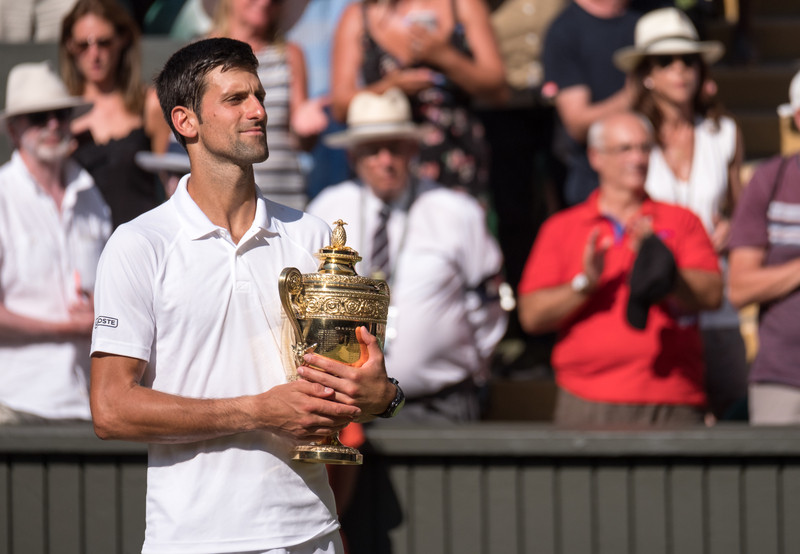
Djokovic’s comeback does not prove a pressure-training hypothesis. Injury rehabilitation, coaching, physical preparation and numerous other factors were involved. But it illustrates something important: even one of the greatest competitors in tennis history can move through periods when technical ability and competitive execution no longer align.
The skill exists. The challenge is accessing it when it matters.

How Can Tennis Players Train to Perform Under Pressure?
This mirrors how high-stakes professions outside sport approach performance. Aviation and emergency medicine do not wait for the real event to teach the skill. The cost of learning live is too high.
Instead, they train in realistic simulations repeatedly until the correct response becomes familiar before it is ever needed in a real situation.
Tennis training has historically focused heavily on the technical and physical sides of the game: stroke mechanics, footwork, conditioning and repetition. Much of that work takes place in environments where the consequence of missing one ball is almost zero.
Competition is different. At 30-30 late in a deciding set, the same forehand suddenly carries a completely different psychological weight.
The research suggests that executing under pressure deserves deliberate, repeated attention just like a backhand or a serve. It should not simply be left to whatever psychological response a player happens to bring onto the court that day.
The next time a close match turns on a handful of points, it is worth remembering: the player who finds a way is not necessarily the more talented one. They may simply be the player who has become better prepared to execute when the point feels different from every other point.
Can You Actually Train Clutch Performance?
Here is the practical question. If pressure affects execution, can you train yourself to perform better when it rises?
There are good reasons to believe that pressure response can be trained. But first, you need to know where you start.
Think of it like a satnav: it is useless until it knows your current location. Pressure training works the same way. Before anyone can build a route toward executing better under pressure, they need to know where their own game begins to change when pressure rises.
Most players have never had that measured. They simply have a vague sense that they tighten up on break points, stop going for their shots, play too safely, rush, or lose trust in their serve. But they rarely know precisely where the change happens, how frequently it happens, or which situations produce it.
That is the gap the CQ Diagnostic, the Clutch Quotient Diagnostic, was built to help identify: showing players where their performance changes on the points that can quietly decide matches.
The CQ Diagnostic is a practical assessment tool, not the research study itself. Its purpose is to turn the broader question raised by the science — what happens to my performance under pressure? — into something an individual player can examine.
Once you understand your starting point, training can become specific instead of generic.
Sometimes the Difference Is Only a Few Points
Tennis has an unusual scoring system. You can win almost as many points as your opponent and still lose the match.
That means a very small number of high-leverage points can sometimes separate winning from losing. In an extremely close match, changing the outcome of only a few decisive points can change the scoreline entirely.
Under the right circumstances, two crucial points can be the difference between losing two tiebreak sets and winning them. That is why learning to execute when the score creates pressure can have an outsized effect.
Then something better can happen. Once executing the decisive point has been rehearsed enough that it stops feeling exceptional, that confidence can begin influencing the rest of the match. You commit earlier, hesitate less, and trust patterns that have already survived pressure.
The objective is not to somehow switch on a magical clutch mode at 6-6. The objective is to make the behaviors required under pressure part of your normal game.

There Is No Magic Gene
There is no evidence that the greatest tennis players simply carry a biological switch that turns them into different human beings when the score gets tight.
Pressure affects them too. Research suggests that it increases errors even at the highest level of the sport. Research also suggests that players differ in how successfully they perform on important points.
That difference matters.
And if at least part of that response can be measured, rehearsed, and trained, then what we casually call “clutch” becomes something far more useful than a compliment commentators give after a match.
It becomes a performance skill. And every skill starts with understanding where you are today.
You can take the CQ Diagnostic here: https://cqdiagnosticv1.scoreapp.com

Sources
González-Díaz, J., Gossner, O., & Rogers, B. W. (2012). Performing best when it matters most: Evidence from professional tennis. Journal of Economic Behavior & Organization.
Additional research on point importance, decision-making, and behavioral responses to pressure in professional tennis informed this analysis.
About the Author:
Mark Jeffery is a former Army tennis champion and creator of the CQ Diagnostic, focused on training performance under competitive pressure