Grass court tennis remains one of the most fascinating and demanding forms of the sport. While most professional tournaments are played on hard courts or clay, grass presents a unique set of challenges that reward a very different style of player. Understanding how the surface affects movement, tactics, and shot selection helps players and fans appreciate why success on grass is considered one of tennis's greatest achievements.
The Surface That Started It All
Grass is not simply one of three tennis surfaces. It is the original surface — the one the sport was literally invented on. When the All England Lawn Tennis and Croquet Club held its first Championships in 1877, the surface wasn't a choice; it was the ground beneath their feet. Clay came later. Hard courts came much later. Grass was tennis.
That history matters because it explains why grass continues to hold a special place in the sport. Grass produces a style of tennis that cannot be replicated on any other surface: faster, lower, and more aggressive from the first ball. A single well-placed serve can end a point before the rally truly begins.
Understanding what makes grass different is not an academic exercise. It is the difference between watching grass court tennis and actually understanding what is happening.

The Physics: Why the Ball Behaves Differently
Everything about grass court tennis flows from one fact: the ball bounces differently here than anywhere else.
On a hard court, the ball grips the surface and launches upward at a predictable angle. On clay, the surface absorbs speed and kicks the ball high, giving the receiver time to reset. On grass, neither of those things happens.
Grass courts have lower friction, so the ball skids across the surface rather than gripping it. Vertical energy is absorbed by the living turf beneath, so the ball stays low after the bounce instead of rising. Horizontal speed is preserved, so the ball arrives at the opponent fast and flat.
The practical result is a lower contact point. What would be a comfortable waist-high ball on clay becomes a knee-high scramble on grass. Every shot requires more knee bend, quicker preparation, and less time to think.
Grass is also uniquely sensitive to external conditions. Temperature, humidity, and court wear all affect how the ball behaves, making it the least predictable of the three major tennis surfaces.
Grass vs. Clay vs. Hard Courts
How Grass, Clay, and Hard Courts Differ: Grass courts are the fastest tennis surface, producing a low, skidding bounce and rewarding aggressive play, strong serves, quick reactions, and effective net play. Clay courts slow the ball down, create a higher bounce, and favor patience, consistency, and endurance. Hard courts provide a middle ground with a more predictable bounce and balanced style of play. Each surface requires different movement patterns, strategies, and technical adjustments for success.
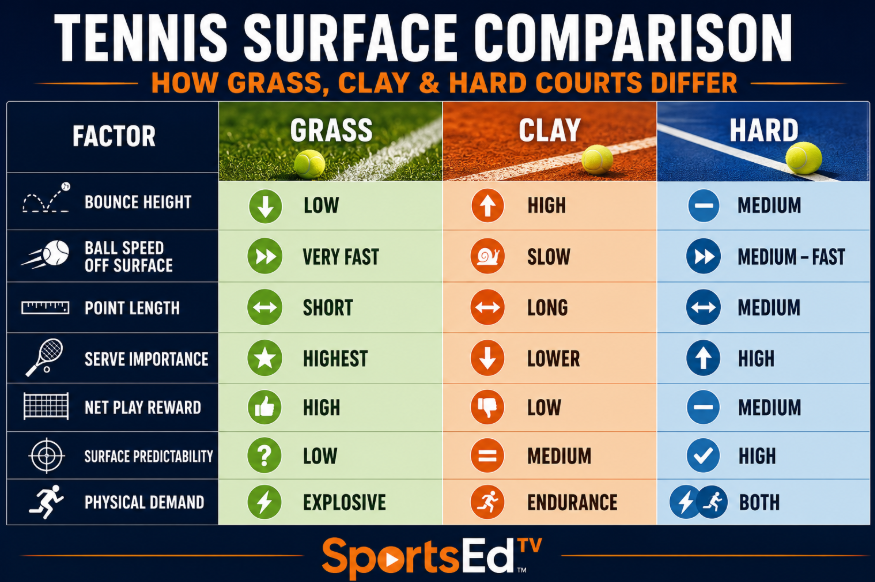
The contrast with clay is especially striking. Clay slows everything down, rewards patience and topspin, and punishes players who try to end points quickly. Grass rewards players who can attack and take time away from their opponents. Points that might become 15-ball rallies on clay often become three-ball exchanges on grass.
The Seven Qualities That Define a Great Grass Court Player
1. A Dominant Serve
No surface amplifies the serve like grass. The low bounce means kick serves stay low and jam the receiver. The flat ball speed means a well-placed first serve offers almost no time to react.
The serve matters in two ways. First, it wins free points directly through aces and unreturnable deliveries. Second, it dictates the tone of the rally before it starts. A quality first serve on grass forces a defensive return, giving the server the initiative from the very first shot.
Slice serves are particularly effective. A slice serve wide on the deuce court or into the body on the ad court skids through the grass and stays low, pulling receivers off the court or jamming them with little room to swing.
2. Instinctive Net Play
Historically, serve-and-volley was the defining tactic of grass court tennis. John McEnroe, Pete Sampras, Boris Becker, and Stefan Edberg attacked the net relentlessly because the surface rewarded forward movement.
Pure serve-and-volley is rarer today. Modern racket and string technology allows players to hit passing shots at speeds not possible in previous decades, and many grass courts have become slightly slower and more consistent. Yet the principle remains unchanged.
Net presence is rewarded on grass more than on any other surface because passing shots must often be struck from below knee height. Players who can move forward confidently and finish points at the net retain a major advantage.
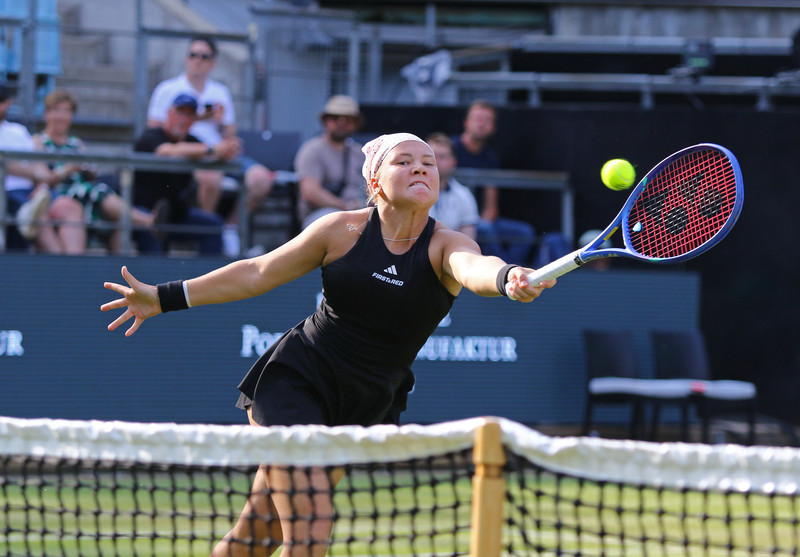
3. Explosive, Compact Footwork and Exceptional Balance
Grass court movement is unlike movement on any other surface. Sliding, common on clay, can be risky on grass because the footing is less predictable.
The footwork that succeeds on grass is compact, balanced, and efficient. The best movers use short adjustment steps, maintain a low center of gravity, and keep their weight centered throughout the point.
Grass court movement is not simply about speed. It is about balance. Players must constantly manage varying levels of traction across the court. The baseline areas become worn and firmer with use, while the outer areas often remain greener and more slippery. When moving wide to retrieve a ball, players must carefully control their center of gravity because those less-traveled sections can provide significantly less traction.
The first step is different as well. On hard courts, players can explode aggressively into the court. On grass, too much force can lead to a loss of footing. Elite grass-court players learn how to accelerate efficiently while maintaining balance and control.
This is one reason why Roger Federer is widely regarded as one of the greatest grass-court players in tennis history. His movement looked effortless, but it was built on extraordinary balance, body control, and the ability to change direction smoothly without losing stability.
4. Flat, Penetrating Groundstrokes
Topspin is one of the defining weapons of clay court tennis, but its effectiveness is reduced on grass because the ball does not bounce high enough to create the same discomfort.
Flat groundstrokes and slices become more valuable. A flat forehand driven through the court uses the speed of the surface to rush opponents. A sliced backhand can stay extremely low, forcing awkward contact and defensive replies.
The best grass court baseliners are often players who can flatten out their shots and take the ball early.
5. The Return of Serve
Returning serve on grass is arguably the most difficult task in tennis.
The returner must deal with pace, skid, low bounce, and reduced reaction time all at once. Successful returners often simplify their approach by blocking the ball back deep and neutralizing the server's advantage.
Many analysts consider Novak Djokovic among the greatest returners the sport has ever seen because of his ability to read serves, position himself effectively, and consistently put returns back in play under pressure.
6. Tactical Intelligence and Patience Under Pressure
Grass rewards aggression, but reckless aggression loses matches.
Players must know when to attack and when to absorb pressure. Service breaks are rare, which means a single poor decision can determine an entire set.
The best grass court competitors understand momentum, percentage tennis, and shot selection. They recognize which opportunities are worth pursuing and which situations require patience.
7. Adaptability
Grass is a living surface, and no two courts play exactly the same.
Some courts play faster than others. Weather conditions can influence speed and bounce. Even within a single match, worn areas and changing conditions can alter how the ball behaves.
The best grass court players adapt continuously. They adjust positioning, shot selection, and risk tolerance based on what the court is giving them.

How Modern Grass Court Tennis Has Evolved
The serve-and-volley era largely faded in the early 2000s as grass courts became more consistent and racket technology evolved.
The goal was not to eliminate aggressive tennis but to encourage a broader range of playing styles. The result is a modern grass-court game that features more baseline exchanges while still rewarding first-strike tennis.
Grass generally remains the fastest surface used at the highest levels of the sport. Serving, returning, taking the ball early, and moving forward remain critical skills.
Throughout tennis history, the most successful grass-court players have been those willing to adapt their games to the unique demands of the surface. Champions such as Roger Federer, Pete Sampras, Martina Navratilova, Novak Djokovic, and Carlos Alcaraz have all demonstrated how serving, movement, balance, and tactical variety become even more important when playing on grass.
Five Things to Watch During Grass Court Matches
Watching grass court tennis becomes much more interesting when you know what to look for.
Wide serves followed by aggressive first shots
Many points are won within the first two shots of the rally.
Blocked returns instead of full swings
Players often use the server's pace rather than trying to create their own.
Slice backhands
The slice becomes a powerful attacking weapon on grass.
Players moving forward
Expect more net approaches than on clay courts.
Movement and balance
Watch how the best players stay balanced when changing direction and moving into the less-worn portions of the court.
What Makes Wimbledon Unique
While grass-court tournaments are played around the world, Wimbledon remains the most famous grass-court event in tennis.
The All England Club's courts are known for balancing speed with consistency, rewarding complete players rather than simply the biggest servers.
The tournament's two-week format adds another layer of complexity. Players must adapt not only to opponents but also to a living surface that changes over time.
Although technology, equipment, and training methods continue to evolve, the unique demands of grass court tennis remain unchanged.
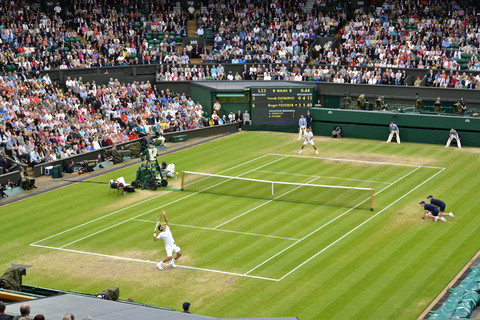
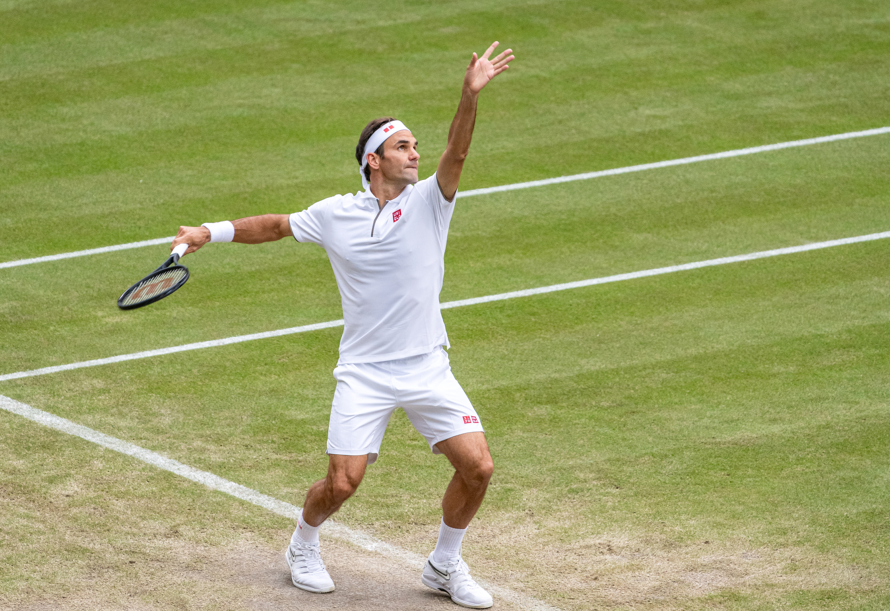
Wimbledon 2012 men's semi-final, Roger Federer versus Novak Djokovic
Frequently Asked Questions About Grass Court Tennis
Why is grass court tennis faster than clay?
Grass courts create less friction between the ball and the surface. The ball skids after the bounce and retains more speed, reducing the time available for opponents to react.
Why is Wimbledon played on grass?
Wimbledon is the oldest tennis tournament in the world and has maintained its grass surface since the event began in 1877.
Why are there more aces on grass courts?
The combination of low bounce, fast court speed, and reduced reaction time makes serves more effective and more difficult to return.
Is grass the hardest tennis surface to play on?
Many players believe grass has the steepest learning curve because of the low bounce, fast pace, and unique movement demands.
Why do some clay court specialists struggle on grass?
Clay rewards heavy topspin, long rallies, and defensive skills. Grass rewards aggressive positioning, flatter shots, quicker reactions, and more precise movement.
Which skills are most important on grass courts?
A strong serve, effective return of serve, compact footwork, balance, net play, tactical awareness, and the ability to take the ball early are all critical.
The Bottom Line
Grass court tennis demands a different version of every skill in the sport. The serve must be a weapon, not just a starting mechanism. Groundstrokes must be flatter and earlier. Movement must be compact and controlled. Net play must be genuine, not theoretical. And the mind must be prepared for short, high-pressure points where a single mistake can determine the outcome.
Whether watching Wimbledon, playing at a local grass-court club, or studying the tactics of the game's greatest champions, one truth remains constant: grass-court tennis rewards players who can take time away from their opponents while maintaining balance, precision, and control.
The serve becomes more dangerous, movement becomes more demanding, and every point carries greater urgency. That combination is what makes grass-court tennis one of the most distinctive and compelling challenges in all of sports.
About the Author
David Collins is an ATP and WTA tour coach with nearly three decades of experience developing professional players. A multiple Grand Slam-winning and Olympic Gold Medal-winning coach, he has worked with leading ATP and WTA athletes, including Grand Slam champions and finalists, helping guide players to major titles, ATP Masters 1000 victories, Wimbledon finals, and success on the world's biggest stages.
SportsEdTV offers free instructional videos, coaching insights, and educational content across more than 30 sports, including tennis. Explore serving, footwork, strategy, and match-play lessons at SportsEdTV.com.