 Sign in

Tennis
The Winter Nobody Trains: An 8-Week Tennis Plan to Win Under Pressure
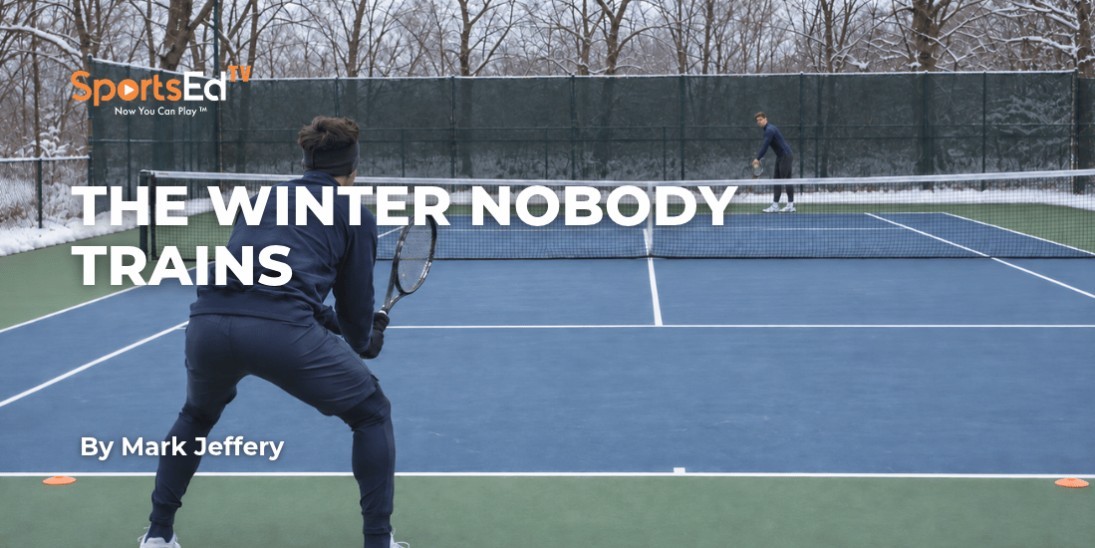
Winning tight tennis matches requires more than technical ability and physical fitness. It requires the ability to perform under pressure, maintain confidence, and execute winning patterns at critical moments. This eight-week winter tennis training plan helps players build mental toughness, improve decision-making, and develop the clutch skills needed to win more close sets, tiebreaks, and competitive matches.
Plutarch wrote that the Spartans were the only men in the world for whom war brought a respite from training.
Don't worry. This isn't a plan to turn you into a Spartan.
They trained from childhood to hold a narrow pass against an army many times their size. Your battle is much smaller, and much closer to home.
Two extra points at 30-all, at 5-all, or at 8-all in a tiebreak. One shot to close out the set. One point to save it.
But the Spartan principle still holds: when practice is harder than the moment, the moment feels like a rest.


Every year, the ATP and WTA Finals offer a powerful reminder of what separates champions from the rest. At the highest level of tennis, where technical and physical differences are often minimal, a handful of points can decide an entire season.
A player saves three set points. A doubles team survives match points in a semi-final and goes on to lift the trophy. A player produces their best tennis precisely when the pressure is greatest.
What most people miss is the preparation behind those moments. Professional players deliberately create training conditions that are more demanding than competition itself. They simulate pressure, rehearse difficult situations, and prepare for the points that matter most.
These moments are not simply a product of talent. They are the result of purposeful training.
The season is over. What happens next will help determine who wins the next one.

What the pros do now
The professional off-season is brutally short.
Most top players take ten days to a fortnight away from the game. Then they go straight into a pre-season block of three to eight weeks: gym, track, physio, and hours on court rebuilding the base.
Last year, Alcaraz started his pre-season on 13 December and was back on court four days later. By early January, most top players are competing again. The Australian Open main draw starts on 17 January.
What the rest of us do
The leagues finish. The evenings get dark. The courts get cold. Christmas arrives.
Most amateurs do one of two things. They stop altogether. Or they keep playing the same friendly doubles, the same warm-up, the same rhythm, with nothing riding on it.
Then January comes. The first league match. 5-5 in the first set against someone you should beat.
And the same feeling turns up, right on time. Tight arm. Short swing. The safe ball that sits up. Ten minutes later you're shaking hands, wondering where it went.
That isn't rust. It's the part of your tennis you've never trained.
The skill nobody trains
Ask club players what they work on in winter: the serve, the backhand, fitness.
I'd argue almost nobody trains clutch: the ability to play your best tennis when the score is tight and the result matters.
Which is strange, because that's the part that decides your season. Matches between players of a similar level are rarely decided by who hits the ball better. They're decided by those few points at 30-all, 5-all, and 8-all.
Talent is born. Clutch is made. And like a forehand, it gets better only if you train it.
The good news is that it doesn't need hours. It needs the right twenty minutes. Yes, you'll feel tired. It's intense and focused. But it's twenty minutes on the points that matter, not a Spartan boot camp.
Your clutch winter: four weeks of training, four of rehearsal
I've built an eight-week course, the course of the book I'm writing with Grand Slam coaches Vlado Pláteník and Dan Kiernan. Keep doing whatever you already do: lessons, drills, social play. The course adds what's missing.
Week 1 — Player.
Get your baseline. Count your tight sets from 2026: every 5-5, every tiebreak, every deciding set. How many did you win? That's your real ranking. Then choose one serve-plus-one pattern for 30-all, and own it.
Week 2 — Pressure.
Bring the scoreboard into every shot. Each shot of a two-shot combination has a target, placed halfway across the nearest white line, with a 4 ft 6 in corridor leading to it. Land in the corridor and you score. Land in the court but outside the corridor, and it's minus one. Win or lose, you get immediate feedback on every shot. Then play sets from 5-5 and tiebreaks from 3-6 down, with a consequence for losing.
Week 3 — Person.
Change the story you tell yourself at 5-5. After every session, bank one thing you did well under pressure. Evidence, not hope.
Week 4 — Clutch.
Bring it all together, and make practice harder than the match. Have your partner serve from inside the baseline. Play points where you must win two in a row to score one.
Weeks 5 to 8 — Rehearsal and perfect repetition.
Training builds it. Rehearsal makes it yours. Perfect reps, every session, right through Christmas until the Australian Open starts in mid-January.
Let me be clear: we don't train technique. Your coach has your forehand. We train what makes up clutch. The patterns. The drills. The targets. The scoring. The shift in identity. And getting past the thoughts that turn up at 5-5.
By the time the Australian Open starts, "I win tight ones" won't be a hope. It will be a habit.

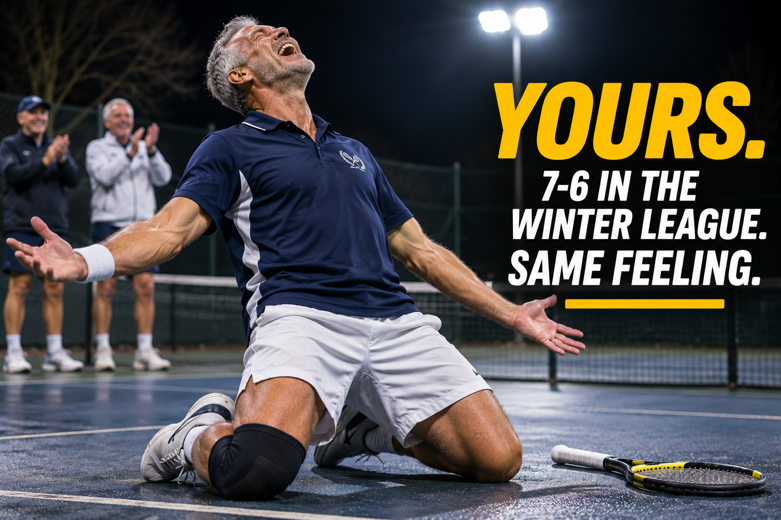
Champions are made in December
In January, the commentators in Melbourne will talk about natural talent.
Alcaraz lost the same final twelve months ago, and played this week injured. What looked like talent in Turin was trained long before it.
Champions are made in December. They're revealed in January.
The first step
The first step isn't a drill. It's a decision.
Decide that this is the winter you train what nobody trains.
Then find out where you stand. Take the Clutch Quotient Diagnostic. It takes a few minutes and shows how your tennis holds up when the score gets tight, so you know exactly what to work on this winter: https://clutchquotient2026.scoreapp.com/
And for the stories from the pro tour every week, join The Sunday Briefing, my weekly newsletter on pressure-driven performance in tennis: https://winningtennis.kit.com/c8d0ff77d7
Four weeks to train it. Four weeks to rehearse it. A completely different 2027.
Who's up for it?
Mark Jeffery is a tennis coach, the founder of T.R.U.S.T. and CLUTCH, and the author of the forthcoming book Trust the Training (2027), with Grand Slam coaches Vlado Pláteník and Dan Kiernan.