 membership.
Continue the signup process, and we'll do the rest.
Tennis, Mental Toughness
How to Control Your Emotions in Tennis
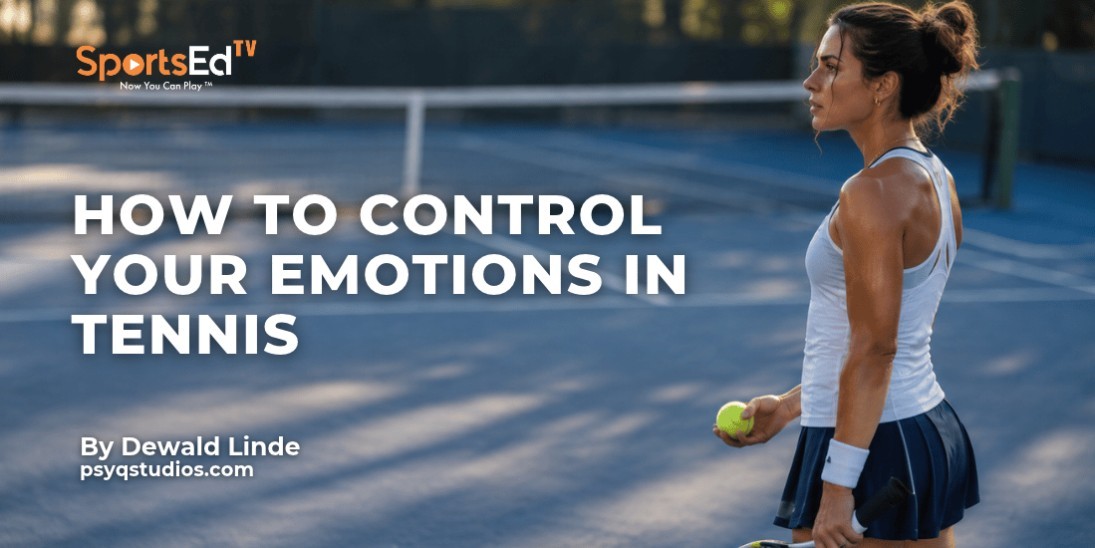
We’ve all heard that getting angry makes you play worse, or that getting nervous or playing with fear isn’t good for you. These are all true statements; we’re going to dig a little deeper into this topic and explore what exactly happens inside of your brain, what emotions do to your thinking process, and how they influence your performance.
What Happens in Your Brain After an Unforced Error?
The image below illustrates the brain and the four areas we will be discussing in this topic, namely, the prefrontal cortex, the amygdala, the hippocampus, and the basal ganglia.
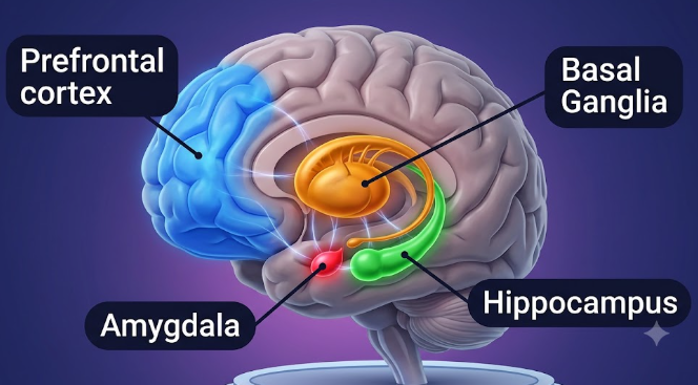
Image 1: The human brain highlighting the prefrontal cortex, the amygdala, the basal ganglia, and the hippocampus.
Let’s have a closer look at the functions of each of these areas that we’ve highlighted.
Prefrontal Cortex: Choosing Your Next Shot
It’s the part of the brain in the front, behind your forehead.
Controls executive functions – meaning that it’s the command center of the brain; it’s responsible for higher thinking. It processes game strategy, predicts where an opponent is likely to hit based on their body language and shot selection (e.g., choosing a drop shot over a cross-court forehand), and helps regulate emotional focus under pressure.

Amygdala: Why a Mistake Can Feel Like a Threat
It’s found almost in the middle of your brain, between the two halves.
Think of the amygdala as the security alarm system – its job is to keep you safe.
Picture yourself reading your opponent well and choosing your shots with time to spare. Then you make three unforced errors. As you walk back to the baseline, you’re still arguing with yourself about the last forehand. By the time you look up, you’ve barely thought about where to serve. That’s how frustration can change a match: it takes attention away from the decisions you still get to make.
Hippocampus: Why Past Mistakes Come to Mind
Found deep in the brain, next to the amygdala.
The emotional memory bank. It ties emotions to specific past experiences, like remembering the frustration of losing to a specific playing style or the confidence of a past victory. Now, in this particular scenario, the hippocampus is remembering all the frustrations you’ve felt in the past
Basal Ganglia: The Role of Practiced Movements
A bunch of nerves in the middle of the brain.
The basal ganglia are responsible for creating smooth, automatic movements and habits. It’s the things I have trained over and over, kind of like an “autopilot.” But when influenced by the amygdala, instead of executing smooth, automatic movement, it triggers my auto-response “Fight-or-flight” mode, which is activated by my hypothalamus.
Do you see how these 4 areas of the brain all work together and influence each other? The image below summarizes what we’ve just explained.
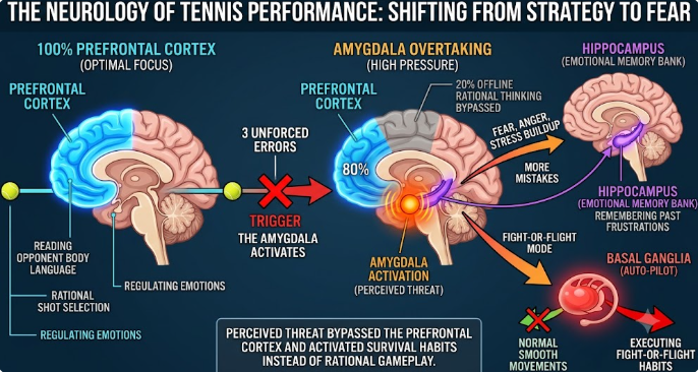
Image 2: The neurology of tennis performance: shifting from strategy to fear.
So, as we can see, it’s very tough to get back to playing with an activated prefrontal cortex.
How to Keep Your Competitive Fire Under Control
Bringing out the best in yourself during a tennis match is like a fireman that lights a contained fire. Powerful, strong, determined, but contained. You have to play with this fire inside you so that you can have a good chance of success, but your prefrontal cortex has to contain the fire before outside elements such as mistakes, the sun, the wind, the opponent, and the circumstances cause that controlled fire to turn into a wildfire.
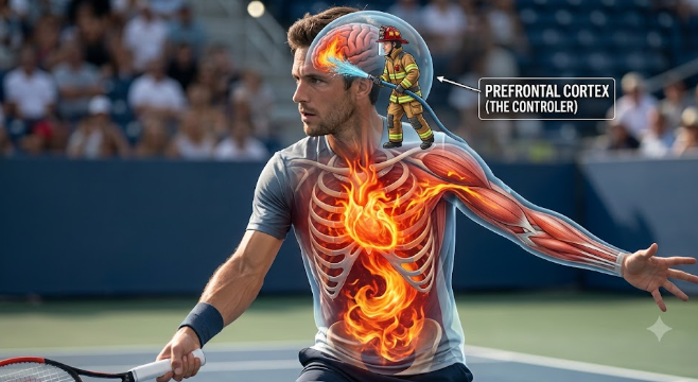
Image 3: The contained fire.
Why It’s Hard to Play One Point at a Time
The next thing to consider in this equation is emotions. What are emotions? In simple terms, emotions are short-term, immediate reactions to a specific situation. Yes, this emotion can stay with you, but you can also make the conscious decision to let it go.
Here’s what’s truly happening:
All emotions have a past or a future. You can say that the emotion is caused by an experience in the past that rendered the same emotion – so there is a memory of this emotion connected to this experience. On the other hand, you can say that you feel an emotion for what might happen in the future. For example. Anger. You are angry about the mistake that you MADE (past tense), or most likely about a few that you MADE in the past. What about anxiety? I am anxious because of what could possibly happen in the future. Happiness? Something that happened? Excitement? Something that could happen? Every emotion has a tense to it: Past or Future.
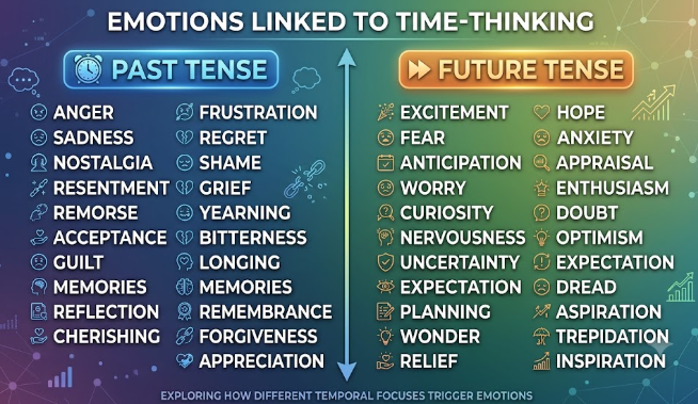
Image 4: Emotions linked to time thinking, past and future.
Between the last point and the next one, you have a few seconds to choose where your attention goes. When a coach says “One point at a time,” give yourself something specific to do. If you missed your last return, watch the server’s toss and pick a target with room over the net.
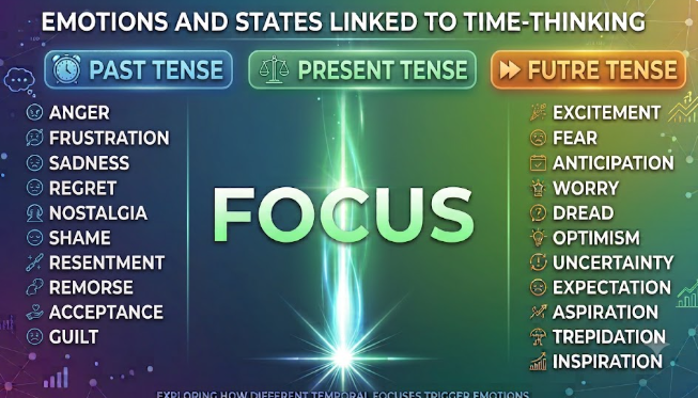
Image 5: Emotions linked to time thinking, past, present and future.
I mentioned earlier that the amygdala is the brain’s security alarm system. This means that the human brain is designed for survival. Thousands of years ago, it was truly about survival. Cavemen had to hunt to feed their family or fight off bears to protect them. That was the competitive world they lived in. Then, as time went by, sport was created to be competitive, but in a safer environment. Our brains still perceive that same threat because the hormones and “messengers,” or neurotransmitters, released by the body are the same, so the brain perceives it as the same threat. But what is really noteworthy is that professional players have realized that there is no real threat here. It’s merely our bodies that perceive it as a threat.

How to Refocus Between Points
So the question now is: how do I prevent my emotional center (amygdala) from activating? How do I ensure that I keep competing using my prefrontal cortex? How do I stay, or quickly bring myself back to a state of awareness?
The trick is this word: AWARENESS.
In Practice, Write Down Three Things to Focus On
Professionals have tirelessly practiced this. When you go onto court, write down what you want to focus on today. Write down 3 things, with the date, and a tick box next to each.
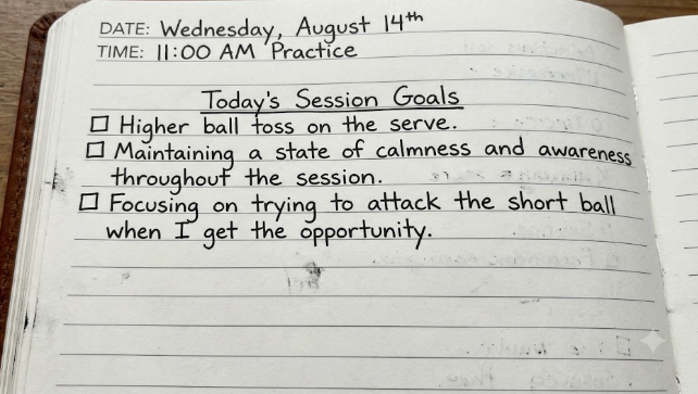
Image 6: Example of awareness diary.
Now, throughout the session, stay aware of your focus. Where is your focus currently? Is it still on your goals? During water breaks, take out your diary and do a cross-check. Am I still on track? This will significantly help you train your awareness to stay present.
After Each Point, Ask “What’s Important Now?”
Something you can do in both practice and matches is to employ the word WIN – “What’s important now”. Asking yourself “What’s important now” after every point helps you refocus your mind on the present moment. Sounds easy, but you’ll see. It’s tougher than it sounds… In the beginning, when things are in control, and when things are out of control.
Novak Djokovic talks about the storm that is going on inside him. This simply means that, like you and I, he constantly moves in and out of the present. But he can stay in the future or past for a few seconds before bringing it back to the center, back to the present tense.
Learn to control your awareness, learn to control your actions!