Golf
The Science of the "Trampoline Effect" in Golf
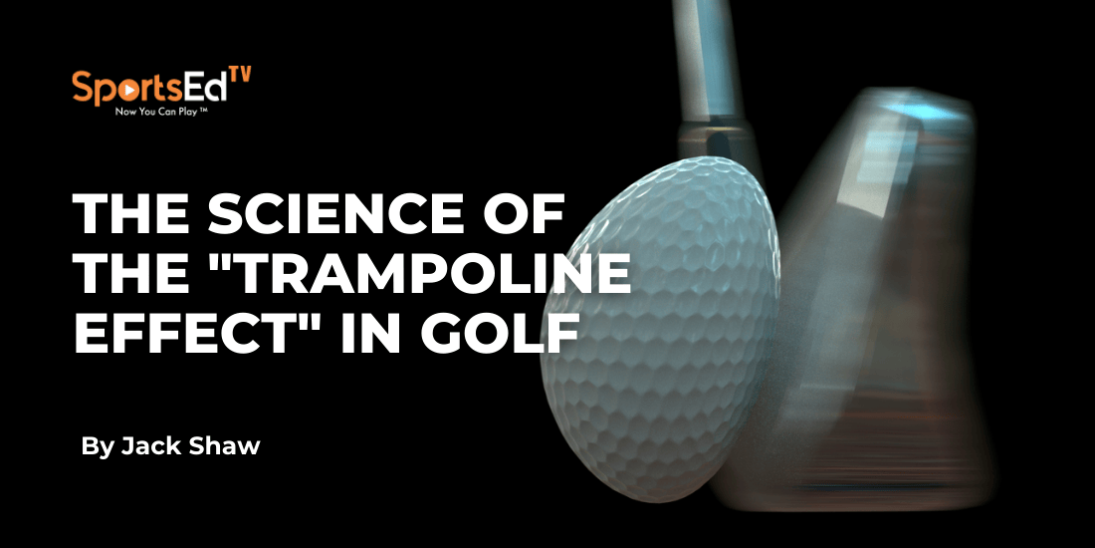
Playing on a trampoline is fun, and when you time your jumps right, you get a greater pushback and higher bounce. The trampoline effect in golf works similarly. It happens when a thin, flexible clubface temporarily deforms and rebounds upon impact with the golf ball, imparting more energy and velocity to the ball. Here’s a closer look at how this phenomenon works, why governing bodies have rules to limit it, and how golfers can leverage it.

The Physics Behind the Trampoline Effect
The core of this phenomenon is the principle of elastic energy storage and release. When the driver strikes the ball at high velocity, its titanium face bends inward, temporarily storing kinetic energy as elastic potential energy. The face releases the stored energy when it springs back to its original shape, propelling the ball further and faster.
The trampoline effect is most prominent when using clubfaces made from light, flexible, and strong materials like titanium. It doesn’t happen with rigid clubfaces because they can’t bend and cause rebounds.
What Affects the Trampoline Effect?
The following factors affect how fast and far the rebound can send golf balls:
- Material flexibility: The more flexible the material, the greater the elasticity of the clubface, resulting in higher energy transfer and a stronger trampoline effect.
- Face thickness: Thick clubfaces can be rigid, which limits the rebound.
- Face structure: The center of the face is convex at rest, but some manufacturers engineer it to be flatter at impact to maximize energy transfer.
- Golf ball: How much a golf ball deforms upon impact depends on its compression levels, but softer balls deform more, which improves their spring-like effect.
- Impact location: Hitting the ball with the clubface’s center maximizes energy transfer.
- Swing speed: Faster swings generate more force, which heightens the rebound.
- Golfer’s skill: Golfers who can consistently strike the ball with the clubface’s center are more likely to achieve the effect.
- Club wear and tear: Clubfaces can lose their elasticity over time.
Leveraging this phenomenon can give golfers an edge, but think twice about making it your go-to strategy. The United States Golf Association (USGA) and the Royal and Ancient Golf Club of St. Andrews (R&A) have rules that limit the trampoline effect to protect the role that skill plays in golf.
How to Measure Trampoline Effect
Regulations regarding this rebound phenomenon focus on how effectively a clubface can achieve it. The calculation requires the coefficient of restitution (COR) and characteristic time (CT).
COR compares ball speeds before and after impact to measure energy transfer efficiency. The formula is ball speed after impact minus the club speed after contact, divided by club speed before impact. The USGA also uses a pendulum test to determine the coefficient of restitution, with the maximum allowed being 0.822. The USGA’s limit for the COR hasn’t changed since 1998.
Meanwhile, CT refers to the duration of ball-to-face contact. Longer contact periods mean a greater rebound. Characteristic time determines whether the clubface is too elastic or conforms to the Rules of Golf set by the USGA and R&A. The limit is 239 microseconds, but it can stretch to 257 microseconds.
How Club Design Maximizes the Rebound Effect
Before titanium, golf clubs were made of wood, zinc, and stainless steel. Manufacturers began making them from titanium alloys in the early 1990s, and they soon became the metal of choice. The material allowed for more forgiving drivers with a greater “sweet spot” or center than earlier versions.
Since then, golf equipment companies have been experimenting with materials to improve their products continuously. Many golf clubs, especially drivers, use advanced alloys and composites to achieve optimal rebound. These materials allow the clubfaces to flex efficiently on contact and maintain performance over repeated high-speed impacts.
While using golf clubs that ensure consistent energy transfer can give you a competitive edge, it can’t compensate for skills. Good club design only goes as far as how well a golfer can maximize it.

Regulations That Affect the Trampoline Effect
The USGA and R&A ban the use of clubs that exceed the COR and CT limits in official competition, so you can only use them for noncompetitive games. To compensate for the restrictions, golf equipment manufacturers have innovated other aspects of the club to improve rebound. Some focus on improving aerodynamics, while others focus on optimizing weight distribution.
The USGA and R&A are also introducing new rules to limit golf ball distance, which will apply to professionals in 2028 and recreational golfers in 2030. They set the “golf ball rollback” rules as a solution to the problem of increased hitting distances threatening the integrity and challenge of the game on traditional courses.
The rules have sparked debate and controversy. Many believe that it could slow innovation and make the game less exciting. Others agree that it’s essential to preserving golf’s skill and strategy factors.

Training Implications for Professional Golfers
The trampoline effect’s "smash factor" makes golf more fun, but it might be better to limit training with it if you’re aiming for professional competition. Make sure the distances you aim for when practicing comply with the golf ball rollback. Otherwise, you risk getting disqualified if you accidentally go beyond it during a tournament.
Adjusting your club selection during training can help you maintain the right mindset. The correct equipment can optimize your distance, trajectory, and control. Avoid using distance-enhancing clubs when you’re training for competitions. Use them only if you’re playing for fun. Instead, stick to products that comply with USGA and R&A requirements.
Practice Tips to Maximize Rebound
If you’re a recreational golfer, achieving the trampoline effect can make scrambles, casual rounds, and other for-fun matches more exciting. Here are some tips to help you do it more consistently:
- Increase club speed: The faster you swing the club, the more kinetic energy you’ll impart on impact and the greater the distance the ball will travel. Enhance your club speed by doing strength and flexibility exercises to make your swings faster and more powerful. Training that focuses on core rotations, hip mobility, and upper body strength is also recommended.
- Focus on center contact: Pay close attention to how close you hit the clubface’s center. Move closer or further from the ball if needed. Widen your stance slightly to help shift your weight when you swing. If you’re using a driver, tee the ball higher to increase launch angle and distance.
- Work with a coach: Seasoned golfers can tell you what you’re doing right and what you can improve on. If you want to focus on consistently achieving the trampoline effect, your coach can help you perfect your swing and ensure you’re making the most of your equipment.

Maximizing the Trampoline Effect for Fun
While rules and equipment regulations limit the use of this phenomenon, it isn’t banned outright. Feel free to make the most of it when you’re playing recreationally. Use clubs with strong but flexible faces and aim for their sweet spot when practicing. Once you’ve mastered this trick, get ready to wow your golf friends in your next match.