Tennis
5 Doubles Tennis Strategies That Helped Me Win More Recreational Matches

As a 29-year Community Tennis Organizer in Southern California and an active participant in many of the thousands of doubles round robin matches I organized, I made it a habit to learn from the best teaching pros in the business. Here are the five most important lessons I took away from reading books and listening to some of the game's greatest teachers.
- Vic Braden: Low to High
- Bryan Brothers: The Middle Is Money
- Bryan Brothers, Ken DeHart, and Jason Jamison: The Aggressive Net Position
- Ali Ordonez: Put It Where They Ain't—and Where They Least Expect It
- Unknown Teaching Pro: Test Your Opponents' Overheads

The Doubles Tennis Advice That Actually Works
Countless articles and videos offer advice on how to win at doubles tennis—many of them excellent insights from true experts. Personally, I've attended my fair share of clinics, mostly led by Southern California teaching pros. However, the results have been mixed, largely due to the varying levels of training these pros bring to the table. My late friend, the legendary Vic Braden, put it perfectly:
"Southern California tennis pros are a dime a dozen."
While you can find truly exceptional coaches in almost any community, they are rare gems—and when they retire, their wisdom often goes with them.
Looking back at my recreational doubles matches—played primarily alongside and against senior players—I realize that my winning track record comes down to just a few key techniques. Every one of them is a lesson I carry from the exceptional teachers who stood out from the crowd.
Strategy #1: Hit Low to High for More Consistent Doubles Groundstrokes
The late Vic Braden was a wonderfully cheeky fellow. His stories about Bobby Riggs during keynote speeches were always hilarious, but he truly took his famous "low-to-high" mantra to the extreme.
About 25 years ago, I hired him for a one-day clinic at the stunning Rancho Valencia Resort near San Diego. Several of the resort's teaching pros worked alongside him across different courts for our group of about 50 adults. Vic set up a video camera on his court to analyze everyone's forehands and backhands.
Afterward, he brought those clips to a conference room for small-group review. Since I stayed for every session, I watched him give the exact same advice to all 50 players:
"There's one easy way to consistently clear the net: low to high. Always remember that."
Seeing every player receive the identical diagnosis made me realize just how fundamental that rule really is.
Forget about the "Western grip," the "16 steps to a great serve," or the "split step"—and all the other high-level advice that seems to work only for touring pros. After attending dozens of clinics where teaching pros desperately tried to hammer home the split step, I noticed something telling: not a single one of my friends ever actually formed a habit of doing it. In fact, most of them think it's a complete waste of time.
Shortly after the Vic Braden clinic, I watched a video by the late PTR founder Dennis Van der Meer, who echoed that very same advice.
"Whenever you have to stretch to hit a low ball near the net—forehand or backhand—your first thought must always be that the ball has to be lifted up. Otherwise, it will most likely end up in the net."
There it was again: low to high.
A sincere thank you to both Vic and Dennis.
By the way, Dennis Van der Meer also taught me, through one of his instructional videos, the importance of moving dynamically with your partner in doubles. Game-changing advice!

Strategy #2: Aim Down the Middle to Win More Doubles Points
This is the first of two lessons I learned from reading Mike and Bob Bryan's book, Double or Nothing: How We Learned to Live and Win as a Team.
Joel Drucker described it in Tennis Magazine:
"The Middle Is Money."
This foundational doubles strategy emphasizes that aiming down the center of the court limits your opponents' angles, creates confusion about who should take the shot, and minimizes the risk of hitting the ball out of bounds.
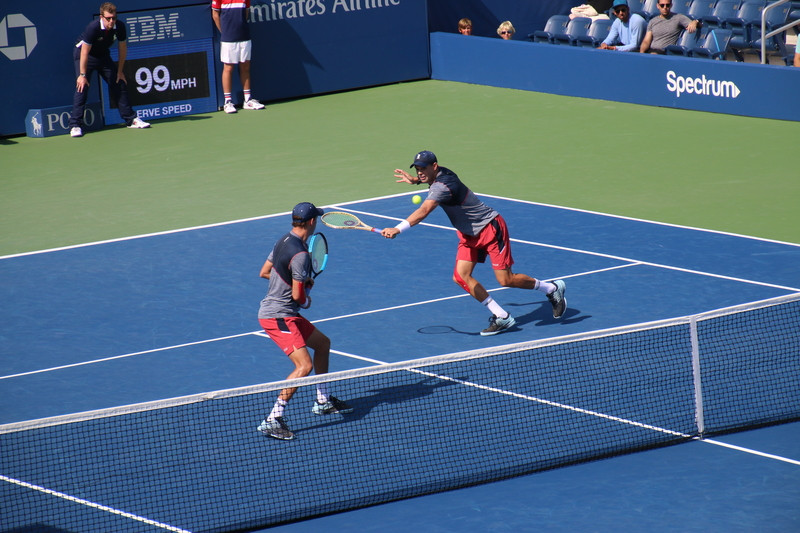
Time and again, I've found this exact advice to be completely spot on. It's a game-changing tool that belongs in every doubles player's arsenal.
Strategy #3: Use Aggressive Net Positioning and Smart Poaching
This brings us to the second lesson popularized by the Bryan Brothers: move the exact moment your partner's serve lands in the service box.
This doesn't require an exaggerated motion that might trigger a hindrance violation. Instead, a simple, calculated step to either side is often all it takes to throw off the receiver's timing.
It mirrors Ken DeHart's advice in his 10 Core Doubles Strategies to play like a "tiger"—always assuming the ball is yours to intercept and aggressively poaching whenever possible.
I use the Bryan Brothers' and Ken's advice all the time.
In fact, a teaching pro I had the pleasure of playing a set with, Jason Jamison, masterfully combined both concepts for me.
It must have been around 2009 or 2010. I was still working on the USTA TennisLink team and attended a community tennis event organized by the USTA Southern California Section at the spectacular Indian Wells Tennis Garden.

Later that day, two former Division I female college players challenged me to a set, telling me I could pick any partner I wanted.
The first person I approached was Jason Jamison, who was speaking at the event.
I told him this might be way out of my league, but he immediately tried to calm my nerves.
"Accept the challenge," he said with a smile. "We'll figure out the strategy on the court."
It didn't actually calm me down, but we grabbed our racquets anyway and headed out to face the two young women, who were waiting for us with knowing grins.
Jason took me aside and asked:
"What's your favorite position in doubles?"
I told him it was playing the net, where I could volley and punch away easy points.
He immediately laid out our strategy.
"Stay at the net and never look back at what I'm doing. Keep your eyes locked on the opponents and watch where they stand. Be aggressive, and poach any ball that comes anywhere near you. When you're up there, and my serve hits the box across the net, move. Left or right, it doesn't matter—just shift a little."
I watched in amazement as Jason completely commanded the court with his powerful groundstrokes, leaving me free to poach to my heart's content.
Needless to say, we comfortably won the set.
Strategy #4: Hit to Open Spaces (Put It Where They Ain't)
I became friends with Ali Ordonez during my visits to the USTA Southern California Section office, back when I was training league coordinators on NTRP and setting up adult leagues.
Later, I had the chance to watch her play in 5.0 matches and even partner with her for some recreational mixed doubles.
The very first thing that struck me about her game was her shot placement: she never hit the ball directly at her opponents. Wherever they were standing during a point, she deliberately aimed elsewhere.
It sounds incredibly logical, of course, but as a lower-intermediate recreational player at the time, it was a concept I had never really considered.
The other brilliant lesson Ali taught me was how to hit overheads where opponents least expect them—for instance, carving a sharp, short angle just behind the net. The ball bounces away from the ad-court opponent, who is almost always bracing for an overhead down the middle.
You don't even have to smash it hard—just accurately.
Ali was, and probably still is, an absolute master of those precision shots.

Strategy #5: Test Your Opponents' Overheads Early
Ken DeHart wrote about "testing their volleys":
"Do not be intimidated by the net player. Hitting the ball directly at them early on helps you identify their weak spots."
Great advice.
I'm simply taking it one step further.
A San Diego teaching pro—whose name unfortunately escapes me—instilled another tactical idea in me: test the opposing net player's overheads.
If you notice they don't have a reliable smash, look uncomfortable tracking high balls, or simply push the ball back into play rather than putting it away, feed them a few reachable lobs.
Then get ready to pounce on the weak return that often follows.
The idea first came to me during a league match about ten years ago, and it has frequently proven to be a match-deciding strategy.
The Ultimate Recreational Doubles Tennis Blueprint
Looking back at all those hours on the court, it's clear that winning recreational doubles isn't about mastering the complex, flashy techniques you see on television.
It's about executing a few fundamental, rock-solid strategies with confidence.
By keeping your strokes low to high, injecting purposeful movement when your partner serves, targeting open spaces, and testing your opponents' overheads, you completely change the dynamic of the game.
You don't need a pro-level toolkit to dominate your local leagues.
You simply need to master the fundamentals that the professionals taught you.
So, the next time you step onto the court, leave the "nonsense" behind, channel your inner tiger, and stick to what actually works.