SportsEdTV recently published its 100 Greatest Athletes of All Time, a weighted model, with every score published; Wayne Gretzky at #1, Muhammad Ali at #40, a sumo wrestler ahead of him. The methodology is transparent almost to a fault. It measures peak dominance, longevity, depth of competition, titles, cultural impact. Five criteria, no hidden adjustments.
But no model measures the moment the scoring stops. What happens to a GOAT the day the sport, the crowd, and the reason for getting up at 5 a.m. all disappear at once?
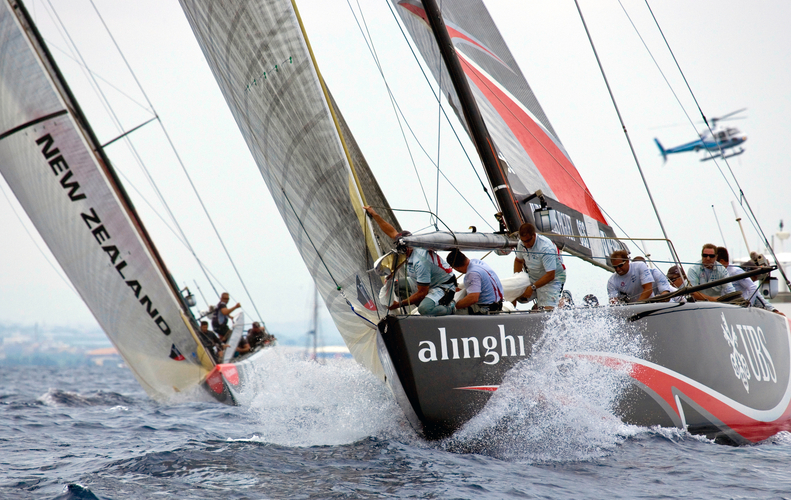
I've felt a version of this myself. I ran an America's Cup campaign, and there's a line sailors trade in those circles: what's harder to get off, the America's Cup or heroin? The answer is…. The America's Cup!.
Four years of total, narrowed focus. A team that becomes family. Crowds, broadcasters, sponsors, the whole apparatus of attention pointed at one event. Then it's over, win or lose, and the circus simply moves on without you.
I watched people unravel — marriages, drink, a few who genuinely ended up on the street. Nobody warns you that the hardest part of an obsessive campaign isn't the campaign. It's the Tuesday afterward.

SportsEdTV recently published its 100 Greatest Athletes of All Time, a weighted model, with every score published; Wayne Gretzky at #1, Muhammad Ali at #40, a sumo wrestler ahead of him. The methodology is transparent almost to a fault. It measures peak dominance, longevity, depth of competition, titles, cultural impact. Five criteria, no hidden adjustments.
But no model measures the moment the scoring stops. What happens to a GOAT the day the sport, the crowd, and the reason for getting up at 5 a.m. all disappear at once?
I've felt a version of this myself. I ran an America's Cup campaign, and there's a line sailors trade in those circles: what's harder to get off, the America's Cup or heroin? The answer is…. The America's Cup!.
Four years of total, narrowed focus. A team that becomes family. Crowds, broadcasters, sponsors, the whole apparatus of attention pointed at one event. Then it's over, win or lose, and the circus simply moves on without you.
I watched people unravel — marriages, drink, a few who genuinely ended up on the street. Nobody warns you that the hardest part of an obsessive campaign isn't the campaign. It's the Tuesday afterward.
The science has a name for this
Sport psychologists call it athletic identity foreclosure: committing so completely to the athlete role that no other identity ever gets explored alongside it. Studies going back decades link this to depression, disordered eating, collapsed confidence, and substance abuse after retirement. One survey of former college athletes found two-thirds struggled with real emotional distress once their careers ended, and a joint NCAA-NFLPA study found roughly a third of retired NFL players reported moderate to severe depression.
You don't need to be a college athlete or an NFL veteran for this to bite. Michael Phelps, arguably the greatest Olympian who has ever lived, has said the crash hit him after his very first Games, reaching the top of the mountain and suddenly not knowing what came next, or who he even was without the pool. That same question returned after Beijing, then London, until, by his own account, it very nearly cost him his life. The most decorated athlete in Olympic history and one of the loneliest men in the building were the same person, four Olympiads running.

Tamara Lowe interviews Michael Phelps at a Get Motivated Seminar at the Arco Arena in Sacramento, California.
The veteran parallel isn't a metaphor — it's the same architecture
There's a correlation between goats and veterans. The psychology is structurally identical. Military service builds what researchers call identity fusion: rank tells you where you stand, the uniform tells the world what you do, the unit gives you belonging, the mission gives you purpose. Separation from that system means losing status, belonging, and purpose all at once, especially when civilian life offers nothing built to replace them. Researchers describe the resulting question in almost existential terms: who am I, now that the markers that used to answer that are gone?
Swap "uniform" for "jersey," "unit" for "team," "mission" for "campaign," and you're describing a GOAT the year after the last final. Different stadium, same architecture of loss.

The part that should give you hope
Here's the finding that matters most, and it's the one people skip past. Researchers who followed elite athletes through retirement found the ones who fared best weren't the ones who quit cold. They were the ones who had already started, quietly, building a second self while the first one was still winning. Deliberately loosening their grip on the athlete identity, exploring other roles and interests, long before the final whistle. That advance work is what kept the ground from disappearing entirely on retirement day.
That answers the central question directly: yes, you can train into the gap before the curtain falls. You don't need to wait for the silence to start building what comes after it. The same discipline that built a world-class serve, jump shot, or start-line routine. The daily, unglamorous repetition is exactly the skill required to build a second identity. Most GOATs already own the mechanism. They've simply never pointed it at anything but the sport.
The current generation is proving it in public. David Beckham signed a lifetime Adidas deal at 23, years before his career was over, and spent the two decades that followed quietly building a commercial infrastructure alongside his football, so the boots came off onto a business already waiting, not a void.
Roger Federer took an equity stake in the running brand On years before he retired, now worth many times a cash sponsorship.
Serena Williams launched Serena Ventures, backing dozens of startups, while she was still winning majors. Ditto Maria Sharapova.
Novak Djokovic joined the investment firm General Atlantic, saying the discipline of professional sport translates directly to the boardroom.
None of them waited for the lights to go out to find out who they were without a racquet or a ball. They built the second self on the same court as the first, years in advance, on purpose.
And if the break has already happened, if the lights are already out, the research says the door isn't shut either. The veteran transition programs that actually work don't try to talk people out of their old identity; they connect it to a new mission, with the same rigor and the same kind of tribe. Veterans who build communities outside their original one, and who lean on peers who've made the same crossing, consistently adjust with far less difficulty.
The goat who becomes a coach, a broadcaster, a mentor is making the same move. Not abandoning the identity that built them. Translating it.

The chemical cocktail nobody names
There's a reason the America's Cup line isn't just a good line. It's closer to literally true than most people realize.
Strip away the bright lights, the crowd, the winning and the losing, the pressure of a final that only comes once every four years, and what you're really removing is a chemical environment your body has spent years learning to run on.
Competition at that level floods the system: adrenaline and noradrenaline spike during the event itself, cortisol rides alongside it managing the stress load, and the win, or even just surviving the pressure, triggers a dopamine hit that ordinary life rarely gets close to matching.
Researchers studying elite athletes have started using a word for what happens when that stops: comedown. It's the same term used for coming off a stimulant, borrowed deliberately, because the physiology genuinely overlaps. Sports psychiatrists now describe post-Olympic depression as, in part, an adrenaline-withdrawal phenomenon. The "high" of winning and public attention leaves a gap some athletes fill with alcohol, drugs, or gambling, chasing the same neurochemical hit through a different door.
So when you take away the lights, the winning, the losing, and the pressure, you're not just taking away a lifestyle. You're taking away a legal drug the body has been dosed with, often daily, for a decade or more. Coming off it can look and feel a great deal like withdrawal, because in the ways that matter to the nervous system, it is. That's not a metaphor for the athlete sitting at home eighteen months after the last final wondering why they can't get out of bed. It's closer to a diagnosis.
Commentary and coaching aren't the consolation prize
Set against Beckham's brand empire or Djokovic's investment firm, becoming a TV commentator or a coach can look like the modest option. The fallback for a goat without the capital or connections to build something bigger. That reading has it backward. Proximity to the old identity is not the same as distance from it, and commentary sits right on that line in a way founding a venture fund does not. Compare Murray, Agassi, and McEnroe today.
Done as avoidance, it's the athlete staying two feet from the flame precisely so they never have to answer who they are without it. Same sport, same stadium, just a microphone instead of a jersey. Done as reinvention, it's a real second craft: new skills, a new peer group, a new standard to be judged against, built on the same discipline that built the playing career, just pointed somewhere new.
The job title can be identical in both cases. What separates them is harder to see from the outside than a balance sheet, and it begs the real question underneath everything above.

The identity nobody chose
Here's what makes this bigger than sport, or the military, or any GOAT list. For most people, nobody ever sits down and designs who they are. Identity accumulates by accident: every small win, every small failure, every role you were handed rather than picked, stacking up quietly for thirty or forty years until one day you look in the mirror and call the result "who I am."
You never chose it. You never built it. You certainly never trained it. It just happened to you, the way weather happens to a coastline.
A GOAT, or a soldier, just meets this problem early and violently, in a single afternoon, instead of drifting past it for a lifetime.
Which is the actual question this piece has been circling: if identity can be trained the way a serve or a set of push-ups is trained, rather than simply inherited from whatever life handed you, what does that training look like? How do you choose, create, and train a second, or third, self on purpose?