Every athlete eventually plays a final game. The date is different for everyone, but the question that follows is universal: What comes next?
The right answer is not to ask young athletes to dream smaller. It is to help them build more than one kind of future while they pursue the game they love. Athletic development and professional development should not compete for attention. When handled intentionally, they strengthen one another.
That is the idea behind what I call the Student-Athlete-Professional: a young person who trains seriously, studies purposefully, and begins developing the skills, relationships, and experience needed for life after sports.
The dream is not the problem
Young athletes should imagine themselves on the biggest stage. Ambition can teach discipline, resilience, and the willingness to work toward something difficult. It can also open real doors through education, travel, relationships and competition.
The risk appears when the dream becomes the only acceptable outcome. More than 8.2 million students participated in U.S. high school sports during the 2024–25 school year, according to the National Federation of State High School Associations. The NCAA reports more than 500,000 college athletes and often summarizes the reality plainly: most will become professionals in fields other than sports.
Those numbers are not instructions to quit. They are instructions to prepare. Believing in a professional sports future and preparing for other professional opportunities are not contradictions.
Every athlete eventually plays a final game. The date is different for everyone, but the question that follows is universal: What comes next?
The right answer is not to ask young athletes to dream smaller. It is to help them build more than one kind of future while they pursue the game they love. Athletic development and professional development should not compete for attention. When handled intentionally, they strengthen one another.
That is the idea behind what I call the Student-Athlete-Professional: a young person who trains seriously, studies purposefully, and begins developing the skills, relationships, and experience needed for life after sports.
The dream is not the problem
Young athletes should imagine themselves on the biggest stage. Ambition can teach discipline, resilience, and the willingness to work toward something difficult. It can also open real doors through education, travel, relationships and competition.
The risk appears when the dream becomes the only acceptable outcome. More than 8.2 million students participated in U.S. high school sports during the 2024–25 school year, according to the National Federation of State High School Associations. The NCAA reports more than 500,000 college athletes and often summarizes the reality plainly: most will become professionals in fields other than sports.
Those numbers are not instructions to quit. They are instructions to prepare. Believing in a professional sports future and preparing for other professional opportunities are not contradictions.

What student-athlete career development really means
Career development is sometimes treated as an emergency service offered near graduation: write a résumé, attend a career fair, and start applying for jobs. That is too late to begin discovering interests, testing abilities, and building relationships.
We would never expect an athlete to begin training a few months before a championship and perform like someone who has practiced for years. Career readiness develops the same way. Small experiences, repeated over time, create confidence and direction.
This is not a “Plan B.” A backup plan sounds like surrender. A dual-track plan recognizes that the habits built through sports can power many kinds of achievement.
The summer that widened my view of success
I learned this earlier than I expected. As a student at Archbishop Molloy High School in New York, I faced a tuition problem that threatened my ability to continue. My basketball coach helped me return to school, but I needed to work during the summer to help cover the next year.
Through my coach, I spent about ten weeks at Zena Jeans, a women’s fashion company in Manhattan. I answered phones, entered orders, filed paperwork, and watched professionals negotiate, sell, develop products, and manage a business.
At first, the job felt like time taken from basketball. It became something far more valuable: evidence that I could picture myself succeeding in another arena. I had not abandoned the athletic dream. I had expanded my understanding of what success could look like.
Later, after college basketball, I received an opportunity to play professionally in Lithuania and chose not to take it. I was ready for a new challenge, but I discovered that my basketball résumé was much stronger than my professional résumé. I had athletic accomplishments and academic knowledge, but too little career experience, too few professional mentors, and no well-developed network outside the game.
That gap shaped how I view student-athlete development. Professional exposure should not happen only by accident or after an athlete’s final season.
A four-stage path from exploration to opportunity
Families, coaches, and schools can make career development age-appropriate. The objective is not to force a 12-year-old to choose a career. It is to let curiosity mature into informed direction.
Middle school: Explore
Introduce young athletes to the range of work that exists. A conversation with a professional, a workplace visit, volunteering, or a short job-shadowing experience can reveal possibilities they have never seen. Discovering that an occupation is not a good fit is useful learning too.
Early high school: Experiment
Turn interests into small tests. Students can help with a community event, take a relevant course, interview someone in a field, or complete a short project. The question changes from “What jobs exist?” to “What kinds of problems do I enjoy solving?”
Late high school and college: Build
Now the athlete can accumulate evidence: summer employment, internships, mentors, portfolio work, certifications, leadership roles, and professional references. Academic choices become more meaningful when they connect with real experience.
Before graduation: Launch
The student-athlete should be able to explain how athletic experience translates into professional value. That includes a résumé, a network, examples of completed work, and a clear description of transferable skills. Graduation should not mark the first attempt to enter the professional world.
The skills sports develop only matter when athletes can translate them
Employers may value discipline and teamwork, but simply listing those words is not enough. Athletes need examples that show what they did and what changed as a result.
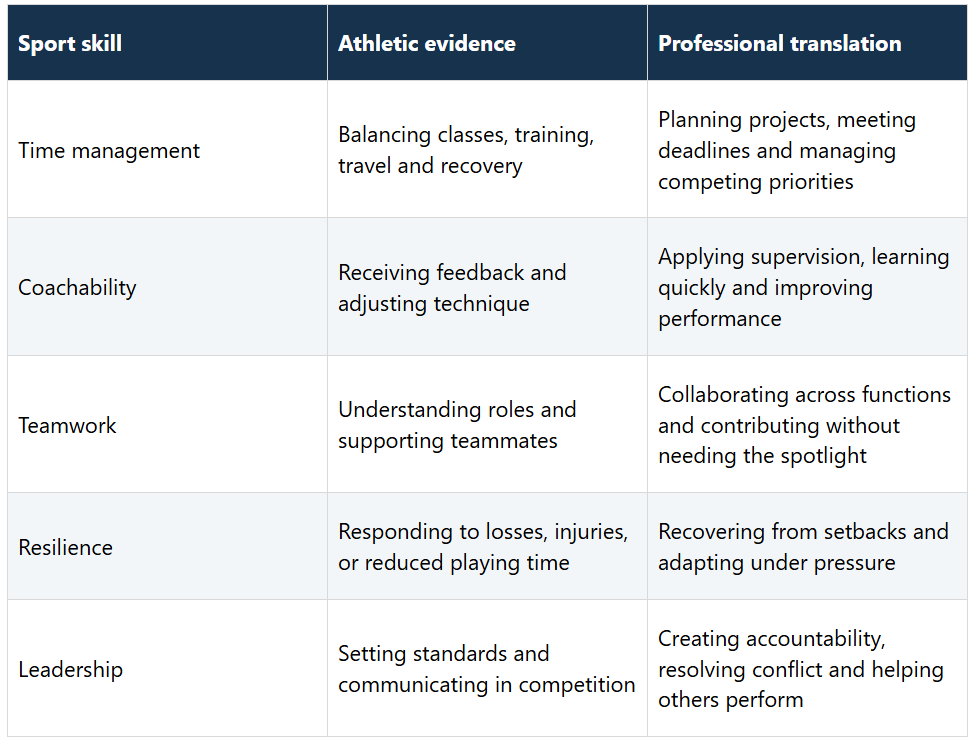
One intentional hour can compound
A week contains 168 hours, and serious student-athletes already carry demanding schedules. Career development does not need to become another overwhelming obligation. It can begin with one protected hour each week.
That hour might be used to research an industry, speak with a mentor, practice a technical skill, update a portfolio, or help an organization. Consistency matters more than intensity at the beginning. One hour a week creates roughly 50 hours of exposure in a year. Over several years, those hours can become a meaningful body of experience.
The target is not a magic number or a guarantee of employment. The purpose is to ensure an athlete graduates able to show development, not merely describe potential.

What parents can do
· Ask about interests beyond a sport without treating the conversation as doubt about the athlete’s ability.
· Use your network to arrange short conversations, workplace visits or job-shadowing opportunities.
· Praise curiosity, reliability and initiative with the same seriousness given to scores and statistics.
· Help the athlete keep a simple record of projects, service, work experience, contacts and lessons learned.
· Protect rest and recovery. Professional development should support a healthy life, not fill every open minute.
What coaches and sports organizations can do
· Invite professionals from varied fields to speak with athletes and explain what their work actually involves.
· Connect team service projects with career exposure when possible.
· Teach athletes to describe sport experiences in language employers understand.
· Create internships, introductions and mentoring opportunities through alumni, sponsors and community partners.
· Measure development beyond wins by tracking leadership, education, career exposure and continued participation in sport.
A better definition of winning
Sports can help young people become healthier, more disciplined and more connected. They can earn scholarships, build friendships and sometimes reach the professional level. But the value of the experience should not disappear when elite competition ends.
The goal is for a student-athlete to finish with two records of growth. One shows what the athlete accomplished in competition. The other shows what the developing professional explored, learned, built, and contributed.
If professional sports calls, the athlete is ready to consider it. If business, public service, entrepreneurship, graduate school, or another field calls, that opportunity is not evidence that the dream failed. It is evidence that preparation created choices.
Eventually, every ball stops bouncing. The person does not stop developing. Our responsibility is to help young athletes compete wholeheartedly while becoming ready for everything that can follow.
Frequently asked questions
When should career development begin for student-athletes?
Career exploration can begin in middle school with low-pressure activities such as conversations, volunteering, and workplace visits. Career selection can come much later.
Does career planning distract athletes from pursuing professional sports?
No. Age-appropriate career development can coexist with serious training. The goal is not less ambition, but broader preparation and more future choices.
What are the most valuable transferable skills from sports?
Common examples include time management, teamwork, coachability, resilience, communication, leadership, and performing under pressure. Athletes should support each skill with a specific example.
How can a busy student-athlete gain work experience?
Start small: one hour a week, short job-shadowing visits, project-based volunteering, summer work, remote mentoring, or internships scheduled around the competitive season.
What should student-athletes have before graduation?
Ideally, they should have a résumé, professional references, mentors, work or project examples, a developing network, and the ability to connect athletic experiences to workplace value.

Author
Jason Gilliam-Alexander works with student-athletes, parents, coaches, schools, and organizations to develop leadership, discipline, career readiness, and life skills for success during and beyond an athletic career.
Editorial notes and sources
· NFHS participation reporting: More than 8.2 million U.S. high school athletics participants in 2024–25.
· NCAA overview: More than 500,000 NCAA student-athletes and career preparation messaging.
· Original first-person source by Jason Gilliam-Alexander
· Suggested internal SportsEdTV: youth sports development; coaching education; athlete mental health; transferable skills through sports; college recruiting realities.