Youth-serving organizations carry one responsibility that outweighs every other operational priority: protecting the children placed in their care.
Yet many leagues, clubs, facilities, and community programs still depend primarily on periodic criminal background checks. Those checks are an important starting point, but they provide only a limited snapshot. They do not necessarily reveal recent concerns, civil matters, credential problems, inappropriate public behavior, or issues that emerge after the initial screening.
CoachFax was created to move protection further upstream. Its model combines multiple screening tools, ongoing accountability, and a voluntary public credential designed to help parents and organizations identify coaches willing to demonstrate their commitment to a safer environment.
The goal is not simply to satisfy a compliance requirement. It is to build trust before a coach gains access to children.

The Financial Cost of Getting Safety Wrong
The human cost of abuse can never be reduced to a dollar amount. Financial settlements do, however, show boards and leadership teams how quickly a failure of protection can threaten an institution.
Seven widely reported American abuse matters have resulted in approximately $3.27 billion in settlements and compensation:
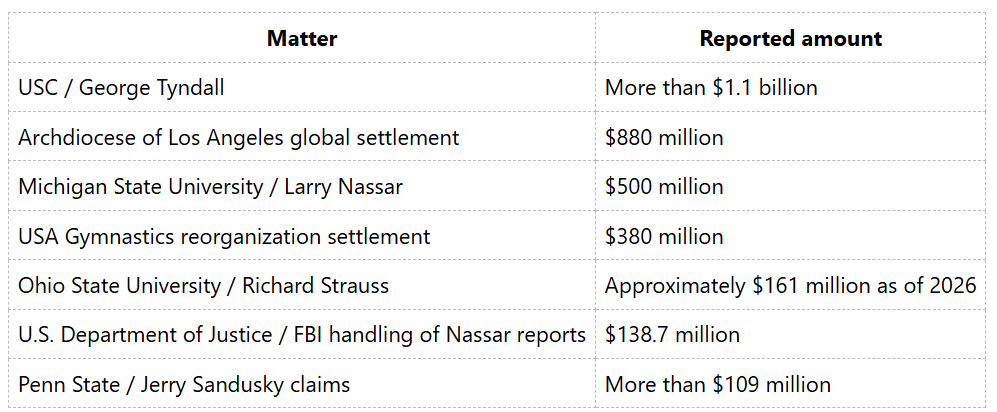
Many other cases are resolved confidentially and never enter the public record. CoachFax estimates that the wider institutional exposure over a decade could reach $4 billion to $6 billion or more.
Legal costs are only part of the damage. Organizations can also face higher insurance premiums, loss of coverage, declining registrations, sponsor and donor withdrawal, staff departures, and the destruction of trust built over decades.
Safety is therefore not only a moral responsibility. It is a fundamental part of financial stewardship, brand protection, and organizational continuity.
Why Organizations Hesitate to Go Further
Most youth organizations want to protect children. Resistance to advanced vetting usually comes from practical concerns.
Leadership teams may assume stronger screening will be too expensive, complicated or difficult to administer. Volunteer programs worry about discouraging coaches. Smaller clubs may lack dedicated safety personnel. Others continue using the same annual process because it is familiar and appears to satisfy their immediate obligations.
But organizations must compare the cost of prevention with the cost of failure.
CoachFax approaches vetting as an ongoing process rather than a one-time administrative event. By combining several forms of screening and accountability, it gives organizations and families a more complete picture of the adults working with young athletes.
Built From Inside Sports
CoachFax was founded by Bill Fauver, a two-time U.S. Olympic pairs skater and Master-rated coach with more than 35 years of experience.
Fauver understands the trust placed in coaches, the access they receive, and the influence they have on a young athlete’s development. He also understands the operational realities of sports organizations and the difficulty of applying one mandatory system across thousands of independent leagues, facilities, and programs.
CoachFax was built around a simple question: What if responsible coaches could proactively demonstrate that they are willing to meet a higher standard?
Instead of waiting for every organization to impose the same requirement, CoachFax uses a voluntary membership model. Coaches choose to complete the company’s screening process. Those who meet its membership standard receive a verifiable CoachFax Member ID and can appear in a public directory.
Coaches aren't just saying they care about athlete safety. They are taking additional steps to demonstrate it.
A Layered Approach to Coach Vetting
CoachFax goes beyond a single database search. Its system brings together several screening and accountability components.
Proprietary Automated Voice Screening
CoachFax uses proprietary automated voice technology to identify stress and other emotional markers during screening. The system provides an additional layer of information beyond written forms and static records.
According to CoachFax, approximately 95 percent of safe coaches move successfully through this first automated layer. The process is designed to make advanced screening scalable while directing additional attention where it's needed.
Continuous Public-Social-Media Review
A person’s public conduct can change long after an annual background check. CoachFax monitors publicly available social-media activity for potential indicators of grooming behavior, inappropriate boundaries, or conduct inconsistent with the responsibilities of working with children.
This continuous approach replaces the one-and-done screening mentality with ongoing accountability.
Random Drug-Screening Protocols
CoachFax members may be subject to unannounced drug-screening protocols. The purpose is to reinforce an ongoing professional standard and give organizations and families greater confidence in participating coaches.
Civil-Record Research
Criminal background checks don't tell the whole story. CoachFax can examine relevant civil records, including restraining orders and other court information that may not appear in a standard criminal search.
Résumé and Credential Verification
CoachFax reviews professional histories, employment information, coaching credentials, and relevant sports affiliations. This can help identify résumé discrepancies or credential fraud while confirming the experience of qualified coaches.
Why the Voluntary Model Matters
Youth sports is highly fragmented. Millions of coaches and volunteers work across independent clubs, private facilities, schools, churches, recreational leagues, civic programs, and sport-specific organizations. No single organization controls them all.
CoachFax addresses that reality by making its credential portable and voluntary. A coach can carry a verified membership identity across programs instead of starting from scratch every time they change clubs, rent a facility, or join a new league.
The public directory also gives parents a practical role. Families can look for participating coaches and ask organizations whether staff members have completed advanced vetting.
CoachFax publishes successful membership, not failed assessments. Someone’s absence from the directory does not establish wrongdoing. The directory simply confirms which coaches have voluntarily completed the CoachFax process and earned active membership.
This creates transparency without turning the platform into a public blacklist.
What CoachFax Offers Organizations
For leagues, clubs, and facilities, CoachFax supports several important objectives:
-
Greater parent confidence through a visible and verifiable credential.
-
Stronger brand protection by demonstrating that safety is part of the operating model.
-
Better risk documentation for boards, insurers, sponsors, municipalities, and facility partners.
-
A recruiting advantage for organizations and coaches that welcome professional accountability.
-
Continuous accountability that extends beyond the initial screening date.
Trust is one of the most valuable assets in youth sports. CoachFax gives organizations something concrete to communicate instead of relying on a general statement that coaches have been “checked.”

A Large and Fragmented Market
CoachFax has built its initial market analysis from 44 named target organizations representing an estimated 14.24 million coaches and volunteers.
Its target sectors include baseball and softball, youth and civic organizations, special-needs programs, scouting, churches, football, multisport organizations, soccer and basketball. Among the largest individual opportunities identified are Little League International, Southern Baptist Convention churches, Scouting America, USA Football’s Heads Up Football program, US Youth Soccer and Girl Scouts of the USA.
The scale illustrates why a portable, voluntary system could be valuable. The market is too large and fragmented to depend on one employer or one annual screening event.
The Team Behind the Standard
CoachFax combines sports credibility with expertise in technology, behavioral science, and community engagement.
Bill Fauver, Founder and CEO, brings the perspective of a two-time Olympian and a 35-year Master-rated coach. He owns the company’s connection to sport, coaching culture, and athlete protection.
Dean Grey, COO, is a behavioral scientist, technology entrepreneur, and AI innovator. His work focuses on building values-based online communities that maintain engagement over time, an essential capability for a recurring membership platform.
Together, they are building CoachFax not as another static background-check provider, but as an ongoing trust and accountability network for youth-serving environments.
Moving Protection Further Upstream
Most safety systems become visible only after someone raises a concern. CoachFax is designed to operate earlier, before a coach is given access and throughout the period the coach works with young people.
Its distinction comes from five ideas:
-
Prevention begins before access is granted.
-
Vetting should use multiple layers, not a single database.
-
Accountability should continue after the initial check.
-
Responsible coaches should be able to prove their commitment voluntarily.
-
Parents and organizations should be able to verify active membership easily.
That creates a different relationship among coaches, organizations, and families. Safety becomes visible, portable, and continuous.

The Costliest Choice May Be Doing Nothing
Advanced screening requires an investment of time, money and organizational attention. But continuing to depend exclusively on minimum, periodic checks carries its own costs.
CoachFax offers a proactive alternative: a voluntary membership credential supported by layered vetting, ongoing monitoring, and public verification. It lets responsible coaches show they welcome a higher level of accountability while giving organizations and parents another tool for making informed decisions.
Children deserve more than a box checked once a year. Parents deserve greater visibility. Responsible coaches deserve a way to distinguish themselves.
CoachFax brings those three needs together by making youth-sports safety preventive, voluntary, and continuous.