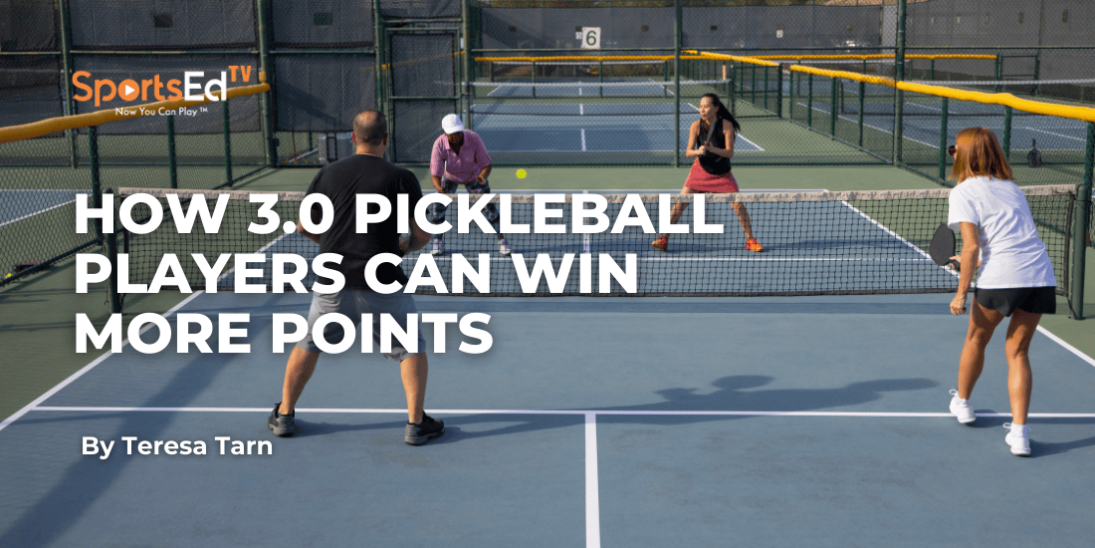
Reaching the 3.0 level in pickleball usually means you have developed a basic foundation.
You can serve consistently. You can return. You understand the two-bounce rule. You can sustain rallies, dink, volley, and recognize basic doubles positioning.
Moving from 3.0 to 4.0, however, requires something different.
The game becomes less about simply keeping the ball in play and more about managing the rally.
Players at the 4.0 level are generally better at controlling pace, neutralizing attacks, creating favorable court position, recognizing attackable balls, and understanding how one shot sets up the next.
That does not necessarily mean they hit harder.
In many cases, they simply make better use of the ball they receive.
For players who have reached 3.0 and feel their development beginning to stall, these are some of the most important skills to address.
1. Build a Reliable Third Shot Drop
The third shot is one of the defining situations in doubles pickleball.
The returning team usually has the opportunity to move toward the non-volley zone immediately after the return. The serving team, meanwhile, must allow the return to bounce before playing the third shot.
That creates a positional advantage for the receiving team.
The third shot drop is one of the primary tools used to neutralize that advantage.
The objective is to send a softer ball over the net that lands in the opponent's kitchen and makes it difficult for them to attack downward.
A successful drop can give the serving team time to move forward and begin closing the distance to the non-volley zone.
Why the shot is difficult
The third shot drop requires several qualities that developing players may not yet possess consistently:
-
Touch
-
Trajectory control
-
Appropriate paddle speed
-
Good contact point
-
Balance
-
Patience
Many 3.0 players instinctively try to solve the third-shot problem with pace.
That can work in certain situations, and the third-shot drive has an important place in the game. But if driving is the only option a player possesses, stronger opponents can anticipate it and keep the serving team under pressure.
The goal is not to choose between driving and dropping forever.
The goal is to develop both.
SportsEdTV coaching point
Practice the drop progressively.
Start closer to the kitchen and establish control before moving farther back. As consistency improves, gradually increase the distance until you can reproduce the same trajectory from the baseline.
The emphasis should be on landing the ball softly and giving yourself time to advance, not trying to hit a perfect winner.

2. Learn How to Reset an Attack
As the level of play increases, so does the speed of the game.
Players hit harder volleys. They attack balls earlier. They direct shots toward the feet and body.
At the 3.0 level, one strong attack can often end the rally.
At 4.0, players become increasingly capable of neutralizing that attack.
That is where the reset becomes essential.
A reset is a controlled shot that absorbs incoming pace and returns the ball softly into the kitchen.
Instead of trying to fight power with more power, the player takes speed out of the rally.
This is particularly important in the transition zone, where players are moving from the baseline toward the non-volley line.
Use soft hands
A reset should not involve a large swing.
The paddle remains relatively stable while the player's hands absorb the energy of the incoming ball.
The goal is to produce a ball that drops below the opponent's preferred attacking height.
This is fundamentally a control skill.
And like most control skills, it requires repetition.
SportsEdTV coaching point
Do not practice resets only during games.
Set up a drill where one player applies controlled pressure while the other works exclusively on absorbing pace and dropping the ball into the kitchen.
The purpose of the drill is not to win the rally.
It is to develop the feel required to turn an offensive ball into a neutral one.
3. Turn the Dink Into an Offensive Tool
By 3.0, many players understand how to dink.
The next step is understanding why they are dinking to a particular location.
A dink should not simply be a ball that clears the net and lands in the kitchen.
It can also be used to manipulate positioning.
For example:
-
A wide crosscourt dink can pull an opponent away from the middle.
-
A dink toward the backhand can test a weaker side.
-
A deeper dink toward the feet can reduce attacking options.
-
A change of direction can force an opponent to move unexpectedly.
-
Repeated crosscourt dinks can create space before changing the pattern.
The important development is moving from ball control to point construction.
SportsEdTV coaching point
Add targets to your dink practice.
Instead of counting how many consecutive dinks you can hit, identify specific areas of the kitchen and score the drill based on placement.
Consistency remains important, but consistency with purpose is more valuable.
4. Learn Which Balls to Speed Up
One of the clearest signs of an improving pickleball player is not how often they attack.
It is how well they choose when to attack.
Developing players frequently see a ball above net height and immediately accelerate.
But an attackable ball is only part of the equation.
Before speeding up, the player should also consider:
-
Am I balanced?
-
Am I established at the kitchen line?
-
Where is my partner?
-
Is my opponent leaning or moving?
-
Is there an open target?
-
What happens if the opponent counters?
-
Am I attacking from a strong position or reaching for the ball?
This changes aggression from an impulse into a decision.
Placement can matter more than speed
The hardest possible shot is not always the best attack.
Good targets may include:
At the 4.0 level, players begin understanding that the first speed-up does not always need to end the rally.
It may simply create the next attack.
SportsEdTV coaching point
When drilling speed-ups, reward good decisions rather than winners.
If the player attacks the wrong ball but wins the point, it was still a poor tactical decision.
Training should reinforce the decision-making process, not just the outcome.
5. Improve Doubles Positioning Under Pressure
Technical skills receive much of the attention in pickleball instruction.
But many points are lost because of positioning rather than stroke execution.
At 3.0, doubles teams can appear organized while the rally is slow.
When the pace increases, that organization often disappears.
One player moves wide, and the partner does not adjust.
A gap develops through the middle.
One player advances while the other stays deep.
Both players chase the same ball.
The court opens.
Better doubles teams move as a unit.
Understand team movement
Partners should continually adjust their position relative to:
-
The ball
-
Their partner
-
The opponents
-
The likely next shot
When one player is pulled toward the sideline, the partner often needs to shift as well.
When one player remains under pressure deep in the court, the other should be careful about advancing too aggressively.
When both players reach the non-volley zone, they should work to maintain a coordinated defensive line.
Positioning is dynamic.
It changes with every ball.
SportsEdTV coaching point
Include positioning drills where the objective is not simply hitting the ball.
Have players freeze periodically during rallies and evaluate:
Where am I? Where is my partner? What part of the court are we leaving exposed?
Developing spatial awareness can eliminate many points that players mistakenly attribute to poor technique.

6. Use the Return of Serve to Establish Court Position
At lower levels, the return of serve is often treated as a simple requirement:
Get the ball back.
At higher levels, the return becomes part of the tactical structure of the point.
A deeper return can accomplish several things simultaneously.
It can:
-
Keep the serving team farther from the kitchen
-
Increase the difficulty of the third shot
-
Give the returning player more time to advance
-
Help the returning team establish control of the non-volley zone
This is why return depth matters.
A short return can allow the serving team to move forward and play the third shot from a more comfortable position.
SportsEdTV coaching point
The goal should not always be maximum pace.
A high, deep return with good margin can be more valuable than a faster return that lands short or produces unnecessary errors.
After the return, move forward efficiently.
The return and the movement that follows it should be trained as one sequence.
The Real Difference Between 3.0 and 4.0 Pickleball
The progression from 3.0 to 4.0 is often described as a technical jump.
It is also a tactical one.
Players begin learning to control more elements of the rally:
Pace.
When should the ball be accelerated, and when should it be slowed down?
Height.
Can you keep the ball below an opponent's attacking zone?
Position.
Can you move yourself and your partner into stronger court positions?
Placement.
Can you make the opponent move or contact the ball from an uncomfortable location?
Decision-making.
Can you recognize the difference between a ball you can attack and a ball you should attack?
Those distinctions become increasingly important as the level rises.
Playing More Is Not the Same as Practicing Better
Recreational games are valuable.
They develop anticipation, competitive instincts, shot recognition, and an understanding of how rallies develop.
But games do not always provide enough repetition to correct specific weaknesses.
If a player struggles with third shot drops, for example, a two-hour playing session may provide only a limited number of meaningful opportunities to practice them.
A focused drill can provide dozens of repetitions in several minutes.
The same applies to:
-
Resets
-
Dinks
-
Transition play
-
Return depth
-
Speed-up selection
-
Defensive positioning
This is the principle of deliberate practice.
Identify the skill.
Isolate it.
Repeat it.
Add movement and decision-making.
Then bring it back into competitive play.
A Simple 60-Minute 3.0-to-4.0 Training Session
Players looking to improve can organize a one-hour practice around the skills that appear repeatedly in doubles.
10 Minutes: Third Shot Drops
Begin from the transition zone and gradually work backward.
Focus on height, trajectory, depth, and consistency.
10 Minutes: Resets
One player applies controlled pressure while the other works on taking pace off the ball.
Switch roles regularly.
10 Minutes: Targeted Dinking
Use specific targets.
Work crosscourt, middle, backhand, and wide-angle patterns.
10 Minutes: Speed-Up Recognition
Play controlled kitchen rallies.
Attack only when the ball and court position justify it.
10 Minutes: Transition and Team Positioning
Practice moving from the baseline toward the non-volley zone while maintaining spacing with your partner.
10 Minutes: Competitive Points
Finish by playing points in which the objective is to recognize and apply the skills practiced earlier.
This last stage is critical.
Technique must eventually function inside the uncertainty of competition.
How Do You Know You Are Improving?
Rating progression should not be measured only by wins and losses.
Look at the quality of the points you are playing.
Ask:
-
Are more of my third shot drops giving me an opportunity to advance?
-
Can I neutralize hard balls instead of immediately losing the rally?
-
Am I dinking to locations rather than simply over the net?
-
Am I attacking fewer balls from poor positions?
-
Is my doubles team maintaining better spacing?
-
Are my returns consistently deep?
-
Am I reaching the kitchen under control more often?
-
Am I making opponents hit difficult balls instead of waiting for them to miss?
These are signs that the structure of your game is changing.
That is often more important than the score of any individual match.
The Bottom Line
Moving from 3.0 to 4.0 in pickleball is not simply a matter of hitting the ball harder.
It is about developing more options and making better decisions.
The third shot drop helps neutralize the receiving team's positional advantage.
The reset gives you a way to survive pressure.
Purposeful dinking allows you to construct points.
Better speed-up selection makes aggression more effective.
Improved doubles positioning reduces unnecessary openings.
And a better return of serve can influence the rally before the third shot is even struck.
None of these skills requires exceptional athletic ability.
They require instruction, repetition, feedback, and deliberate practice.
That is the important lesson for players trying to break through the 3.0 plateau.
Do not simply play more points.
Learn how better points are built.

Frequently Asked Questions
What is the biggest difference between a 3.0 and 4.0 pickleball player?
The difference is not one particular shot. A 4.0 player generally demonstrates better control of pace, placement, positioning, transition play, and shot selection. The player is more capable of neutralizing pressure and creating favorable situations rather than simply reacting to the opponent.
What should a 3.0 pickleball player practice first?
Third shot drops and resets are excellent starting points because they help players move from defensive or neutral positions toward the kitchen. Players should also devote time to return depth, purposeful dinking, and doubles positioning.
Do you need more power to reach 4.0 in pickleball?
Not necessarily. Power can be valuable, but better players also know how to remove pace from the ball. Touch, placement, control, court position, and decision-making are central to higher-level doubles play.
How should I practice the third shot drop?
Start closer to the non-volley zone and build control before increasing the distance. Once you can consistently produce the correct trajectory and landing area, gradually move toward the baseline.
Why is the reset important in pickleball?
The reset allows a player to take pace off an opponent's attack and return the ball softly into the kitchen. This can neutralize offensive pressure and create an opportunity to continue moving toward the non-volley zone.
Is drilling better than playing games?
They serve different purposes. Drilling provides concentrated repetition of a specific skill. Games develop recognition, decision-making, and competitive execution. Players generally benefit from combining both.
How can I move from 3.0 to 4.0 faster?
Identify the situations where you consistently lose points and train those situations directly. Improvement is more likely when practice is specific rather than simply increasing the number of recreational games you play.