At SportsEdTV, we believe supplementation should be guided by science, education, and trusted expertise, not marketing hype. That is why we recommend Thorne. With guidance from hundreds of coaches, sports scientists, nutrition experts, and performance professionals, we value products that emphasize ingredient quality, rigorous testing, clean manufacturing, and evidence-based performance.
Nutrition, Pickleball
The 4 Best Supplements I Take for Pickleball — and What the Science Says
Updated: 2026-08-25
Original: 2026-08-19
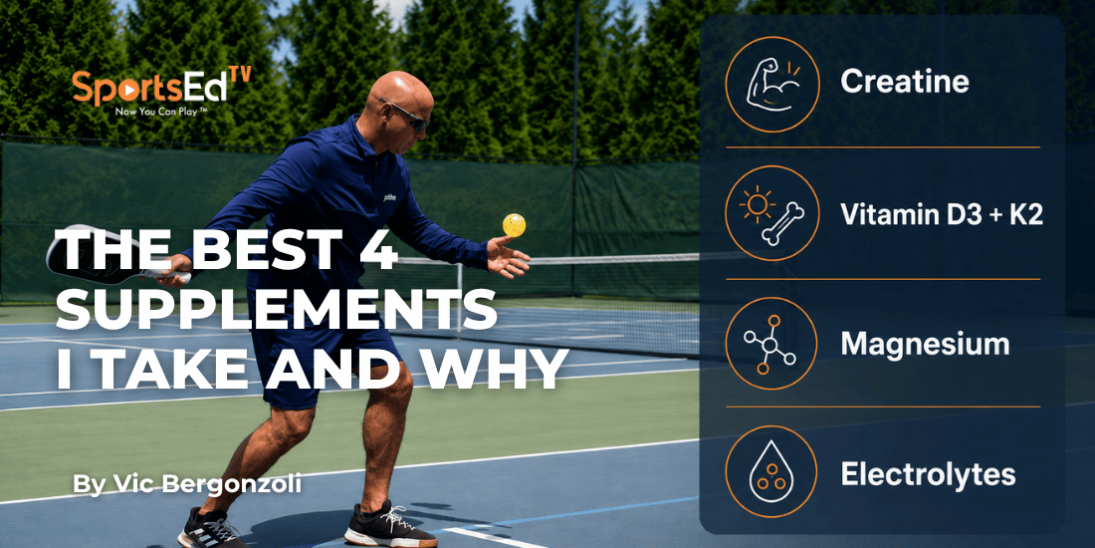
I am 60 years old, I play pickleball and tennis, and I still enjoy testing myself against players who are much younger than I am. What has changed with age is not my desire to compete, but how much attention I have to pay to my body. When I was younger, I could get away with poor sleep, inadequate hydration, or a less-than-perfect diet and barely notice. Today, every part of my body seems to shout loudly when something is missing.
That has made me much more deliberate about nutrition and recovery. I am not trying to reverse aging or pretend that a supplement can make me 25 again. My objective is much simpler: I want to preserve strength, maintain energy, recover well, and continue playing the sports I love for as long as possible.
Food remains the foundation of my diet, but I don't believe every nutrient has to come exclusively from food. In some cases, supplementation is simply a more efficient and practical way to obtain a useful amount of a particular nutrient. The best example is creatine. Creatine is naturally present in meat and fish, but obtaining several grams per day entirely through food would require eating an enormous amount. Roughly two pounds of beef provides only around four grams of creatine, depending on the cut and preparation. I enjoy beef, but I have no interest in eating two or three pounds of it every day simply to reach a creatine target.
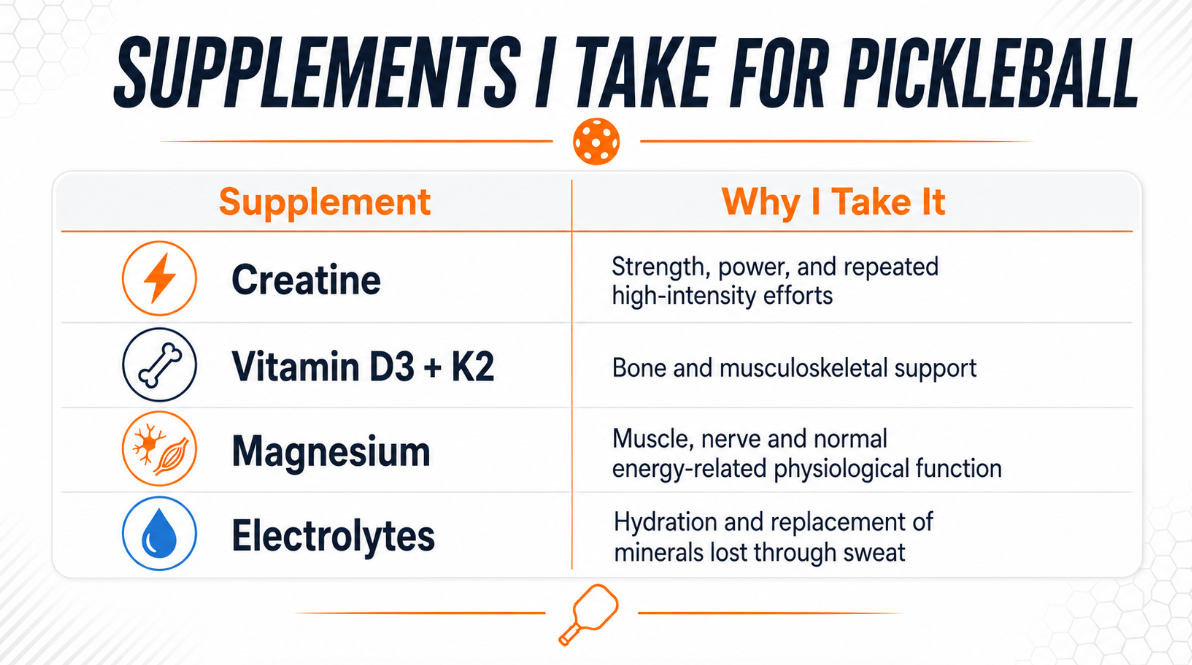
That is the basic philosophy behind the four supplements I currently pay the most attention to for pickleball: creatine, vitamin D3 with K2, magnesium, and electrolytes. They aren't equally important, and I wouldn't describe all four as direct performance enhancers. Creatine has the strongest evidence for improving strength, power, and repeated high-intensity exercise. Electrolytes become relevant when heat, duration, and sweating increase. Vitamin D and magnesium are more about maintaining the physiological foundation that allows the body to perform properly in the first place.

Me playing in the Miami Heat in 2026 (60 years old)
Creatine: The One I Consider Most Important
If I had to choose only one supplement from this list, creatine would probably be it. Pickleball may not look explosive to someone watching casually, but anyone who plays competitively knows how often the sport demands short bursts of force. You accelerate toward the kitchen, stop abruptly, change direction, reach for a dink, push backward for an overhead, recover, and then repeat the process seconds later.
Creatine helps muscles regenerate ATP, the immediate energy source used during high-intensity muscular efforts. This is why creatine monohydrate has been studied so extensively in sports involving strength, power, sprinting, and repeated bursts of activity. The evidence for creatine is considerably stronger than for most supplements marketed to athletes.
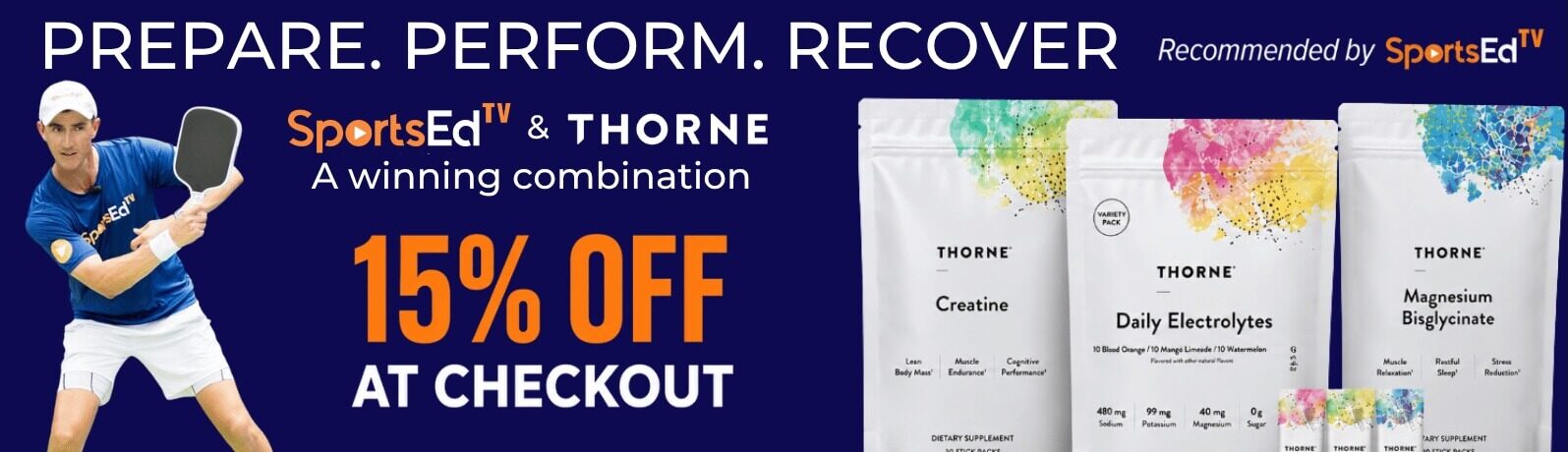
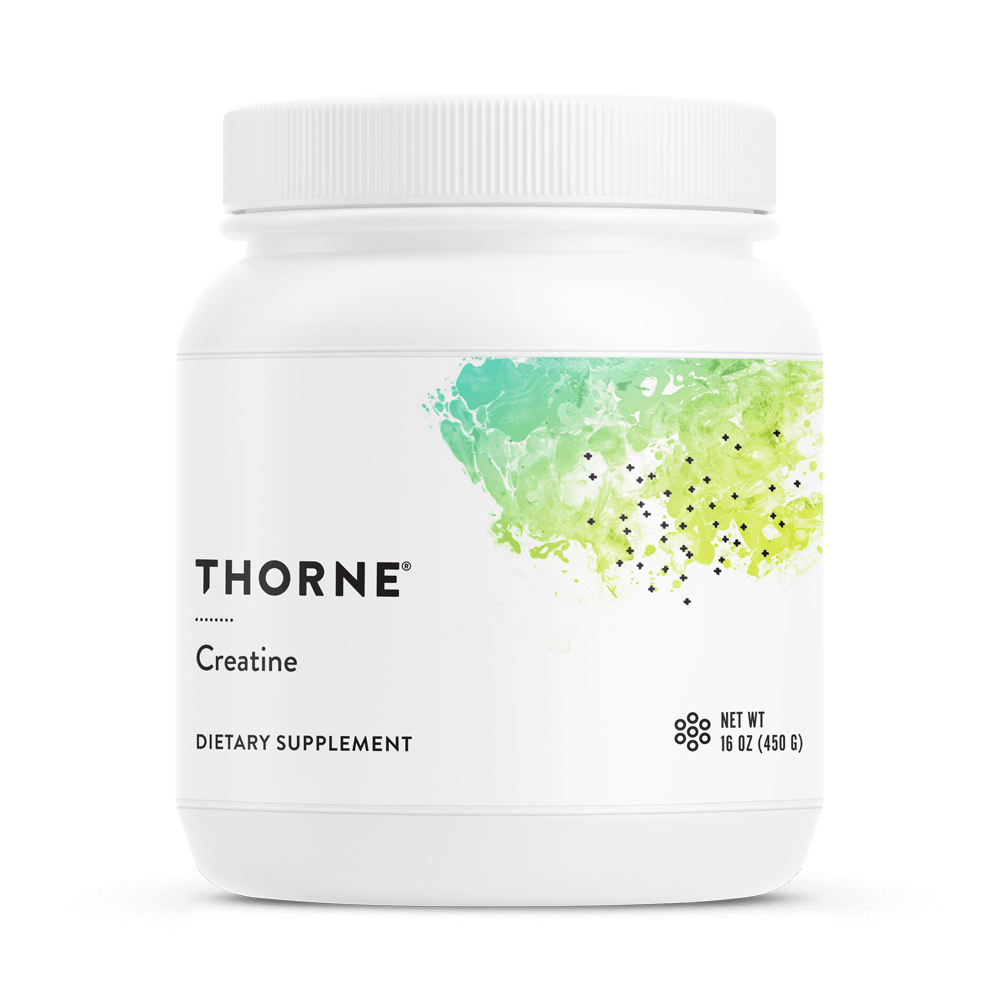 Thorne Creatine (create an account and get 15% off at checkout)
At my age, however, the performance argument is only part of the reason I take it. Maintaining muscle mass and strength becomes increasingly important as we get older. Research in older adults has shown that creatine, particularly when combined with resistance training, can help improve strength and support lean body mass. For me, that matters as much as any short-term performance benefit.
I want to continue moving quickly, generating force, and maintaining strong legs. Those qualities help me on the pickleball court today, but they are also part of a much larger objective: remaining physically capable as I age. That is why creatine makes so much sense to me. It is inexpensive, extensively studied, easy to take, and obtaining a comparable amount from food every day would be impractical.
This may be equally important for women, particularly around and after menopause, when declining estrogen contributes to losses in muscle mass and strength. Research increasingly suggests that creatine, especially when combined with resistance training, can help women preserve lean mass and improve strength as they age. That matters directly in pickleball, where acceleration, balance, stability, and the ability to repeatedly generate force are all part of performance.
Vitamin D3 and K2: Thinking Beyond the Next Match
Vitamin D occupies a very different place in my routine. I do not take it because I expect to feel an immediate difference during a game. I take it because bone health, muscle function, and long-term physical resilience become increasingly important with age.
Vitamin D helps the body absorb calcium and plays an important role in maintaining bones and normal muscle function. That matters in a sport that involves repeated lunging, rapid deceleration, lateral movement, rotation, and occasional falls. Pickleball is accessible, but that doesn't mean the body isn't under stress.
Vitamin D is also relatively difficult to obtain in meaningful quantities from food alone. Fatty fish and fortified foods can provide it, and sunlight enables the body to produce vitamin D, but the amount produced varies according to age, season, geography, skin exposure, and other factors. For that reason, vitamin D is one of the nutrients where supplementation can make practical sense, particularly when blood testing indicates that levels are lower than desirable.
I take vitamin D3 together with K2 because vitamin K is involved in proteins associated with bone mineralization and calcium metabolism. I would not describe K2 as a pickleball performance supplement, nor would I claim that everyone taking vitamin D must automatically take K2. I see the combination as part of a broader strategy to maintain bone and musculoskeletal health over time.
The distinction matters. The supplement industry tends to turn every useful nutrient into a performance claim. I prefer to think in terms of function. Creatine may help me produce and preserve muscular power. Vitamin D and K2 are more about maintaining the structure that allows me to keep training and competing.

Thorne Vitamin D3/K2 (create an account and get 15% off at checkout)
Magnesium: Supporting the Machinery Behind Performance
Magnesium is easy to underestimate because its role is mostly behind the scenes. It is involved in hundreds of biochemical reactions and is essential for normal muscle contraction, nerve function, energy production, and protein synthesis—all processes that matter every time we move on the court.
I take magnesium bisglycinate, also called magnesium glycinate. Magnesium is bound to the amino acid glycine, making it a well-tolerated form that is commonly used for daily supplementation.
I do not take magnesium because I expect it to make me faster or stronger overnight. The objective is much simpler: make sure I am getting enough. Magnesium is readily available in foods such as nuts, seeds, beans, whole grains, and leafy vegetables, but my diet varies from day to day. Supplementation gives me consistency without having to calculate every micronutrient in every meal.
At 60, I am less interested in nutritional perfection than in avoiding deficiencies that could affect how I feel, recover, and perform.
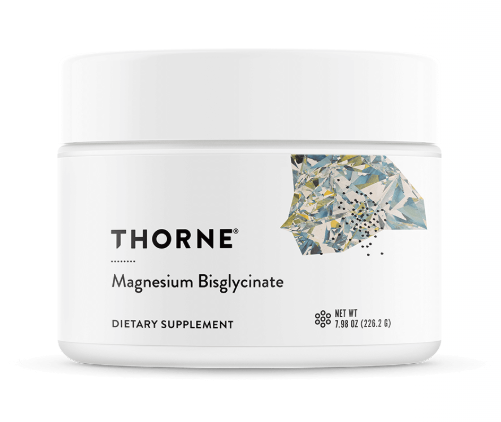 Thorne Mg Bisglycinate (create an account and get 15% off at checkout)
Electrolytes: When Water Is Not Enough
Electrolytes are the most situational supplement on my list. If I am playing for a relatively short period in comfortable weather, water and a normal diet may be entirely sufficient. But the equation changes when a session becomes longer, the temperature rises, or I start sweating heavily.
Sweat is not simply water. Sodium and other electrolytes are lost with it, and those minerals support fluid balance, nerve function, and muscle contraction. During prolonged play, particularly in hot and humid conditions, replacing only water may not adequately replace what you're losing.
This is where electrolytes make practical sense for me. I could replace sodium and other minerals later through food, but during a long session it is much easier to put electrolytes directly into my water bottle. That is another example of why I use supplements. They are not necessarily superior to food; they are simply more convenient in certain situations.
The key is context. I do not believe every hour of pickleball requires an expensive electrolyte drink. The longer the duration, the greater the heat, humidity, and individual sweat loss, the more relevant electrolyte replacement becomes.
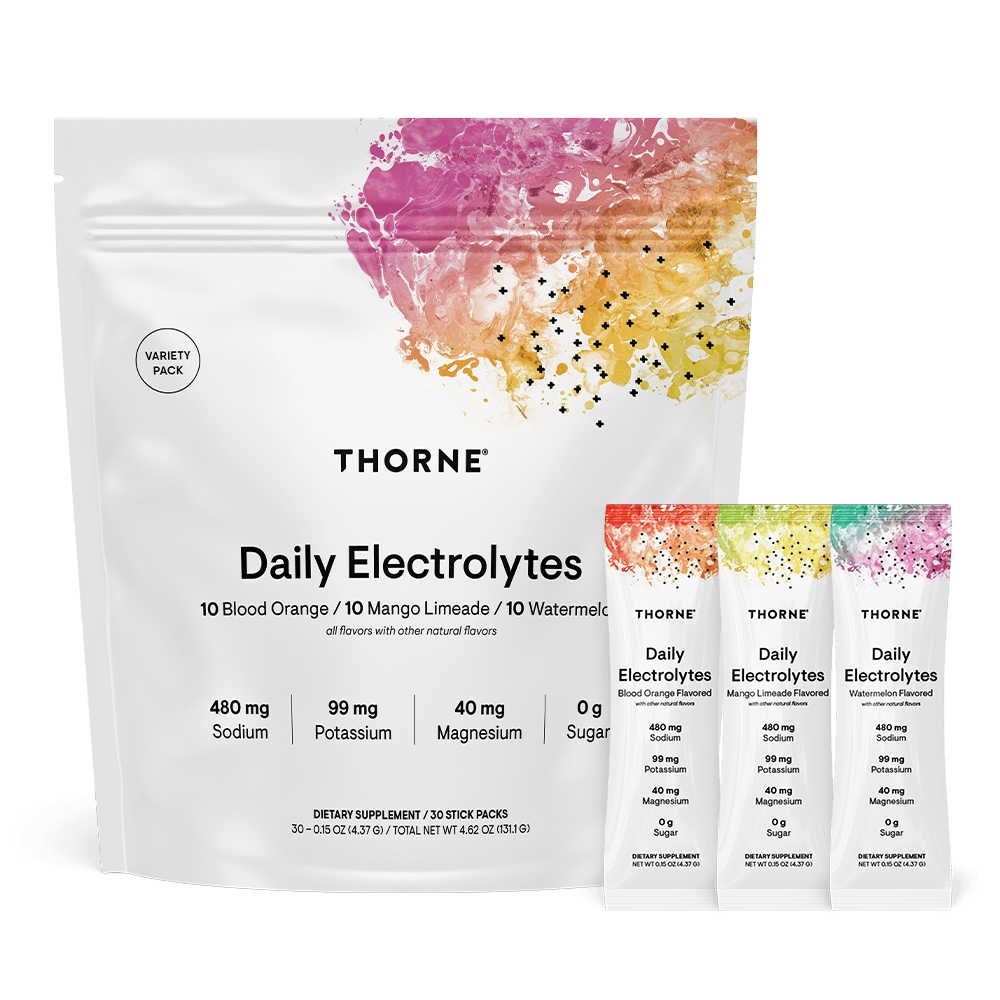 Thorne Electrolytes (create an account and get 15% off at checkout)
Why I Use Supplements Rather Than Relying Only on Food
The idea that serious athletes should obtain absolutely everything from food sounds appealing, but it can become impractical when taken literally. There is nothing inherently superior about forcing yourself to consume huge quantities of a particular food when the nutrient you want can be obtained safely and precisely in a much smaller form.
Creatine illustrates the point perfectly. Yes, meat contains creatine, but I would have to eat roughly two pounds of beef to obtain about four grams. Magnesium is easy to obtain from food, but intake varies dramatically depending on what I eat that day. Vitamin D occurs naturally in relatively few foods. Electrolytes can be replaced through meals, but that is not particularly convenient in the middle of a two-hour pickleball session in the heat.
My approach is therefore not “supplements instead of food.” It is food first, with supplementation where supplementation is more practical.
That distinction is important because no supplement can compensate for the fundamentals. Creatine does not replace strength training. Magnesium does not replace sleep. Electrolytes do not replace proper hydration. Vitamin D does not replace a nutritious diet. None of them will correct poor technique or make someone a good pickleball player without practice.
Why do I Choose Thorne?
At 60, Performance Has a Different Meaning
Perhaps the biggest change in my thinking has been my definition of performance itself. When I was younger, performance was mostly about what I could do at that moment: how strong I was, how fast I could move, and whether I could beat the person in front of me.
I still care about winning. Competition is one reason I love sport.
But now I have added another measurement: can I come back tomorrow and do it again?
That question changes everything. Maintaining muscle matters because I want to remain strong years from now. Bone health matters because I want to keep moving confidently. Hydration matters because I want to finish a session feeling good, not depleted. Recovery matters because playing well today is less meaningful if I cannot play again for several days.
This is ultimately why these four supplements have earned a place in my routine. Creatine supports strength, power, and repeated high-intensity effort. Vitamin D3 and K2 are part of my approach to maintaining bone and musculoskeletal health. Magnesium helps ensure adequate intake of a mineral involved in muscle, nerve, and energy metabolism. Electrolytes help replace what I lose when sweat and heat become significant.
None of this is revolutionary, and that is probably a good thing. I am not looking for the newest miracle ingredient or an anti-aging powder with thirty substances I cannot pronounce. I am looking for a small number of well-understood tools that make sense for the way I train, compete, and live.
At 60, my body communicates much more clearly than it used to. If I neglect something, it lets me know sooner or later. I have learned that it is much easier to listen before it has to start shouting.
And for me, that is what smart supplementation is really about: not trying to beat aging, but giving myself the best possible chance to keep playing, competing, and enjoying the game for many years to come.
Frequently Asked Questions
What is the best supplement for pickleball performance?
Of the supplements discussed here, creatine monohydrate has the strongest evidence for directly supporting strength, power, and repeated short-duration, high-intensity exercise. That type of activity is highly relevant to the repeated accelerations and explosive movements found in pickleball.
How much creatine is in beef?
The NIH estimates roughly 500 mg of creatine in a four-ounce serving of beef or salmon. At that approximation, two pounds of beef would provide around 4 grams of creatine.
Do pickleball players need electrolytes?
Not necessarily for every session. For shorter exercise in normal conditions, water and a normal diet may be sufficient. Electrolyte replacement becomes more relevant during prolonged play, hot conditions or for athletes who sweat heavily.
Does magnesium prevent muscle cramps?
Magnesium is essential for normal muscle and nerve function, but muscle cramping has multiple possible causes. Taking magnesium should not be viewed as a guaranteed way to prevent exercise-associated cramps, particularly when someone already has adequate magnesium status.
Should everyone take vitamin D?
No. Vitamin D requirements and blood levels vary. A blood test measuring 25-hydroxyvitamin D can help determine vitamin D status rather than simply assuming that more supplementation is better.
Is K2 necessary when taking vitamin D3?
Vitamin K is important for bone health and normal blood clotting, but evidence does not justify saying that every person taking D3 must also take K2. Vitamin K can also interact with anticoagulant medications such as warfarin.
This article describes my personal approach to nutrition and supplementation and is intended for educational purposes only. It is not medical advice. Individual needs vary according to diet, health status, medications, age, and activity level. Consult a physician or qualified sports dietitian before starting or substantially changing a supplementation program.

Share this story: