Baseball, Softball
10 × 10-Yard Sprint Drill for Baseball and Softball - A Sport-Specific Way to Build Acceleration and Repeat Sprint Ability
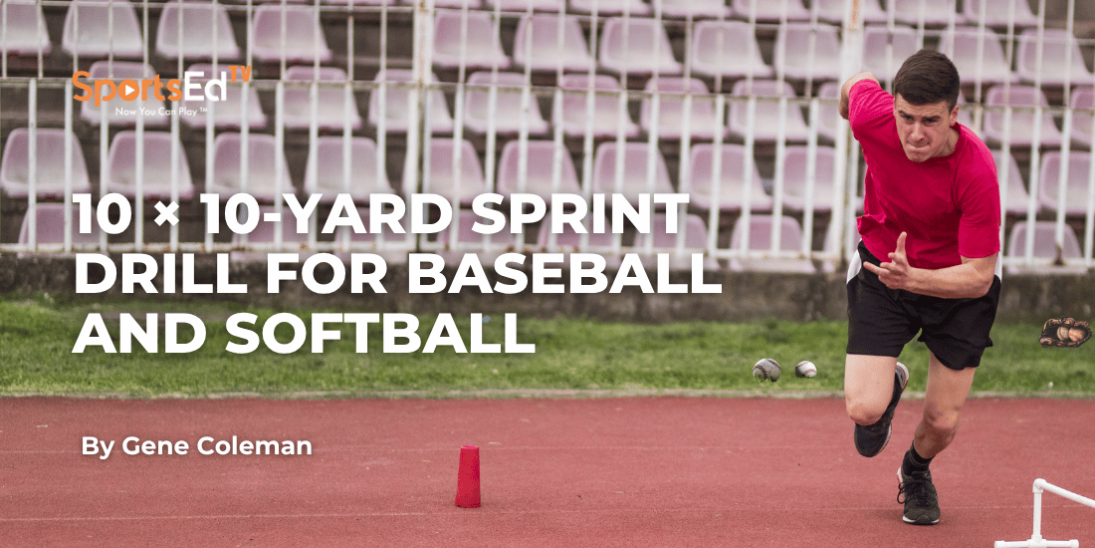
In baseball and softball, speed is rarely measured over 40 or 60 yards. It is usually measured in the first few steps.
Whether an athlete is beating out an infield hit, stealing second base, charging a ground ball, covering first base, tracking a fly ball, or scoring from third, many game-changing plays are decided within the first 10 to 15 yards.
Players rarely have enough time or space to reach maximum running speed before the play is over. That is why acceleration, rather than top-end sprint speed, is one of the most important physical qualities a baseball or softball player can develop.
One of the simplest and most effective preseason drills for improving acceleration while building sport-specific conditioning is the 10 × 10-yard sprint protocol, popularized by sprint coach Derek Hansen.
Although the drill is simple, it closely matches the movement demands of baseball and softball. It teaches athletes to produce repeated explosive efforts while maintaining speed, power, and proper running mechanics.
Sometimes the simplest drills produce the greatest results.

What Is the 10 × 10-Yard Sprint Drill?
The 10 × 10-yard sprint drill consists of ten maximum-effort accelerations over 10 yards, with enough recovery between repetitions to maintain speed and proper sprint mechanics.
For baseball and softball players, the drill can help develop:
- First-step quickness
- Short-distance acceleration
- Repeat sprint ability
- Controlled deceleration
- Baseball- and softball-specific conditioning
- The ability to maintain speed throughout practices and games
The goal is not to make athletes exhausted. The goal is to help them repeat high-quality, explosive efforts with minimal decline in performance.
Why Acceleration Matters in Baseball and Softball
Baseball and softball are intermittent sports. Players perform short, explosive actions followed by periods of relative recovery.
A typical game includes dozens of brief accelerations rather than continuous running. Examples include:
- Exploding out of the batter’s box
- Stealing a base
- Breaking toward a fly ball
- Charging a bunt
- Scoring from third base
- Covering first base
- Tracking a ball into the gap
- Moving quickly to back up a play
- Reacting to a passed ball or wild pitch
Each effort usually lasts only a few seconds.
Training should reflect those demands. If the sport requires repeated accelerations, conditioning should prepare athletes to accelerate repeatedly.
Long-distance running may develop general endurance, but it does not closely reproduce the speed, recovery patterns, or movement mechanics involved in most baseball and softball plays.
Why Use 10-Yard Sprints?
The first 10 yards can determine success on many baseball and softball plays.
During the early portion of a sprint, the athlete is still accelerating. Maximum velocity is reached later, often after the distance involved in a typical baseball or softball play has already been covered.
That means improving the first three to five steps may have a greater impact on game performance than spending large amounts of training time on maximal sprint speed.
A faster first step can help an athlete:
- Reach first base sooner
- Get a better jump when stealing
- Close more quickly on a ground ball
- Cover more space in the outfield
- React faster to a bunt
- Score on a close play at the plate
Simply put, the athlete who accelerates first usually arrives first.
Why Perform Ten Sprint Repetitions?
A single sprint can train acceleration. Repeated high-quality sprints train the athlete’s ability to reproduce that acceleration throughout a practice, game, doubleheader, or tournament.
Sport scientists commonly refer to this quality as repeat sprint ability. It is the capacity to perform repeated explosive efforts while limiting the decline in speed and power from one repetition to the next.
That quality is important in baseball and softball because players may need to accelerate dozens of times during a game.
The objective is not exhaustion. The objective is to maintain speed, power, and mechanics from the first repetition to the last.
If the first sprint is fast and technically sound but the final repetitions are slow and poorly executed, the drill is no longer accomplishing its primary purpose.
How to Perform the 10 × 10-Yard Sprint Drill
One of the drill’s greatest strengths is its simplicity. It requires only a flat running surface, a stopwatch, and a few cones or field markers.
Athletes should complete a thorough dynamic warm-up before beginning. Sprinting should not be performed without first preparing the muscles, joints, and nervous system for explosive movement.
Equipment and Course Setup
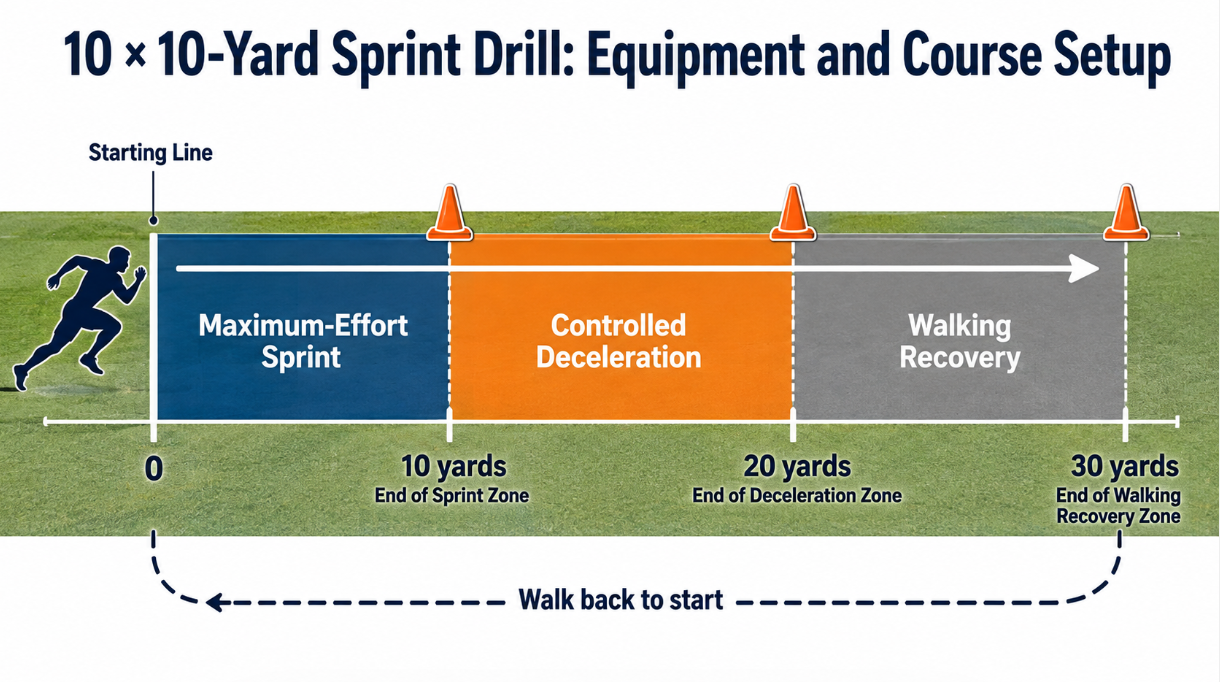
Use a marked starting line and place three cones at the following distances:
- 10 yards: End of the sprint zone
- 20 yards: End of the deceleration zone
- 30 yards: End of the walking recovery zone
The course is divided into three sections:
- 0 to 10 yards: Maximum-effort sprint
- 10 to 20 yards: Controlled deceleration
- 20 to 30 yards: Walking recovery
Athletes can then walk back to the starting line before beginning the next repetition.
Step-by-Step Instructions
- Begin from an athletic stance or another sport-appropriate starting position.
- Accelerate as quickly as possible through the first 10 yards.
- Sprint through the 10-yard line rather than slowing down before reaching it.
- Gradually decelerate over the next 10 yards.
- Do not stop suddenly or plant aggressively at the finish.
- Walk the final 10 yards as active recovery.
- Walk back to the starting line.
- Rest longer when necessary, so the next sprint can be performed at maximum quality.
- Repeat until 10 high-quality sprints have been completed.
Every repetition should resemble the first one.
If sprint speed, posture, coordination, or mechanics begin to decline, the athlete should receive more recovery. Continuing to sprint with poor mechanics teaches the athlete to move slowly and inefficiently.
How Much Rest Should Athletes Take Between Sprints?
A 10-yard sprint lasts only a few seconds. Athletes should generally receive enough recovery to repeat the sprint at or near maximum speed.
For many athletes, approximately 30 to 40 seconds of total recovery between repetitions will be appropriate. This can include walking through the recovery zone, walking back to the starting line, and any additional standing rest.
Some athletes may need more recovery, especially:
- Early in the preseason
- After returning from an injury
- During hot or humid conditions
- When working with younger players
- When sprint mechanics begin to decline
- When the drill is performed after another demanding activity
Recovery should be determined by performance quality, not only by the stopwatch.
The next repetition should begin when the athlete is physically and technically prepared to sprint well.
Do Not Confuse Conditioning With Fatigue
One of the biggest mistakes coaches make is assuming that conditioning must leave athletes exhausted.
Making athletes tired does not necessarily make them better conditioned.
Baseball and softball consist primarily of brief, explosive movements separated by periods of recovery. They are not continuous endurance events.
The 10 × 10-yard sprint protocol should prepare athletes for that pattern. It should improve their ability to perform repeated explosive efforts without allowing speed and mechanics to deteriorate.
Players should finish the workout feeling challenged, but not mechanically broken down.
The goal is to become better, not simply more tired.
Sprint Technique: Quality Before Quantity
Every sprint should be performed at or near maximum intensity while maintaining proper technique.
Athletes should focus on:
- Exploding with the first movement
- Creating a strong forward body angle
- Pushing forcefully into the ground
- Driving the arms aggressively
- Taking powerful early steps
- Accelerating through the 10-yard line
- Decelerating gradually and under control
Athletes should not reach for the ground with long, braking steps. During acceleration, the feet should contact the ground underneath or slightly behind the body’s center of mass.
Great acceleration comes from applying force into the ground, not simply from moving the legs faster.
When sprint mechanics deteriorate, the quality of the training declines.
Practice does not automatically make perfect. Practice makes movement patterns permanent, whether those patterns are effective or ineffective.
Coaching Cues for Better Acceleration
Coaching instructions should be short, clear, and easy to apply at high speed.
Useful acceleration cues include:
- “Explode on the first movement.”
- “Push the ground away.”
- “Stay low during the first steps.”
- “Drive the arms.”
- “Push, do not reach.”
- “Run through the line.”
- “Decelerate under control.”
- “Recover before repeating.”
Avoid giving athletes too many instructions at once. Select one or two cues based on the athlete’s most important technical need.
How to Progress the 10 × 10 Sprint Protocol
Like any successful training program, the 10 × 10 protocol should follow the principle of progressive overload.
Begin with the minimum effective workload. Increase the training demand only after athletes demonstrate that they can maintain excellent speed and sprint mechanics throughout the session.
Increase only one variable at a time.
Do not increase the number of sets and the sprint distance during the same progression.
Phase 1: Increase the Number of Sets
Begin with:
1 × 10 × 10
This means:
- One set
- Ten repetitions
- Ten yards per sprint
After several weeks of successful training, athletes may progress to:
- 2 × 10 × 10
- 3 × 10 × 10
Allow approximately two to three minutes of recovery between sets.
Each set should be treated as a speed-development activity, not a test of how much discomfort the athlete can tolerate.
If the athlete cannot maintain speed and technique, the workload is too high or the recovery is too short.
Phase 2: Increase the Sprint Distance
Rather than continuing to add more sets, coaches can gradually increase the sprint distance while maintaining ten repetitions.
A logical progression is:
- 10 × 10 yards
- 10 × 15 yards
- 10 × 20 yards
- 10 × 25 yards
- 10 × 30 yards
The distance should increase only when athletes can perform every repetition with good posture, force production, coordination, and controlled deceleration.
For many youth and high school baseball and softball players, 10 × 20 yards provides sufficient acceleration and conditioning for the demands of the sport.
Longer progressions, such as 10 × 25 yards and 10 × 30 yards, are generally more appropriate for advanced high school athletes, collegiate players, and professionals with greater sprinting experience and work capacity.
Train for the demands of the game, not simply to perform more work.
Where Should the Drill Fit Into a Workout?
The 10 × 10-yard sprint drill should usually be performed early in a training session, after the dynamic warm-up and before physically demanding conditioning or strength work.
Speed is best trained when the athlete is relatively fresh.
A practical session order might be:
- Dynamic warm-up
- Sprint preparation drills
- 10 × 10-yard sprint protocol
- Agility or baseball-specific movement work
- Strength training
- Additional conditioning, when appropriate
- Cooldown
Performing the drill after athletes are already exhausted may reduce sprint speed and increase the likelihood of poor movement mechanics.

Common Coaching Mistakes
Coaches should avoid turning the drill into punishment.
Common mistakes include:
- Shortening recovery until sprint quality declines
- Adding unnecessary running distance
- Asking athletes to sprint while fatigued
- Treating baseball conditioning like football conditioning
- Ignoring acceleration mechanics
- Allowing athletes to slow down before the 10-yard line
- Stopping abruptly after each sprint
- Increasing volume too quickly
- Rewarding fatigue instead of speed
- Continuing after the athlete’s performance has clearly declined
More work is not always better.
Better work is better.
When Should the Drill Be Stopped?
The session should be stopped or modified when:
- Sprint times decline noticeably
- The athlete begins standing upright too early
- Arm action becomes passive or uncoordinated
- Steps become long and reach forward
- The athlete cannot decelerate safely
- The athlete reports pain
- The running surface becomes unsafe
- Effort or concentration declines substantially
A coach may add recovery, reduce the number of repetitions, or end the drill entirely.
Ten sprints are a target, not an obligation. Eight high-quality sprints are more valuable than ten poorly executed ones.
Frequently Asked Questions About the 10 × 10 Sprint Drill
What is the 10 × 10-yard sprint drill?
The drill consists of ten maximum-effort sprints over 10 yards. Athletes receive enough recovery between repetitions to maintain speed, power, and proper running mechanics.
Is the 10 × 10 sprint drill good for baseball players?
Yes. Baseball players frequently perform short accelerations when leaving the batter’s box, stealing bases, fielding balls, covering bases, and scoring. The drill closely reflects those game demands.
Is the drill appropriate for softball players?
Yes. Softball also requires rapid first steps, short accelerations, controlled deceleration, and repeated explosive efforts throughout a game.
How long should athletes rest between 10-yard sprints?
Approximately 30 to 40 seconds of total recovery may be appropriate for many athletes. More recovery should be provided if speed or sprint mechanics begin to decline.
How often should athletes perform the drill?
For many athletes, one or two sessions per week during the preseason may be sufficient. The appropriate frequency depends on the athlete’s age, experience, competition schedule, strength program, and total training workload.
Should youth players complete all ten sprints?
Not necessarily. Younger or less experienced players can begin with fewer repetitions, such as five or six high-quality sprints, and gradually progress toward ten.
Quality should always take priority over completing a predetermined number.
Should athletes run the drill at maximum effort?
The sprint portion should be performed at or near maximum effort, provided the athlete is properly warmed up and can maintain safe mechanics.
Can this drill replace all conditioning?
No. It is one component of a complete baseball or softball performance program. Athletes may also need strength training, mobility work, change-of-direction training, position-specific movement, and other forms of conditioning.
Should the drill be performed before or after strength training?
It is usually best performed before strength training, when the athlete is fresh enough to produce maximum speed and high-quality movement.
What is the difference between acceleration and maximum speed?
Acceleration is the process of increasing speed during the early steps of a sprint. Maximum speed is the highest speed an athlete reaches later in the sprint. Because many baseball and softball plays cover short distances, acceleration is often more relevant than maximum velocity.

Key Takeaways
Conditioning should prepare athletes for the demands of competition, not simply make them tired.
The 10 × 10-yard sprint protocol provides a simple, practical, and highly effective way to develop:
- First-step quickness
- Short-distance acceleration
- Repeat sprint ability
- Controlled deceleration
- Sport-specific conditioning
The keys to the drill are maximum-quality effort, sufficient recovery, proper sprint mechanics, and gradual progression.
Baseball and softball are not endurance sports. They are repeat-acceleration sports.
Train accordingly.
About the Author
Dr. Coleman is Professor Emeritus and former Chair of the Fitness and Human Performance Program at the University of Houston-Clear Lake, a strength and conditioning consultant for the Texas Rangers, and a Website Education Manager at baseballstrength.org