By Gene Coleman, Ed.D., RSCC*E
Effective arm care goes far beyond resistance bands and shoulder exercises. Durable throwing arms are developed through proper mechanics, progressive throwing workloads, whole-body strength and mobility, adequate recovery, nutrition, hydration, and sleep.
Ask ten baseball or softball players what “arm care” means, and most will mention resistance bands, tubing exercises, or an ice bag after a game.
While those tools may have value, they represent only a small part of the picture.
True arm care begins long before the first throw. It is not simply a warm-up routine, a collection of shoulder exercises, or a recovery protocol performed after practice.
Arm care is a comprehensive approach to developing an athlete capable of throwing repeatedly, recovering efficiently, and remaining healthy throughout a season and a career.
Healthy arms are not created by one exercise or one program. They are developed through intelligent training, sound mechanics, appropriate workloads, and consistent recovery.

Why Do Baseball and Softball Throwing Arms Break Down?
The shoulder and elbow are required to transfer tremendous amounts of force during throwing.
During a baseball pitch, the shoulder can rotate at more than 7,000 degrees per second, while the elbow experiences forces approaching the limits of its structural capacity.
Despite these extraordinary demands, the arm itself is rarely the only source of the problem.
Most throwing injuries are associated with one or more of the following:
-
Excessive throwing volume
-
Inadequate recovery between throwing sessions
-
Poor movement efficiency
-
Deficiencies in strength, mobility, or stability
-
Improper conditioning
-
Fatigue
-
Rapid increases in workload
Simply put, the arm often becomes the victim rather than the cause.
When the rest of the body fails to generate or transfer force efficiently, the shoulder and elbow are forced to compensate. Over time, those repeated compensations can lead to tissue overload and eventually breakdown.
Arm Soreness vs. Injury: Understanding Throwing Overload
Athletes often use the word “injury” whenever they experience arm pain. However, not every sore arm is injured.
Understanding the difference between overload and injury is critical.
Overload occurs when tissues are exposed to more stress than they have been prepared to handle.
This can happen after:
-
A sudden increase in throwing volume
-
Multiple tournaments
-
Consecutive days of pitching
-
Returning too quickly after time off
-
Inadequate recovery
Overload often presents as soreness, stiffness, fatigue, or reduced performance.
Given proper rest and appropriate adjustments to workload, the body can often recover.
An injury, on the other hand, involves actual structural damage to muscles, tendons, ligaments, or bone. Injuries typically require medical evaluation, rehabilitation, and a gradual return-to-play process.
The important point is that many injuries begin as overload.
Ignoring fatigue, pitching through pain, or consistently exceeding the body’s ability to recover can allow manageable overload to progress into a more serious problem.
One of the primary goals of an effective arm care program is recognizing overload early enough to prevent it from becoming an injury.
Durability Should Be the Goal of Arm Care
The objective of arm care should not simply be injury prevention.
The goal is durability.
Durability is the ability to perform at a high level repeatedly over long periods while recovering efficiently between outings.
Durable athletes tend to:
-
Maintain velocity throughout the season
-
Recover efficiently after throwing
-
Tolerate higher training demands
-
Miss fewer practices and games
-
Continue improving year after year
Durability is built, not inherited.
It develops through years of progressive training, appropriate workloads, quality movement, proper nutrition, adequate sleep, and intelligent recovery.
The strongest arm is not necessarily the healthiest arm.
The healthiest arm is the one that continues performing consistently throughout the season.
The Kinetic Chain: Why Throwing Is a Whole-Body Movement
One of the greatest misconceptions in baseball and softball is that throwing is primarily an arm action.
It isn’t.
Throwing is a whole-body movement.
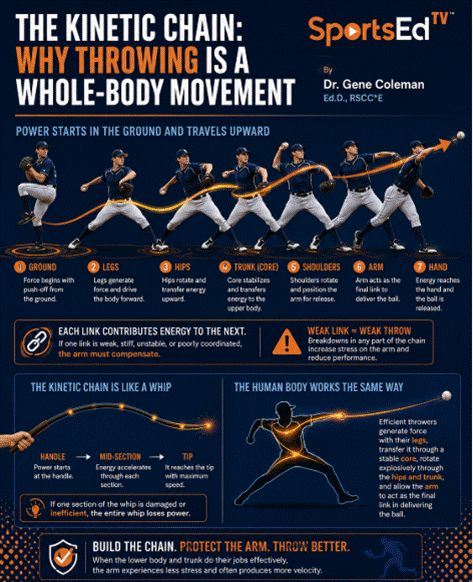
Power begins in the ground and travels upward through the legs, hips, trunk, shoulder, arm, and finally the hand before the ball is released.
This sequence is known as the kinetic chain.
Each segment contributes energy to the next. If one link becomes weak, stiff, unstable, or poorly coordinated, the arm may be forced to compensate by producing additional force.
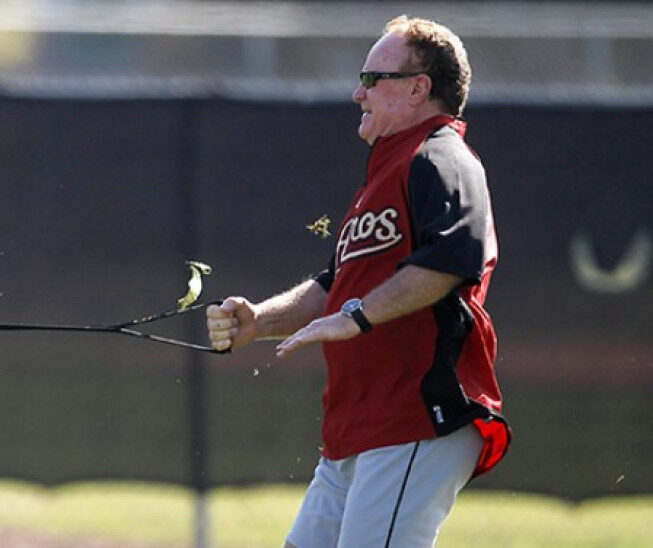
Imagine cracking a whip.
Power starts at the handle and accelerates through each section until reaching the tip. If one section of the whip is not functioning properly, the entire system becomes less efficient.
The human body works in much the same way.
Efficient throwers generate force with their legs, transfer it through a stable core, rotate explosively through the hips and trunk, and allow the arm to act primarily as the final link in delivering the ball.
When the lower body and trunk do their jobs effectively, the arm can experience less unnecessary stress while often producing greater velocity.
What Should a Complete Baseball or Softball Arm Care Program Include?
An effective arm care program extends far beyond shoulder exercises.
A comprehensive approach should include:
-
Proper throwing mechanics
-
Progressive throwing programs
-
Individualized workload management
-
Full-body strength development
-
Hip mobility
-
Thoracic spine mobility
-
Core stability
-
Lower-body strength and power
-
Recovery strategies
-
Adequate sleep
-
Proper nutrition
-
Hydration
Bands, tubing, and rotator cuff exercises certainly have their place.
But they cannot compensate for excessive throwing, poor mechanics, inadequate recovery, or deficiencies elsewhere in the body.
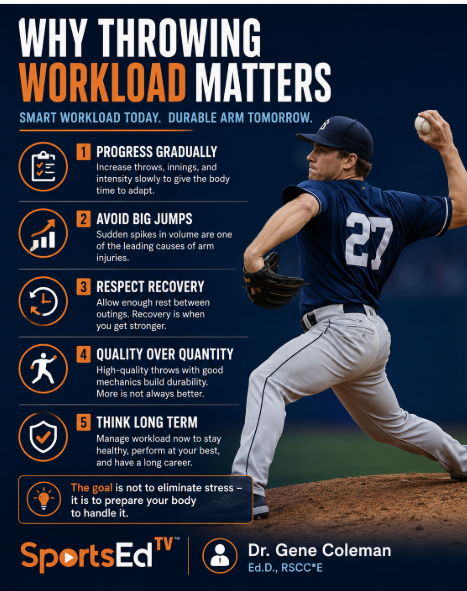
Why Throwing Workload Matters
Every throw creates stress.
That stress is not automatically harmful. In fact, the body needs appropriately applied stress in order to adapt and become more capable.
Problems arise when the amount of stress exceeds the athlete’s ability to recover from it.
That is why throwing workload should progress gradually.
Athletes who go from limited throwing to high-volume practices, showcases, tournaments, or consecutive pitching appearances can expose the arm to demands it has not had time to prepare for.
The body needs both loading and recovery.
Training provides the stimulus. Recovery allows the adaptation.
Without both, durability becomes difficult to develop.

Building Stronger Throwers from the Ground Up
Arm care should not begin at the shoulder.
It should begin at the ground.
The legs provide the foundation for force production. The hips and trunk help transfer that force. The core provides stability. The upper body then completes the movement.
Weakness, stiffness, poor timing, or instability anywhere along that chain can reduce throwing efficiency and shift additional stress toward the shoulder and elbow.
This is why full-body strength and conditioning should be considered part of arm care.
Developing stronger legs, improving hip mobility, creating better trunk control, and building rotational power can all contribute to a more efficient throwing motion.
The objective is not simply to strengthen the arm.
The objective is to improve the entire system responsible for producing the throw.
Recovery Is Part of Training
Throwing programs often focus almost entirely on what athletes do during practice or competition.
What happens between throwing sessions is equally important.
Recovery includes adequate sleep, nutrition, hydration, reduced workload when necessary, and sufficient time between demanding throwing sessions.
Athletes cannot continually add stress without allowing time for adaptation.
Fatigue changes movement.
When athletes become tired, mechanics can deteriorate, movement efficiency can decrease, and tissues may be forced to absorb stresses differently than when the athlete is fresh.
For that reason, fatigue should not simply be viewed as something an athlete must “push through.”
It is information.
Coaches and athletes should pay attention to changes in soreness, velocity, control, mechanics, and recovery because they can provide early indications that workload may need to be adjusted.
Build the Athlete, Not Just the Arm
Every throw places stress on the body.
The goal is not to eliminate stress. That is impossible.
The goal is to prepare the athlete to tolerate it.
Healthy arms are not built through one exercise, one warm-up, or one recovery tool. They are developed through years of intelligent training, progressive loading, efficient movement, and consistent recovery.
When coaches, parents, and athletes begin thinking of arm care as a whole-body performance system rather than a collection of shoulder exercises, they take the first step toward building stronger, healthier, and more durable throwers.
Remember: Healthy arms are developed, not protected by one exercise.

Frequently Asked Questions About Baseball and Softball Arm Care
What is the best way to protect a throwing arm?
The best approach is not to rely on one exercise or recovery tool. Throwing-arm durability comes from proper mechanics, progressive workload management, full-body strength, mobility, conditioning, adequate recovery, sleep, nutrition, and hydration.
The goal should be to prepare the entire athlete to tolerate the stresses of repeated throwing.
Are resistance bands enough for baseball arm care?
No.
Resistance bands, tubing, and rotator cuff exercises can be useful components of an arm care program, but they cannot compensate for excessive throwing, poor mechanics, inadequate recovery, fatigue, or weaknesses elsewhere in the kinetic chain.
Arm care must address the whole athlete.
What is the kinetic chain in throwing?
The kinetic chain describes how force moves through the body during a throw.
Force begins with the interaction between the athlete and the ground and then travels through the legs, hips, trunk, shoulder, arm, and hand.
When each part of the chain functions efficiently, force can be transferred effectively to the ball. When one part of the chain does not function properly, the shoulder and elbow may be required to compensate.
What is the difference between arm soreness and a throwing injury?
Soreness can be a sign of overload, meaning the tissues have been exposed to more stress than they are currently prepared to tolerate.
An injury involves structural damage to muscles, tendons, ligaments, or bone and may require medical evaluation and rehabilitation.
Because overload can progress into injury, persistent pain, worsening symptoms, or significant changes in throwing ability should not be ignored.