Boxing, Martial Arts, Taekwondo
What Is the Toughest Martial Art? Ranking 25 Combat Sports and Competitive Formats
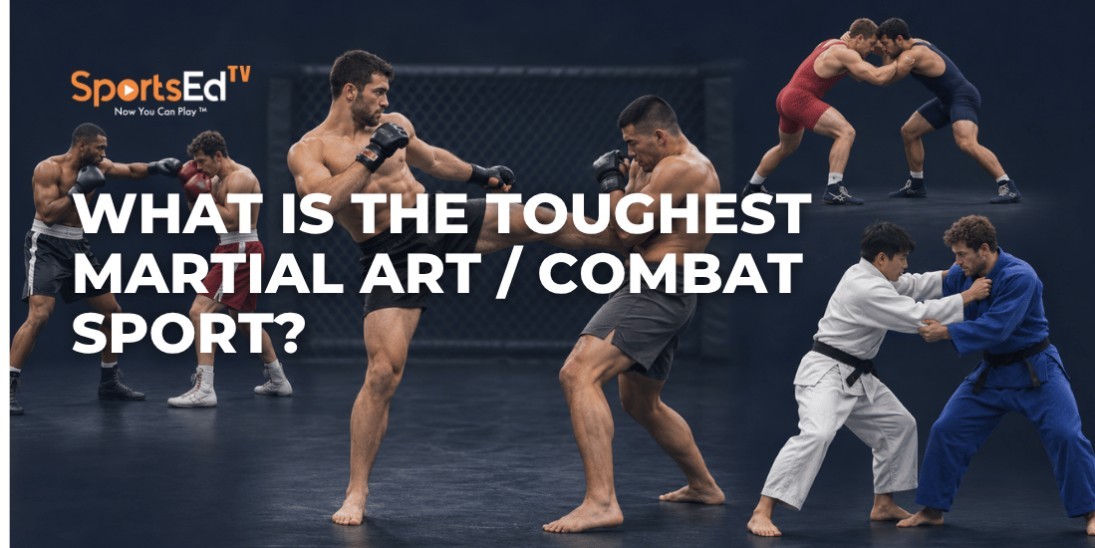
A boxer must keep making decisions while punches come at his head. A wrestler must generate explosive force against an opponent who is trying to control every movement. A judoka may have only a fraction of a second to prevent a throw that ends the contest.
Each faces a different kind of difficulty. So what does it actually mean to call one martial art tougher than another?
SportsEdTV compared 41 competitive martial arts and combat-sport formats using a framework that considers physical demands, technical complexity, psychological pressure, injury hazards, and the event itself.
MMA earns the highest score at 86.9, followed by combat sambo at 86.1. But the more meaningful finding is that these two remain the leading candidates even when the model’s scores and weights vary. Their small numerical gap does not justify declaring an undisputed winner.
Here is what the ranking measures, why the leading disciplines score so highly, and how to interpret the results.

What does “toughest” mean?
For this comparison, toughness means the demands of elite competition, together with the physical hazards associated with the format.
That includes the strength needed to control an opponent, the endurance to sustain repeated attacks, the skill to recognize an opening, and the composure to act while exhausted. It also includes facing several opponents during a tournament and making weight before competing.
The ranking does not measure street-fighting effectiveness, cultural importance or which martial art someone should learn. It compares specified competitive formats.
That distinction matters. Professional boxing and Olympic boxing have different bout structures. Combat sambo and sport sambo allow different techniques. Karate kata, WKF kumite, Kyokushin, and Karate Combat present very different challenges.
The model therefore scores them separately.
The five factors behind the ranking
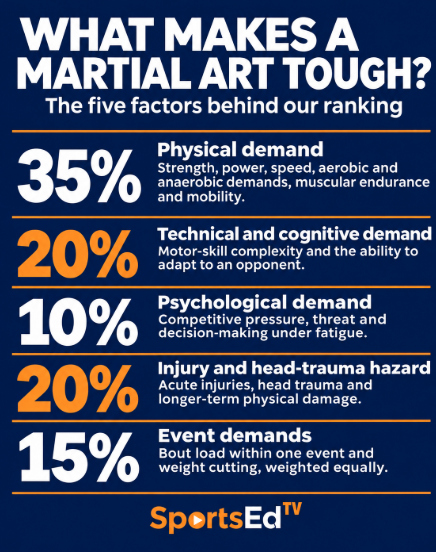
Each format receives scores against written criteria. Those scores feed into five weighted categories:
-
Physical demand—35%: Strength, power, speed and agility, aerobic capacity, repeated anaerobic efforts, muscular endurance and mobility.
-
Technical and cognitive demand—20%: The complexity of the required skills and the ability to read and adapt to an opponent.
-
Psychological demand—10%: Competitive pressure, opponent threat, the consequences of mistakes, and maintaining control under fatigue.
-
Injury and head-trauma hazard—20%: Acute injuries, head trauma and longer-term physical damage.
-
Event demands—15%: The number and scheduling of contests within an event, plus weight cutting. These two components receive equal weight.
The resulting scale runs from 10 to 100. Scores are shown to one decimal place so readers can follow the calculation; that decimal should not be mistaken for precise measurement of athletic toughness.
The inputs are editorial ratings guided by published scoring anchors, with selected ratings checked against research and competition rules. They produce an index ranging from 10 to 100.
These are model scores, not measured percentages of toughness. A score of 86 does not mean a discipline is “86% tough.”

The 25 toughest martial arts and combat sports
SportsEdTV evaluated 41 competitive formats. Below are the top 25 by base score; the complete ranking of all 41 appears in the accompanying white paper. Interpret close scores alongside the uncertainty analysis.
- Mixed martial arts — 86.9
- Combat sambo — 86.1
- Lethwei — 83.2
- Professional boxing — 82.2
- Freestyle wrestling — 81.8
- Muay Thai — 81.3
- US collegiate folkstyle wrestling — 80.3
- Judo — 79.7
- Karate Combat — 79.0
- Greco-Roman wrestling — 78.8
- Sport sambo — 78.6
- Taekwondo (WT) — 78.3
- Kudo — 78.0
- Kung fu: Sanda — 77.8
- Kickboxing (K-1 / Glory) — 77.5
- Submission grappling (no-gi) — 77.3
- Amateur Muay Thai (IFMA) — 77.2
- Bare-knuckle boxing (BKFC) — 76.6
- Amateur kickboxing (WAKO K-1) — 75.7
- Kyokushin, All-Japan Open format — 74.6
- Savate (combat) — 74.1
- Brazilian jiu-jitsu (gi) — 73.9
- Olympic boxing — 73.8
- Jujutsu, JJIF fighting system — 72.9
- Shuai jiao — 72.6
The full comparison also includes savate, Brazilian jiu-jitsu in the gi, Olympic boxing, traditional wrestling styles, fencing, kendo, forms competitions, and Shodokan competitive aikido.
Why MMA has the highest score
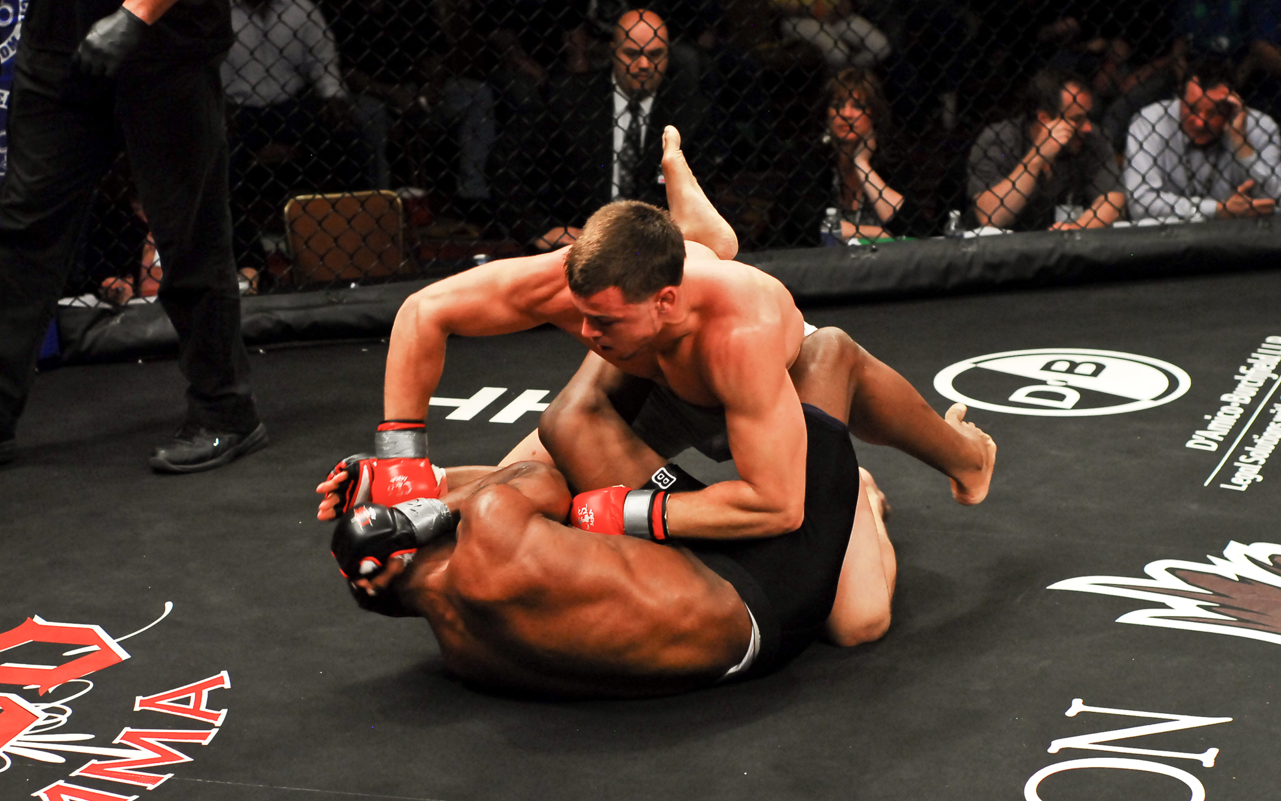
MMA places striking, clinch work, takedowns, ground control, and submissions within the same contest. An athlete must connect those skills while recognizing when the fight is moving from one phase to another.
A striking exchange can become a takedown attempt. A defensive movement can expose a submission. A successful attack can leave the attacker vulnerable to a counter.
In this model, MMA receives the maximum technical and cognitive score. It also scores highly for physical demand, psychological pressure, injury hazard, and weight cutting.
Its event-demand score is more moderate because the selected professional format involves one bout. A tournament athlete may have to recover and compete again several times before the event is over.
That difference helps explain why combat sambo is so close.
Why combat Sambo belongs beside MMA
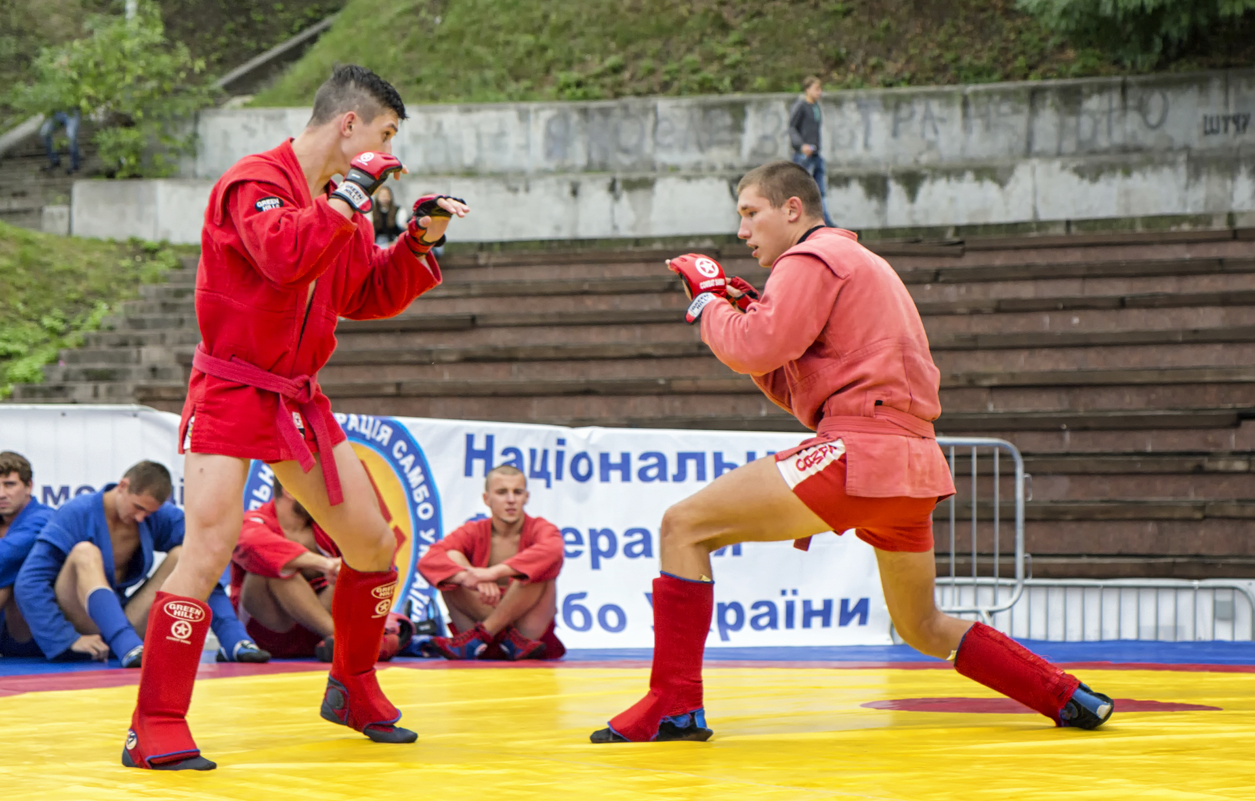
Combat sambo combines striking with throws, takedowns, and submissions. The model gives it the same physical-demand score as MMA and a nearly identical technical score.
Its tournament structure adds another challenge: advancing through multiple opponents in a single event. That gives combat sambo a higher bout-load score than professional MMA.
MMA gains ground through its psychological and weight-cutting scores under the selected rules and scoring criteria. Combat Sambo gains ground through its event structure.
The result is a narrow gap: 0.8 points.
When scores and weights are varied, MMA finishes first more often in four of the five scenarios. Combat Sambo finishes first more often in the widest uncertainty scenario. Both remain credible candidates for the top position.
Why boxing, Lethwei and Muay Thai rank highly
Professional boxing ranks fourth. Its championship format combines sustained physical effort with repeated defensive decisions and substantial head-trauma exposure. The model gives it maximum psychological and head-trauma scores.
Lethwei ranks third. Its bare-knuckle format and permitted headbutts contribute to high injury-hazard and psychological scores, alongside demanding striking skills and physical requirements.
Muay Thai ranks sixth because it combines punches, kicks, knees, elbows, and clinch work. It requires athletes to generate force, manage distance, and maintain balance while attacking and defending at close range.
Their positions also illustrate an important feature of the framework: danger contributes to toughness, but it does not determine the entire result. Injury hazard accounts for 20% of the total. Physical ability, skill, psychological demand, and event structure account for the rest.
Why wrestling and judo remain near the top
Freestyle wrestling and US collegiate folkstyle wrestling share the highest physical-demand score in the model.
Both require explosive attacks, sustained muscular effort, and the ability to keep working against an opponent’s resistance. Their tournament formats add repeated contests and limited recovery.
Freestyle ranks fifth and NCAA Division I folkstyle seventh. Their different event schedules and weight-cutting scores account for the separation in this model.
Judo ranks eighth. Explosive throwing ability, grip fighting, ground skills, and rapid tactical decisions combine with the demands of advancing through a tournament bracket.
These results show why a toughness ranking cannot be based only on striking or visible damage. Controlling a resisting opponent can impose exceptional demands without punches being part of the rules.
Why event structure matters
A professional championship fight and a tournament final represent different paths through competition.
One athlete prepares for a single opponent. Another may face several opponents, with recovery squeezed between contests. Sumo presents a different pattern again: fifteen bouts across fifteen consecutive days.
The model captures this through bout load within an event. It does not reward or penalise athletes simply for competing more or less frequently throughout the year.
Weight cutting contributes separately. Formats with no weight classes receive the minimum weight-cutting score. That lowers their total in this category without diminishing the strength, skill or endurance their competition requires.
How reliable is the order?
The model tests uncertainty by varying scores and weights across five scenarios, each with 20,000 simulations.
Inputs treated as fixed by the selected rules remain fixed. Less-supported estimates receive wider variation. Other scenarios test what happens when scoring errors move together across related disciplines.
Across those scenarios, MMA finishes first in approximately 33% to 63% of runs, and combat sambo in 34% to 41%. No other discipline exceeds approximately 7%.
These are frequencies within the model’s simulations—not measured probabilities that a sport is truly the toughest.
The clearest finding is the strength of the leading pair. Further down the ranking, positions overlap considerably. A few tenths of a point should not be used to claim that one discipline is definitively tougher than another.

What a lower position means
Brazilian jiu-jitsu ranks 22nd in the gi, despite receiving a very high technical score. Fencing also scores highly for technical and cognitive demand, but lower injury-hazard and weight-cutting scores reduce its overall total.
That is how a weighted comparison works: excellence in one category does not automatically produce the highest combined score.
A lower position does not mean a discipline is easy, less valuable, or less worthy of respect. It means its selected competitive format receives a lower total under this particular definition of toughness.
The comparison covers men’s elite formats, with NCAA Division I wrestling included as a specific collegiate format. It does not describe the demands of a beginner’s class or every possible ruleset within an art.
A ranking readers can examine
SportsEdTV’s ranking is an editorial model with published scoring criteria, weights, and calculations. Its purpose is to make the argument clear enough to examine.
Readers can identify the score they disagree with, explain why, and see how changing it affects the result.
MMA leads the base scores. Combat Sambo remains its closest rival. Behind them, striking and grappling disciplines offer different combinations of physical effort, skill, pressure, and event demands.
The accompanying white paper and workbook provide the complete 41-format ranking, scoring criteria, and uncertainty analysis.