By SportsEdTV Research
Who is the greatest male taekwondo athlete in history? Steven Lopez? Hadi Saei? Lee Dae-hoon? Or one of the champions who dominated before taekwondo became an official Olympic sport?
For decades, the answer has largely depended on whom you ask.
Some experts prioritize Olympic gold medals. Others emphasize World Championship titles, career longevity, or dominance within a particular generation.
But comparing athletes across eras has a fundamental problem: they didn't compete under the same conditions or have access to the same opportunities.
At SportsEdTV, we wanted to approach this question differently.
We developed the World Taekwondo Historical Performance Index (WT-HPI), a quantitative model that evaluates athletic achievement across generations using consistent, transparent criteria.
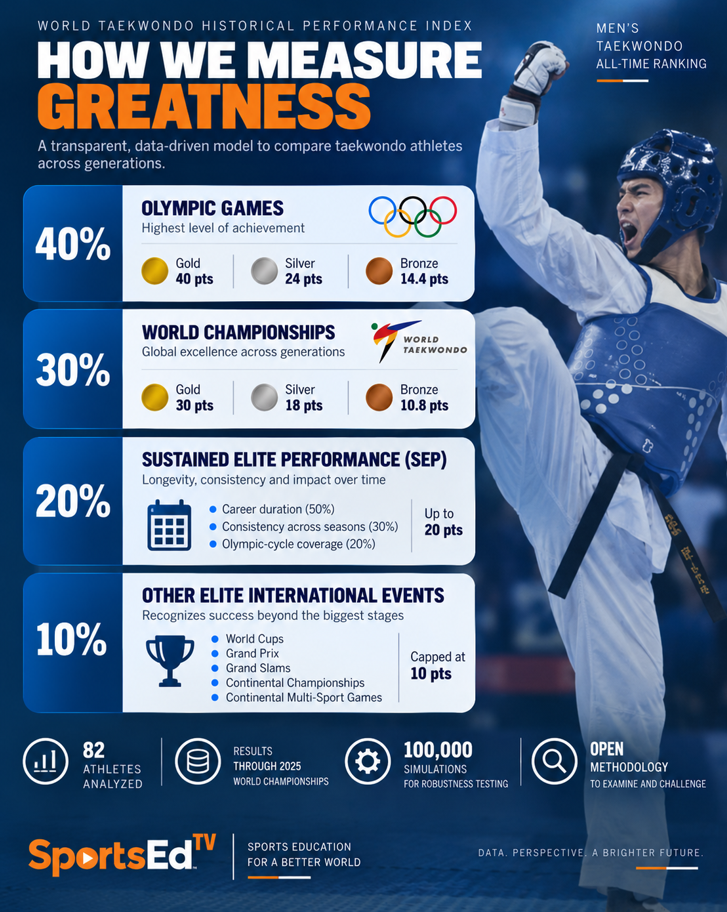
Our research examined 82 historical candidates, incorporated results through the 2025 World Championships, and tested the rankings through 100,000 statistical simulations.
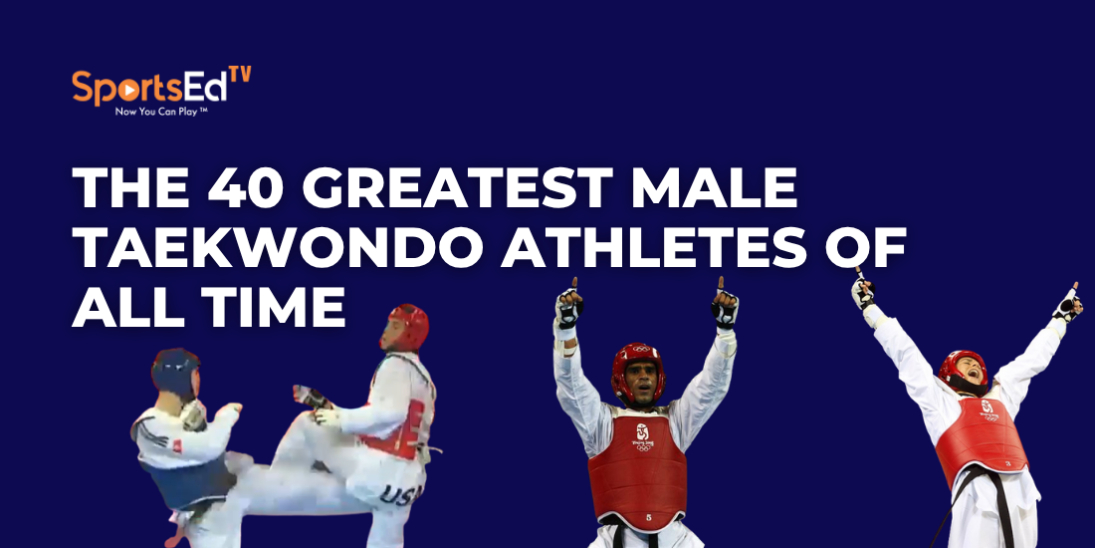
The result is our ranking of the 40 greatest male taekwondo athletes of all time.
And the athlete at the top stands considerably ahead of everyone else.

Who Is the Greatest Male Taekwondo Athlete of All Time?
Steven Lopez of the United States ranks #1 in the SportsEdTV WT-HPI historical index, with a score of 267.20.
Lopez's résumé includes two Olympic gold medals, an Olympic bronze, and five World Championship gold medals.
His combination of major titles, sustained international performance, and competitive longevity makes him the strongest overall performer under our methodology.
Iran's Hadi Saei ranks second at 205.43, followed by Turkey's Bahri Tanrıkulu at 165.47 and South Korea's Lee Dae-hoon at 163.10.
The gap between Lopez and Saei is substantial. But it is important to understand what the numbers mean.
WT-HPI scores are historical performance index points, not percentages or subjective ratings out of 100. The index accumulates weighted achievements, with additional bounded contributions for longevity and other elite events.
That distinction matters when interpreting both the scores and the distances between athletes.
The 40 Greatest Male Taekwondo Athletes: Complete WT-HPI Ranking
The following ranking uses the frozen WT-HPI methodology and competition results through the 2025 World Championships.
Rank Athlete Country WT-HPI
1 Steven Lopez USA 267.20
2 Hadi Saei Iran 205.43
3 Bahri Tanrıkulu Turkey 165.47
4 Lee Dae-hoon South Korea 163.10
5 Joel González Spain 148.04
6 Servet Tazegül Turkey 141.02
7 Zhao Shuai China 140.75
8 Choi Yeon-ho South Korea 133.62
9 Jeong Kook-hyun South Korea 131.78
10 Bradly Sinden Great Britain 128.70
11 Kim Tae-hun South Korea 122.51
12 Huang Chih-hsiung Chinese Taipei 122.10
13 Chu Mu-yen Chinese Taipei 116.82
14 Vladislav Larin Russia 116.62
15 Rafael Alba Cuba 113.96
16 Yousef Karami Iran 113.53
17 Cheick Sallah Cissé Ivory Coast 107.14
18 Simone Alessio Italy 105.99
19 Mark Lopez USA 104.53
20 Kim Je-kyoung South Korea 101.90
21 Ulugbek Rashitov Uzbekistan 100.82
22 Anthony Obame Gabon 98.96
23 Yang Dae-seung South Korea 97.90
24 Carlo Molfetta Italy 97.09
25 Seif Eissa Egypt 96.36
26 Jin Seung-tae South Korea 95.40
27 Kim Yong-ki South Korea 95.25
28 Jun Jang South Korea 93.08
29 Vito Dell'Aquila Italy 91.54
30 Mohamed Khalil Jendoubi Tunisia 90.67
31 Roberto Cruz Philippines 89.96
32 Juan Antonio Ramos Spain 89.90
33 Radik Isayev Azerbaijan 89.80
34 Mohammad Bagheri Motamed Iran 89.21
35 Milad Beigi Harchegani Azerbaijan 88.37
36 Aleksey Denisenko Russia 86.76
37 Maksim Khramtcov Russia 86.39
38 Cha Dong-min South Korea 85.38
39 Bae Jun-seo South Korea 82.22
40 Ahmad Abughaush Jordan 78.12
Source: SportsEdTV WT-HPI men's historical performance model. Scores are rounded to two decimal places; ranks are determined using the model's full-precision calculations and tie convention.
How Did SportsEdTV Calculate the Rankings?
Our objective was not to create another opinion poll.
We wanted a reproducible framework that could be examined, challenged, and recalculated.
The WT-HPI model has four components.
1. Olympic Games Performance
Olympic achievements receive the greatest weight.
A gold medal earns 40 index points, a silver earns 24, and a bronze earns 14.4.
This recognizes the Olympic Games' quadrennial scarcity, competitive pressure, and importance within modern taekwondo.
However, Olympic medals alone cannot adequately measure an entire career.
2. World Championship Performance
Senior World Championship medals are also heavily weighted:
-
Gold: 30 points
-
Silver: 18 points
-
Bronze: 10.8 points
World Championships matter most when comparing historical athletes who competed before taekwondo became an official Olympic medal sport in Sydney in 2000.
They also reward athletes who demonstrated repeated excellence beyond a single Olympic appearance.
3. Sustained Elite Performance (SEP)
Winning one major title is extraordinary.
Remaining internationally competitive across multiple seasons is another achievement entirely.
Our SEP component awards up to 20 points based on three elements:
-
Duration (50%) — the number of seasons with qualifying elite results.
-
Persistence (30%) — how consistently those seasons occur across an athlete's career.
-
Olympic-cycle coverage (20%) — sustained performance across successive competitive cycles.
The model uses a duration-gated formula so a short career can't get an artificially high longevity score simply by being concentrated in one period.
An elite season must contain a qualifying scored achievement, not merely tournament participation.
4. Other Elite International Achievements
Olympic Games and World Championships are not the only meaningful international competitions.
WT-HPI also recognizes senior World Cups, Grand Prix, Grand Slams, continental championships and qualifying continental multi-sport Games.
These competitions are grouped into two levels:
Tier C: Major global secondary competitions, including World Cups, Grand Prix, Grand Slams and the historically designated 1988 and 1992 Olympic demonstration events.
Tier D: Eligible senior continental championships and continental multi-sport Games.
Tier D medal units receive a lower coefficient than Tier C.
Crucially, the model caps the entire Other Elite component below 10 points using a saturating mathematical function.
Why?
Because an athlete competing in a modern calendar with many international tournaments should not automatically outrank a historical champion with far fewer opportunities to earn secondary medals.
The model rewards secondary success without allowing it to overwhelm major championships.
Why Comparing Taekwondo Athletes Across Generations Is Difficult
Imagine comparing a World Champion from the 1980s with an Olympic Champion from the 2020s.
The modern athlete has access to official Olympic medals, Grand Prix competitions, Grand Slams and a larger international calendar.
The historical athlete may have competed in an era when some of those opportunities did not exist.
A simple medal count would reward the number of available events as much as athletic achievement.
Our approach reduces that distortion through differentiated event weights, longevity measurement, secondary-event saturation, and explicit historical competition rules.
The 1988 Seoul and 1992 Barcelona Olympic demonstration events illustrate the problem.
They were significant international competitions, but their medals were not officially equivalent to Olympic medals awarded from 2000 onward.
WT-HPI therefore recognizes eligible demonstration results within Tier C rather than assigning official Olympic gold-medal points.
This does not eliminate every historical disadvantage. It establishes a consistent rule instead of treating all medals as interchangeable.
Why Steven Lopez Ranks First
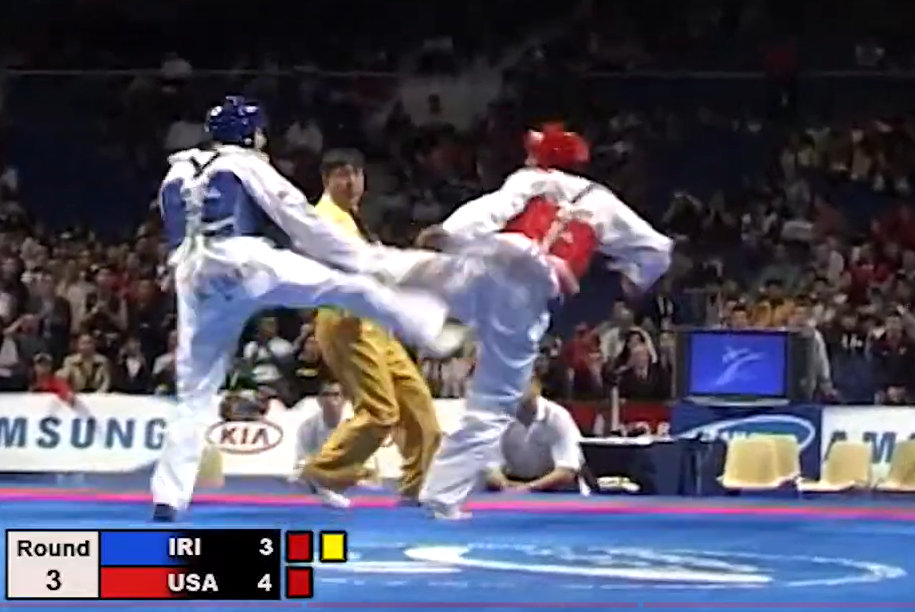
Steven Lopez's leadership is not simply the result of having two Olympic gold medals.
He also accumulated five senior World Championship gold medals, an exceptional record of repeated success at the sport's highest level.
His results combine three attributes that are difficult to achieve simultaneously: major-title volume, international dominance, and longevity.
In the model, his Olympic and World Championship medals alone contribute 244.4 points before longevity and secondary-event achievements.
His total reaches 267.20.
Hadi Saei, another two-time Olympic champion, ranks second with 205.43.
The difference reflects the complete weighted record, not a judgment about who was more talented or technically gifted.
WT-HPI measures documented competitive achievement. It does not claim to measure hypothetical head-to-head ability between athletes from different eras.
Why Lee Dae-hoon Is Fourth Despite Never Winning Olympic Gold
Lee Dae-hoon is one of the ranking's most interesting results.
He won Olympic silver and bronze but never Olympic gold.
Yet he ranks fourth overall.
Why?
Because his résumé includes three World Championship gold medals and an extraordinary record of sustained success across major international competitions.
His career demonstrates why counting Olympic gold medals alone can produce a misleading historical hierarchy.
The model recognizes excellence across an entire career rather than defining greatness by the outcome of one Olympic final.
Why Four-Time World Champions Matter
Two South Korean athletes illustrate another important aspect of the index.
Choi Yeon-ho ranks eighth, while Jeong Kook-hyun ranks ninth.
Both earned four senior World Championship gold medals.
Jeong competed in the pre-official-Olympic era, when opportunities for modern athletes were fundamentally different.
Their positions reflect the model's treatment of World Championship dominance, longevity, and eligible secondary achievements.
They also demonstrate why a historical ranking must reach beyond familiar Olympic champions.
Without a comprehensive World Championship record, some of the sport's greatest historical performers could disappear from the conversation entirely.
Why Is Two-Time Olympic Champion Ulugbek Rashitov Only 21st?
This is likely to be one of the most debated results.
Uzbekistan's Ulugbek Rashitov won Olympic gold at Tokyo 2020 and Paris 2024.
Two Olympic titles represent one of the most impressive achievements in taekwondo.
So why is he outside the Top 10?
Because WT-HPI measures more than Olympic victories.
As of the 2025 World Championships data cutoff, Rashitov's total World Championship and sustained secondary-event record produces a lower overall index score than those of athletes with more extensive careers.
He ranks 21st with 100.82 points.
This does not diminish his Olympic achievements.
It reflects the difference between Olympic greatness and total historical career achievement.
And importantly, Rashitov's career is not finished. Future qualifying results could change his historical position.
How Reliable Are the Rankings? The 100,000-Simulation Test
Every ranking model depends on assumptions.
How much more should an Olympic gold be worth than a World Championship gold?
Should longevity matter more?
Should silver medals receive 60% of gold-medal value, or slightly less?
Rather than assume our chosen parameters were the only reasonable ones, we tested alternatives.
WT-HPI uses a reproducible 100,000-run Monte Carlo robustness analysis.
Across those simulations, we varied major-championship coefficients, medal-value ratios, longevity shares, and secondary-event parameters within documented ranges.
The purpose was to distinguish stable results from positions sensitive to the model's assumptions.
Several findings stand out.
Steven Lopez ranked first in every simulation.
Hadi Saei ranked second in every simulation.
Bahri Tanrikulu and Lee Dae-hoon exchanged third and fourth in some scenarios.
At the bottom of the Top 10, uncertainty increases. Jeong Kook-hyun and Bradly Sinden remained in the Top 10 in approximately 93% and 92% of simulations, respectively.
This is an important distinction.
The published ranking represents the baseline model. The robustness analysis shows how frequently an athlete retains a position or ranking threshold under alternative assumptions.
A model can be transparent without pretending that every position is indisputable.
Why the 40th Position Is Particularly Competitive
The final Top 40 boundary is close.
Ahmad Abughaush of Jordan ranks 40th with 78.12 points.
The difference between athletes near this cutoff is small, and reasonable changes to model weights can affect who enters or exits the Top 40.
The robustness analysis therefore reports the probability of each athlete remaining in the Top 40 under the tested parameter combinations.
This probability is not a prediction of future athletic performance.
It measures sensitivity to the model's assumptions.
Consider the baseline ranking and the robustness results together.

What Makes This Ranking Different From Traditional GOAT Lists?
Many rankings rely primarily on expert judgment or medal totals.
Our approach uses an explicit scoring framework, historical event classifications, and quantitative sensitivity testing.
The research process also included reconciling Olympic and World Championship results, correcting historical medal records, reviewing athlete identities, and examining candidates capable of entering the Top 40.
That does not make the ranking unquestionable.
It makes the assumptions visible.
Readers can disagree with the relative importance of Olympic medals, World titles or longevity. Those disagreements are legitimate.
But they can now be discussed as methodological questions rather than arguments based only on personal preference.
The purpose is not to remove debate from sport. It is to give that debate a stronger factual foundation.
Frequently Asked Questions
Who is the greatest male taekwondo athlete of all time?
Steven Lopez ranks first in the SportsEdTV WT-HPI model, with 267.20 points, followed by Hadi Saei with 205.43.
Who has the highest WT-HPI score?
Steven Lopez of the United States. His five senior World Championship gold medals, two Olympic golds, and an Olympic bronze are major contributors to his score.
Why isn't the ranking based only on Olympic gold medals?
Because official Olympic taekwondo medals have been awarded only since 2000, Olympic results alone don't capture the full competitive record of historical or modern athletes.
Are World Championships as important as the Olympic Games?
They are both major components, but the model assigns 40 points to an Olympic gold and 30 to a senior World Championship gold.
Are older athletes disadvantaged?
Historical opportunity differences remain a limitation of any cross-era ranking. WT-HPI addresses them through explicit competition classifications, a longevity component, and capped secondary-event scoring.
What does WT-HPI stand for?
WT-HPI stands for World Taekwondo Historical Performance Index, the historical ranking model developed for this SportsEdTV study. It is an independent research index, not an official ranking issued by World Taekwondo.
What does a WT-HPI score of 267 mean?
It represents accumulated weighted historical performance points. It is not a percentage, and the index does not have a fixed maximum of 100.
Can active athletes move up the ranking?
Yes. The published study uses results through the 2025 World Championships. Additional qualifying results after that cutoff can be incorporated in a future edition.
Is the ranking scientifically definitive?
No historical ranking can eliminate every judgment about event importance or differences between eras. WT-HPI transparently interprets documented results quantitatively and supports its conclusions with sensitivity testing.

Final Perspective: Can We Measure Sporting Greatness?
There may never be universal agreement on the greatest taekwondo athlete in history.
And perhaps there shouldn't be.
Sport is more than numbers. It includes unforgettable moments, extraordinary rivalries, cultural influence and performances that inspire future generations.
But when we make historical comparisons, we should explain the criteria behind our conclusions.
At SportsEdTV, we believe a serious ranking should be transparent enough to challenge and structured enough to reproduce.
Our research places Steven Lopez first, Hadi Saei second, and Bahri Tanrıkulu third.
It also highlights remarkable athletes whose achievements deserve greater recognition, particularly those who competed before the modern Olympic and Grand Prix eras.
The ranking is our conclusion. The methodology is open for examination.
Now we would like to hear from the taekwondo community.
Who is missing from our Top 10, and who would you remove to make room?
Research note: SportsEdTV WT-HPI men's historical ranking, using competition results through the 2025 World Championships. The index is an independent historical research model, not an official World Taekwondo ranking. Robustness probabilities reflect parameter uncertainty within the tested model and do not constitute statistical proof of historical superiority.