Volleyball
Volleyball Rules Explained
Volleyball Rules Explained
Volleyball is played by two teams of six on a court divided by a net, and each team tries to ground the ball on the other side while stopping the opponent from doing the same. A team gets three hits to return the ball, plus any block touch, and every rally scores a point. The rules below follow the FIVB Official Volleyball Rules 2025 to 2028, which apply to all competitions that began after January 1, 2025.
This guide replaces our earlier two-part series, which was based on the 2017 to 2020 rulebook. Several rules have changed since then, including who must be in rotational order at the serve, whether a libero can be captain, and how screening is judged. If you play in the United States, high school, college, and club volleyball each modify these rules, so we cover the main differences at the end.

What has changed in the volleyball rules?
The biggest change in the 2025 to 2028 rules is that only the receiving team must be in rotational order when the ball is served. Under Rule 7.4, serving team players may stand anywhere on their own court at the service hit. The receiving team must still respect the overlap rules, and the serving team must still serve in the correct order.
The screening rule is also stricter. Rule 12.5.3 now forbids any serving team player from raising their hands above their head during the serve until the ball passes the net.
A few other points differ from the 2017-2020 rules our old series described. A libero may now be the team captain or game captain. An expelled team member goes to the team's dressing room for the rest of the set, since the penalty area is no longer used. In senior FIVB, World, and Official competitions, a team may list up to 14 players, and two liberos are mandatory when more than 12 players are listed.
How big is a volleyball court, and how high is the net?
A volleyball court is 18 by 9 meters (59 by 29.5 feet), surrounded by a free zone at least 3 meters wide on every side. The free zone is part of the playing area, so players may chase and play the ball there. Above the court, there must be at least 7 meters of clear space. FIVB, World, and Official competitions require more: a 5-meter free zone beside the sidelines, 6.5 meters behind the end lines, and 12.5 meters of height.
All lines are 5 centimeters wide and are drawn inside the court dimensions, which is why a ball touching a line is in. The center line splits the court into two 9-by-9-meter halves. On each side, the attack line sits 3 meters from the center line and marks the front zone, which extends beyond the sidelines to the end of the free zone. The service zone is the 9-meter-wide area behind each end line.
The top of the net is 2.43 meters (7 feet 11 5/8 inches) for men and 2.24 meters (7 feet 4 1/8 inches) for women, measured at the center of the court. Both ends must be at the same height and no more than 2 centimeters above the official height. Two white side bands sit directly above the sidelines, and an antenna is fastened at the outer edge of each band. The antennae are 1.80 meters long, rise 80 centimeters above the net, and count as part of the net.
The ball measures 65 to 67 centimeters in circumference, weighs 260 to 280 grams, and is inflated to 0.30 to 0.325 kg/cm2 (4.26 to 4.61 psi). A team may list up to 12 players for a match, or up to 14 in senior FIVB, World, and Official competitions, and six are on court at all times.
[IMAGE: court diagram with attack lines, front zone, service zone and free zone labeled]
How does scoring work in volleyball?
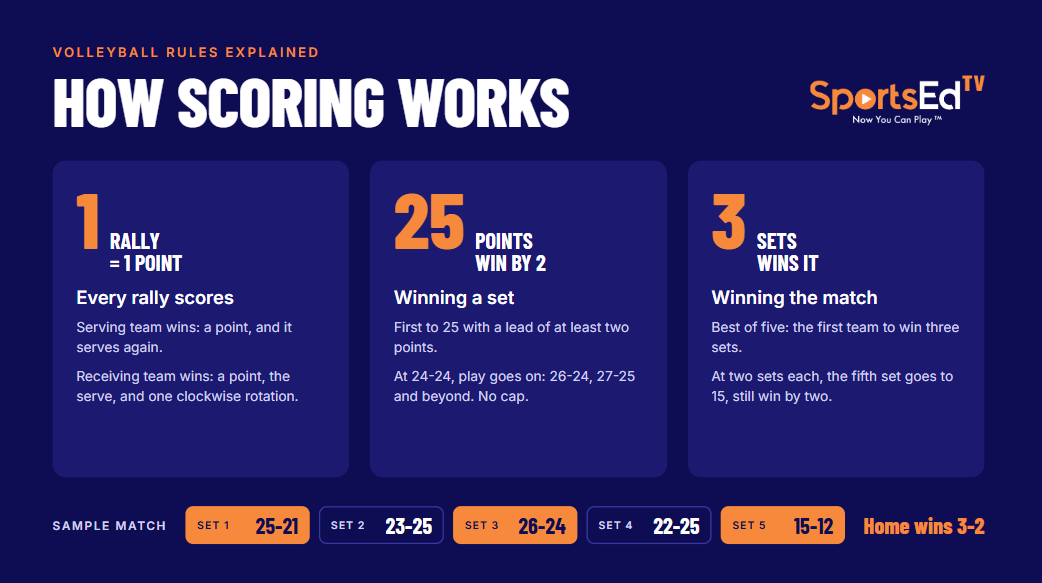
Volleyball uses rally scoring, so the team that wins each rally scores a point whether it served or not. A team scores when the ball lands in the opponent's court, when the opponent commits a fault, or when the opponent receives a penalty. If the serving team wins the rally, it keeps serving. If the receiving team wins, it scores, gains the serve, and rotates one position clockwise.
The first team to 25 points, with a lead of at least two, wins the set. At 24 to 24, play continues until one team leads by two, so sets can end 26 to 24, 27 to 25 and so on. The first team to win three sets wins the match. If the match reaches two sets each, the deciding fifth set is played to 15, again with a two-point lead.
Before the match, the first referee holds a toss with both captains. The winner chooses either to serve or receive, or which side of the court to start on, and the loser takes the other choice. A new toss is held before a deciding set. Each set after the first starts with the team that did not serve first in the previous set.
Teams change sides after every set except the deciding set. In the fifth set, they change sides as soon as the leading team reaches 8 points. The interval between sets lasts three minutes, and the break between the second and third sets may be extended to 10 minutes at the organizer's request.
If both teams commit faults at the same time, the referee calls a double fault, and the rally is replayed. If one fault follows another, only the first counts.
How many touches does a team get?
Each team gets a maximum of three hits to return the ball, and a block touch does not count as one of them. Using a fourth hit is a fault called four hits. A hit is any contact with the ball by a player in play, and the ball may touch any part of the body.
A player may not hit the ball twice in a row. There are two exceptions. A blocker may touch the ball more than once during one blocking action, and on the team's first hit, such as a serve receive or a dig, the ball may contact several parts of the body in succession as long as it happens in one action. On the second and third hits, a double contact is a fault under the FIVB rules. The ball must also rebound cleanly; catching or throwing it is a fault.
When two or three teammates touch the ball at the same moment, it counts as two or three hits. If two players reach for the ball but only one touches it, it is one hit, and a collision between teammates is not a fault. If two opponents touch the ball at the same time above the net and it stays in play, the receiving team gets three new hits. If that ball goes out, the fault belongs to the team on the opposite side.
A player may not use a teammate or any object for support to reach the ball. A teammate may, however, hold back a player who is about to touch the net or cross the center line.
After a block, the blocking team still has three hits, and the player who touched the ball on the block may also make the next contact.
When is the ball in or out?
The ball is in if any part of it touches the court, including the boundary lines. It is out when every part that touches the floor lands completely outside the lines, or when it touches the ceiling, an object outside the court, or a person who is not in play. It is also out if it hits an antenna, the posts, the ropes, or the net outside the side bands, or if it passes completely under the net.
To cross to the other side, the ball must pass through the crossing space. That space sits above the net, between the antennae and their imaginary upward extension, up to the ceiling. The ball may touch the net while crossing, including on a serve. A ball driven into the net may be played again as long as the team stays within its three hits.
There is one rescue exception. If a team's first hit sends the ball outside an antenna into the opponent's free zone, a player may chase it and play it back, provided the ball returns outside the antenna on the same side, and the player does not touch the opponent's court. The opponents may not interfere. If the ball comes from the second or third hit, it is out as soon as it crosses the net plane outside the antenna.
What are the net and center line rules?
Touching the net between the antennae while playing the ball is a fault. Playing the ball includes the take-off, the hit or attempted hit, and the landing until the player is ready for a new action. A player close to the ball who tries to play it is considered to be playing the ball even if they never touch it. Touching the net outside the antennae, or the posts and ropes, is allowed as long as it does not interfere with play or serve as support.
Using the net for support, grabbing it, gaining an unfair advantage by touching it, or hindering an opponent's legitimate attempt to play the ball are all faults. If the ball is driven into the net and the net touches an opponent, that is not a fault.
A player may reach under the net into the opponent's space if it does not interfere with the opponent. A foot may touch the opponent's court only if part of that foot stays in contact with, or directly above, the center line. A foot that crosses the center line completely is a fault. Any other body part above the feet may touch the opponent's court as long as it does not interfere with play.
Blockers may reach over the net, but they may not touch the ball on the opponent's side before the opponent's attack hit. After a team's own attack hit, a player may follow through over the net if they made contact on their own side.
How do rotations and positions work?
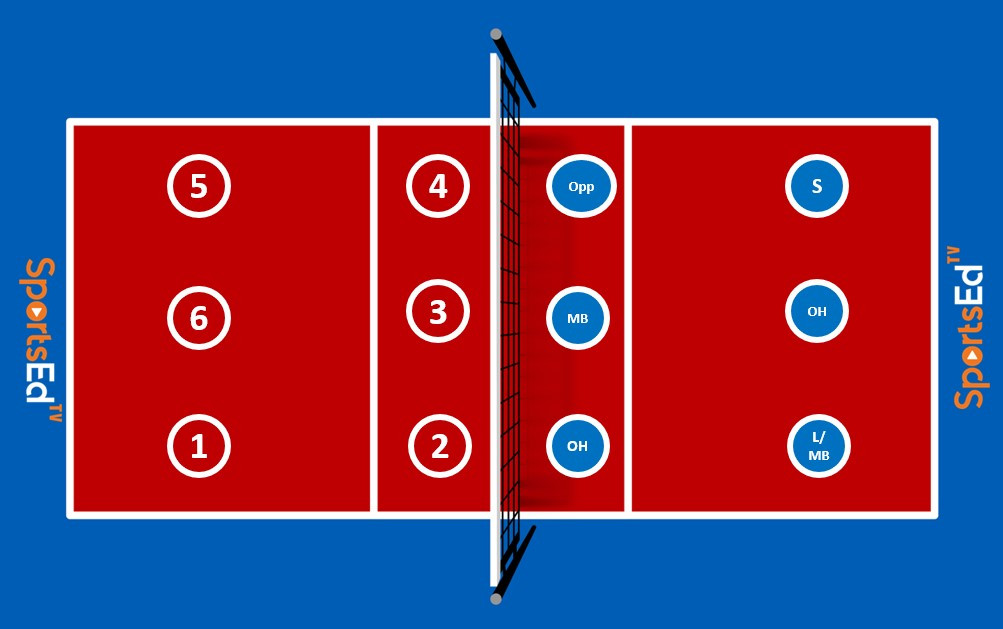
The starting line-up sets the rotational order of the six players, and that order must remain the same for the whole set. The three players along the net are front-row players in position 4 (front left), position 3 (front center), and position 2 (front right). The three behind them are back-row players in positions 5 (back left), 6 (back center), and 1 (back right). The player in position 1 serves.
[IMAGE: court diagram with positions 1 to 6, front row 4-3-2 at the net, back row 5-6-1]
When the receiving team wins a rally and gains the serve, its players rotate one position clockwise. The player in position 2 moves to position 1 to serve, the player in position 1 moves to position 6, and so on around the court. A team that keeps winning on its own serve does not rotate. For a full walkthrough, read Volleyball Rotations Explained.
Who has to be in rotational order at the serve?
Under the 2025 to 2028 FIVB rules, only the receiving team must be in rotational order when the server hits the ball. The serving team's players must be inside their own court, but they may stand in any arrangement they like. This lets the serving team start in its defensive and blocking positions instead of switching after the serve.
The serving team still has to serve in the correct order, and its back-row players are still back-row players. A back-row player who stands at the net at the serve still may not block or attack from the front zone above the net.
What are the overlap rules for the receiving team?
At the moment of the serve, each back-row player on the receiving team must be farther from the center line than the front-row player directly in front of them. Position 5 must be behind position 4, position 6 behind position 3, and position 1 behind position 2. Within each row, the left player must be closer to the left sideline than the center player, and the right player must be closer to the right sideline than the center player.
Positions are judged only by the feet touching the floor, and the last contact with the floor fixes a jumping player's position. A back-row player is legal if they are level with, or have at least part of one foot farther back than, the front foot of the corresponding front-row player. The sideline comparisons work the same way, and being level is also legal under FIVB rules. Players do not need to stand in two neat rows, which is why serve-receive formations often look scattered.
Once the ball is served, every player on both teams may move anywhere on their court and in the free zone. To see how teams use that freedom, read our guides to Volleyball Positions and the 5-1 and 6-2 Systems of Play.
What happens when a team is out of position or out of rotation?
A positional fault, where a receiving player is out of place at the serve, gives the opponent a point and the serve, and the players are put back in their correct positions. If the server also makes a fault at the moment of the service hit, the serving fault counts first. If the serve was hit correctly but later goes out or over a screen, the positional fault counts first.
A rotational fault happens when the wrong player serves. The opponent gets a point, and the serve, and the order is corrected. If the scorer can pinpoint when the error began, all points the team at fault scored from that moment are canceled, while the opponent keeps its points.

What are the serving rules?
The back-right player serves from the service zone behind the end line. The server has 8 seconds after the first referee's whistle to hit the ball; if the server hits before the whistle, the serve is canceled and repeated. The server must toss or release the ball and then hit it with one hand or any part of the arm. Only one toss or release is allowed, although the server may bounce or move the ball in their hands beforehand.
At the moment of the hit, or the take-off for a jump serve, the server may not touch the court, including the end line, or the floor outside the service zone. After the hit, the server may land inside the court.
If the serving team wins the rally, the same player serves again. If the receiving team wins, it rotates first, and the player who moves from front right to back right becomes the new server.
The serving team may not screen the receivers. A screen happens when players wave their arms, jump, move sideways or stand grouped so that both the service hit and the flight of the ball are hidden until the ball reaches the net. Under the current rules, no serving-team player may raise their hands above their head until the ball has passed the net.
A serve is a fault, and the serve goes to the other team, if the wrong player serves or the serve is not executed properly. A correctly hit serve becomes a fault if it touches a teammate, fails to cross through the crossing space, lands out, or passes over a screen. Blocking the serve is a fault, and attacking the serve while it is in the front zone and entirely above the top of the net is also a fault.
What counts as an attack, and who can attack?
Any action that sends the ball toward the opponent is an attack hit, except a serve or a block. This includes a spike, a tip, or a free ball; a tip is legal only if the ball is cleanly hit, not caught or thrown. An attack hit is complete once the ball fully crosses the net plane or an opponent touches it.
A front-row player may attack from any height as long as they contact the ball on their own side of the net. A back-row player may also attack from any height, but only from behind the attack line. Their take-off foot may not touch or cross the attack line, although they may land in the front zone after the hit. This is the familiar back-row attack, often called a pipe.
A back-row player may attack from the front zone only if part of the ball is below the top of the net at contact. A back-row player commits a fault if they complete an attack from the front zone when the ball is entirely above the net. An attack is completed when the ball crosses the net or an opponent touches it, so a back-row player who hits a high ball from the front zone that opposing blockers touch commits the fault.
The libero has stricter limits, covered below.

What are the blocking rules?
A block is when players close to the net reach higher than the top of the net to stop a ball coming from the opponent. Only front-row players may complete a block, and part of the blocker's body must be above the top of the net when the ball is touched. A jump at the net without touching the ball is a block attempt, and a block is completed whenever a blocker touches the ball. Two or three players blocking together form a collective block.
Blockers may reach over the net, but they may not touch the ball on the opponent's side before the opponent's attack hit, and they may not interfere with the opponent's play. A blocker may touch the ball several times in quick succession if it happens in one action. The block touch does not count as one of the team's three hits.
It is a blocking fault when a back-row player or a libero completes a block or takes part in a completed block, when a libero even attempts a block, or when anyone blocks the serve. It is also a fault to block the ball in the opponent's space from outside the antenna. If the ball goes out off the block, the attacking team wins the point.
What are the libero rules?
The libero is a defensive specialist who wears a jersey in a clearly different dominant color from the rest of the team. Each team may designate up to two liberos, but only one may be on the court at a time. In senior FIVB, World, and Official competitions, teams must list at least 12 players if they use two liberos.
The libero may replace any back-row player and play only in the back row. Under FIVB rules, the libero may not serve, block, or attempt to block. The libero also may not complete an attack hit from anywhere on the court or free zone when the ball is entirely above the top of the net.
There is also one setting limit. If the libero sets a ball with an overhand finger pass from the front zone, a teammate may not attack it while it is entirely above the net. A set made from behind the attack line may be attacked freely, which is why liberos often bump-set from the front zone.
Libero replacements are not substitutions and are unlimited, but a completed rally must separate two replacements. They happen while the ball is out of play, before the serve whistle, through the libero replacement zone on the bench side between the attack line and the end line. Only the player they replaced or the team's second libero may replace the acting libero. A libero may be the team captain or game captain.
If a team's only libero is injured, ill, expelled, or disqualified, the coach may re-designate another player who is not on the court as the new libero for the rest of the match. For more on the role, read What Does It Take to Become a Good Libero?

How many timeouts and substitutions does each team get?
Under FIVB rules, each team may take two timeouts and make six substitutions per set. Every timeout lasts 30 seconds, although the FIVB may approve a different length for its own competitions. The coach requests a timeout with a hand signal while the ball is out of play and before the serve whistle, and the players go to the free zone near their bench.
Substitution limits are tight at the international level. A player in the starting line-up may leave the set once and return once, and only to their original position. A substitute may enter once per set in place of a starter and can be replaced only by that same starter. Several players may be substituted at once in a single request, but a team must play a completed rally between two separate substitution requests. The substitute starts the request by walking into the substitution zone, ready to play.
If a player cannot continue because of injury, illness, expulsion, or disqualification and no legal substitution is possible, the team may make an exceptional substitution. Any player not on the court, except a libero or the libero's replacement player, may enter, and the replaced player may not return for the rest of the match. If an injured player cannot be replaced, they get one three-minute recovery period per match. Libero replacements never count toward the six substitutions.

What are the most common faults in volleyball?
Every fault gives the opponent a point and the serve. The ball-handling faults are four hits, a double contact by one player, a catch or throw, and an assisted hit using a teammate or object for support. Net faults include touching the net between the antennae while playing the ball, a foot crossing completely over the center line, and interfering with the opponent under or over the net.
Serving faults include serving out of order, an improper toss or foot fault, taking longer than 8 seconds, a serve that lands out or fails to cross through the crossing space, and screening. Position faults occur when a receiving player is out of place at the serve, or the wrong player serves. Attack and block faults occur when a back-row player attacks above the net from the front zone, a back-row player or libero blocks, a libero attacks above the net, a player attacks or blocks the serve, or a player touches the ball on the opponent's side before their attack.
How do delays and misconduct cards work?
Delays are team sanctions that last the whole match. The first delay brings a delay warning, and each subsequent delay by the same team earns a delay penalty worth a point and the serve to the opponent.
Misconduct is handled on a scale. Minor misconduct earns a verbal warning, then a yellow card, which is recorded but costs nothing. Rude conduct earns a penalty, shown with a red card, which gives the opponent a point and the serve. Offensive conduct, or a second rude conduct, earns an expulsion, shown with red and yellow cards held together, and the player leaves for the rest of the set. Aggression, a second offensive conduct, or a third rude conduct earns a disqualification, shown with red and yellow cards held apart, and the player leaves for the rest of the match. Expulsion and disqualification carry no extra point.
How do high school, college and club rules differ?
Most volleyball in the United States is played under one of three domestic rulebooks: NFHS rules for high school, NCAA rules for college, and USA Volleyball rules for club and junior play. All three start from the international game but change several rules that players notice right away.
The biggest difference for 2026 is rotations. None of the three US codes has adopted the FIVB change that frees the serving team. In high school, college, and club volleyball, both teams must be in correct rotational order when the ball is served, and the NCAA and USA Volleyball rulebooks require each player to be closer to the net or sideline than the corresponding teammate, not merely level.
All three US codes also relax the double-contact rule on the second hit. A setter's ball may touch the hands in succession during one action, as long as a teammate makes the next contact. Under FIVB rules, that is still a fault.
High school (NFHS)
High school teams get two 60-second timeouts per set and 18 substitutions per set. Starting with the 2026-27 season, a team may designate up to two liberos for each set, but only one may be on the court at a time, and the libero's uniform bottoms may now be any color. Unlike the FIVB libero, a high school libero may serve, but only in one position in the serving order. From 2026-27, state associations may also approve a textured ball, and players may not wear microphones or cameras during a match.
College (NCAA women)
College matches are best of five, with sets to 25, a fifth set to 15, and no point cap. The default timeout is 75 seconds, two per set, and conferences may add media timeouts or a technical timeout when a team reaches 15 points. Division I teams get 15 substitutions per set, and Divisions II and III get 18, with unlimited entries per player inside that limit. Teams may list up to two liberos per set, and either may serve in one rotation.
Several NCAA rules changed for the 2026 season. A foot that completely crosses the center line is now a fault, as in the FIVB rules, and coaches may challenge that call on video. Players may now chase a first-hit ball outside the antenna and play it back; serving-team players may not raise their hands above their heads during the serve, and misconduct cards now carry over for the whole match. Teams change benches only after the second set and stay on their side for the fifth.
Club and junior (USA Volleyball)
USA Volleyball uses the FIVB rules with domestic changes, and FIVB rules still apply at its highest adult levels. Teams get 15 substitutions per set, up from 12, with unlimited entries per player inside that limit, though events may cut the limit to six. Teams may designate zero, one or two liberos, and a libero may serve in one rotation. Matches may be best of three with a deciding set to 15, and by default teams stay on the same side for the whole match. Net heights drop for younger age groups, to 2.13 meters (7 feet) for 12-and-under play and as low as 1.98 meters (6 feet 6 inches) for girls 10 and under.
Test your knowledge
Think you know the rules? Take our volleyball rules quiz and see how you score.
Prefer to watch? Dr. Gylton Da Matta walks through the basic rules and player positions in our video, Volleyball Rules: How to Play the Game.

Volleyball Rules: Your Questions Answered
Q: How many players are on a volleyball team? Six players from each team are on the court at all times. Under FIVB rules, a team may list up to 12 players for a match, or up to 14 in senior FIVB, World, and Official competitions.
Q: How many points do you need to win a set? A set goes to 25 points, and the winner must lead by at least two. The deciding fifth set goes to 15, again with a two-point lead.
Q: Does the serving team have to be in rotation? Not under the 2025 to 2028 FIVB rules, which require only the receiving team to be in rotational order at the serve. In US high school, college, and club volleyball, both teams must still be in rotational order.
Q: Can the serve touch the net? Yes. A serve that touches the net and continues into the opponent's court through the crossing space is legal and stays in play.
Q: Is a ball on the line in or out? In. The lines are part of the court, so any contact between the ball and a line counts as in.
Q: Can you play the ball with your foot? Yes. The ball may touch any part of the body, as long as you don't catch or throw it.
Q: Can a back-row player hit at the net? A back-row player may attack from the front zone only if part of the ball is below the top of the net. To attack a higher ball, they must take off from behind the attack line. Back-row players may never complete a block.
Q: Can the libero serve? Not under FIVB rules. In NFHS, NCAA, and USA Volleyball competition, a libero may serve in one rotation position per set.
Q: How long is a timeout? An FIVB timeout lasts 30 seconds. High school timeouts last 60 seconds, and NCAA timeouts default to 75 seconds. Each team gets two per set under all three codes.
Q: Is touching the net always a fault? No. Touching the net is a fault only when you touch it between the antennae while playing the ball; contact outside the antennae is allowed unless it interferes with play or you use it for support.
Sources
FIVB Official Volleyball Rules 2025 to 2028 · 2026 and 2027 NCAA Women's Volleyball Rules and Interpretations · NCAA: Changes to center-line faults approved in women's volleyball · USA Volleyball Abridged Indoor Rules 2025 to 2027 · NFHS 2025-26 Volleyball Rules Changes · NFHS: Libero Rules Adjusted in High School Volleyball (2026-27) · NFHS Volleyball Rules Interpretations 2026-27 · Referee: rule differences between codes
About the Author
Gylton Da Matta, Ph.D. – Sports Pedagogy & Motor Learning at the University of South Carolina. Postdoc in Applied Technology in Team Sports Research at the University of Barcelona, Spain. International volleyball instructor, researcher, and consultant.