Media
The 120 Most Influential Athletes of All Time — Ranked by Their Impact Beyond Sports
Winning changes a scoreboard. Sometimes, an athlete changes society.
A champion can do more than win medals, lift trophies, or set records. An athlete may challenge discrimination, help establish a hospital, build opportunities for women and girls, advance disability inclusion, inspire a country, or change the way a sport is played and accessed. SportsEdTV's Global Human Impact Index (GHII) asks a different question from a greatest-of-all-time list: Which athletes made a meaningful positive difference in other people's lives?
Our global ranking considers athletes across eras, countries and sports, from tennis and cricket to squash, ice hockey, para-sport, table tennis and weightlifting. It combines documented contributions with an explicitly judgment-based scoring framework. The scores are evidence-informed editorial assessments, not scientific measurements of the worth of a person or a claim that every social outcome was caused by one athlete.
Full research: Read the white paper

How we built the ranking
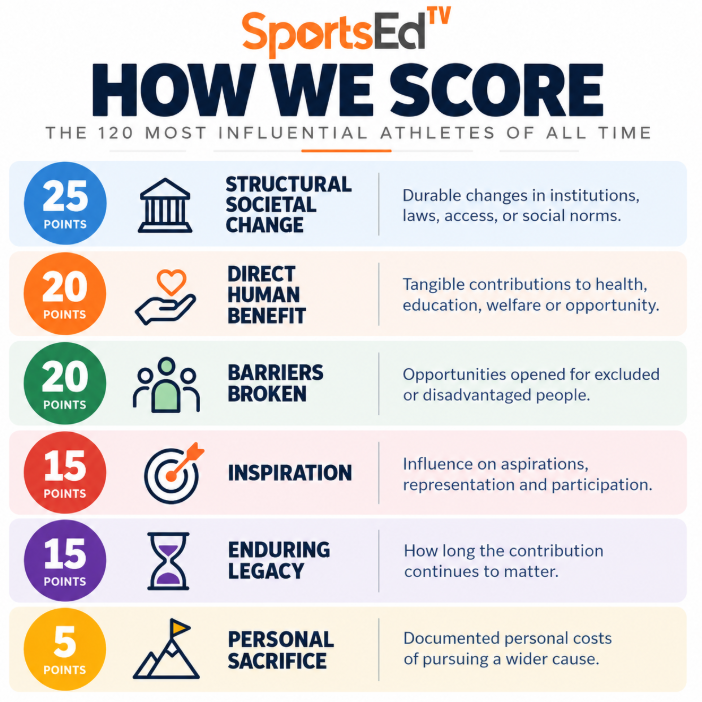
Every athlete can earn up to 100 points across six dimensions:
We reviewed historical records, institutional reports, journalism and, where available, peer-reviewed studies. A Hall of Fame induction or sporting achievement alone does not prove societal impact. Foundation-reported reach does not automatically demonstrate improved long-term outcomes. The same principle applies to famous athletes and lesser-known pioneers.
We also considered historical fairness. Jesse Owens, for example, lacked access to the resources of today's sports superstars, but his achievements challenged racist propaganda in a very different era. Conversely, symbolic breakthroughs are not automatically treated as legislative reforms. We assess each historical event for the athlete's own contribution rather than counting it repeatedly as several separate societal changes.
The ranking is ordered by total score. Ties are broken by structural-change score, then barriers-broken score, then alphabetical order. Documented harmful conduct matters for interpretation and is not erased by an athlete's charitable activities.
How robust is the order?
The companion research uses Monte Carlo sensitivity testing to examine how ranks can move when category weights and athlete-level assessments vary under specified assumptions. Such tests measure sensitivity to assumptions, not the truth of each historical claim. Do not mistake exact rank positions, especially among athletes with similar totals, for definitive scientific distinctions. Readers can inspect the six scores, supporting links and statistical methods in the white paper and workbook.
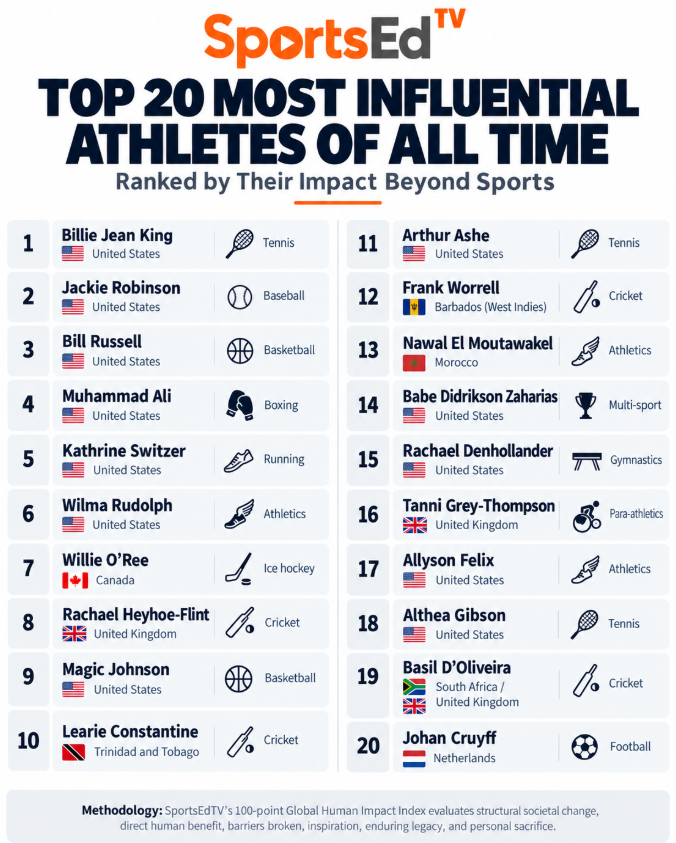
The complete Top 120
Each entry begins with a short introduction to the athlete, followed by why he or she earned a place in the ranking. The evidence notes intentionally distinguish verified outcomes from broader cultural influence or institutional claims that have not been causally isolated.
1. Billie Jean King — United States | Tennis | 91/100
American tennis champion and former world No. 1 who won 39 Grand Slam titles across singles and doubles.
Why she made the list: The Women’s Sports Foundation reports King founded the organization in 1974 and that it has invested more than $100 million in opportunities for girls and women. This institutional cumulative spending is not a unique-beneficiary or causal impact estimate. Supporting source.
2. Jackie Robinson — United States | Baseball | 87/100
American baseball infielder who debuted for the Brooklyn Dodgers in 1947.
Why he made the list: He integrated modern MLB and later participated in civil-rights advocacy. Supporting source.
3. Bill Russell — United States | Basketball | 86/100
American basketball center who won 11 NBA championships with the Boston Celtics.
Why he made the list: He attended the 1963 March on Washington, ran integrated basketball camps in Mississippi and became the first Black head coach in a major US professional sports league. Supporting source.
4. Muhammad Ali — United States | Boxing | 81/100
American heavyweight boxing champion and Olympic gold medalist, born Cassius Clay.
Why he made the list: His conscientious-objector stance cost him his boxing license and title during the Vietnam War; the US Supreme Court overturned his conviction in 1971. Supporting source.
5. Kathrine Switzer — United States | Running | 80/100
American marathon runner who became the first woman to officially enter and finish the Boston Marathon in 1967.
Why she made the list: Her 261 Fearless organization records her official 1967 Boston Marathon entry and later organization of a women’s running circuit of 400 races across 27 countries; its claimed million-plus participants are organization-reported. Supporting source.
6. Wilma Rudolph — United States | Athletics | 79/100
American sprinter who won three gold medals at the 1960 Rome Olympics.
Why she made the list: She refused a segregated 1960 homecoming parade; Clarksville subsequently held its first integrated public event. Supporting source.
7. Willie O’Ree — Canada | Ice hockey | 79/100
Canadian ice hockey forward who made his NHL debut with the Boston Bruins in 1958.
Why he made the list: First Black NHL player (1958); as the league's diversity ambassador, he helped establish 39 grassroots hockey programs and introduced more than 130,000 young people to the sport, according to the NHL. The reach figure is program participation, not a measured long-term effect. Supporting source.
8. Rachael Heyhoe-Flint — United Kingdom | Cricket | 78/100
English cricket captain who led her country to the inaugural Women's Cricket World Cup title in 1973.
Why she made the list: ICC documents her central role in establishing the 1973 Women’s Cricket World Cup. Supporting source.
9. Magic Johnson — United States | Basketball | 78/100
American basketball legend who won five NBA titles with the Los Angeles Lakers.
Why he made the list: Cardazzi, Martin and Rodriguez (Health Economics, 2023) estimate approximately 800 additional AIDS diagnoses among heterosexual men in NBA metropolitan areas after Johnson’s 1991 disclosure, with improved 10-year survival; these were earlier diagnoses of existing illness, not new infections. Supporting source.
10. Learie Constantine — Trinidad and Tobago | Cricket | 77/100
Trinidadian-born West Indies cricketer who also became a lawyer, diplomat and public figure in Britain.
Why he made the list: Britain’s National Archives documents Constantine’s 1943 Imperial Hotel discrimination, successful legal claim, parliamentary questions following the case, and wartime welfare advocacy. These are identifiable legal and public-policy consequences, not merely sporting symbolism. Supporting source.
11. Arthur Ashe — United States | Tennis | 77/100
American tennis champion, the first Black man to win the US Open, Australian Open, and Wimbledon singles titles.
Why he made the list: Ashe advocated for civil rights and HIV/AIDS awareness. He disclosed his AIDS diagnosis in 1992 after learning a newspaper intended to publish it; subsequent public advocacy is separately documented. Supporting source.
12. Frank Worrell — Barbados (West Indies) | Cricket | 77/100
West Indian cricket captain from Barbados, celebrated for his leadership of the Caribbean team.
Why he made the list: Wisden documents the Caribbean movement that secured his appointment as the first substantive Black West Indies Test captain and describes his unifying leadership. The movement was collective; its social effects cannot be assigned solely to Worrell. Supporting source.
13. Nawal El Moutawakel — Morocco | Athletics | 77/100
Moroccan hurdler who won the inaugural Olympic women's 400-meter hurdles in 1984.
Why she made the list: World Athletics identifies her as the first African and Muslim woman to win Olympic gold in 1984. The IOC documents her subsequent women-and-sport committee and sport development roles. Inspirational and institutional roles are established; beneficiary-level impact is not. Supporting source.
14. Babe Didrikson Zaharias — United States | Multi-sport | 76/100
American multi-sport champion who excelled in athletics, basketball and golf.
Why she made the list: Co-founded the LPGA, contributing to durable institutional opportunities for professional women golfers. Supporting source.
15. Rachael Denhollander — United States | Gymnastics | 74/100
American former gymnast whose testimony helped expose abuse by a USA Gymnastics team doctor.
Why she made the list: Her public disclosure of abuse by Larry Nassar contributed to wider institutional scrutiny and athlete safeguarding reforms. These connected consequences are not treated as two independent reforms. Supporting source.
16. Tanni Grey-Thompson — United Kingdom | Para-athletics | 74/100
British wheelchair racer who won 11 Paralympic gold medals and later entered public service.
Why she made the list: UK Sport documents her 11 Paralympic gold medals and post-sport governance roles. The British Institute of Human Rights documents advocacy on disability rights, welfare, legal aid, and access to justice. No specific legislative change is attributed to her here. Supporting source.
17. Allyson Felix — United States | Athletics | 73/100
American sprinter who won seven Olympic gold medals across her career.
Why she made the list: BBC and the Washington Post report that Nike expanded pregnancy-related protections in 2019 after public criticism from Felix and other athletes. The reform reflects a collective campaign, not Felix alone. Supporting source.
18. Althea Gibson — United States | Tennis | 73/100
American tennis and golf pioneer who broke racial barriers in both sports.
Why she made the list: The Smithsonian documents Gibson breaking exclusionary entry barriers in major tennis and later professional golf. These are identifiable access breakthroughs, rather than evidence of a particular law being changed. Supporting source.
19. Basil D’Oliveira — South Africa / United Kingdom | Cricket | 72/100
South African-born cricketer who represented England during the apartheid era.
Why he made the list: Wisden documents the 1968 D’Oliveira affair and its consequences for apartheid-era cricket relations. It cautions that D’Oliveira was primarily a cricketer rather than an organized political campaigner. Supporting source.
20. Johan Cruyff — Netherlands | Football | 71/100
Dutch footballer and coach, a three-time Ballon d'Or winner associated with Total Football.
Why he made the list: Founded a foundation that develops neighborhood courts and accessible sports programs for disadvantaged children and young people with disabilities. Later foundation activities are credited as institutional legacy, not solely as his direct personal delivery. Supporting source.
21. Marcus Rashford — United Kingdom | Football | 70/100
English football forward who rose through Manchester United's academy.
Why he made the list: BBC Sport reported that, following Rashford's campaign, the June 2020 extension of summer free-school-meal vouchers reached about 1.3 million eligible children. The number is eligibility, not an independently counted number of meals consumed. Supporting source.
22. Tony Hawk — United States | Skateboarding | 70/100
American professional skateboarder who popularized vertical skating and the 900 trick.
Why he made the list: Founded The Skatepark Project, which reports helping create nearly 700 public skateparks across the United States, expanding free recreational access in underserved communities. Counts reflect facilities supported, not causal health gains. Supporting source.
23. Stephen Curry — United States | Basketball | 70/100
American NBA point guard and four-time champion with the Golden State Warriors.
Why he made the list: Stephen and Ayesha Curry co-founded Eat. Learn. Play. Its reported outputs include millions of meals and school infrastructure projects in Oakland; Oakland school-board records also document specific foundation grants. Figures describe joint institutional work, not benefits personally delivered by Stephen alone. Supporting source.
24. Venus Williams — United States | Tennis | 69/100
American tennis champion with seven Grand Slam singles titles and four Olympic gold medals.
Why she made the list: The WTA credits Williams as a leading advocate for equal prize money at Wimbledon, which adopted equal payouts in 2007. The policy outcome was collective, not solely attributable to her. Supporting source.
25. Sachin Tendulkar — India | Cricket | 69/100
Indian batting great whose international cricket career spanned 1989 to 2013.
Why he made the list: UNICEF documents his sanitation and hygiene advocacy since 2008, his appointment as UNICEF South Asia regional ambassador in 2013, and his campaign involvement. These establish sustained advocacy, not quantified behavior change attributable to him. Supporting source.
26. Maya Moore — United States | Basketball | 69/100
American WNBA champion who stepped away from basketball to work on criminal justice issues.
Why she made the list: Moore suspended her basketball career to advocate for Jonathan Irons, whose conviction was overturned and who was exonerated in 2020. The exoneration is documented; it cannot be generalized into a nationwide justice-system reform. Supporting source.
27. Alice Coachman — United States | Athletics | 69/100
American high jumper who became the first Black woman to win Olympic gold in 1948.
Why she made the list: The National Women’s History Museum documents her 1948 breakthrough as the first Black woman Olympic gold medalist, the segregation she faced at her homecoming, and her 1994 foundation supporting young athletes and former competitors. Supporting source.
28. Mia Hamm — United States | Football | 69/100
American football star who helped the United States win the 1991 and 1999 Women's World Cups.
Why she made the list: The Mia Hamm Foundation supports marrow and cord-blood transplant awareness and opportunities for girls in sport. No independent number of transplant outcomes is established here. Supporting source.
29. Joe Louis — United States | Boxing | 68/100
American heavyweight boxing champion who became a national icon in the 1930s and 1940s.
Why he made the list: Smithsonian documents civil disobedience against segregated military transport and subsequent policy redress, as well as wartime fundraising. Supporting source.
30. Mithali Raj — India | Cricket | 68/100
Indian cricketer and longtime national captain, a leading run-scorer in women's international cricket.
Why she made the list: The ICC documents her 23-year international career and credits her with elevating the profile of women’s cricket in India. This shows representation, not a measured change in girls’ participation. Supporting source.
31. Sana Mir — Pakistan | Cricket | 68/100
Pakistani cricketer and former national captain known for her off-spin bowling.
Why she made the list: ICC documents her advocacy for women’s rights, mental health and women’s cricket in Pakistan. Supporting source.
32. Cathy Freeman — Australia | Athletics | 68/100
Australian sprinter of Aboriginal heritage who won Olympic 400-meter gold at Sydney 2000.
Why she made the list: Freeman’s Olympic achievements became an important symbol of Indigenous Australian representation. She subsequently founded a charity supporting educational opportunities for Indigenous children; the long-term outcomes require separate evaluation. Supporting source.
33. Michael Jordan — United States | Basketball | 68/100
American basketball star who won six NBA championships with the Chicago Bulls.
Why he made the list: Helped globalize basketball and financed community primary-care clinics in underserved North Carolina neighborhoods. Novant Health documents four Michael Jordan Family Medical Clinics opened by February 2025; its first Wilmington clinic served nearly 1,800 patients in its first nine months. These figures do not independently establish long-term health outcomes. Supporting source.
34. Martina Navratilova — Czechoslovakia / United States | Tennis | 67/100
Czech-born American tennis champion who won 18 Grand Slam singles titles.
Why she made the list: The WTA documented the professional and sponsorship risks of publicly disclosing her sexuality in 1981, making her a prominent figure in LGBTQ+ representation. Supporting source.
35. Imran Khan — Pakistan | Cricket | 67/100
Pakistani cricket captain who led his team to the 1992 World Cup title.
Why he made the list: Khan founded the Shaukat Khanum cancer-care initiative. Institutional care activity and charity support require attribution to the hospital network rather than solely to its founder. Supporting source.
36. Marta — Brazil | Football | 67/100
Brazilian footballer who won a record six FIFA Women's World Player of the Year awards.
Why she made the list: Marta serves as a UN Women Goodwill Ambassador for women and girls in sport and has publicly advocated for equal sporting opportunity. Documented advocacy does not equal a quantified policy change. Supporting source.
37. Roberto Clemente — Puerto Rico (United States) | Baseball | 67/100
Puerto Rican baseball great who starred for the Pittsburgh Pirates.
Why he made the list: Clemente died while accompanying a relief flight to earthquake-stricken Nicaragua in 1972. His humanitarian commitment and personal cost are documented; the mission’s cargo was not successfully delivered. Supporting source.
38. Tamika Catchings — United States | Basketball | 66/100
American basketball player who won a WNBA championship and five Olympic gold medals.
Why she made the list: Catchings received ESPN’s inaugural Sports Humanitarian of the Year award in 2015 for her Catch the Stars Foundation’s youth mentoring, literacy, and fitness work. The award verifies recognition, not independent beneficiary outcomes. Supporting source.
39. Tiger Woods — United States | Golf | 66/100
American golfer who won 15 major championships and transformed the sport's global visibility.
Why he made the list: His foundation reported reaching two million students through education and youth-development programs by 2021. The count is cumulative institutional reach, not independently established long-term learning gains; his visibility also challenged golf's racial conventions. Supporting source.
40. Tegla Loroupe — Kenya | Athletics | 65/100
Kenyan long-distance runner and former marathon world-record holder.
Why she made the list: Peace and Sport documents Loroupe’s peace initiatives and refugee training center accommodating approximately 30 athletes. Broader peace outcomes have not been causally measured. Supporting source.
41. Alysia Montaño — United States | Athletics | 64/100
American middle-distance runner and Olympic medalist known for competing while pregnant.
Why she made the list: Publicly challenged pregnancy-related contract penalties and helped raise awareness of maternity protection gaps. Supporting source.
42. Jesse Owens — United States | Athletics | 64/100
American sprinter and long jumper who won four gold medals at the 1936 Berlin Olympics.
Why he made the list: The U.S. Holocaust Memorial Museum documents Owens’s four 1936 Olympic gold medals and their challenge to Nazi racial propaganda, while emphasizing that U.S. segregation persisted afterward. Supporting source.
43. Jim Thorpe — United States | Multi-sport | 64/100
Native American all-around athlete who won two gold medals at the 1912 Olympics.
Why he made the list: Indigenous Olympic pioneer whose recognition and later treatment reveal discriminatory sporting institutions. Supporting source.
44. Dikembe Mutombo — DR Congo | Basketball | 64/100
Congolese-born NBA center, eight-time All-Star and celebrated shot-blocker.
Why he made the list: Mutombo founded a hospital initiative in Kinshasa. A hospital’s existence is a direct institutional contribution, but a humanitarian award doesn't drive patient-level outcomes. Supporting source.
45. Lewis Hamilton — United Kingdom | Motorsport | 63/100
British Formula One champion who has won seven world drivers' titles.
Why he made the list: Mission 44 documents his education and STEM inclusion initiatives; the Hamilton Commission produced ten recommendations on representation in British motorsport. Independent measurement of long-term student outcomes remains limited. Supporting source.
46. Siya Kolisi — South Africa | Rugby | 63/100
South African rugby captain who led his country to victory at the 2019 World Cup.
Why he made the list: His foundation describes programs addressing food security, gender-based violence and education; specific long-term outcomes are not independently established. Supporting source.
47. Didier Drogba — Côte d’Ivoire | Football | 63/100
Ivorian football striker who became a Chelsea legend and captain of Côte d'Ivoire.
Why he made the list: BBC reporting documents Drogba’s appeal for peace after Côte d’Ivoire qualified for the 2006 World Cup. The country’s peace process was collective; his appeal cannot be credited with ending the war alone. Supporting source.
48. Marshall “Major” Taylor — United States | Cycling | 62/100
American cyclist who became a world champion in the late nineteenth century.
Why he made the list: Pioneering Black world champion in cycling who faced exclusion and discrimination. The Smithsonian documents his achievements and barriers; no specific legal or institutional desegregation reform is attributed to his victories. Structural influence is distinguished from barrier-breaking, inspiration, legacy, and personal costs. Supporting source.
49. Serena Williams — United States | Tennis | 62/100
American tennis champion who won 23 Grand Slam singles titles in the Open Era.
Why she made the list: Her career expanded the visibility of Black women in tennis; quantifiable downstream participation is not established here. Supporting source.
50. Kipchoge Keino — Kenya | Athletics | 62/100
Kenyan distance runner who won Olympic gold medals in 1968 and 1972.
Why he made the list: Kip Keino and his wife Phyllis founded Kipkeino School in 1999 near Lewa Children’s Home, educating vulnerable and community children. The school documents its operating history but not independent long-term outcomes. Supporting source.
51. Esther Vergeer — Netherlands | Wheelchair tennis | 62/100
Dutch wheelchair tennis player who dominated the sport and won seven Paralympic gold medals.
Why she made the list: Laureus records her 2002 and 2008 disability-sport awards; this establishes visibility but not direct beneficiaries. Supporting source.
52. Nadia Comaneci — Romania | Gymnastics | 62/100
Romanian gymnast who scored the first Olympic perfect 10 in 1976.
Why she made the list: Special Olympics documents her long-standing advocacy for people with intellectual disabilities, alongside her gymnastics legacy. Supporting source.
53. Derartu Tulu — Ethiopia | Athletics — distance running | 61/100
Ethiopian distance runner who became the first Black African woman to win Olympic gold.
Why she made the list: First Black African woman to win Olympic gold (Barcelona 1992). Her shared victory lap with South African Elana Meyer was a powerful post-apartheid reconciliation symbol. Contemporary reporting identifies her influence on Ethiopian women runners. Supporting source.
54. Ibtihaj Muhammad — United States | Fencing | 61/100
American Olympic fencer who competed in hijab at Rio 2016.
Why she made the list: The National Women’s History Museum documents her as the first US Olympian to compete in hijab and her advocacy for Muslim women. Supporting source.
55. John Carlos — United States | Athletics | 61/100
American sprinter and 1968 Olympic medalist who joined the Mexico City podium protest.
Why he made the list: IOC confirms Carlos raised his fist during the 1968 medal ceremony in protest against racial discrimination. The shared protest should not be triple-counted as three reforms. Structural scoring recognizes this individual’s act and its consequences, not three separate reforms caused by the shared 1968 podium episode. Supporting source.
56. Tommie Smith — United States | Athletics | 61/100
American 200-meter Olympic champion whose 1968 podium protest became historic.
Why he made the list: The IOC confirms Smith raised his fist during the 1968 medal ceremony in protest against racial discrimination. The shared protest should not be triple-counted as three reforms. Structural scoring recognizes this individual’s act and its consequences, not three separate reforms caused by the shared 1968 podium episode. Supporting source.
57. Pelé — Brazil | Football | 61/100
Brazilian football icon who won three men's World Cups.
Why he made the list: Global football ambassador whose career became a powerful source of Brazilian identity and international sporting aspiration. As Brazil's sports minister, he submitted the proposal that became the 1998 Pelé Law, which strengthened athletes' contractual rights; this ministerial legislative outcome is documented here but excluded from his structural score under the index's political-office rule. Supporting source.
58. Jack Nicklaus — United States | Golf | 61/100
American golfer who won 18 men's major championships.
Why he made the list: Co-founded the Nicklaus Children’s Health Care Foundation with Barbara Nicklaus in 2004 to support pediatric healthcare. The foundation reports raising more than $250 million for pediatric initiatives; fundraising is an institutional output rather than a verified measure of health improvement. Supporting source.
59. Manny Pacquiao — Philippines | Boxing | 60/100
Filipino boxer who won world titles across eight weight divisions.
Why he made the list: Supported low-income housing in the Philippines. Habitat for Humanity documented a land donation and plans for 100 homes; plans are not completed homes. His derogatory 2016 statements about same-sex relationships, which led Nike to terminate its sponsorship, are relevant adverse conduct and are discussed under the index conduct rule. Supporting source.
60. Colin Kaepernick — United States | American football | 59/100
American football quarterback whose anthem protest began in 2016.
Why he made the list: Associated Press reporting documents Kaepernick’s 2016 anthem protest against racial injustice and the resulting movement among athletes. Supporting source.
61. Fanny Blankers-Koen — Netherlands | Athletics — sprints and hurdles | 59/100
Dutch sprinter and hurdler who won four Olympic gold medals at London 1948.
Why she made the list: Won four gold medals at the 1948 Olympics as a mother of two, challenging prevailing assumptions about women and motherhood in elite sport. Historical records substantiate her barrier-breaking example, but not a specific legal reform. Supporting source.
62. Nicol David — Malaysia | Squash | 59/100
Malaysian squash champion who held the women's world No. 1 ranking for nine consecutive years.
Why she made the list: The Nicol David Organization confirms David co-founded a subsidized after-school initiative combining squash and English tutoring for children from lower- and middle-income families. Long-term education outcomes are not independently established here. Supporting source.
63. Li Na — China | Tennis | 59/100
Chinese tennis player who won the 2011 French Open and 2014 Australian Open.
Why she made the list: Laureus credits Li Na as a trailblazer whose Grand Slam victories contributed to tennis visibility in China. Supporting source.
64. Sadio Mané — Senegal | Football | 59/100
Senegalese football forward who won major titles with Liverpool and his national team.
Why he made the list: In an April 2020 Guardian interview, Mané described financing a hospital in Bambali and supporting local schooling. This establishes a specific initiative, not independently measured patient or education outcomes. Supporting source.
65. Roger Federer — Switzerland | Tennis | 59/100
Swiss tennis champion who won 20 Grand Slam men's singles titles.
Why he made the list: The Roger Federer Foundation reports multi-country early-childhood education initiatives and substantial institutional reach. Reach and teacher support are outputs, not verified learning gains. Supporting source.
66. Belinda Clark — Australia | Cricket | 58/100
Australian cricketer and former national captain who became a leader in women's cricket administration.
Why she made the list: ICC Hall of Fame identifies her administrative contributions to women’s cricket at Cricket Australia and on the ICC Women’s Committee; no quantified participant outcome supplied. Supporting source.
67. Neeraj Chopra — India | Athletics — javelin | 58/100
Indian javelin thrower who won Olympic gold at Tokyo 2020.
Why he made the list: India’s first Olympic athletics gold medalist. The Athletics Federation of India established National Javelin Day and organized affiliated competitions, documenting a participation-oriented institutional response. Supporting source.
68. Yasuhiro Yamashita — Japan | Judo | 58/100
Japanese judoka who won Olympic gold in 1984 and later worked in sport education.
Why he made the list: Founded Solidarity of International Judo Education in 2006. The Sasakawa Sports Foundation documents international coaching exchanges, Israeli–Palestinian joint programs, and donated judo uniforms and mats for developing countries; these activities do not establish long-term peace outcomes. Supporting source.
69. Deng Yaping — China | Table tennis | 58/100
Chinese table tennis champion and four-time Olympic gold medalist.
Why she made the list: Initially excluded from elite selection because of her height, Deng became a defining champion and subsequently served on the IOC Athletes' Commission and worked on women's table-tennis development. No specific reform is attributed to her alone. Supporting source.
70. Mary Kom — India | Boxing | 58/100
Indian boxer and six-time women's world champion.
Why she made the list: Olympedia confirms her Olympic boxing representation; social participation effects are an interpretive claim rather than a measured outcome. Supporting source.
71. Susan Devoy — New Zealand | Squash | 58/100
New Zealand squash champion and former world No. 1.
Why she made the list: Former squash champion who later served as New Zealand Race Relations Commissioner; administrative outputs require separate evidence. Supporting source.
72. Rani Rampal — India | Field hockey | 58/100
Indian field hockey captain who helped her national team reach the Tokyo Olympic semifinals.
Why she made the list: FIH documents her rise from financial hardship to captaining India and advocating for girls’ opportunities in sport. Supporting source.
73. Susi Susanti — Indonesia | Badminton | 58/100
Indonesian badminton champion who won women's singles gold at the 1992 Olympics.
Why she made the list: IOC identifies Susanti as Indonesia’s first Olympic gold medallist in 1992; subsequent participation effects are not quantified by this source. Supporting source.
74. Yuna Kim — South Korea | Figure skating | 58/100
South Korean figure skater who won Olympic gold in 2010.
Why she made the list: Olympic champion and major Korean winter-sport icon; UNICEF appointed her a goodwill ambassador in 2010. UNICEF documents campaigns and support for children affected by emergencies; outreach does not establish independently measured beneficiary outcomes. Supporting source.
75. Hidilyn Diaz — Philippines | Weightlifting | 58/100
Filipino weightlifter who won the country's first Olympic gold medal.
Why she made the list: IOC confirms Diaz won the Philippines’ first Olympic gold medal in 2021. This establishes a national sporting breakthrough but not an independently measured social outcome. Supporting source.
76. Sakshi Malik — India | Wrestling | 57/100
Indian freestyle wrestler and Olympic bronze medalist.
Why she made the list: Indian Olympic wrestling medalist and prominent advocate for athlete safety amid sexual-abuse allegations involving wrestling leadership. She joined the 2023 protests and announced her retirement on December 21, 2023 after the federation leadership election; enduring governance outcomes require separate evidence. Supporting source.
77. Lang Ping — China | Volleyball | 57/100
Chinese volleyball star who won Olympic gold as a player and later coached China to gold.
Why she made the list: Helped establish women's volleyball as a source of national pride in China, becoming an Olympic champion as a player and later as a coach. The case is strong for durable inspiration and sport development, but direct social reform is less established. Supporting source.
78. Yusra Mardini — Syria | Swimming | 57/100
Syrian swimmer who competed on the first Refugee Olympic Team at Rio 2016.
Why she made the list: UNHCR documents her 2017 Goodwill Ambassador appointment, refugee advocacy and 2023 foundation launch. Beneficiary outcomes cannot be inferred from the size of refugee communities visited. Supporting source.
79. Megan Rapinoe — United States | Football | 56/100
American footballer who won two Women's World Cups with the United States.
Why she made the list: A prominent participant in a collective equal-pay campaign that culminated in the 2022 US national-team collective bargaining agreements; attribution is shared with other players and unions. Supporting source.
80. Naomi Osaka — Japan / United States | Tennis | 56/100
Japanese tennis champion and four-time Grand Slam singles winner.
Why she made the list: Her 2021 public stand on mental health was followed by Grand Slam organizers’ pledge to address player well-being. Supporting source.
81. Maria Mutola — Mozambique | Athletics | 56/100
Mozambican middle-distance runner who won Olympic 800-meter gold in 2000.
Why she made the list: After becoming Mozambique’s first Olympic champion, Mutola launched a provincial campaign encouraging young people to participate in sport (World Athletics/AFP, 2000). Supporting source.
82. Hayley Wickenheiser — Canada | Ice hockey | 56/100
Canadian ice hockey star and four-time Olympic gold medalist.
Why she made the list: A pioneer of women's ice hockey who became a physician and NHL executive. Her visibility and career progression broadened representation; the cited NHL profile does not establish a distinct causal policy reform. Supporting source.
83. P. V. Sindhu — India | Badminton | 56/100
Indian badminton champion and two-time Olympic medalist.
Why she made the list: Indian badminton pioneer; source supports elite representation, not measured downstream participation. Supporting source.
84. Rafael Nadal — Spain | Tennis | 56/100
Spanish tennis champion who won 22 Grand Slam men's singles titles.
Why he made the list: The Rafa Nadal Foundation operates education-and-sport projects for vulnerable children in Spain and India. Laureus described more than 1,000 young people served in its 2024 award account; this is program reach, not independently measured long-term improvement. Supporting source.
85. Caster Semenya — South Africa | Athletics | 55/100
South African middle-distance runner and two-time Olympic 800-meter champion.
Why she made the list: The European Court of Human Rights Grand Chamber ruled in July 2025 that Switzerland had violated Semenya’s right to a fair hearing in the review of her sports eligibility dispute. This does not mean the court struck down the eligibility regulations themselves. Supporting source.
86. Abebe Bikila — Ethiopia | Marathon | 55/100
Ethiopian marathon runner who won Olympic gold in Rome 1960 and Tokyo 1964.
Why he made the list: World Athletics describes his 1960 Olympic gold as a landmark for African sporting representation and later distance runners. Supporting source.
87. Lionel Messi — Argentina | Football | 55/100
Argentine footballer who captained his country to the 2022 World Cup title.
Why he made the list: UNICEF Goodwill Ambassador since 2010 and founder of the Leo Messi Foundation, which supports children's healthcare, education and sport. UNICEF documents his advocacy; independent causal effects of the foundation's programs have not been established in this dossier. Supporting source.
88. Kareem Abdul-Jabbar — United States | Basketball | 54/100
American NBA center who won six championships and became a prolific writer and advocate.
Why he made the list: The Annenberg Foundation describes his Skyhook Foundation’s STEAM education program for underserved students. Supporting source.
89. Shelly-Ann Fraser-Pryce — Jamaica | Athletics | 54/100
Jamaican sprinter and three-time Olympic 100-meter champion.
Why she made the list: The Pocket Rocket Foundation publishes its scholarship program for Jamaican students, establishing a direct opportunity mechanism. Supporting source.
90. François Pienaar — South Africa | Rugby | 54/100
South African rugby captain who led the Springboks to the 1995 World Cup title.
Why he made the list: Captained the 1995 South African rugby side in a reconciliation moment shared with Nelson Mandela and the wider team. Supporting source.
91. Enid Bakewell — England | Cricket | 54/100
English cricketer who won the inaugural Women's Cricket World Cup in 1973.
Why she made the list: ICC confirms her 2012 Hall of Fame induction and playing achievements; this does not independently establish wider social outcomes. Supporting source.
92. Usain Bolt — Jamaica | Athletics | 53/100
Jamaican sprinter who won eight Olympic gold medals.
Why he made the list: Independent Jamaican reporting documents his foundation’s financial assistance for more than 100 hurricane-affected students in 2026. Supporting source.
93. Hicham El Guerrouj — Morocco | Athletics | 53/100
Moroccan middle-distance runner who won Olympic gold in the 1500 and 5000 meters in 2004.
Why he made the list: World Athletics documents El Guerrouj’s UNICEF goodwill ambassadorship and his 2005 UN NGO conference remarks about sport, poverty and health; the impact of this advocacy is not quantified. Supporting source.
94. Mohamed Salah — Egypt | Football | 53/100
Egyptian football forward who became a Liverpool and Egypt national-team star.
Why he made the list: Egypt Today documented Salah’s voluntary participation in Egypt’s 2022 anti-drug campaign. Officials reported increased hotline calls, but this does not isolate Salah’s causal contribution. Supporting source.
95. Samuel Eto’o — Cameroon | Football | 53/100
Cameroonian football striker who won the Champions League with Barcelona and Inter Milan.
Why he made the list: Anadolu Agency reported the May 2017 inauguration of a pediatric emergency and resuscitation ward in Douala, financed by Eto’o. The existence of the facility is documented; patient outcomes are not quantified. Supporting source.
96. Sarah Storey — United Kingdom | Para-cycling | 53/100
British Paralympic champion in swimming and cycling.
Why she made the list: The International Paralympic Committee reports 19 Paralympic gold medals and her continuing advocacy for visibility and opportunities in para-sport; medals alone do not establish social outcomes. Supporting source.
97. Hashim Khan — Pakistan | Squash | 53/100
Pakistani squash champion whose British Open success began in the 1950s.
Why he made the list: Colorado Sports Hall of Fame documents Khan’s rise in squash after Pakistan’s 1947 independence and his subsequent teaching career. Supporting source.
98. Ellyse Perry — Australia | Cricket | 53/100
Australian cricketer who represented her country in both cricket and football.
Why she made the list: ICC documents her pioneering dual-sport career and role in visibility of professional women’s cricket; downstream participation is not measured. Supporting source.
99. Peter Norman — Australia | Athletics | 53/100
Australian sprinter and 1968 Olympic silver medalist.
Why he made the list: IOC records Norman wearing a badge in solidarity with Tommie Smith and John Carlos at the 1968 Mexico City podium protest. It is a shared event, not three independent structural reforms. Structural scoring recognizes this individual’s act and its consequences, not three separate reforms caused by the shared 1968 podium episode. Supporting source.
100. Eliud Kipchoge — Kenya | Athletics | 53/100
Kenyan marathon champion and former world-record holder.
Why he made the list: Founded education and conservation initiatives; source describes mission, not independently evaluated results. Supporting source.
101. Kumar Sangakkara — Sri Lanka | Cricket | 53/100
Sri Lankan batsman and wicketkeeper who captained his national cricket team.
Why he made the list: ICC confirms Sangakkara’s 2021 Hall of Fame induction; this is sporting recognition and not independent evidence of his health-advocacy impact. Supporting source.
102. Muttiah Muralitharan — Sri Lanka | Cricket | 53/100
Sri Lankan spin bowler who took 800 Test wickets.
Why he made the list: ICC records Muralitharan as a 2016 Hall of Fame selection (formally presented with his commemorative cap in June 2017); no humanitarian outcome is established by the Hall of Fame listing. Supporting source.
103. Garfield Sobers — Barbados (West Indies) | Cricket | 52/100
Barbadian West Indies cricketer renowned for batting and all-round excellence.
Why he made the list: ICC confirms 2009 Hall of Fame induction and exceptional cricket career; the page does not measure effects on people’s lives. Supporting source.
104. Jonah Lomu — New Zealand | Rugby | 52/100
New Zealand rugby wing who became an international star at the 1995 World Cup.
Why he made the list: New Zealand’s official history describes Lomu’s role in globalizing rugby and supporting its professional-era transition. These are sport-cultural effects rather than verified humanitarian outcomes. Supporting source.
105. Viv Richards — Antigua and Barbuda (West Indies) | Cricket | 52/100
Antiguan West Indies batsman and former captain known for his attacking style.
Why he made the list: ICC lists Viv Richards as a 2009 Hall of Fame inductee; historical influence beyond sporting recognition requires separate evidence. Supporting source.
106. Feyisa Lilesa — Ethiopia | Marathon | 52/100
Ethiopian marathon runner and Olympic silver medalist in 2016.
Why he made the list: The 2016 Olympic silver medalist protested the treatment of Oromo people and sought asylum; a documented high-cost act of conscience. Supporting source.
107. Yao Ming — China | Basketball | 52/100
Chinese basketball center who became an NBA All-Star with the Houston Rockets.
Why he made the list: WildAid documents his public shark-fin conservation campaign beginning in 2006 and his involvement in wildlife protection advocacy. WildAid credits him with influence, but attributable ecological outcomes are not established here. Supporting source.
108. Bebe Vio — Italy | Wheelchair fencing | 52/100
Italian wheelchair fencer and Paralympic gold medalist.
Why she made the list: Her academy offers children with and without disabilities inclusive opportunities to experience multiple Paralympic sports. Supporting source.
109. Valerie Adams — New Zealand | Athletics | 52/100
New Zealand shot put champion and four-time Olympic medalist.
Why she made the list: New Zealand appointed Adams its first Pacific Sports Ambassador in 2016, with a mandate including coaching clinics and encouraging physical activity in Tonga and Samoa. The government announcement establishes the initiative, not its ultimate participation effect. Supporting source.
110. Dhyan Chand — India | Field hockey | 52/100
Indian field hockey legend and three-time Olympic gold medalist.
Why he made the list: His pre-independence hockey achievements became a durable symbol of Indian sporting pride. Supporting source.
111. Haile Gebrselassie — Ethiopia | Athletics | 52/100
Ethiopian distance-running great who won Olympic gold at 10,000 meters in 1996 and 2000.
Why he made the list: World Athletics reported that Gebrselassie operated Ethiopian businesses employing approximately 600 people in its 2011 report. This documents employment activity, not a causal estimate of wider social benefit. Supporting source.
112. Cristiano Ronaldo — Portugal | Football | 52/100
Portuguese football forward and five-time Ballon d'Or winner.
Why he made the list: Global football figure and charitable advocate. Save the Children confirmed that his support for Syrian children included a donation to help provide food, clothing, and medical care; the amount and long-term beneficiary outcomes were not disclosed. His global cultural reach is treated separately from documented direct benefits. Supporting source.
113. Shingo Kunieda — Japan | Wheelchair tennis | 51/100
Japanese wheelchair tennis champion and multiple Paralympic gold medalist.
Why he made the list: ITF documents his pioneering career in wheelchair tennis and historic first men’s wheelchair career Golden Slam. Supporting source.
114. Trischa Zorn — United States | Para-swimming | 51/100
American Paralympic swimmer who won 55 medals across seven Games.
Why she made the list: The International Paralympic Committee records 55 medals and describes Zorn as a pioneering Paralympian; this establishes sporting representation, not a quantified inclusion outcome. Supporting source.
115. LeBron James — United States | Basketball | 51/100
American NBA forward and four-time champion who founded an education initiative in Akron.
Why he made the list: The I PROMISE program reports educational support for more than 1,400 students in Akron; learning effects require external evaluation. Supporting source.
116. Nour El Sherbini — Egypt | Squash | 50/100
Egyptian squash champion and multiple world-title winner.
Why she made the list: US Squash documents El Sherbini’s record-equalling eighth women’s World Championship in 2025. This establishes elite female sporting visibility, but not a measured change in access or participation. Supporting source.
117. Raneem El Welily — Egypt | Squash | 50/100
Egyptian squash champion who reached world No. 1 in 2015.
Why she made the list: In 2015, she became the first Arab woman to reach world No. 1 in any sport, a documented milestone in female sporting representation. Supporting source.
118. Duke Kahanamoku — United States (Hawaii) | Surfing | 49/100
Native Hawaiian Olympic swimmer who helped popularize surfing internationally.
Why he made the list: Library of Congress documents his Native Hawaiian representation and role in spreading surfing internationally. Supporting source.
119. Juan Mata — Spain | Football | 49/100
Spanish football midfielder who won the World Cup in 2010.
Why he made the list: Common Goal documents Mata as a co-leader of its 2017 1% pledge. The network reports large aggregate youth reach; those network totals cannot be attributed personally to Mata. Supporting source.
120. George Weah — Liberia | Football | 49/100
Liberian footballer and 1995 Ballon d'Or winner who later became president of Liberia.
Why he made the list: UNICEF documents his advocacy for immunization and HIV/AIDS education in Liberia and Ghana. Outcomes of his presidency are excluded. Supporting source.
What the ranking tells us
This list is not a measure of athletic talent alone. Some people on it helped change institutional rules; others established lasting services, broke visible barriers, or helped their countries imagine new possibilities. Their contributions differ in scale, mechanism, and certainty. A person can rank highly through structural change without being wealthy, and a famous champion does not automatically get a bonus for followers or trophies.
The Global Human Impact Index is intended to make these judgments visible and contestable. Readers are invited to examine the linked evidence, question category weights, and distinguish historical inspiration from proven social outcomes.
Explore the complete methodology and athlete dossiers: White paper