Weightlifting
Weightlifting Programming Modifications: Balancing Strength, Speed, and Intensity
Programming effective weightlifting training requires more than simply making athletes stronger. Coaches must work within proven benchmarks that help maintain a balance between strength development, speed production, and technical proficiency.
For those of you coaches who are programming weightlifting, it's good to realize that there are some benchmarks that will help you to keep your calculations balanced so that there are increases in both strength and speed. There are several, and they are based on well-researched, accurate data sources. They're part of the methodology that's used in my book Weightlifting Programming. The data is derived from the work of several Soviet coaches who worked with athletes ranging in ability from novice to international elite.
The ratio of the snatch maximum to the clean and jerk maximum is in the range from 78% to 82%. The ratio of the back squat maximum to the clean and jerk maximum is 131%. The ratio of the front squat maximum to the clean and jerk maximum is 105%.
The tendency among newer coaches is to try to get the athlete stronger and stronger, and so they have a tendency to want to increase the intensity. What that's going to do is it will make the athlete stronger, but it's not going to make the athlete any quicker. Weightlifting performance depends on both increases in strength and speed.

Understanding Key Weightlifting Programming Benchmarks
The second benchmark that we have to consider is the average relative intensity, or ARI. The figures will vary slightly between preparation, pre-competition, and transitional meso cycles.
The final benchmark that we're going to consider is the K-value, which is the average absolute intensity of a macrocycle divided by the competition total that's achieved at the conclusion of that macrocycle.
Modifying Training Based on the Snatch-to-Clean & Jerk Ratio
The first modification that we're going to consider is the ratio of the snatch to the clean and jerk.
To begin with, we have to assume that the athlete has proficient technique in both the snatch and the clean and jerk. Otherwise, we'll have to spend some of the time getting up to the point where the snatch technique and the clean and jerk technique are both refined.
If the maximal snatch is less than 78% of the clean and jerk, that means in the preparation training and also somewhat in the pre-competition training, we will have to increase the loading of the snatch and the snatch pull, and we will have to decrease somewhat the loading for the clean or the jerk. Now we are assuming that the 100% clean and 100% jerk are very close to each other.
If the maximal snatch to the maximal clean and jerk ratio is greater than 82%, then that means we will have to decrease the loading of snatch and snatch pulls and increase the clean loading.
Furthermore, one of the reasons for a disproportionately high snatch compared to the clean and jerk could be improper body weight. If the athlete's body weight is too low for his or her height, it would be advisable to increase body weight over the course of the marathon macro cycle.
Adjusting Back Squat and Front Squat Loading
If the ratio of maximal back squat to maximal clean and jerk is greater than 131%, it's advisable to reduce back squat loading and focus on more technical training for the clean and jerk.
If the maximal back squat to maximal clean and jerk is less than 131%, then the back squat loading must be increased in the training. If the maximum back squat-to-clean-and-jerk ratio is less than 131%, there is a need to increase the back squat load.
If the front squat maximum-to-clean-and-jerk maximum ratio is greater than 105%, it is advisable to decrease the front squat load.
On the other hand, if the front squat maximum-to-clean-and-jerk maximum is less than 105%, increase the front squat load and perhaps work on clean-and-jerk technique a bit more.

Average Relative Intensity (ARI) Guidelines by Athlete Classification
The following table displays the optimal average relative intensities for each of the classes as designated in the previous blog posts in this series.
The second column in each category designates the number of 90 to 100% lifts that should be included within that particular mesocycle.
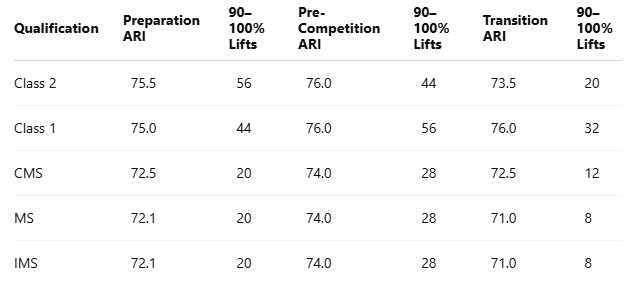
If the ARI is too low, then there must be an increase in the loading and the reps per set.
On the other hand, if the ARI is too high, the loading should be decreased, and the reps per set decreased as well.
Using the K-Value to Fine-Tune Weightlifting Programs
Once the optimal K-value is empirically determined for each individual athlete, any modifications should occur during the pre-competition mesocycle.
FAQ: Weightlifting Programming Modifications
What is the ideal snatch-to-clean and jerk ratio in weightlifting?
The recommended ratio of maximal snatch to maximal clean and jerk performance is typically between 78% and 82%.
What is the recommended back squat to clean and jerk ratio?
The benchmark ratio for maximal back squat to maximal clean and jerk performance is approximately 131%.
What is the optimal front squat to clean and jerk ratio?
The recommended ratio for maximal front squat relative to clean and jerk performance is approximately 105%.
What does ARI mean in weightlifting programming?
ARI stands for Average Relative Intensity. It refers to the average training intensity within a training cycle and varies depending on the mesocycle phase and athlete classification.
What is the K-value in weightlifting programming?
The K-value is the average absolute intensity of a macrocycle divided by the competition total achieved at the end of that macrocycle.
Why is balancing strength and speed important in Olympic weightlifting?
Weightlifting performance is dependent on both strength and speed increases. Increasing intensity alone may improve strength but not necessarily improve bar speed or overall lifting performance.
How can AI help weightlifting programming?
AI-based programming tools may eventually automate calculations involving load, intensity, volume, ARI, and individualized programming adjustments, helping coaches create optimized programs for each athlete.

The Future of AI-Based Weightlifting Programming
I realize that all of the calculations that are necessary to determine load, intensity, and volume are rather tedious.
What I'm trying to do at this point is to design an AI-based programming agent that will do all of the calculations for any given athlete, as well as provide them with an optimal training program.
More details on this will come in future blog posts.
Good luck with your programming.