Taekwondo
Greatest Women’s Taekwondo Athletes of All Time: A Data-Driven Top 20 Ranking
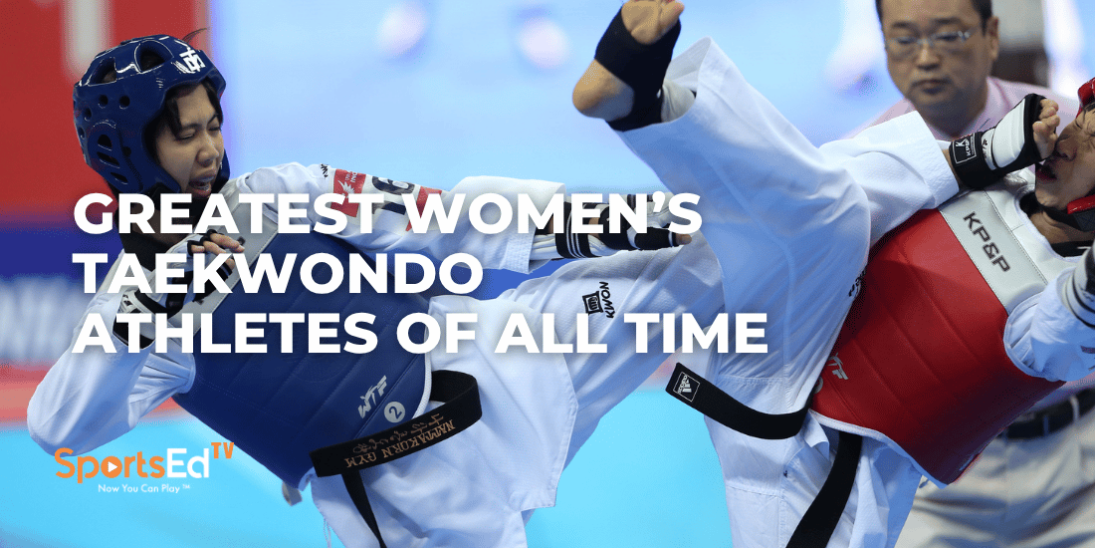
Who is the greatest female taekwondo athlete of all time? The question becomes surprisingly difficult to answer objectively. Olympic medals are the rarest major prizes in the sport, but the World Championships provide a much larger body of evidence across an athlete's career. Longevity matters too, as does sustained success against the world's best competitors. The challenge grows even greater when comparing athletes from different generations, because the competitive opportunities available today differ greatly from those available 20 or 30 years ago.
At SportsEdTV, we wanted to approach the question the same way we have approached other historical sports rankings: establish the criteria first, build as complete a dataset as possible, and then let the results determine the ranking.
For this study, we developed the Women's Taekwondo Historical Performance Index (WT-HPI), a model that evaluates Olympic results, senior World Championship results, sustained elite performance, and other major international achievements. Our research universe currently includes 134 athletes, and we tested the ranking across 100,000 different combinations of reasonable model weights to determine which conclusions were robust and which depended more heavily on how greatness is defined.
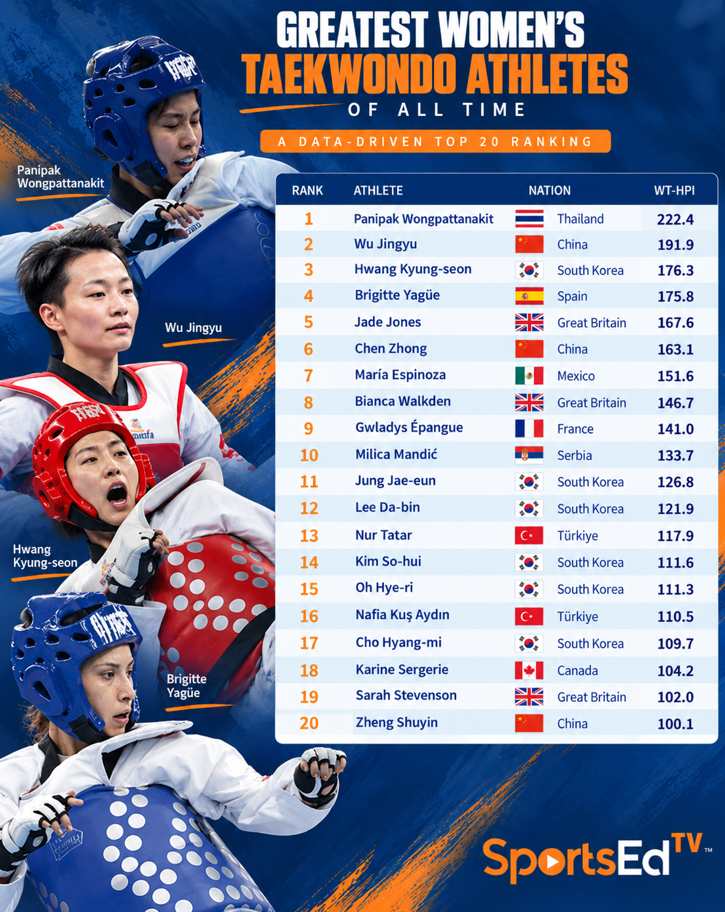
The result is a ranking that places Thailand's Panipak Wongpattanakit at No. 1, followed by China's Wu Jingyu, South Korea's Hwang Kyung-seon, Spain's Brigitte Yagüe, and Great Britain's Jade Jones.
Top 20 Greatest Women’s Taekwondo Athletes of All Time
How We Ranked the Greatest Female Taekwondo Athletes
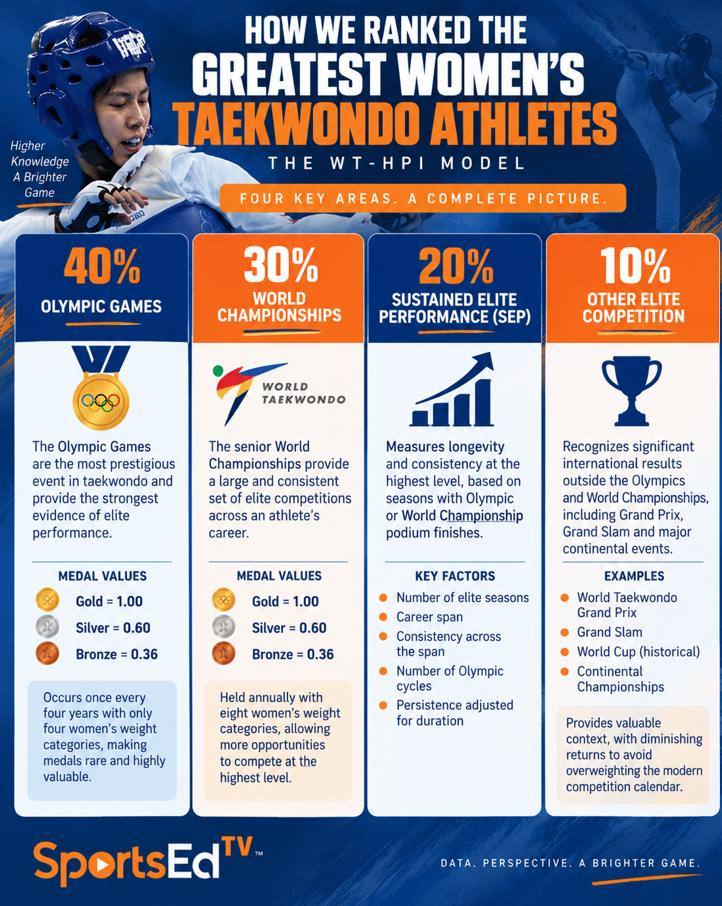
The foundation of WT-HPI is relatively simple. We wanted the sport's most important achievements to matter most, so the Olympic Games and senior World Championships form the core of the model. We then added measures for sustained elite performance and for significant international achievements outside those two championships.
Olympic medal units receive a coefficient of 40 and World Championship medal units a coefficient of 30. Sustained Elite Performance can contribute up to 20 additional points, while Other Elite competition can contribute up to 10. Do not interpret these numbers as percentages. Olympic and World Championship achievement is additive and uncapped, so an athlete who repeatedly medals at those events continues to accumulate points.
Medals are valued using a 1.00 / 0.60 / 0.36 relationship for gold, silver, and bronze. This follows the placement-decay principle used in World Taekwondo's ranking system and gives us a consistent way to distinguish between winning a championship, reaching the final, and reaching the podium.
This structure deliberately makes WT-HPI a major-championship-driven model. Longevity and other international results matter, particularly when comparing athletes with similar Olympic and World records, but they cannot overwhelm what an athlete accomplished at the two most important championship levels.
Why Olympic Taekwondo Medals Receive the Most Weight
Giving the Olympics the highest coefficient was an important methodological decision. The Games occur only once every four years, which means even an athlete with a long international career may have only two or three realistic opportunities to become Olympic champion. Qualification further restricts the field, and Olympic taekwondo uses only four women's weight categories compared with eight at the senior World Championships.
That difference in weight structure is significant. A woman who competes in one of eight World Championship divisions may have to move into a broader Olympic division. The Olympic medal therefore reflects not only the scarcity of a four-year opportunity but also a more compressed competitive structure.
For these reasons, WT-HPI values Olympic achievement more than an equivalent World Championship result. At the same time, we did not want Olympic medals to become the sole factor in the ranking. An athlete who dominates the World Championships over many years has produced evidence of greatness that should not disappear simply because another athlete won one Olympic tournament.
Brigitte Yagüe is an excellent example. Her Olympic résumé alone would never place her fourth on an all-time list, but her extraordinary World Championship career—three gold medals, two silvers and a bronze—changes the picture substantially.
Comparing Taekwondo Champions Across Different Eras
Cross-era comparison may be the hardest part of the exercise. Today's elite athletes have opportunities that previous generations never had. The World Taekwondo Grand Prix, for example, gives modern athletes additional chances to compete against elite international fields and accumulate major results. Simply counting all international medals would therefore inherently advantage athletes competing in the modern calendar.
WT-HPI handles this by separating international competition into levels. The Olympics and World Championships remain the core of major championships. Below them, Tier C represents major global elite competition, including the modern Grand Prix and Grand Slam structure and, where appropriate, historical World Cup equivalents. Tier D captures significant senior continental competition.
We then apply diminishing returns to this portion of the score. Winning additional elite events still helps an athlete, but the tenth or fifteenth secondary international medal does not have the same marginal effect as the first. This prevents the volume of opportunities available in the modern calendar from overwhelming the accomplishments of athletes from earlier generations.
We also deliberately avoided awarding hypothetical Olympic medals to athletes who competed before Olympic taekwondo existed. There is no defensible way to know what an athlete would have done in a competition she never had the opportunity to enter. Instead, the model evaluates what she actually accomplished within the elite competitive structure available during her career.
How Longevity Is Measured in the WT-HPI Model
Longevity presents another challenge because simply having a long career is not the same as remaining one of the world's best athletes for a long time. WT-HPI therefore measures Sustained Elite Performance, or SEP, using the seasons in which an athlete reached the podium at the senior Olympic Games or World Championships.
The calculation considers the number of elite seasons, the span between an athlete's first and last elite season, the consistency of those elite seasons within that span, and the number of Olympic cycles across which she remained at major-championship level.
We also adjust persistence for duration. Without that safeguard, an athlete who had one major season in a one-year career would technically have 100% persistence, which would give too much longevity credit to a short peak. In WT-HPI, persistence becomes increasingly valuable only as an athlete demonstrates meaningful duration.
This allows longevity to do what we intended: distinguish repeated excellence from both a single exceptional tournament and a career that was merely long.
Why Panipak Wongpattanakit Ranks No. 1
Panipak's top spot comes from an unusual mix of peak achievement and sustained excellence. She has won two Olympic gold medals and an Olympic bronze, giving her one of the strongest Olympic records in women's taekwondo history. She also has five senior World Championship medals: two gold, two silver, and one bronze.
Her résumé extends beyond those championships. Panipak accumulated exceptional success on the Grand Prix and Grand Slam circuits while remaining elite across multiple Olympic cycles. The result is a WT-HPI score of 222.4, comfortably ahead of Wu Jingyu at 191.9.
What makes Panipak's result particularly interesting, however, is not simply the size of the score. We wanted to determine whether she ranked first because of our particular choice of coefficients, so we tested the model across 100,000 alternative combinations.
Her position proved exceptionally robust.
Within the range of assumptions WT-HPI tested, Panipak remains the strongest historical performer. That is a more meaningful conclusion than simply declaring her the GOAT based on one fixed formula.
Why Wu Jingyu, Hwang Kyung-seon, Brigitte Yagüe and Jade Jones Rank So High
Wu Jingyu's two Olympic titles give her an exceptional foundation, but her No. 2 ranking isn't based on the Olympics alone. Her World Championship record and sustained international success produce a profile that remains extremely strong regardless of reasonable changes to the model's weights.
The next positions illustrate different paths to an all-time great career. Hwang Kyung-seon's Olympic record is among the best in the sport. Brigitte Yagüe accumulated extraordinary World Championship depth. Jade Jones combined two Olympic gold medals with extensive success during the modern international circuit era, while Chen Zhong also won two Olympic titles and repeatedly succeeded at the World Championships.
This is where the model becomes particularly useful. No obvious philosophical answer exists for whether Hwang's Olympic résumé should outrank Yagüe's extraordinary World Championship record. WT-HPI makes that tradeoff explicit and lets us measure how often their positions change as the underlying assumptions shift.

How Stable Is the Women’s Taekwondo GOAT Ranking?
To test the ranking, we ran 100,000 admissible weighting combinations. We allowed the Olympic coefficient to vary between 35 and 45, World Championships between 25 and 35, Sustained Elite Performance between 15 and 25, and Other Elite competition between 5 and 15. In every simulation, the Olympic coefficient had to remain at least as large as the World Championship coefficient.
The top of the ranking proved highly stable. Panipak remained first, and Wu remained second. Hwang generally occupied third or fourth, Yagüe ranged from third to sixth, Jade Jones from fourth to fifth, and Chen Zhong from fifth to sixth.
Further down the ranking, the differences naturally become less certain. An athlete around No. 19 can move outside the Top 20 under a reasonable alternative set of assumptions, while the athletes at the very top barely move.
We think that distinction is important. A ranking shouldn't create the false impression that the difference between No. 19 and No. 21 is as big as the difference between No. 1 and No. 10. The sensitivity analysis shows where the evidence is strong and where the ordering remains legitimately debatable.

What the Data Tells Us About the Greatest Women in Taekwondo
WT-HPI does not eliminate judgment from the GOAT debate. No historical ranking can. Decisions still have to be made about the relative importance of Olympic medals, World Championships, longevity, and other international competitions.
The model makes those decisions visible.
If someone believes Olympic results should matter even more, we can test that assumption. If someone wants to increase the value of World Championships, we can test that too. If a historical medal or event result is found to be incorrect, we can correct the underlying data and rerun the calculations rather than defending a ranking simply because it has already been published.
Under the current methodology and dataset, Panipak Wongpattanakit has produced the strongest historical performance record among the women evaluated, with Wu Jingyu firmly in second place. Behind them is a fascinating group of athletes whose careers represent very different forms of greatness—from Olympic dominance to extraordinary World Championship success and sustained excellence across multiple competitive cycles.
That, ultimately, is what we wanted this research to provide: not simply another Top 20 list, but a transparent framework for a better conversation about the greatest women in taekwondo history.
Frequently Asked Questions About the Greatest Women’s Taekwondo Athletes
Who is the greatest women’s taekwondo athlete of all time?
According to the Women’s Taekwondo Historical Performance Index (WT-HPI), Panipak Wongpattanakit ranks No. 1. Her record combines two Olympic gold medals and an Olympic bronze with multiple World Championship medals, sustained elite performance and extensive success at other major international events.
What does WT-HPI stand for?
WT-HPI stands for Women’s Taekwondo Historical Performance Index. It is the data-driven model developed for this research to compare elite women’s taekwondo careers across different generations.
How are the greatest female taekwondo athletes ranked?
WT-HPI evaluates four main areas: Olympic Games performance, World Championship performance, sustained elite performance, and other elite international competitions. Olympic results receive the greatest weight because the Games occur only once every four years and use fewer weight categories than the World Championships.
Who are the top five women’s taekwondo athletes of all time?
The current WT-HPI ranking places Panipak Wongpattanakit first, Wu Jingyu second, Hwang Kyung-seon third, Brigitte Yagüe fourth, and Jade Jones fifth.
Why are Olympic medals worth more than World Championship medals?
The Olympic Games occur only once every four years, qualification opportunities are limited, and Olympic taekwondo uses four women’s weight categories compared with eight at the senior World Championships. WT-HPI therefore assigns Olympic medal units a higher coefficient while still valuing World Championship success.
How are gold, silver and bronze medals valued?
WT-HPI uses medal values of 1.00 for gold, 0.60 for silver, and 0.36 for bronze. These values follow the placement-decay principle used in World Taekwondo’s ranking framework.
How does the ranking compare athletes from different eras?
The model does not penalize earlier athletes simply because modern competitions such as the Grand Prix did not exist during their careers. Historical World Cups and other appropriate elite competitions are classified alongside comparable modern events, while a diminishing-returns formula prevents today's denser competition calendar from creating an automatic advantage.
Does longevity count in the taekwondo GOAT ranking?
Yes. WT-HPI includes Sustained Elite Performance (SEP), which measures the number of elite seasons, the athlete’s elite career span, consistency during that period, and performance across multiple Olympic cycles. This rewards sustained excellence rather than career length alone.
How many athletes were considered for the ranking?
The research identified a candidate universe of 134 women’s taekwondo athletes. The public article presents the Top 20, while the research white paper provides additional methodology and ranking detail.
How reliable is the Top 20 ranking?
The methodology was tested across 100,000 admissible weighting combinations. The leading positions proved particularly stable, while some positions near the bottom of the Top 20 changed under alternative reasonable assumptions. These results are reported as rank-stability ranges rather than claiming that every position is absolute.
Is Panipak Wongpattanakit definitely the women’s taekwondo GOAT?
WT-HPI does not claim that mathematics can establish one universally correct definition of greatness. It shows that Panipak ranks No. 1 under the published methodology and remains exceptionally robust when the model’s assumptions are varied. Readers can examine the methodology and decide whether they agree with the criteria.
Can the WT-HPI ranking change?
Yes. Active athletes can add achievements to their records, and historical data can be corrected if stronger evidence becomes available. However, the model is additive, so a new result does not retroactively rescale retired athletes' achievements.