Physical Education
Let the Children Play: Making Inclusive PE Meaningful for Every Child
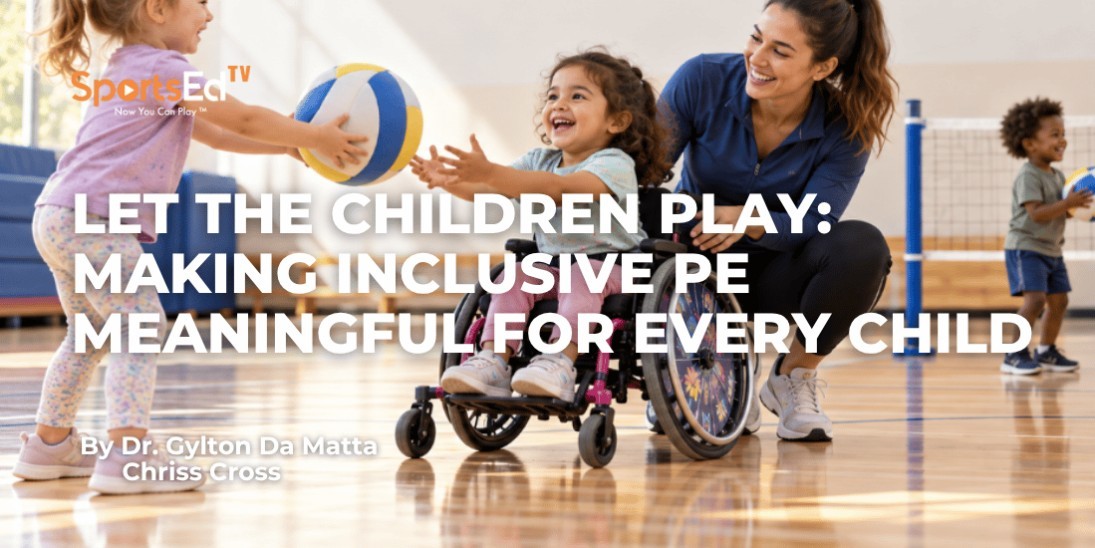
By Chris Cross and Dr. Gylton Da Matta
A child can be present in a physical education class without having a meaningful opportunity to learn.
They may stand beside their classmates, wait for a turn, or receive encouragement from a teacher. But if equipment, instructions, or the activity prevents them from practicing, inclusion in the group is only the beginning.
Inclusive physical education should give every child opportunities to move, explore, develop skills, connect with others, and experience progress.
Our earlier article, Inclusive Physical Education: Strategies for Every Child, introduced practical approaches such as adapting activities, offering choices, encouraging cooperation, and celebrating individual improvement. Those principles provide a useful foundation. This article builds on them by asking a more specific question: What should meaningful inclusion look like during the preschool years? SportsEdTV
For teachers, parents, and coaches introducing children to activities like volleyball, the answer starts with purposeful play.

Why Preschool Movement Experiences Matter
During the preschool years, children learn to control their bodies and interact with the world around them.
Running, reaching, balancing, catching, and throwing are learning experiences. Children discover how far to reach, how much force to use, how to change direction, and how to coordinate their movements with another person.
For children with disabilities or developmental delays, differences in movement, communication, sensory processing, or attention may create barriers to these experiences.
Providing access to a play area is valuable. Instruction, appropriate equipment, and repeated practice make that access more meaningful.
A 2022 systematic review by Yang and colleagues examined instruction in fundamental motor skills for preschoolers with disabilities or developmental delays. Only seven studies met the review’s inclusion criteria, highlighting the limited research base and the need for more rigorous studies. The review reinforces the importance of examining how these skills are taught, rather than assuming play will meet every child’s learning needs. PALAESTRA
The practical message is to give play a purpose while protecting the enjoyment that makes children want to participate.
Start With the Skill, Then Adapt the Activity
Before choosing a game, ask: What are we helping children learn?
The answer might be throwing, balancing, tracking an object, moving through space, or cooperating with a partner.
Once the objective is clear, the teacher can offer different ways to work toward it.
For a throwing activity, one child might toss a beanbag toward a nearby hoop. Another might throw a foam ball toward a larger target. A third might practice while seated.
Equipment, distance, and starting position can vary as each child continues practicing throwing.
This distinction matters. If a child spends the entire activity keeping score or cheering, they may have a social role but miss the intended movement practice.
Encouragement and teamwork are valuable. Every child also deserves an accessible opportunity to develop the skill being taught.
What Should Inclusive Preschool PE Teach?
A balanced program gives children opportunities to develop several related areas of movement.
Locomotor Skills
These involve moving from one place to another, including walking, running, jumping, hopping, and galloping.
Activities should reflect each child’s movement abilities and support needs. Teachers can adjust pathways, distances, pace, and available assistance.
Object-Control Skills
Throwing, catching, rolling, kicking, and striking help children explore how their actions affect an object.
Teachers can vary equipment size, weight, texture, and speed to create a manageable challenge.
Balance and Stability
Reaching, turning, bending, and maintaining a position help children practice controlling their bodies.
A child might start with stable support or a wider base before trying a more demanding task.
Body Awareness, Space, and Cooperation
Children also need opportunities to move safely around others, follow simple movement sequences, take turns, and share equipment.
Weave these learning goals into stories, music, exploration, partner games, and activity stations. They do not require a class built around isolated drills.
Plan for Different Learners From the Beginning
An inclusive lesson should offer options before a child encounters a barrier.
This is a central idea behind Universal Design for Learning, or UDL: anticipate differences among learners and provide multiple ways to access and engage with the activity.
For example, a throwing station can include several objects, different target sizes, and multiple starting distances. Children can use an appropriate option without being singled out.
Research offers a promising example of this approach. Ostrosky and colleagues studied CHAMPPS, the CHildren in Action: Motor Program for PreschoolerS. Their randomized controlled trial involved a 21-week program with 42 lessons incorporating UDL.
Data from 51 children with disabilities provided initial evidence of benefits for motor development, active engagement, and social development. Teachers also rated the program highly for feasibility and usability. These findings are encouraging, but they should not be treated as a guarantee that every program or child will achieve the same results. Illinois Experts
For everyday teaching, the useful principle is straightforward: build flexibility into lesson design.
Give Children More Opportunities to Practice
A well-organized activity can still provide very little movement practice.
Consider a class in which one child throws while everyone else waits in line. Each child may receive only a few attempts before the lesson ends.
Small groups, partner activities, and multiple stations create more opportunities to participate.
Repetition can remain playful. Children might throw beanbags into different “islands,” move through an imaginary forest, or work with a partner to send an object toward a shared target.
The teacher can then adjust the challenge as the child develops confidence and control.
Progression does not always mean moving faster or using more difficult equipment. It might mean completing a movement with less assistance, sustaining attention for another attempt, or participating more independently.
What Movement Research Tells Us About Learning
Movement gives children information about their bodies and surroundings. They see an object move, feel contact with it, and experience changes in balance and body position.
Practice creates opportunities to use that feedback and adjust the next attempt.
In their paper, the authors connect this process with motor learning and the developing nervous system. They also draw on a 2022 systematic review by Su and colleagues examining neural effects of physical activity and movement interventions in people with developmental disabilities.
That review covered 32 papers and reported evidence of neural and behavioral changes. However, the authors note that much of this research involved school-age children rather than preschoolers.
These findings do not establish that a particular preschool game will produce a specific neurological change. A more useful teaching principle is this: offer consistent, meaningful opportunities to move, practice, receive feedback, and try again.

Bringing These Principles Into Early Volleyball Activities
For young children, a volleyball-themed activity can start with exploring movement and cooperative play.
The examples below apply the paper’s teaching principles; they are not volleyball interventions tested in the studies discussed.
Track and Catch
Invite children to follow a gently tossed, lightweight ball and catch it using a method that matches their current abilities.
Adjust the distance, ball size, or speed. Some children may begin by receiving the ball close to their bodies, while others can reach toward it.
The focus is tracking and coordinating a response.
Send Toward a Target
Children can practice sending a soft ball toward a large floor target or across a low divider.
Identify the skill first. If the objective is throwing, provide throwing practice. If it is striking, choose equipment and support that allow the child to attempt a strike.
Related activities can build readiness, but treat them as distinct skills.
Play With a Partner
Create a cooperative challenge in which two children take turns sending and receiving an object.
A pair might roll a ball between them, toss and catch, or explore gentle hand contact, depending on the intended learning goal.
Give both children opportunities to practice. Adjust the task so that one child does not become the permanent helper while the other receives all the instruction.
The immediate aim is enjoyable movement, shared participation, and a manageable challenge.
Use Simple Cues and Specific Feedback
Long explanations can make an activity harder to follow.
Demonstrate the movement, give a brief cue, and allow the child to try. Pictures, gestures, and floor markings can make instructions easier to understand.
Useful cues might include:
- “Watch the ball.”
- “Reach.”
- “Use two hands.”
- “Send it toward the hoop.”
Feedback should help children recognize what they did.
“You used two hands to catch it” gives more information than “Good job.”
“You tried again after it dropped” recognizes persistence.
“You balanced for three seconds” makes progress visible.
Choose cues and feedback that fit the child’s communication and sensory needs. The goal is to help the child understand the next step.
Make Belonging Part of the Activity
Inclusive PE also creates opportunities to learn with other children.
Passing an object to a partner, taking turns, working toward a shared goal, and celebrating another child’s progress can all be part of movement learning.
Where possible, provide individualized support within shared activities. A child should not automatically spend the whole lesson at a separate station because they need a different ball, more time, or additional assistance.
Teachers should also communicate with families, adapted PE teachers, special educators, and relevant therapists. Their insights can help clarify how a child moves, communicates, and responds to different situations.

Measure Each Child’s Progress
A useful assessment begins with three questions:
- What could this child do before?
- What can this child do now?
- What is an appropriate next challenge?
For one child, progress might mean catching a ball independently. For another, it might mean reaching toward it, joining a partner activity, or completing a task with less support.
These changes deserve recognition.
Let the children play. Give their play direction, provide the support they need, and create enough opportunities for learning to happen.
The goal is for every child to leave with something more than attendance: a new experience, a developing skill, a connection with a classmate, or the confidence to try again.
References
Ostrosky, M. M., et al. (2024). Investigating the impact of a motor program on preschoolers with disabilities: Findings from a randomized controlled trial. Infants & Young Children, 37(1), 3–19. Read the study.
SportsEdTV. (2025, September 26). Inclusive Physical Education: Strategies for Every Child.
Su, W.-C., Amonkar, N., Cleffi, C., Srinivasan, S., & Bhat, A. (2022). Neural effects of physical activity and movement interventions in individuals with developmental disabilities: A systematic review. Frontiers in Psychiatry, 13, 794652. Read the review.
Yang, H.-W., Ostrosky, M., Meadan, H., & Cheung, W. C. (2022). Teaching fundamental motor skills to preschoolers with disabilities or developmental delays: A systematic review. Palaestra, 36(1). Read the review.