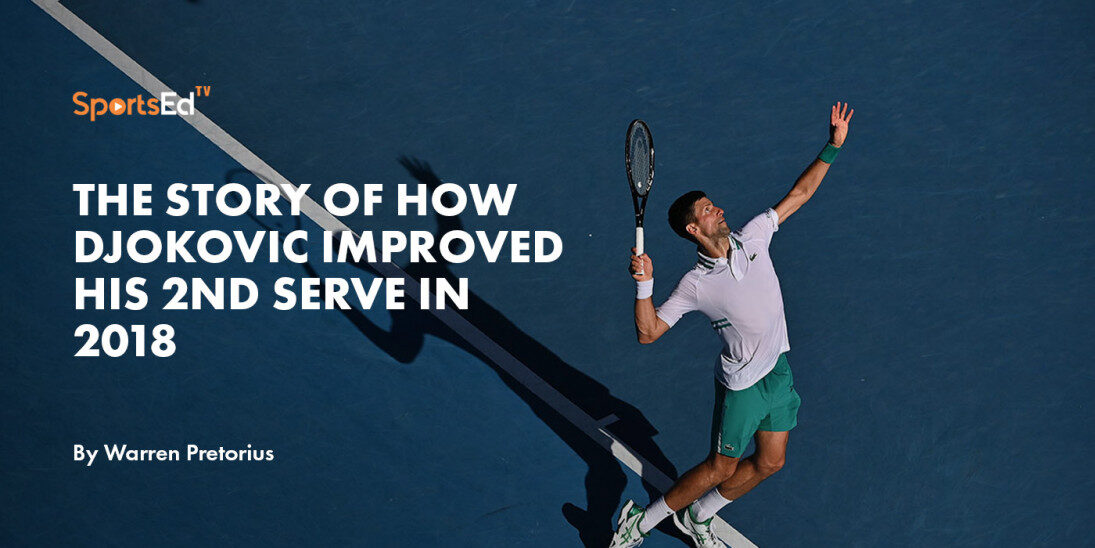
Novak Djokovic finishes first. Serena Williams finishes second. Roger Federer and Rafael Nadal follow.
Those are the leading results of SportsEdTV’s Tennis GOAT Model, a comparison of 82 selected men and women across generations. But the most interesting part of the ranking is what happens when we ask a question that a trophy count cannot fully answer: What should greatness actually measure?
Grand Slam titles matter. So do sustained dominance, the quality of an athlete’s rivals, the opportunities available during a career, and the impact that player had on tennis itself.
Developed as a tennis spinoff of SportsEdTV’s 100 Greatest Athletes of All Time project, the model brings those elements into one framework. Its purpose is to make the debate more transparent: readers can see what is being rewarded, how much it counts, and where a different judgment could change the result.
The white paper uses a stated data cutoff of September 13, 2026, following the US Open. The rankings below reproduce its findings, rather than a live ranking of active players.

Who ranks first in the SportsEdTV Tennis GOAT Model?
Djokovic leads the baseline model with a score of 86.5, ahead of Serena Williams (83.9), Federer (81.7), and Nadal (78.8).
Here are the top 10:
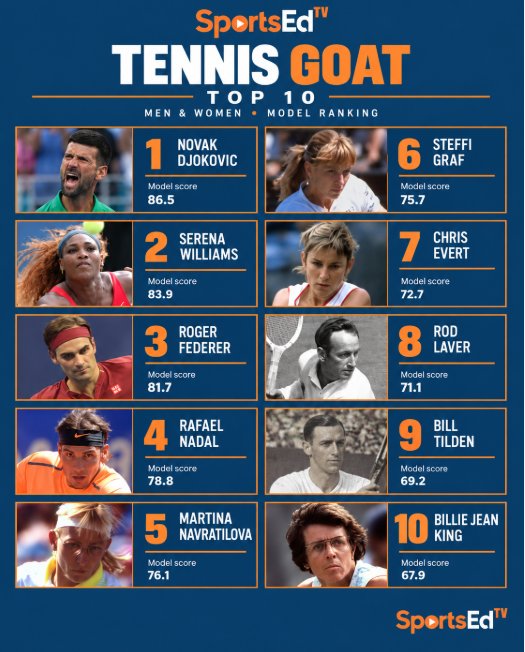
These are composite scores on the model’s 0–100 scale. They are neither win probabilities nor percentages of some absolute standard of greatness. An 86.5 does not mean Djokovic would beat another legend 86.5% of the time.
The scores describe each player’s standing within this selected field under the model’s rules. Small gaps deserve particular care: Navratilova’s 0.4-point advantage over Graf is a result of this specification, not proof of an indisputable separation between their careers.
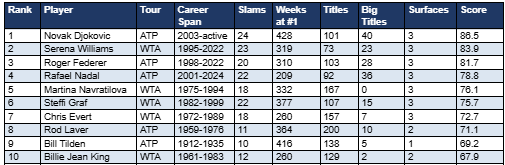
Full model in white paper
Why Grand Slam titles cannot tell the whole story
Counting majors is an understandable starting point. It is simple, familiar, and focused on tennis’s most prestigious singles championships. The difficulty is that players did not all have the same access to those championships.
As the white paper documents, leading professionals were excluded from the amateur majors before Open tennis began in 1968. Rod Laver was barred from those events from 1963 through 1967. Ken Rosewall was excluded from 1957 through 1967. Pancho Gonzales lost access for much of his prime.
A comparison based only on major totals would leave that restriction out of the calculation.
Other historical differences complicate the picture. Travel costs affected participation, tournament structures changed, and records from earlier eras are less standardized than modern tour statistics.
The model addresses some of these differences through an opportunity multiplier. Laver’s major count receives a factor of 1.35, Rosewall’s 1.55, and Gonzales’s 1.45. It also applies a 0.90 factor to Margaret Court’s major count, reflecting its assessment of travel-related field limitations surrounding many of her Australian titles.
These adjustments are disclosed historical judgments. They do not award additional official titles or establish how many majors anyone would have won under different circumstances. Readers can reasonably debate both the adjustments and their size.
How does the model measure tennis greatness?
The framework combines five criteria:
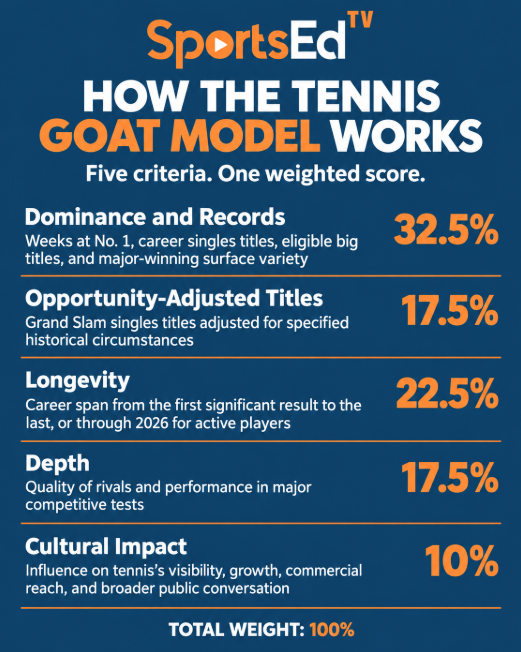
Dominance receives the largest weight. Within that category, weeks at No. 1 account for half the score, followed by career singles titles, eligible big titles, and the number of surfaces on which a player won majors.
Longevity recognizes the span of a career, although it does not measure uninterrupted participation or years spent at peak performance. That distinction matters when comparing a short, extraordinary peak with a much longer career.
Depth and Cultural Impact use explicit scoring rubrics. Even with those guidelines, they remain judgments by our rating team, not an expert panel’s consensus.
The model converts the numerical measures to a common scale before combining them. That makes different kinds of evidence comparable in the calculation, but it does not remove the decisions behind it.
Can men and women be compared in one tennis ranking?
This model places men and women in one field to compare career achievement and influence. It does not predict head-to-head matches between them.
That approach allows Serena Williams, Navratilova, Graf, Evert, and King to sit alongside Djokovic, Federer, Nadal, Laver, and Tilden under the same five criteria.
However, a shared scoring system does not make the tours identical. Schedules, tournament classifications, career opportunities, and historical record coverage differ.
The white paper tests one alternative that normalizes four dominance measures separately within each tour. Under that specification, 33 of the 82 players change position, with the largest movement being five places.
The comparison is possible, but readers should understand the question it answers: how these selected careers rank under a shared framework, with acknowledged differences between tours.
What happens when the scoring weights change?
A ranking becomes more informative when we can see how easily it changes.
The white paper tests three alternative weight sets: equal weighting across all five criteria, a stronger emphasis on recorded results, and another achievement-focused allocation.
Djokovic, Serena Williams, Federer, and Nadal retain the first four positions, in that order, in all three scenarios.
This provides meaningful support for the leading group among the tested alternatives. It does not establish that every reasonable model would produce the same result.
Further down the ranking, the choices matter considerably. Depending on the scenario, 70 to 72 of the 82 players change position. The largest individual movement reaches 24 places.
The subjective ratings also have consequences. In the paper’s tests, changing one player’s Depth rating by one point can move that player as many as 13 positions. A one-point Cultural Impact change can move a player by up to nine places.
These are scenario results, not statistical confidence intervals. They show why you should read a numbered list alongside its assumptions, especially when scores are close.

How does the model handle incomplete historical records?
Modern computer rankings and reconstructed historical rankings are different forms of evidence.
For earlier players, the model uses named contemporary and retrospective authorities to estimate time at No. 1. It then moderates selected component scores for 38 players with historical estimates, moving those scores toward the midpoint.
This reduces the influence of uncertain inputs. It cannot eliminate uncertainty or make an estimate equivalent to a recorded weekly ranking.
The “big titles” category presents another challenge. The model uses an eligibility convention covering specified tournament tiers and historical equivalents, while excluding season-ending championships for every player.
Some historical entries are zero because the model does not itemize any eligible win. That does not necessarily mean the player achieved nothing comparable. The white paper tests alternative treatments of those entries and acknowledges that the historical classification remains incomplete.
The selected field is also a limitation. It includes 82 players, but the paper does not show that it evaluated every potentially deserving player. Adding players can change the statistical reference points and therefore other players’ scores.
Tennis GOAT top 95ranking
-
1 Novak Djokovic
2 Serena Williams
3 Roger Federer
4 Rafael Nadal
5 Martina Navratilova
6 Steffi Graf
7 Chris Evert
8 Rod Laver
9 Bill Tilden
10 Billie Jean King
11 Margaret Court
12 Ken Rosewall
13 Helen Wills Moody
14 Pancho Gonzales
15 Jimmy Connors
16 Venus Williams
17 Andre Agassi
18 Pete Sampras
19 Ivan Lendl
20 John McEnroe
21 Jack Kramer
22 Monica Seles
23 Jaroslav Drobny
24 Bjorn Borg
25 Maria Bueno
26 Maria Sharapova
27 Bobby Riggs
28 Lew Hoad
29 Andy Murray
30 Pancho Segura
31 Henri Cochet
32 Roy Emerson
33 Fred Perry
34 Frank Sedgman
35 Boris Becker
36 Justine Henin
37 Arthur Ashe
38 Martina Hingis
39 Ilie Nastase
40 Don Budge
41 Margaret Osborne duPont
42 Althea Gibson
43 Suzanne Lenglen
44 John Newcombe
45 Lindsay Davenport
46 Guillermo Vilas
47 Evonne Goolagong Cawley
48 Nicola Pietrangeli
49 Stan Smith
50 Virginia Wade
51 Iga Swiatek
52 Doris Hart
53 Mats Wilander
54 Tony Trabert
55 Stefan Edberg
56 Stan Wawrinka
57 Louise Brough
58 Rene Lacoste
59 Molla Bjurstedt Mallory
60 Carlos Alcaraz
61 Jean Borotra
62 Maureen Connolly
63 Lleyton Hewitt
64 Gael Monfils
65 Victoria Azarenka
66 Helen Jacobs
67 Ellsworth Vines
68 Marin Cilic
69 Ashleigh Barty
70 Arantxa Sanchez Vicario
71 Petra Kvitova
72 Alexander Zverev
73 Naomi Osaka
74 Elena Rybakina
75 Juan Martin del Potro
76 Elina Svitolina
77 Karolina Pliskova
78 Aryna Sabalenka
79 Jannik Sinner
80 Sloane Stephens
81 Shirley Fry Irvin
82 Kim Clijsters
83 Kei Nishikori
84 Madison Keys
85 Jim Courier
86 Anastasia Pavlyuchenkova
87 Daniil Medvedev
88 Grigor Dimitrov
89 Michael Chang
90 Coco Gauff
91 Gustavo Kuerten
92 Alice Marble
93 Andy Roddick
94 Marat Safin
95 Pauline Betz
What athletes and coaches can take from the GOAT debate?
For athletes, coaches, and parents, this comparison offers a useful question beyond who finishes first: What does the way we keep score encourage us to value?
A trophy total rewards winning. A broader evaluation can also recognize sustained excellence, success across conditions, the level of opposition, and contributions that help a sport grow.
Those ideas can inform how we discuss development. A player who is improving against stronger opponents may be progressing even when the trophy count slows. A coach evaluating a season may learn more by considering consistency, adaptability, and quality of competition alongside results.
SportsEdTV’s model puts Djokovic first under its baseline assumptions. Its broader contribution is to make the reasoning visible enough to examine and challenge.
Before deciding who deserves the title of tennis GOAT, it helps to decide what we want that title to recognize.

Frequently asked questions
Who is the greatest tennis player according to this model?
Novak Djokovic ranks first with 86.5 points. Serena Williams, Roger Federer, and Rafael Nadal complete the top four. This reflects SportsEdTV’s specific framework, not a universally accepted verdict.
Why does the ranking include both men and women?
It compares career achievement, dominance, longevity, competition, and cultural influence under a common framework. It does not attempt to predict matches between male and female players.
Does the model rely only on Grand Slam titles?
No. Opportunity-adjusted Grand Slam titles carry a direct weight of 17.5%. Major wins also contribute to career-title totals and major-winning surface variety within the Dominance category, so that direct weight is not their entire influence.
Can an active player’s position change?
Yes. Further results can change their inputs. Their ranking can also change if other players’ records, the comparison field, or the model’s assumptions change. This article reports the white paper’s stated September 2026 snapshot.
Where do the findings come from?
This article is based on SportsEdTV’s September 2026 Tennis GOAT Model Methodology White Paper, including its 82-player ranking and reported sensitivity tests. The paper documents its historical sources, editorial assumptions, and evidence limitations. We have not independently reproduced its reported calculations for this article.